
I’m just going to say it.
There’s something oddly humbling about trying to train biceps in a living room that’s basically a “no-gym-zone.”
No dumbbells.
No bands.
No bar.
Just you, gravity, and maybe a couch that squeaks at the wrong moment.
At-Home Biceps Gains: Are They Even Possible?
I used to roll my eyes when people asked this.
Because in the fitness world you hear that everything is possible “with the right mindset.”
But try curling air for 12 weeks and see how far that gets you.
Still, the real answer is more interesting than a simple yes or no.
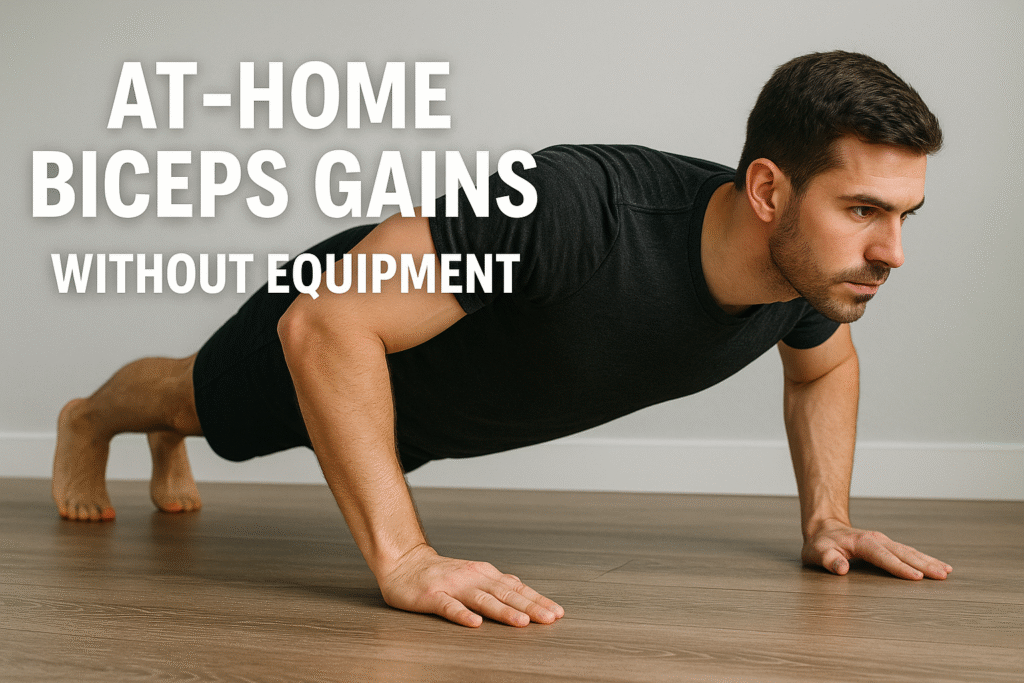
You absolutely can grow your biceps at home without traditional equipment…
…but only if you understand what actually stimulates the muscle.
Understanding What Your Biceps Actually Need
Your biceps grow when they experience mechanical tension.
Not hype.
Not magic.
Not a playlist blasting early-2000s nu-metal.
Just tension.
If you don’t have weights, you create that tension through your own body, leverage, and slow, painful control.
Once that clicked for me, at-home biceps training stopped feeling like a comedy sketch and started feeling like an actual plan.
Using Your Bodyweight in Weird but Effective Ways
Your body can be a weight if you position it right.
And your living room?
It becomes a gym you didn’t ask for but secretly needed.
Self-Resisted Curls (How to Do Them)
Place one hand underneath your working hand.
Push down with the bottom hand as the top hand curls up.
Go painfully slow — five seconds up, five seconds down.
It feels ridiculously effective for something that looks like mime training.
Table Rows With an Underhand Grip (How to Do Them)
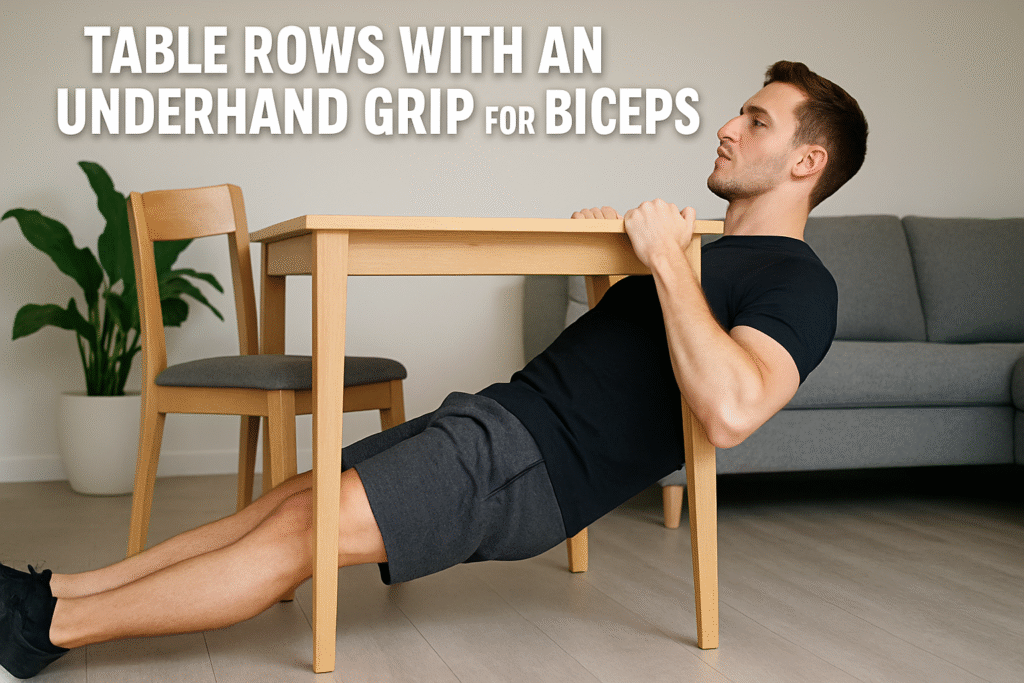
Lie under a sturdy table.
Grab the edge with palms facing you.
Pull your chest toward the table.
Lower with control.
If the table creaks, pretend it’s cheering you on.
Doorframe Static Holds (How to Do Them)
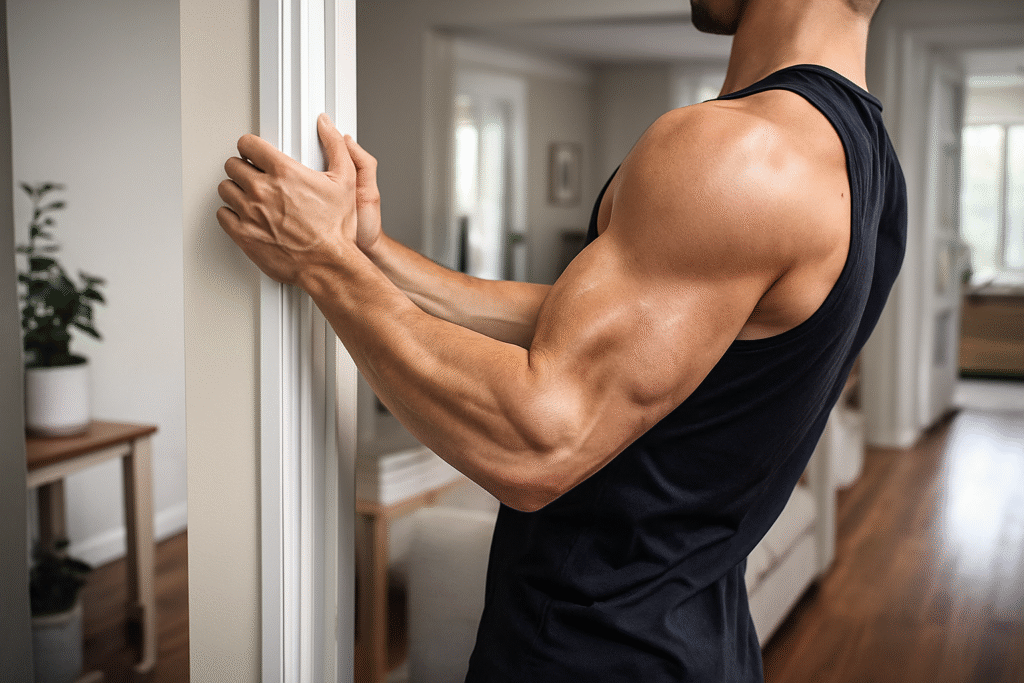
Grab the inside of a doorframe.
Lean back slightly.
Pull in like you’re trying to drag the doorway toward you.
Hold 10–20 seconds.
Forearm Rotations and Supination Drills (How to Do Them)
Make a fist.
Rotate outward like you’re trying to open an old rusty doorknob.
Hold at the end range.
Repeat for high reps.
Why Self-Resisted Work Hits Different
When you create the resistance, the muscle never gets to slack off.
No momentum.
No cheating.
No “oops, I used my shoulder again.”
Just slow, grinding tension that forces your biceps to stay awake and angry.
All the Other Biceps Exercises You Can Do at Home Without Any Equipment
Before I knew it, I started looking around my living room like it was some kind of secret training playground.
Every wall, every corner, every piece of furniture suddenly became a potential pulling surface or leverage point.
That’s the funny thing about training without equipment — once you stop thinking “I have nothing to work with,” you start realizing you actually have way more than you thought.
And once that switch flips, the list of possible exercises opens up fast.
Here’s the complete menu.
Negative-Only Body Drops
Hold a doorframe with palms facing you.
Lean back and slowly lower your body until arms extend.
Towel-Assisted Curls (No Bands Needed)
Step on a towel.
Pull up while the foot pushes down.
Behind-the-Back Isometric Flexion
Hands behind your hips pressing into a wall.
Pull forward like you’re trying to drag the wall with you.
Empty Backpack “Outward-Pull” Curls
Grab the straps.
Curl upward while pulling outward at the same time.
Sliding Floor Curls
Hands on the floor behind you.
Slide your body forward by pulling with your biceps.
Couch Grip Reverse Curls
Place hands under the couch cushion.
Pull upward.
The couch won’t move, but your muscles will reconsider their life choices.
Wall Arm-Wrestling Curls
Push your hand into the wall.
Curl slowly against your own pressure.
Contraction Waves Against the Wall
Push fists into the wall.
Curl, release slightly, re-curl in small waves.
When the Workouts Need That Extra Kick
After a few sessions, you’ll feel your arms adapting.
And this is where things get interesting.
You don’t need heavier weight to keep improving.
You just manipulate how the tension feels.
Here’s how to raise the difficulty without using actual equipment:
Slow the reps to near statue speed.
Squeeze the end range for two solid seconds.
Add a “half rep” in the middle.
Lengthen the lowering part.
Shift to worse leverage (arm further from the torso).
Add tiny mid-rep pauses.
Pull outward while curling.
Hold the stretch position for a full breath.
Tiny tweaks.
Massive difference.
How to Fit These Workouts Into Your Week
Three short sessions.
Ten minutes each.
Zero thinking.
Day 1 — Slow Tension Day
Self-resisted curls.
Forearm supination.
Sliding curls.
Long reps.
No rush.
Day 2 — Isometric Hold Day
Doorframe pulls.
Behind-the-back holds.
Wall contraction waves.
Everything still.
Everything shaking.
Day 3 — Mixed Challenge Day
Negative-only body drops.
Underhand table rows.
Couch reverse curls.
A mix of motion and holds so your biceps don’t get bored.
What Your Biceps Tell You During These Home Workouts
This is the part nobody explains, but it matters.
Your biceps talk.
Not literally.
But through sensations.
When the burn feels “surface level”?
You’re rushing.
When the burn feels deep, like it’s tucked behind the elbow?
That’s the good zone.
That’s the long head waking up.
When your elbow feels pressure but not pain?
Normal.
Isometric work loads the tendons in a healthy way.
When your forearms shake like they’re buffering a YouTube video?
That’s tension spreading through stabilizers.
When your hand starts sweating for no reason?
Welcome to gripping mechanics.
It means everything is firing.
And above all, when your arms feel “full” even though you didn’t use weights…
…that’s when you know you’re doing it right.
RELATED:》》》 Are Doorway Rows Enough to Substitute Pull-Ups Over Time?
Final Word: Yes, At-Home Biceps Gains Are Real — If You Put In the Work
You can grow your biceps without equipment.
You can build strength, control, and definition.
You can make your arms look sharper and feel stronger with nothing but your own resistance.
But you need focus.
You need tension.
And you need to show up even when the couch tries to flirt with you.
Stick with it.
Push through the slow reps and awkward angles.
Follow the weekly plan and tweak the difficulty when your arms adapt.
Your biceps will respond.