I used to think training arms at home felt like bringing a butter knife to a sword fight.
Every time someone asked, “Can you grow your arms without a gym?” I’d picture all the garage-floor push-ups and resistance-band curls in the world and think… yeah, good luck with that.
Then one day a friend asked me straight up, “If I follow exactly what you do at home, can my arms actually grow?”
And instead of giving him the classic “Well, technically…” speech, I realized something embarrassing.
My arms did grow the most in a period when I was stuck training at home.
No fancy machines.
No cable stacks.
No preacher bench calling my name.
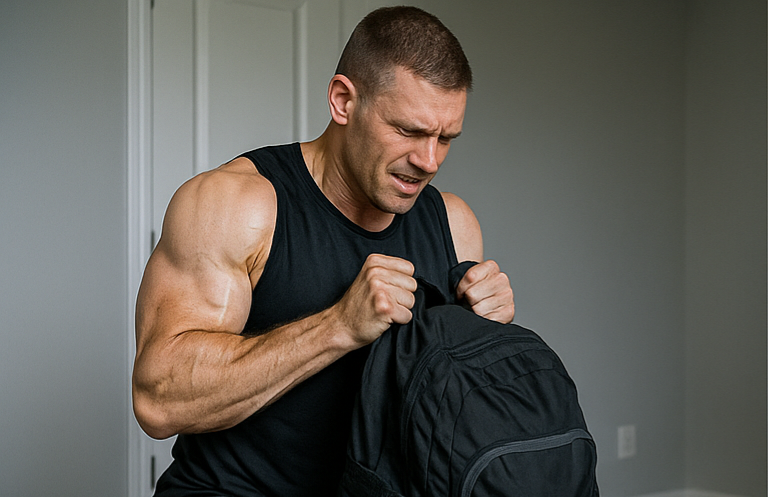
Just me, gravity, a doorway, a backpack full of random items, and a stubborn personality.
So yeah — you can absolutely build bigger arms at home.
But only if your approach isn’t stuck in the “push-ups and hope” era.
Understanding Arm Growth at Home
Arm growth isn’t magic.
It’s tension, fatigue, and consistency showing up to the party at the same time.
Even at home, you can create:
- Enough mechanical tension
- Enough metabolic stress
- Enough progressive overload
to stimulate actual hypertrophy.
The big mistake is thinking you need heavier to make it happen.
You usually need smarter, not heavier.
And that’s where most home workouts crash and burn.
Home Arm Training Needs the Right Kind of Overload
When you don’t have dumbbells that go up to the weight of a small horse, you need to change how you overload.
There are three underrated methods that work insanely well at home:
1. Longer Resistance Paths
Your arms don’t care whether resistance comes from iron, gravity, or a stubborn resistance band that feels like wrestling a python.
If the muscle fibers are under tension through a longer range of motion, they’re forced to work harder.
Think:
- Deep push-up dips with feet elevated
- Slow band curls with a stretch that feels personal
- Overhead triceps extensions only using a backpack
A longer path = more microdamage = bigger arms.
2. Smart Tempo Manipulation
People underestimate slow reps because they’re not as Instagram-worthy as throwing plates around.
But slowing down a curl or a push-up turns it into a completely different monster.
Try:
- 3 seconds up
- 1 second squeeze
- 4 seconds down
Your biceps will light up like a Christmas tree plugged straight into a generator.
3. Modified Leverage Positions
At home, leverage becomes your adjustable “weight stack.”
Move your feet farther.
Elevate your hands.
Change your torso angle.
Every shift tweaks how difficult the exercise becomes.
It’s like upgrading from “casual mode” to “why am I sweating like this?” mode.
A Realistic Way to Build Arm Size at Home

Let’s skip the magic formulas.
If you want bigger arms at home, you need:
- Two movements that hit biceps
- Two movements that hit triceps
- One movement that hits brachialis/forearms
- One “burnout” movement that makes you question your life choices (in a good way)
But the trick isn’t what you do.
It’s how you execute every rep.
You can grow on:
- Push-ups
- Dips between chairs
- Band curls
- Backpack curls
- Close-grip push-ups
- Inverted rows under a table
if your intensity is genuinely high.
“High intensity” doesn’t mean yelling like a powerlifter on TV.
It means your last 3–4 reps feel like moving wet concrete uphill.
Biceps: Home Exercises That Actually Pack Size

Biceps don’t need endless variations.
They need:
- Stretch
- Squeeze
- Fatigue
Backpack Drag Curls
You drag the weight up, elbows slightly behind your body.
The contraction here is nasty in the best way.
Slow Eccentric Band Curls
If you don’t have a band, get one.
It’s the most cost-effective arm-growth tool you’ll ever buy.
And when you slow the eccentric to 3–4 seconds, the muscle does half the complaining and all the growing.
Under-the-Table Bodyweight Curls
This one feels ridiculous until you try it.
You curl your weight up with elbows tight, like an inverted row but with a curl motion.
It sets your biceps on fire.
Triceps: The Key Player in Your Home Training Routine

If you want your arms to look big, triceps do most of the optical illusions.
At home, you’ve got three moves that slap:
Chair Dips With Forward Lean
You lean forward just enough to turn it into a deep triceps stretch on the bottom.
Overhead Backpack Extensions
A loaded backpack is essentially a triceps skull-crusher that doesn’t crush your skull.
Close-Grip Push-Ups with a Slow Descent
Increase the difficulty by elevating your feet and controlling the lowering phase.
Your triceps won’t know what hit them.
The Brachialis: The Sleeper Muscle of At-Home Gains

You want arms that look thicker?
You hit brachialis.
Hammer-Style Band Curls
Neutral grip.
Big squeeze.
Minimal ego — maximal forearm thickness.
Reverse Backpack Curls
Feels awkward at first.
Then you notice your forearms blowing up like old-school strongmen.
Progression at Home: The Only Part People Keep Doing Wrong
You can have the perfect exercises.
You can train hard.
You can even have a deluxe collection of resistance bands in 33 colors.
But if your progression is random, your results will also be random.
Here’s what home progression really means:
- Add reps
- Slow the tempo
- Add a pause
- Change your leverage
- Increase the load (add books, bottles, anything)
- Reduce rest times
Don’t improve everything at once.
Choose one progression per week and ride it until it stops giving returns.
A Weekly Arm-Growth Structure You Can Actually Follow
You train arms 2–3 times a week.
Each session lasts 25–35 minutes.
And you already know the basic layout:
- Two moves for biceps
- Two moves for triceps
- One for brachialis/forearm
- One burnout finisher
Your burnout could be:
- 1-minute band curls
- 1-minute close-grip push-ups
- A strip-set with your backpack
- A max-rep inverted curl hold
This is where most growth happens.
How to Tell If Your Home Arm Workouts Are Actually Working

This is the part nobody talks about.
Your arms won’t suddenly blow up like you’re auditioning for a Marvel role.
But here’s what will happen:
- Your sleeves feel tighter
- Your arms look fuller in the morning
- Veins start appearing where you didn’t remember having veins
- Your pump gets faster
- Sets that used to feel impossible start feeling “warm-upy”
If you get two or three of these signs in a month, you’re on the right track.
The Real Limit of Home Training for Arm Growth
Let’s be honest.
But that ceiling is usually higher than people think.
You can grow beginner-to-intermediate level arms at home.
You can absolutely build aesthetics.
You can absolutely build strength endurance.
You can feel bigger, fuller, stronger.
But if you want elite hypertrophy — the kind that makes people ask if you’ve been sneaking into the gym at 3 a.m. — you’ll eventually need more load than your closet can provide.
Still, for most people?
Home training is enough to get visible progress faster than they expect.
Working Around the Most Common Home-Training Doubts
I’ve noticed something funny about home arm training.
The exercises aren’t the real problem — it’s the doubts that sneak in when you’re alone in your living room.
A lot of people think:
“Do I even have enough space?”
“Is this backpack curl actually doing anything?”
“Will bands give me results or am I basically stretching a giant rubber band for no reason?”
Those little doubts add up and quietly sabotage consistency.
So here’s what actually matters.
If your reps slow down toward the end of the set, your arms are getting the message.
If your muscles feel warm, swollen, and a bit useless after the session, you did it right.
If your technique stays clean but you’re fighting the urge to stop three reps early, you’re on track.
Your house doesn’t need to turn into a gym.
You don’t need a dedicated “workout corner” on Instagram.
You just need enough space to lie down, one doorframe that doesn’t wiggle, and something to load a backpack with.
And if boredom is the enemy?
Rotate tempos.
Change grips.
Do a band session one day and bodyweight the next.
You don’t need novelty — you just need enough variety to keep your brain awake while the muscles take the hit.
Keeping Intensity High at Home Even Without Heavy Weights
Intensity at home isn’t about lifting heavier — it’s about lifting smarter when you can’t cheat the weight.
One trick nobody talks about is the “micro-rest.”
You pause just long enough to breathe once, then jump back in.
It makes the set feel like a broken elevator: stops, starts, and absolutely nowhere to escape.
Another method is something I call “range flipping.”
You spend a whole set in just the top half or bottom half of the movement.
It forces your arms to fight tension where they normally relax.
Then there’s the “lockout fade.”
You push or curl all the way up, hold for a second, and then slowly let the contraction melt away.
It turns even an empty backpack into a problem.
And if you really want to find your actual limit?
Pick a band curl variation and go until your hands literally stop responding.
Not the “this burns” stop.
The “my biceps just deleted the concept of curling” stop.
How Arm Work Fits Into a Realistic Weekly Routine at Home
Arms don’t exist in a vacuum.
They’re usually riding shotgun to chest, back, shoulders, or whatever else you’re doing.
So here’s the layout that actually makes sense at home:
If you train push-ups, dips, or anything chest-focused, your triceps are already halfway fried.
So an arm day right after that will feel like reheating leftovers — still good, but not the same.
If you train rows, pull-ups, towels rows, or table rows, your biceps get pulled into the mix.
So stacking a biceps-heavy day right after a pulling day makes everything feel weaker than it really is.
The sweet spot?
- Arm day between a push and pull day
- Or arms 24–48 hours after any big upper-body session
- Or a quick 20–30 min “arm finisher” twice a week after lighter workouts
And if you mix calisthenics with arm days?
Keep your big skills (handstands, pull-up progressions, front lever attempts) away from heavy arm work — those moves rely on fresh elbows and fresh connective tissue.
Your arms don’t need endless days of recovery.
They just need smart spacing so they’re not showing up to the workout already tired from yesterday’s adventure.
Final Thoughts
If you’re training arms at home, you’re not at a disadvantage.
You’re simply playing a different game with different rules.
And once you understand those rules — tempo, leverage, stretch, and brutal consistency — your arms respond the same way they would in any gym.
You don’t need chrome dumbbells to grow.
You don’t need cables stacked to the ceiling.
You need effort, structure, and a willingness to make the most out of the space you already have.
If you stick with it for 8–12 weeks, your arms will grow.