
Doing crunches in pajamas five minutes before bed sounds like one of those ideas that either makes you a peak-discipline legend… or gives you heartburn.
The truth sits somewhere in the middle.
Training abs before sleep is not automatically “bad”, but it has different outcomes depending on how, how intensely, and what condition you’re in as you crawl into bed afterwards.
Let’s walk through it without the guru speeches or “six-pack in 7 days” promises.
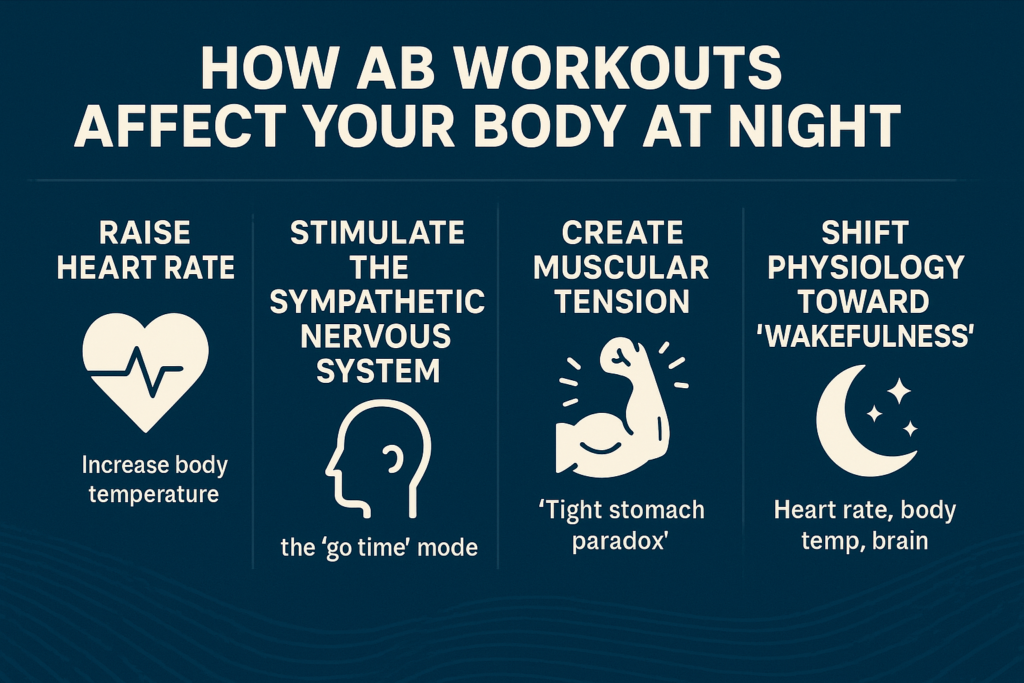
How Ab Workouts Affect Your Body at Night
Your nervous system: are you in “gaming mode” or “sleep mode”?
Your body works a bit like a console.
You’ve got gaming mode (activation, adrenaline, attention).
And sleep mode (shutdown, repair, background processing).
A workout—even “just abs”—tends to:
- Raise heart rate
- Increase body temperature
- Stimulate the sympathetic nervous system (the “go time” mode)
If you do a super-intense core workout right before bed, it’s kind of like finishing a boss fight and then expecting to instantly fall asleep.
Your body needs a cooldown phase.
Think of it like shutting down a PC—
you don’t just yank the power cable while it’s still running updates.
Core tension and relaxation: the “tight stomach paradox”
A good ab workout creates muscular tension.
That’s great for core strength.
But for quality sleep, your body needs some softness:
- Deeper breathing
- A relaxed diaphragm
- An abdomen that isn’t stuck in “brace mode”
If you finish training and immediately hit the pillow with your core still locked in, you may:
- Struggle to get comfortable
- Breathe more shallowly
- Feel like your stomach is “hard” or tight
This isn’t dangerous—
just mildly annoying and counterproductive to relaxation.
Heart rate, body temperature, and sleep timing
A late-night workout temporarily shifts your physiology toward “wakefulness.”
That means:
- Higher heart rate
- Elevated body heat
- A more alert brain
Not ideal right before sleep.
If your ab session is:
- Short
- Moderate
- Controlled
Your body usually settles down fast.
But if it’s 20 minutes of plank + mountain climbers + hollow holds until mechanical failure…
…then lights-out might be rough.
Is It Actually Dangerous to Train Abs Before Bed?
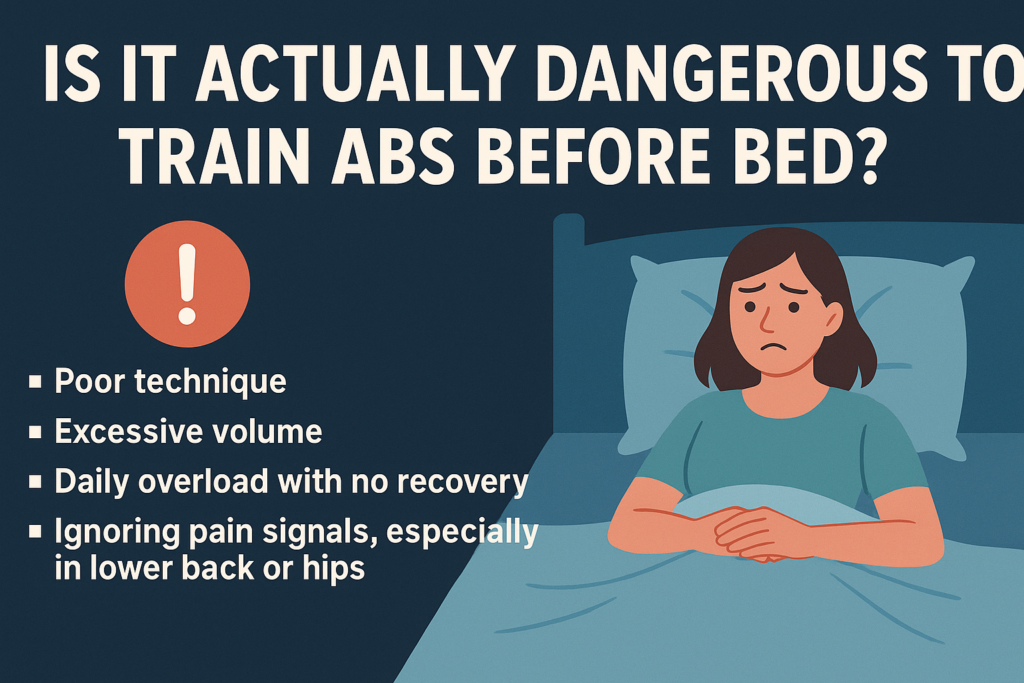
Short answer: no
There is no reliable evidence that nighttime ab training causes:
- Back damage by default
- Hernias just because it’s late
- Interference with muscle growth
What causes problems isn’t the clock—
it’s:
- Poor technique
- Excessive volume
- Daily overload with no recovery
- Ignoring pain signals, especially in the lower back or hips
So if the question is:
“Can I train abs before bed without wrecking my health?”
The answer is: Yes, if technique and programming make sense.
But it can interfere with sleep quality—and that matters
Even if it’s not dangerous, it can be counterproductive if it disrupts sleep.
Sleep is where you:
- Recover properly
- Produce key hormones for muscle growth
- Consolidate neuromuscular adaptations
If nighttime ab training:
- Makes it harder to fall asleep
- Interrupts sleep cycles
- Leaves you wired in bed
It may indirectly slow your progress, not because evening abs are “bad,” but because poor sleep undermines everything else.
When Doing Abs Before Bed Is Totally Fine (or Even Good)
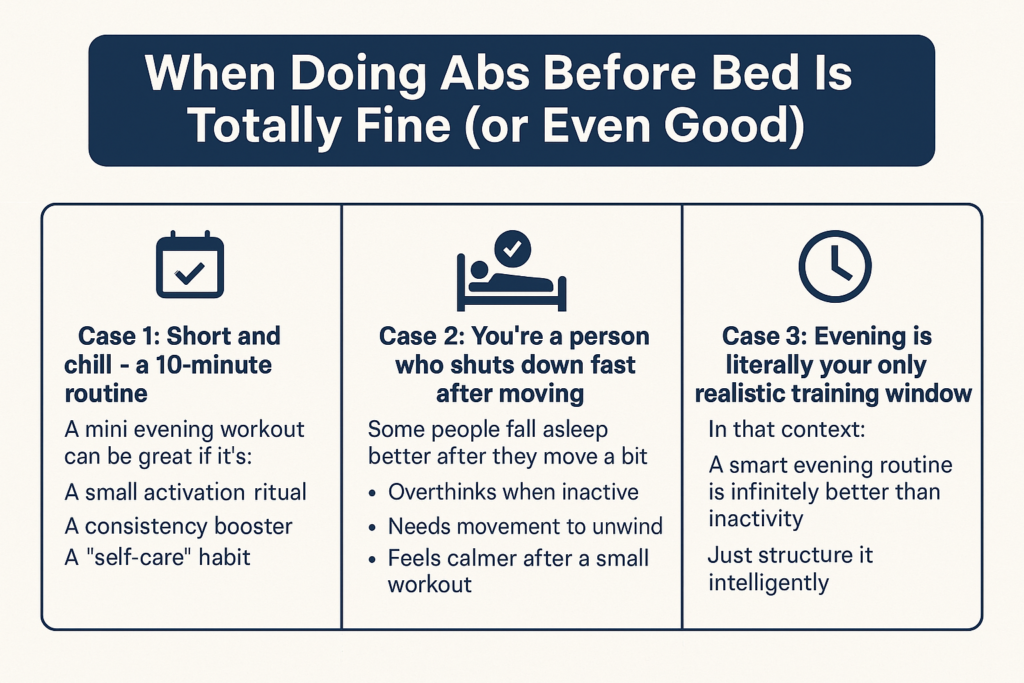
Case 1: Short and chill – a 10-minute routine
A mini evening workout can be great if it’s:
- A small activation ritual
- A consistency booster
- A “self-care” habit, not a battlefield
Example of a bedtime-friendly routine (5–10 minutes):
- Slow dead bug
- Glute bridge with breathing focus
- Low-intensity side plank
- Light hip or lower-back mobility
Focus more on:
- Control
- Breathing
- Alignment
Not annihilation.
A mix of mild core work + gentle stretching can actually relax certain people.
Case 2: You’re a person who shuts down fast after moving
Some people fall asleep better after they move a bit.
If you’re someone who:
- Overthinks when inactive
- Needs movement to unwind
- Feels calmer after a small workout
A light core session can help.
Just don’t turn it into:
- A punishment circuit
- A chase for “extreme burn”
- A sweaty HIIT session at midnight
Case 3: Evening is literally your only realistic training window
Life isn’t a fitness textbook.
If your schedule is:
- Long workdays
- Family duties
- Zero time until evening
Then waiting for the “perfect moment” means no training at all.
In that context:
- A smart evening routine is infinitely better than inactivity
Just structure it intelligently:
- Pick exercises that aren’t neurologically exhausting
- Avoid cardio-intense circuits late at night
- Give yourself 20–30 minutes before lights-out
When It’s Probably Not a Great Idea
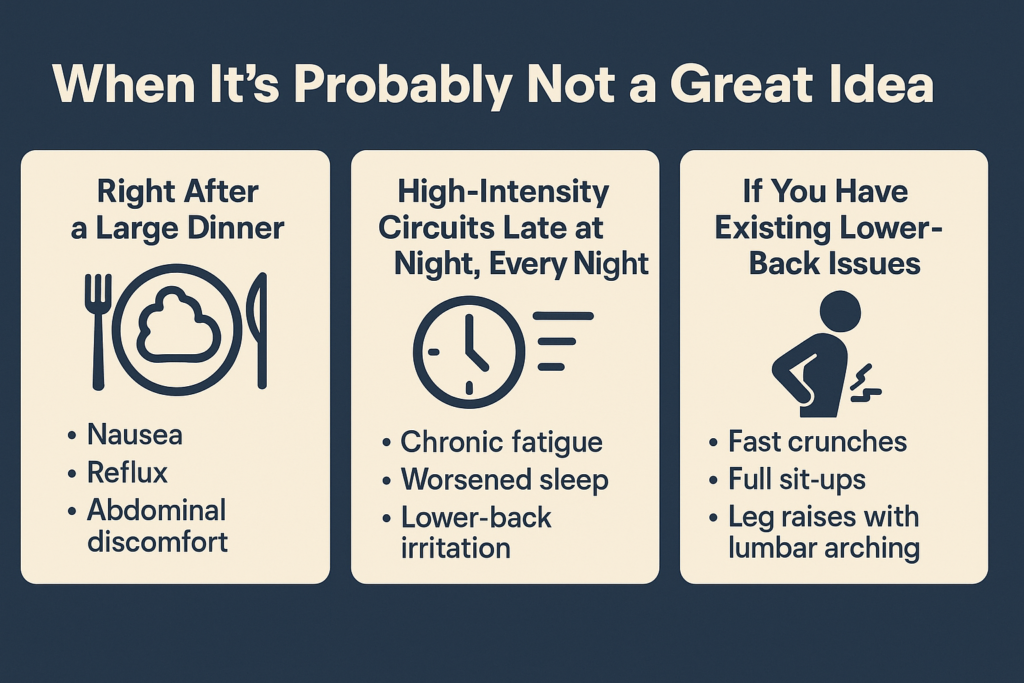
Right after a large dinner
Training abs immediately after eating may cause:
- Nausea
- Reflux
- Abdominal discomfort
Especially if the meal was:
- High-fat
- Heavy
- Fizzy drinks or alcohol involved
Better to:
- Wait 60–90 minutes
- Focus on controlled movements, not breath-stealing isometrics
High-intensity circuits late at night, every night
If you’re doing:
- 20–30 minutes of hardcore abs nightly
- Excessive isometrics
- High-volume circuits
Expect possible outcomes:
- Chronic fatigue
- Worsened sleep
- Lower-back irritation
It’s not a healthy “nightly ritual”—
it’s just poor timing for a high-intensity workout.
If you have existing lower-back issues
Evening fatigue + compromised technique =
high risk of bad mechanics.
If your lower back is:
- Already sore
- Tight from sitting all day
- Weak or unstable
Classic late-night ab work can make it worse:
- Fast crunches
- Full sit-ups
- Leg raises with lumbar arching
Nighttime, when tired, is the worst moment to load a dysfunctional pattern.
What Kind of Ab Routine Works Best Before Bed?
Basic principle: think “control and breath,” not “max burn”
The best nighttime core routine emphasizes:
- Movement quality
- Breath coordination
- Mild activation
Not intensity.
Goal:
- Activate the core
- Undo postural stiffness
- Prepare the body for relaxation
Example of a bedtime-friendly routine (10 minutes)
- Supine diaphragmatic breathing (1–2 mins)Lie on your back with knees bent.
Place a hand on your belly.
Inhale through the nose so your belly rises.
Exhale slowly through the mouth so it relaxes. - Dead bug (2–3 sets of 6–8/side)Lie on your back, arms up, legs bent at 90°.
Press your lower back into the floor.
Lower opposite arm and leg slowly.
Return to center and switch sides. - Glute bridge (2–3 sets of 10–12)Lie on your back, knees bent, feet flat.
Push through heels to lift hips.
Squeeze glutes at the top.
Lower with control. - Side plank (2 sets of 15–20 sec/side)Elbow under shoulder, body in a straight line.
Lift hips and keep core tight.
Hold and breathe.
Use knees-down version if needed. - Cat-cow or gentle spinal mobility (1–2 mins)On hands and knees.
Round your back up (cat).
Then gently arch it down (cow).
Move slowly with the breath.
What to avoid before bed
Probably not ideal at night:
- Fast, bouncing reps
- Neck-driven crunches
- No-rest circuits
- Long isometrics taken to trembling failure
If you get up feeling like you did a YouTube challenge, you overdid it.
Will Evening Ab Workouts Help You Get a Six-Pack Faster?
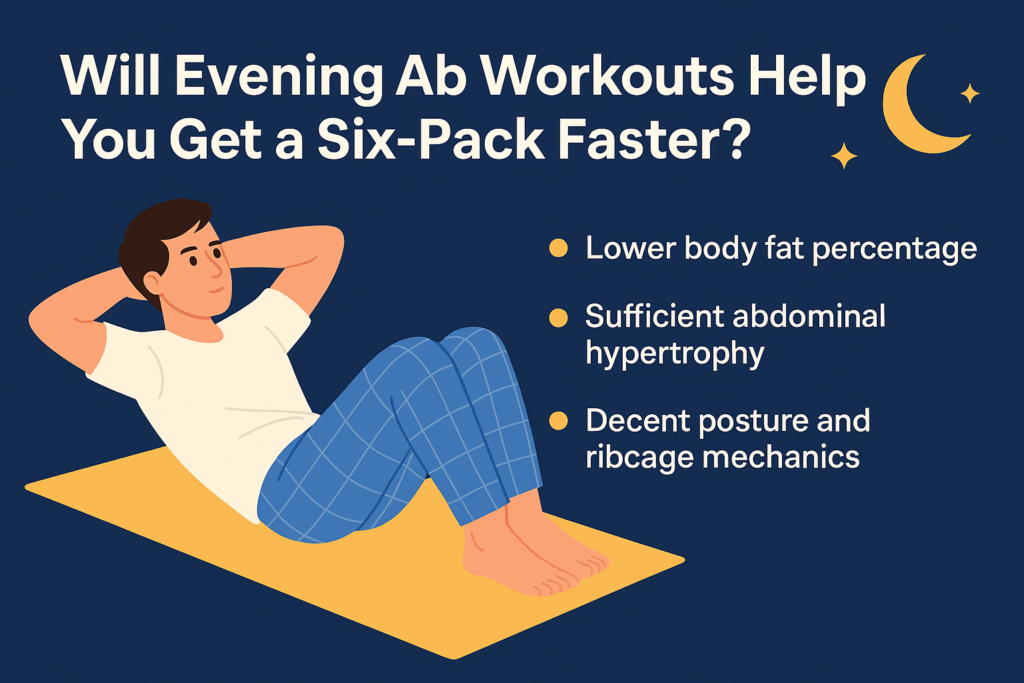
Quick answer: not for the reason you think
Night workouts don’t magically shred belly fat.
Visible abs come from:
- Lower body fat percentage
- Sufficient abdominal hypertrophy
- Decent posture and ribcage mechanics
So the real question is:
“Does training abs at night contribute to total progress?”
Yes—if it keeps you consistent without crushing sleep, energy, or recovery.
The real risk: thinking nightly abs are “everything”
If your only fitness habit is a nightly ab routine, and you ignore:
- Total body strength
- Nutrition
- Sleep quality
It’s like customizing the steering wheel of a car with no engine.
Practical Guidelines: Make Evening Abs Safe and Useful
To keep it simple:
- Moderate volume (5–15 mins is enough)
- Avoid high intensity right before bed
- Give yourself a 20–30 minute buffer before sleeping
- Monitor sleep quality afterwards
- Technique > quantity
- Do what fits your real life, not perfection fantasies
So… Is It Bad to Do Ab Workouts Right Before Sleep?
If by “bad” you mean dangerous:
No, it’s not inherently harmful.
If by “bad” you mean something like:
- It wrecks your sleep
- Keeps your body wired
- Leaves you stiff and fatigued
Then yes—
it might not be great for you at that time, not because evening abs are evil, but because they don’t align with your recovery style.
Think of nighttime core work as a soft landing, not a last-minute sprint.
If it helps you stay consistent, feel stronger, and end the day with a sense of self-care—
Then it’s not a problem.
It’s just another tool,
and it works best when you don’t treat it like self-punishment at 11:59 PM.