I’ve got a confession.
The moment I tried archer push-ups, I thought I’d invented a brand-new form of suffering.
One arm was shaking like a baby deer on ice.
The other felt like it was doing an entire upper-body workout by itself.
And my chest?
Let’s just say it felt like someone had split my pecs’ group chat into two separate conversations.
But here’s the thing.
That weird, uneven feeling is exactly why archer push-ups are so interesting.
They look symmetrical from the outside, but when you’re the one doing them, it becomes pretty obvious that your body is negotiating two very different workloads.
So the big question is simple.
Are archer push-ups secretly a one-sided grind disguised as a cool calisthenics move?
Or do they actually help you build more balanced strength over time?
What Archer Push-Ups Really Do for Your Body
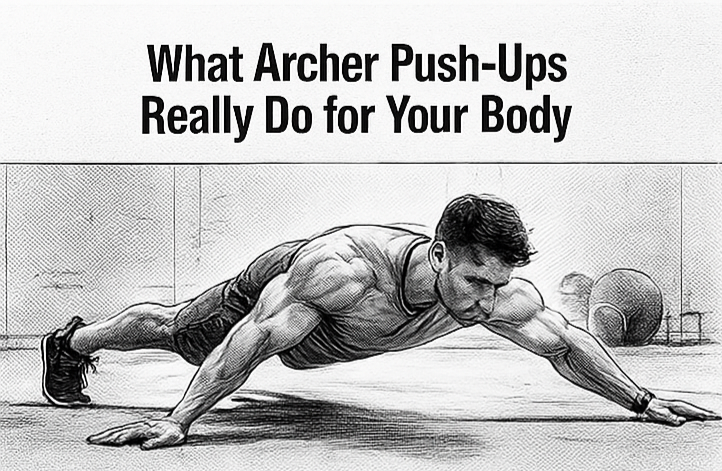
Archer push-ups are a sort of “split-responsibility” exercise.
One arm works like it’s bench-pressing a medium-sized raccoon, while the other arm is playing the role of spotter.
You drop down toward the working arm.
You keep the assisting arm long and strong.
Your torso shifts, your weight shifts, and suddenly your muscle recruitment pattern looks completely different from a regular push-up.
This setup naturally creates asymmetry.
It has to.
There’s no version of the archer that loads both sides equally unless you’re only halfway committing to the movement.
But that’s not a flaw.
That’s literally the point.
You get a hybrid between:
- A unilateral strength builder
- A chest-dominant push-up variation
- A gateway to full one-arm push-ups
- A stability challenge disguised as a flex
Why One Side Feels Like It’s Working Harder (Because It Is)
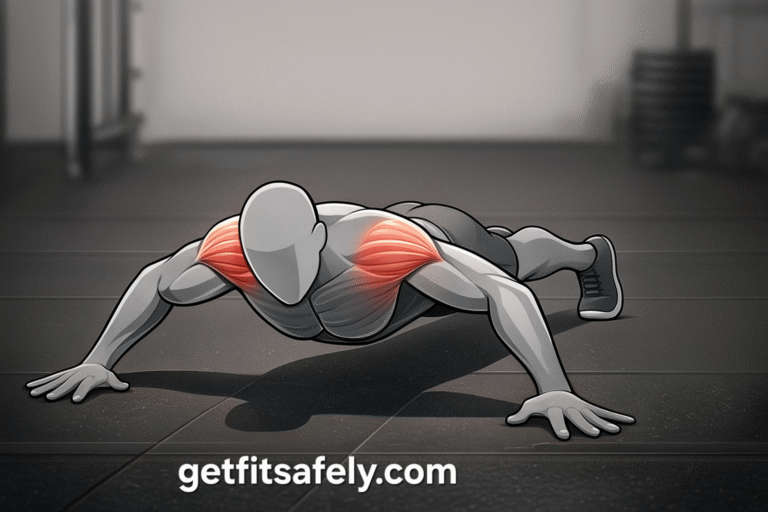
When you drift toward one hand, that arm takes the brunt of the load.
The shoulder stabilizers fire harder.
The pec stretches deeper.
The triceps have to lock out through a longer range.
Meanwhile, the assisting arm behaves more like a dynamic brace.
It’s working, but it’s not working-working.
This can make you feel lopsided.
It can expose weaknesses.
It can even make you wonder whether you’re training intelligently or just punishing the “good” side every time you switch reps.
Here’s the truth, though.
Uneven loading doesn’t mean uneven development.
It just means you need balanced programming.
And that’s where most people mess up.
Stop Archer Push-Ups From Going Lopsided
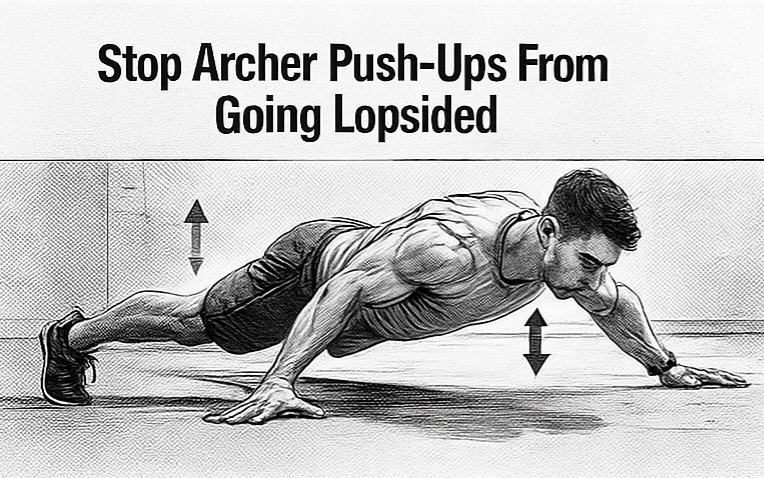
If your archer push-ups look more like a sideways slide than an actual rep, then yeah… your dominant side will absolutely hijack the show.
But if you control the movement, you turn the exercise into a legitimate strength builder.
A few simple adjustments make a huge difference:
- Keep your assisting arm straight, not bent
- Shift your torso intentionally toward the working side
- Pause briefly at the bottom to make sure you’re not rushing through the hard part
- Alternate sides rep by rep, not set by set
- Don’t rotate your hips to “cheat weight away”
- Treat each rep like a single, not a burnout
When you do this, the load becomes more predictable.
Both sides get their moment in the spotlight.
How Archer Push-Ups Compare to Other Unilateral Moves
Archer push-ups sit somewhere on the spectrum between a wide push-up and a full one-arm push-up.
But they’re not just a stepping stone.
They’re a complete movement on their own.
Compared to dips or weighted push-ups, archers hit the lateral chest fibers in a way other moves don’t.
They challenge scapular stability.
They force your shoulders to deal with asymmetrical loads — something traditional bodybuilding work rarely does.
If you’ve ever struggled with bench press stability, this variation teaches your body to handle uneven stress.
And since real life rarely hands you perfectly balanced loads, that’s a skill worth having.
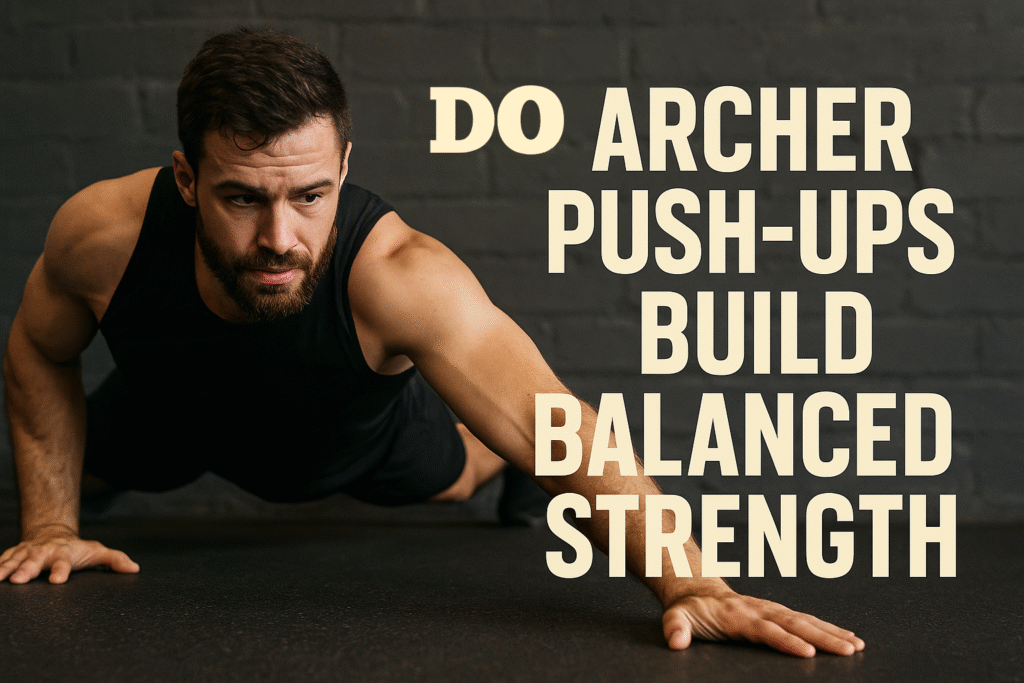
Do Archer Push-Ups Build Balanced Strength?
Absolutely — if you treat them like a symmetric exercise with alternating unilateral focus.
They build balanced strength by:
- Exposing weak spots
- Strengthening stabilizer muscles
- Forcing each side to work independently
- Demanding full-range control
- Encouraging real torque awareness in the shoulder
They make you stronger in ways regular push-ups can’t.
But only if you treat the movement with some intention instead of rushing through reps just to feel “done”.
When Archer Push-Ups Actually Can Create Imbalances
There are a few traps that catch people off guard.
If you’re already very dominant on one side, the stronger arm will always feel more natural.
You’ll distribute weight there even when you don’t mean to.
If you rush your reps, you tilt your body in weird ways.
That reduces the load on the weaker side even more.
And if you never combine archers with other strength work, you can end up reinforcing your natural bias instead of fixing it.
This doesn’t mean the exercise is dangerous — just misunderstood.
You can absolutely use archers to get balanced.
You just need structure.
A Practical Way to Program Archer Push-Ups Without Getting Lopsided
Here’s a simple way to structure them so each arm gets equal attention:
Option A — Alternating Reps
One rep left, one rep right, repeat.
Great for beginners or anyone who feels unbalanced.
Option B — Micro-Sets
3–4 reps left, 3–4 reps right, rest.
Perfect for intermediate athletes who want more tension per side.
Option C — Strength Ladder
Left → Right → Left → Right
With one rep each, then two, then three.
Fantastic for building volume without losing form.
Whichever option you choose, keep the total reps the same for both arms.
No exceptions.
How Archer Push-Ups Stack Up Against Other Push Variations
Once you’ve played with archer push-ups, it’s hard not to compare them to their cousins.
They sit in this weird middle ground — not as intimidating as a full one-arm push-up, but way more serious than your average wide-grip set.
Uneven push-ups?
Those shift weight too, but they don’t give the same long-lever stabilizing challenge.
Typewriter push-ups are close, but they focus more on lateral movement than controlled eccentric strength.
Weighted push-ups deliver raw power, but they don’t expose left–right differences the same way.
Archer push-ups live in that sweet spot where technique, unilateral push strength, uneven loading, scapular control, and chest activation all overlap without becoming a circus act.
And the more you practice them, the more obvious this becomes.
RELATED:》》》 Push-Ups Progression
Useful Concepts That Actually Help Your Training
There are a few terms that sound technical but genuinely matter for how this exercise feels.
Nothing fancy — just the real mechanics behind why archer push-ups make your upper body smarter.
Unilateral push strength is the big one.
Each arm learns to push without relying on backup support, and suddenly your weak side can’t hide behind your dominant one anymore.
Uneven loading is another piece of the puzzle.
Your body adapts to real-world forces where weight isn’t always centered, and your stability muscles level up whether they want to or not.
Then there’s scapular control.
It’s basically your shoulder blade not losing its cool when the load shifts to one side.
That alone makes your pressing mechanics way cleaner.
Chest activation also skyrockets because the working pec gets stretched deep, like opening a stubborn jar with one hand.
And yes — all of this feeds directly into one-arm push-up progression.
Even if you’re not chasing that goal, the movement patterns you learn here translate into everything from better bench press control to more confident overhead work.
Final Thoughts
Archer push-ups aren’t supposed to feel perfectly even.
They’re designed to challenge your asymmetries.
They show you where you’re strong, where you’re compensating, and where you’ve been coasting on autopilot for too long.
But here’s the beautiful part.
If you stick with them, those weird “left versus right” sensations start to fade.
What used to feel like two different workouts becomes one fluid, controlled movement.
You build strength that’s not just bigger, but smarter.
You gain confidence in both arms, not just the one that usually takes the lead.
So give archers a real shot..
Quick Q&A for Real-World Doubts
“Can archer push-ups replace regular push-ups?”
Not quite.
They complement each other.
Regular push-ups give you symmetry and volume, while archers sharpen your strength per side.
“Are archer push-ups bad for shoulders?”
Only if you rush them or twist your way out of the hard part.
Done slowly and cleanly, they improve shoulder stability.
“How many reps should I do per side?”
Start light.
Think 3–5 controlled reps on each arm.
Quality before ego.
“Do they really help with the one-arm push-up?”
Absolutely.
They’re the phase where your body finally starts connecting the dots and understanding how to shift weight the right way.
Can you actually get strong without touching weights?
Yes — bodyweight exercises can build real strength and solid mass when you use harder progressions like archer push-ups, deep-range variations, and single-arm work.