Walking into the gym wearing the wrong shoes almost never feels like a mistake at first.
Nothing pinches, nothing stabs, nothing forces you to stop mid-set and rethink your life choices.
Most of the time, everything feels fine enough to keep going, which is exactly why the problem flies under the radar for so long.
I remember thinking more than once that my knees were just “having an off phase,” because the discomfort wasn’t sharp or dramatic, just annoyingly present in the background.
That’s usually how shoe-related issues start.
Not as pain, but as friction.
You train, you load the bar, you finish the session, and only later do you notice your joints feeling a little more tired than they should.
Over weeks, that “a little” turns into something harder to ignore, especially during stairs, long walks, or the first reps of your warm-up.
At that point, most people start blaming form, mobility, or age, when in reality the shoes have been quietly influencing mechanics the whole time.
Why shoes quietly influence everything above them
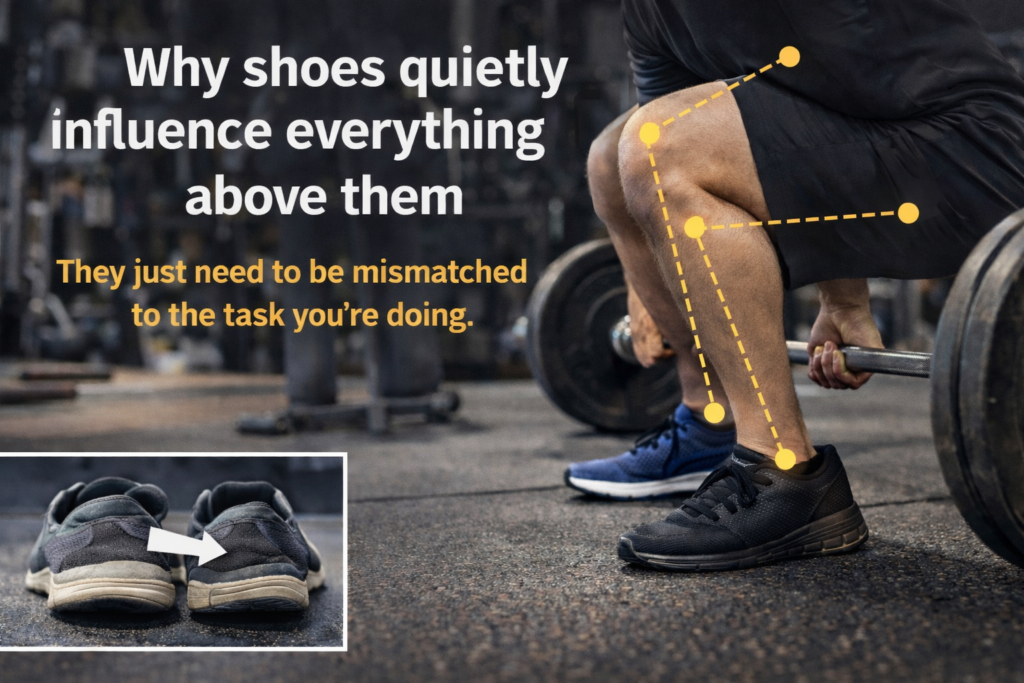
Your feet are the foundation of your entire lower-body system, and everything above them depends on how predictable and stable that foundation is.
Ankles, knees, hips, pelvis, and spine are all part of the same mechanical chain, and when the base changes, the whole system adapts whether you want it to or not.
What often gets missed is that shoes don’t need to be “bad” to change mechanics.
They just need to be mismatched to the task you’re doing.
When I first paid attention to this, what surprised me wasn’t how unstable some shoes felt, but how normal that instability had always seemed.
If the sole compresses unevenly or the foot can’t fully grip the ground, the body starts making small corrections on every rep.
Those corrections usually show up at the knee and hip because they sit right in the middle of force transfer.
The knee gets extra motion.
The hip gets extra rotation.
Neither of them signed up for that job.
Why nothing hurts right away
One of the most misleading aspects of shoe-related joint stress is how slowly it builds.
The human body is incredibly tolerant of small imperfections, especially when you’re strong and generally active.
A single workout in the wrong shoes won’t wreck your knees or hips, and that’s part of the trap.
Training is repetition by definition, and repetition magnifies small mechanical issues.
Three to five training sessions per week means hundreds of loaded reps, all built on the same base.
Over time, tendons become sensitive, cartilage experiences uneven pressure, and muscles start guarding instead of moving freely.
I’ve noticed that this kind of discomfort rarely announces itself during the lift itself, but shows up later, when the adrenaline is gone and the joints are left dealing with the aftermath.
That delayed feedback makes it easy to disconnect the pain from its real cause.
Why overly cushioned shoes confuse stability
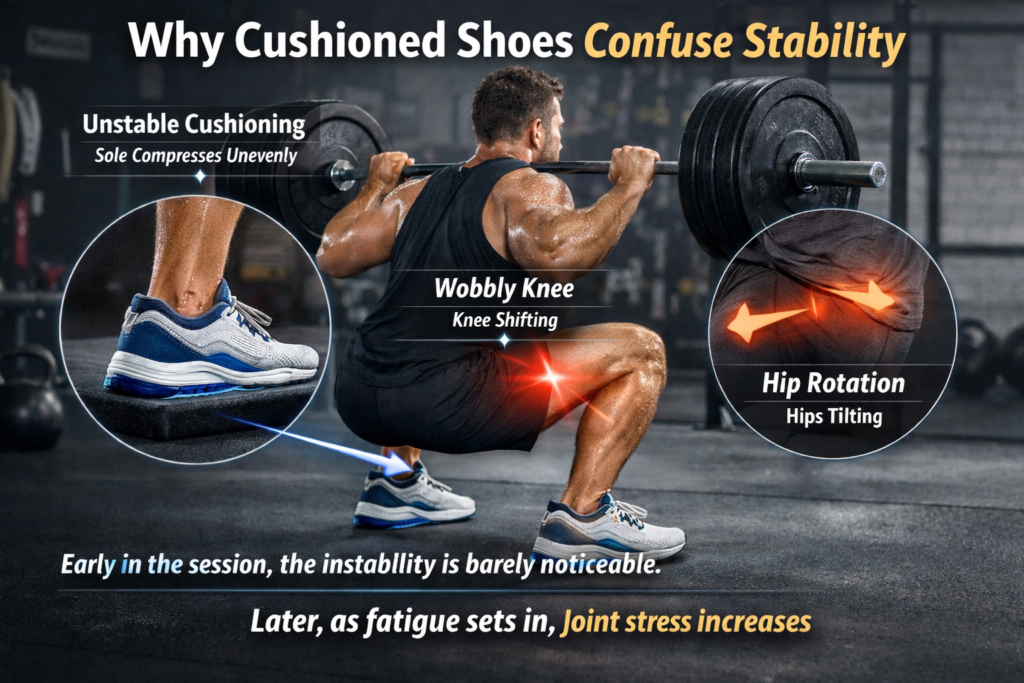
Most running shoes are designed to absorb impact during forward motion, which is great for jogging and walking.
In the weight room, that same cushioning becomes a liability.
When you load a squat or deadlift on thick foam, the sole compresses in slightly different ways depending on how force is applied.
That means your foot isn’t interacting with the floor the same way from rep to rep.
The ankle responds by wobbling.
The knee subtly changes its tracking.
The hip rotates just enough to keep balance.
Early in the session, you barely notice it.
Later on, when fatigue kicks in, those small adjustments become harder to control, and joint stress quietly increases.
I remember switching from soft trainers to firmer shoes and immediately feeling more “connected” to the floor, even though nothing else in my training had changed.
That sense of connection isn’t about performance hype, it’s about predictability.
Heel height without rigidity creates mixed signals
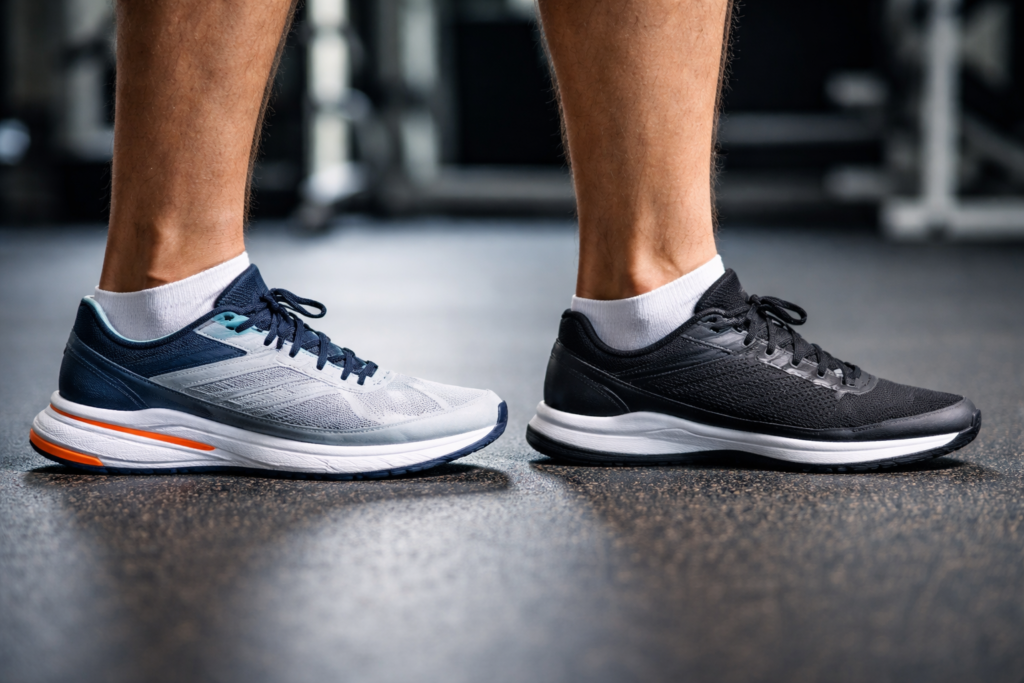
Many gym shoes and running shoes have a raised heel, which shifts your weight slightly forward.
For some lifters, this can make squatting feel smoother by reducing ankle mobility demands.
The issue isn’t the heel itself, but what the heel is made of.
When a raised heel sits on soft foam, it introduces instability instead of structure.
Knee loading tends to increase, especially if you already rely heavily on your quads.
Hip positioning becomes harder to repeat consistently.
Weightlifting shoes also use a raised heel, but they pair it with a rigid, non-compressible sole.
That difference matters more than most people realize.
Heel height plus stability is a tool.
Heel height plus softness is guesswork.
Why toe space matters more than people think
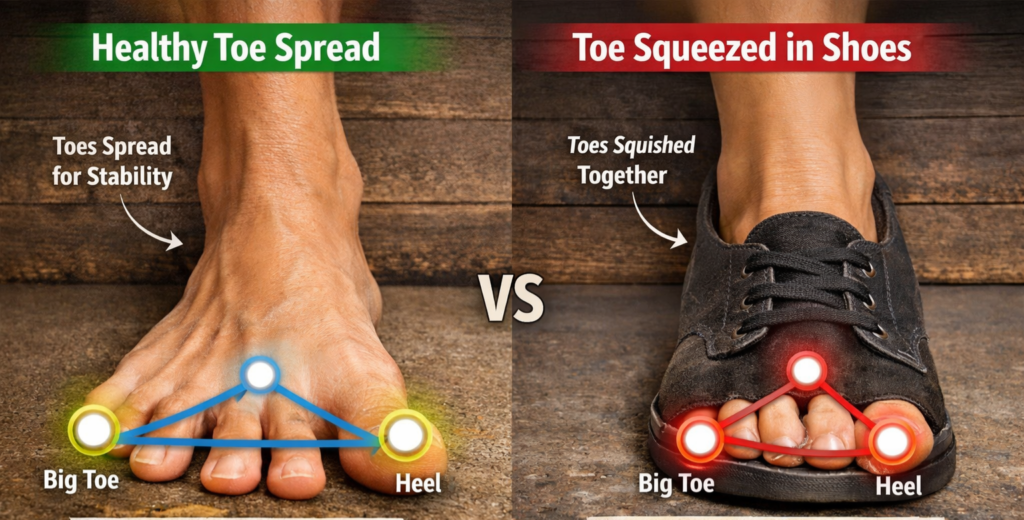
Your toes are designed to spread slightly when you apply force into the ground.
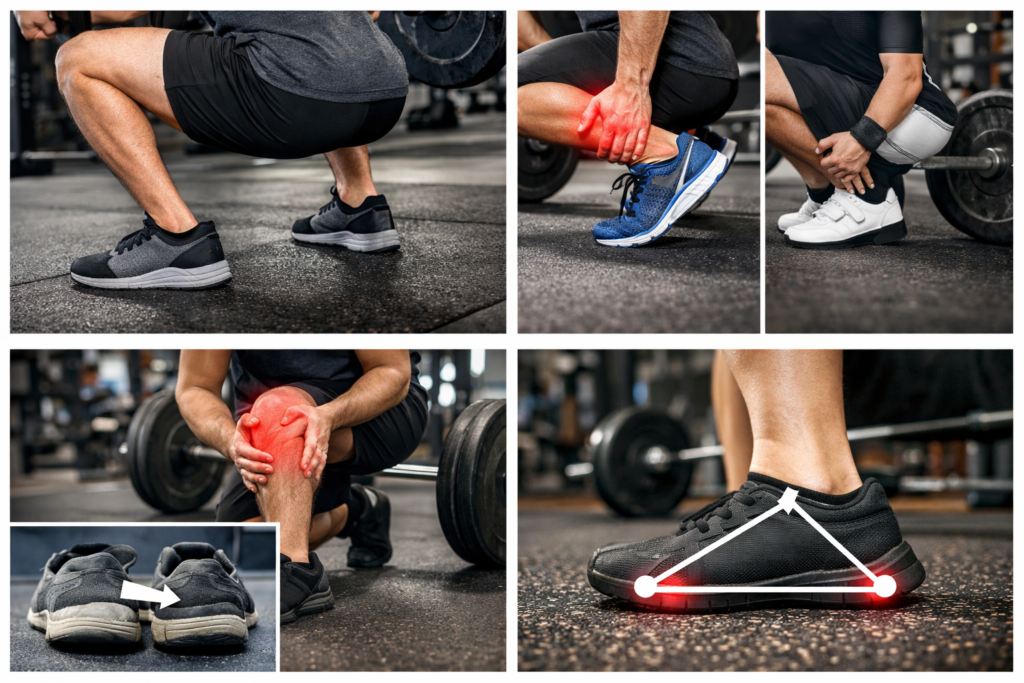
That spread creates a stable tripod between the big toe, little toe, and heel.
When shoes squeeze the toes together, that tripod collapses.
Foot control decreases, especially under load.
The arch may drop more than it should, and that collapse often pulls the knee inward.
The hip then rotates to compensate, trying to stabilize what the foot no longer can.
This chain reaction doesn’t always show up as obvious form breakdown, which makes it easy to ignore.
I’ve seen people clean up knee tracking instantly just by switching to a wider toe box, without changing anything else in their technique.
That’s not magic, it’s mechanics.
When “supportive” shoes become too controlling
Some shoes are designed to aggressively control foot motion, and in daily life that can be useful for certain people.
In the gym, that same control can become a problem if it forces the foot into a position that doesn’t match how you naturally produce force.
When the foot is forced, the knee and hip adapt to maintain balance.
Those adaptations often show up as deep joint discomfort that feels hard to localize or explain.
I’ve personally found that the more a shoe tries to “fix” my foot, the more awkward my hips feel under load.
Support works best when it assists movement, not when it dictates it.
Worn-out shoes and the problem no one checks
Shoes don’t wear down evenly, especially if you naturally load one side more than the other.
Once that happens, you’re effectively training on a slight slope.
That slope subtly shifts your pelvis and alters how your hips and knees move during every rep.
One side starts compensating.
The other side starts complaining.
Because the change is gradual, it’s easy to overlook until discomfort becomes persistent.
I’ve seen knee pain disappear simply by replacing shoes that looked “fine” on top but were completely collapsed underneath.
It’s not exciting, but it’s effective.
| Ever wondered if running shoes actually make sense in the gym?
This video explains the key differences between running shoes and training shoes, and why the wrong choice can affect stability, performance, and safety during workouts. |
How shoe-related knee and hip discomfort usually feels
Pain linked to footwear is rarely sharp or sudden.
It tends to feel like stiffness, dull aching, or irritation that builds as the session goes on.
Knees may feel unstable during lunges or sore afterward.
Hips may feel pinchy at the bottom of a squat or achy on one side after unilateral work.
Often everything feels okay at the start, which makes it tempting to ignore early warning signs.
Fatigue removes your ability to compensate, and that’s when the joints start speaking up.
Why this matters if you plan to train for years
The body works as a chain of linked joints rather than isolated parts.
If the base of that chain is unstable, everything above it spends extra energy correcting movement.
That energy cost accumulates slowly over months of training.
Not as a dramatic injury, but as irritation that reduces training quality and consistency.
Shoes don’t cause every knee or hip issue, but they often amplify existing ones.
Removing that amplification can make a surprising difference.
RELATED:》》》 How to Train Safely Without Losing Progress
The realistic takeaway
The right shoes won’t magically fix your form or make you injury-proof.
They won’t replace good programming or smart load management.
What they can do is remove a constant, low-level stressor from every rep you perform.
When training is consistent, that matters more than people think.
Stable, well-fitting shoes are not a performance trend or a fashion choice.
They’re a long-term joint management decision.
Unexciting, practical, and very easy to underestimate until you feel the difference for yourself.