
I used to roll my eyes whenever someone bragged about their push-up numbers.
“Cool, but how much do you bench?” — that was the only question that mattered in the weight room.
Push-ups felt like the little brother of real training.
Something you do in high school PE class, not when you’re chasing muscle growth.
But here’s the twist: the deeper I got into strength training, the more I realized push-ups aren’t just filler.
They’re a tool. And when used right, they can unlock growth in ways the bench press never will.
The biomechanics nobody talks about

Here’s the first point most people miss: push-ups are a closed-chain movement.
That means instead of moving an external weight (like in a bench press), your body moves through space while your hands stay fixed.
And that single detail changes everything.
- Your core has to stay tight.
- Your glutes engage to keep your hips from sagging.
- Even your legs contribute, acting as stabilizers.
Every rep is full-body work, not just a chest isolation exercise.
On top of that, push-ups are joint-friendly.
There’s no heavy bar crushing your shoulders, no forced scapular position.
You can move more naturally, with a greater range of motion if you elevate your hands on dumbbells, blocks, or push-up handles.
That deeper stretch?
That’s pure hypertrophy fuel — the kind of stimulus your pecs can’t ignore.
Common mistakes that kill chest growth

The reason most lifters dismiss push-ups is simple: they’re doing them wrong.
Here are the classic errors that turn an effective exercise into a time-waster:
- Half reps: dropping halfway and calling it a push-up. If your chest never stretches, your pecs never grow.
- No intensity: stopping at 20 when you could grind out 30+. Muscles don’t care about neat round numbers — they care about effort.
- Treating them as cardio: cranking out fast push-ups like it’s a CrossFit warm-up. That’s fine for conditioning, but not for hypertrophy.
Done this way, push-ups will always feel “too easy.”
Done with control, progression, and intent?
They’ll humble you fast.
Progressions that actually work
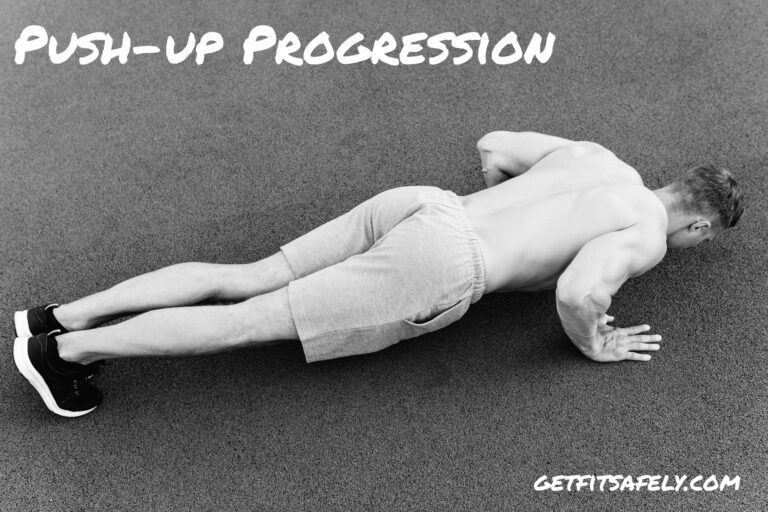
Push-ups are infinitely scalable — the problem is most people never move past the beginner level.
Here’s how to make them grow with you:
- For beginners: master clean, full-range reps. Then move to deficit push-ups (hands elevated) to increase the stretch.
- For intermediates: add external load with a backpack, weight vest, or bands. Start experimenting with tempo: slow eccentrics, pauses at the bottom.
- For advanced lifters: try archer push-ups, pseudo-planche push-ups, or ring push-ups. These variations challenge stability and load in ways barbells can’t.
Tracking progress is simple: instead of plates on the bar, your metrics are reps, resistance, and control.
Why push-ups aren’t just for the chest
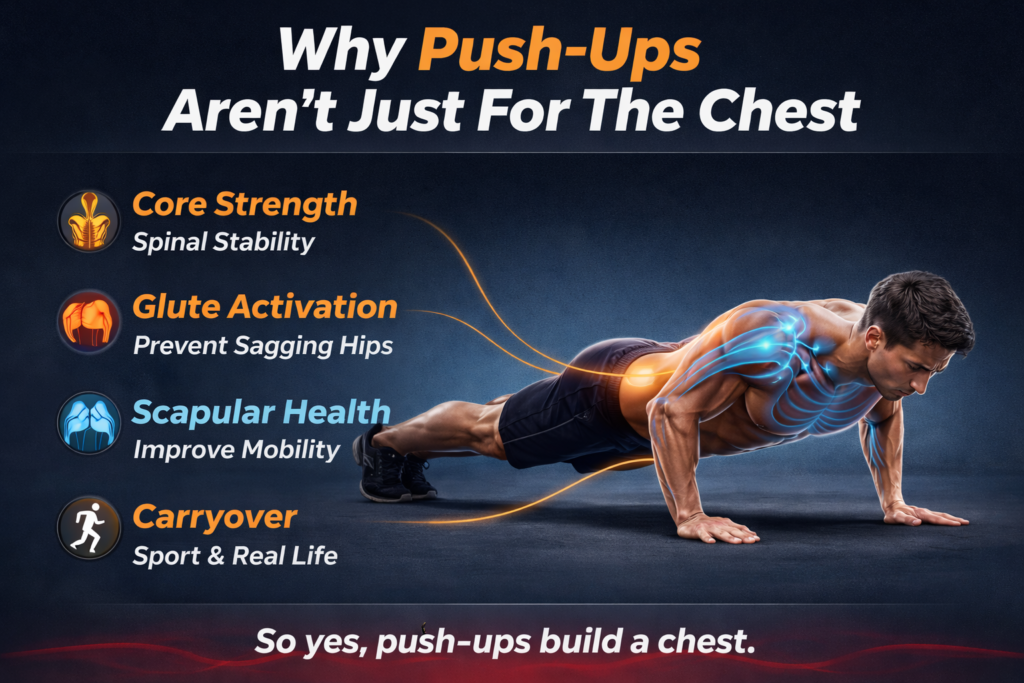
Most lifters think of push-ups as a chest exercise.
And yes, they’re incredible for pec development — especially the upper chest if you manipulate angles.
But the benefits go further:
- Core strength: Every rep demands spinal stability. You’re basically doing a plank under dynamic load.
- Glute activation: Keeping your hips from sagging forces your glutes to fire.
- Scapular health: Unlike the bench, your shoulder blades aren’t pinned down. They can move freely, which improves scapular mobility and long-term joint health.
- Carryover to sport and daily life: Closed-chain movements often have more “real life” transfer — you’re moving your body, not just a bar.
So yes, push-ups build a chest. But they also build a body that works better.
Push-Ups vs Bench: Why you need both
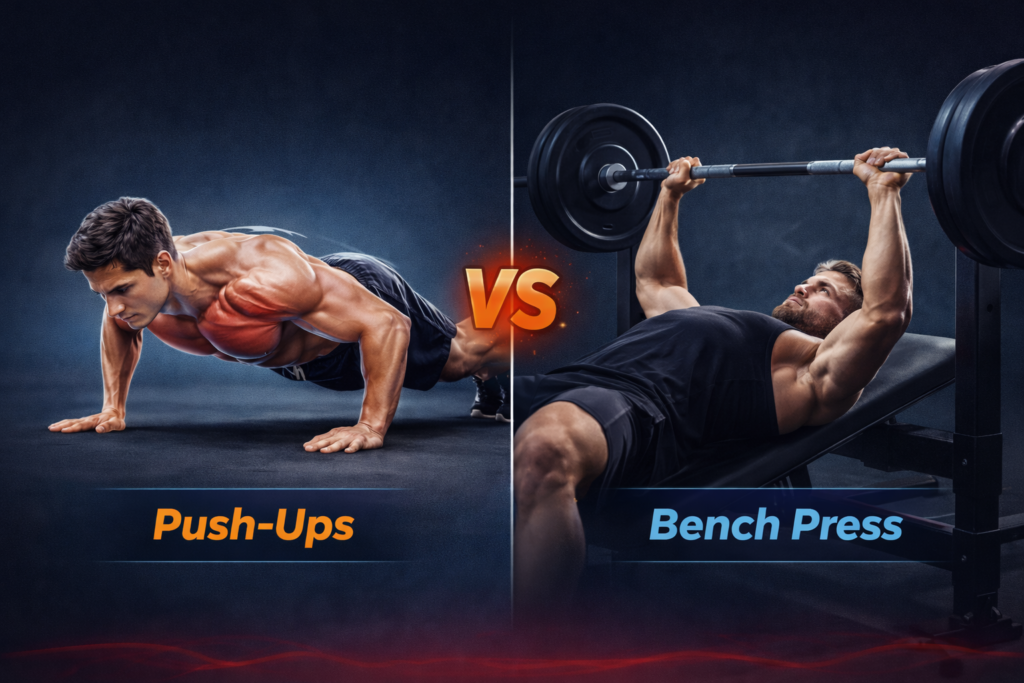
Let’s clear this up: this isn’t a push-up vs bench war.
The bench press is phenomenal for raw strength, muscle density, and gym prestige.
But it’s demanding, recovery-heavy, and often dominated by shoulders and triceps.
Push-ups, on the other hand, give you:
- Frequency — you can do them multiple times a week.
- Volume — way more total reps with less recovery cost.
- Synergy — chest, shoulders, triceps, core, glutes, and stabilizers all work together.
One doesn’t cancel the other.
They’re complementary.
The bench builds the foundation Push-ups add the finishing touches.
And if you’re curious about the bigger debate — whether push-ups can actually replace the bench entirely — I’ve already covered that in detail here.
A push-up gameplan you can actually follow
Here’s the part nobody explains:
It’s not about doing “more push-ups,” it’s about putting them in the right place so they make everything else stronger instead of turning into random volume.
So here’s a clean, realistic weekly layout that slots push-ups exactly where they deliver the most payoff.
Day 1 — Strength focus
This is your heavy pressing day.
You lift first, then use push-ups as the “quality finisher.”
Not fast, not burnout-style — just controlled work that reinforces good mechanics without frying your nervous system.
Something like 2–3 sets of slow, deliberate reps works wonders here.
Day 2 — Skill day
Not intensity.
Not volume.
Just practice.
Pick one variation you’re trying to improve — maybe a harder angle, maybe a cleaner bottom position — and spend 6–10 minutes refining it.
Think of it as treating the push-up like a movement, not a muscle drill.
This is where form transforms.
Day 3 — Hypertrophy session
This is the day where push-ups act like a true chest builder.
You don’t need anything fancy here: choose a version that makes the low position challenging and stay in that sweet muscular tension zone.
Higher reps, slower tempo, or a small added load work perfectly.
This is your “feel the stretch, chase the pump” day.
Day 4 — Optional conditioning touch
Not mandatory, but incredibly useful.
A short push-up element inside a conditioning circuit — nothing wild — helps you build repeatability without turning every rep into sloppy cardio.
It also teaches you how to keep your form tight even when you’re slightly fatigued, which carries over into everything else you do.
A quick example?
- 20 seconds of light bodyweight squats,
- 20 seconds of controlled push-ups,
- 20 seconds of rest.
Just one or two rounds are enough to train clean technique under a bit of pressure.
How you know this plan is working
You’ll feel these signs long before the mirror shows them:
- The bottom position feels stronger instead of sketchy
- You don’t lose tension halfway through a set
- Your reps look identical instead of falling apart after 10
- You recover faster between sets and between sessions
- Your shoulders feel better, not worse
When these happen, you’re not “doing push-ups.”
You’re training them.
The final takeaway
Push-ups aren’t just a warm-up.
They’re not punishment drills from high school gym class.
They’re one of the most scalable, joint-friendly, and underappreciated exercises out there.
If you treat them as serious training, they can build real chest muscle.
They also strengthen your core.
And they can even make your bench press stronger.
So stop dismissing them because they look “simple.”