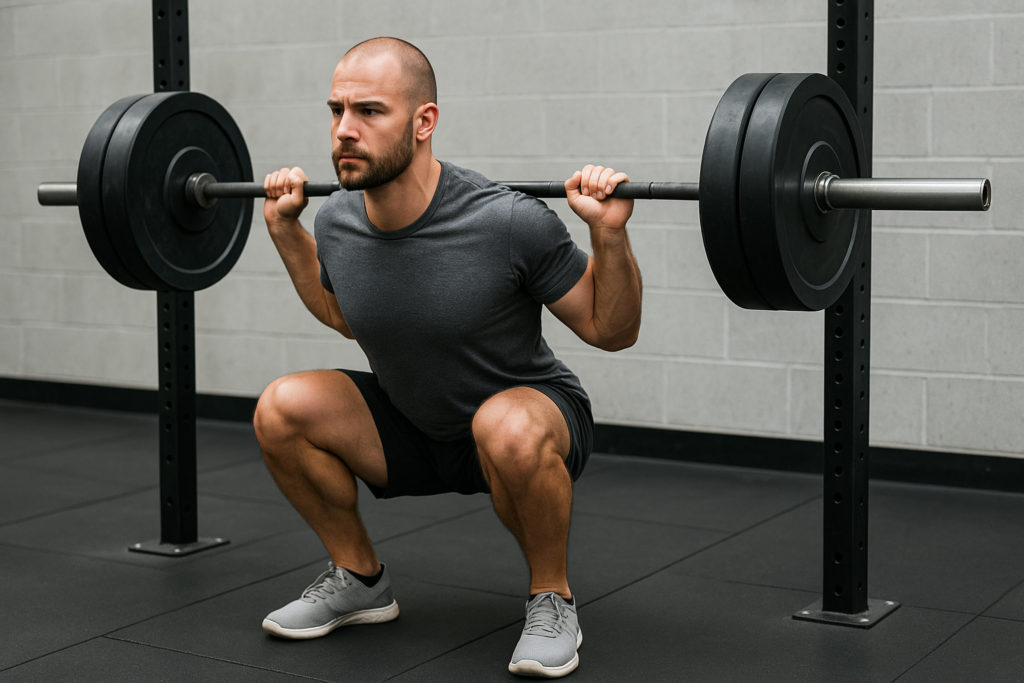
There’s nothing more annoying than telling someone your knees hurt during a deep squat and hearing the automated, lifeless response:
“Your knees are going too far forward.”
Like someone downloaded a free trial of “Squat Coaching 1.0” and never upgraded.
The assumption that all knee pain comes from bad form is way too simplistic, and honestly, it’s the kind of advice that works perfectly on Instagram but falls apart the second you deal with an actual human body that has history, mileage, and habits.
The truth is messy.
You can squat with perfect alignment, flawless knee tracking, and textbook posture, and still feel your knee screaming at the bottom.
Form matters, obviously.
But it’s not a magical force field that neutralizes biology, anatomy, or biomechanics.
Deep squats are mechanically demanding.
And if your joints, tendons, or tissues aren’t prepared for that stress, they will let you know — very loudly — even if your form is picture-perfect.
Deep Squats Expose What’s Already There
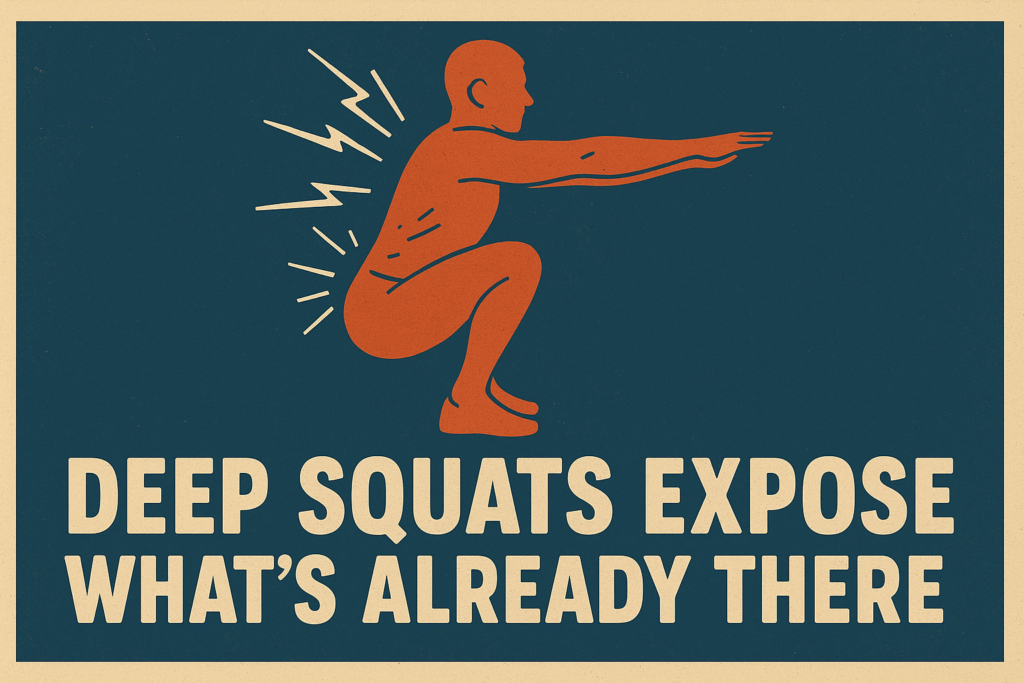
Deep squats don’t create dysfunction out of nowhere.
They just amplify whatever weakness or vulnerability you already have, especially the kind you don’t notice in everyday life.
Pain doesn’t show up because your squat is “dangerous”.
It shows up because deep knee flexion is an extremely loaded position for the knee joint, and if the tissues around that joint are compromised, the pressure becomes unbearable.
These are the most common culprits:
- Patellofemoral pain syndrome
- Patellar tendon irritation
- Meniscus damage or early degeneration
- Weak hip stabilizers
- Tight ankles and hips
- Previous injury that never truly recovered
None of these issues care about how straight your spine is or how evenly your feet are planted.
They show up because of biological vulnerability, not sloppy mechanics.
The Paradox: Deep Squats Are Good For Your Knees… If Your Knees Can Handle Them
This is where mainstream medical articles often fail.
They either demonize squats as “bad for knees” or glorify deep squats as “safe and beneficial for everyone”.
Both takes are lazy.
Deep squats can genuinely improve joint health:
They build quad strength.
Increase hip mobility.
Improve tendon capacity.
Promote bone density.
They’re a powerful stimulus — when you’re ready.
But there’s a huge difference between “good stimulus” and “overwhelming stress”.
Deep squats are great if:
- Your cartilage is healthy
- Your tendons tolerate compression
- Your hips move well
- Your ankles bend more than five degrees
- Your glutes and adductors are strong
If you don’t have those pieces, the squat doesn’t “fix you”.
It exposes you.
Why Deep Squats Hurt More Than Quarter Squats
A question almost every lifter eventually asks:
“Why do I feel pain only when I squat deep, not when I squat shallow?”
Short answer:
Because the highest patellofemoral stress happens between 60° and 110° of knee flexion, which is exactly the zone you enter when you squat deep.
At that angle range:
- The quadriceps pull aggressively
- The patella compresses harder into the femur
- The patellar tendon stretches under load
- Tibial rotation increases
- Joint contact surfaces change configuration
If you have pristine cartilage, strong quads, and stable hips, you can absorb that stress.
If you don’t, the system fails.
And no amount of “knees out” cues will change that.
What If Your Structure Just Isn’t Built For Deep Squatting
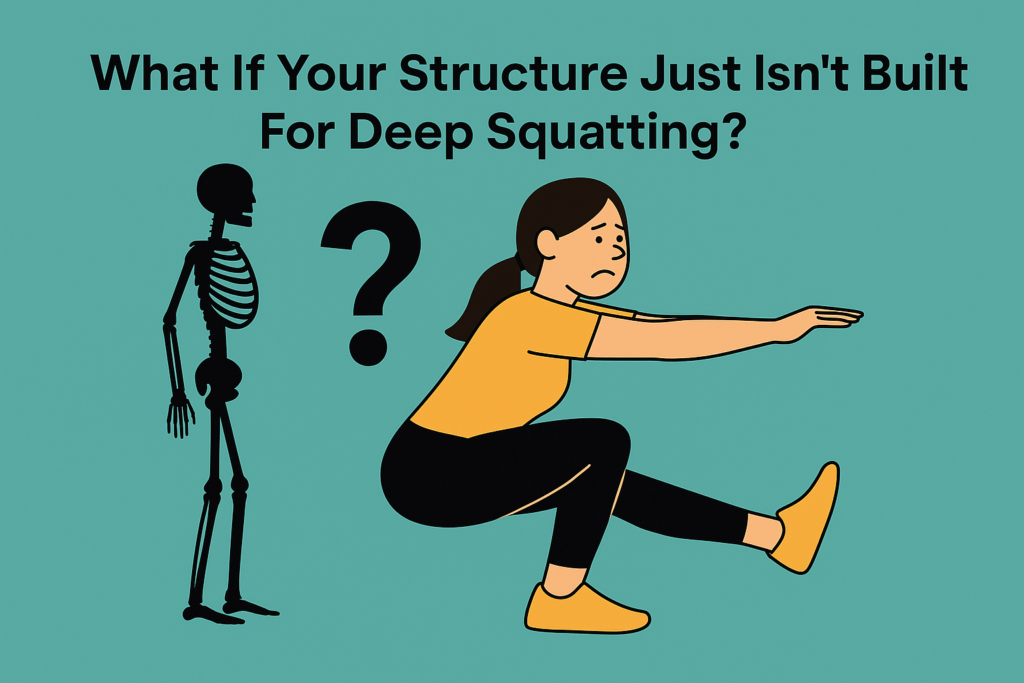
This question rarely gets addressed because it doesn’t fit into a motivational Reel.
But it matters.
Some people have anatomical features that make deep squatting biomechanically harder or less safe, such as:
- Longer femurs
- Shallow acetabulum
- Tight posterior capsule
- Limited tibial rotation
- Reduced ankle dorsiflexion
For these people, the deep squat isn’t “injurious”, but it’s costly.
You need more work, more mobility, more strength, and more patience to make the position sustainable.
Some bodies thrive in deep flexion.
Some fight it every inch of the way.
That’s reality, not weakness.
Why It Might Hurt Only One Knee Instead of Both
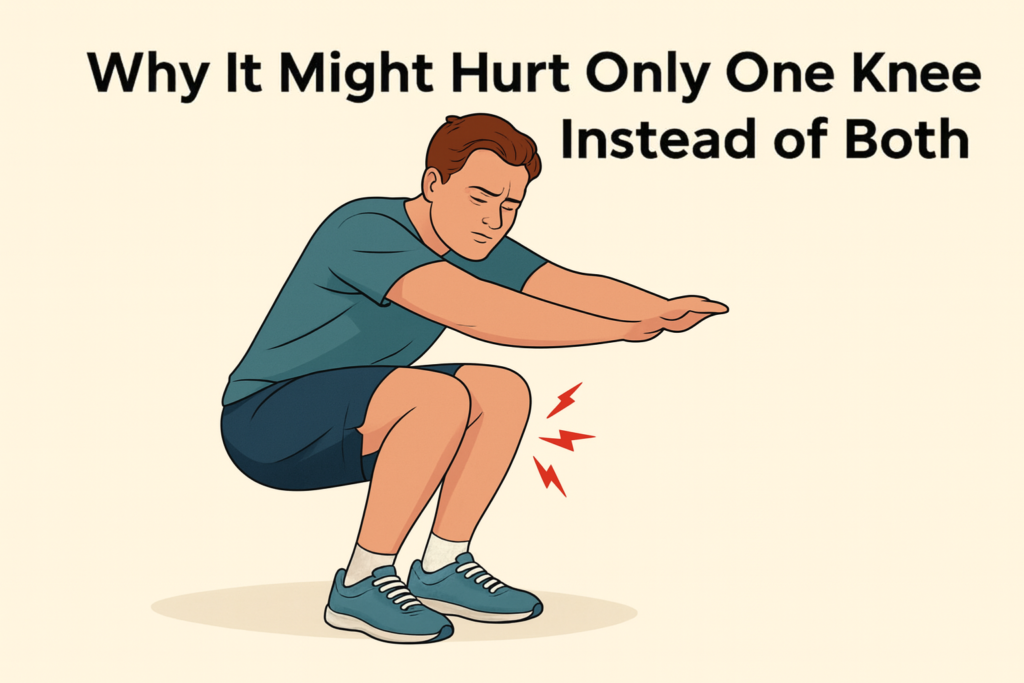
People always get freaked out by asymmetrical pain.
“If it was my technique, wouldn’t both knees hurt?”
Not necessarily.
Unilateral pain is classic for:
- Old injuries
- Mobility asymmetry
- Leg dominance
- Structural variation
- Uneven strength distribution
Your squat stance might look symmetrical.
But your legs are not the same, and your nervous system doesn’t load them equally.
One knee might be doing more work, taking more impact, and absorbing more compression.
That knee screams.
The other one chills.
Is It Normal For Knees to Hurt During Deep Squats?
This is where language matters.
There’s a massive difference between:
- Muscular discomfort
- Ligament stretch sensation
- Deep, sharp, joint pain
Burning in your quads?
Normal.
Tension around the tendons?
Normal.
Sudden stab around the kneecap?
Absolutely not.
The knee joint doesn’t give you “healthy burn” feedback.
When it hurts, it means overload or pathology.
Let’s Talk Tendons: Why They Hate Deep Flexion
Tendons don’t like rapid changes in load or position.
And deep squats create three specific stressors:
- High compression under the patella
- Extreme tension at deep flexion
- Sustained contraction under load
If your tendon has low tolerance because of:
- Poor recovery
- Rapid progression
- Weak collagen capacity
- High volume
- Sleep deprivation
It will inflame.
Tendon pain is slow, dull, and relentless.
It’s not “oh my God ouch”.
It’s “oh no, this again”.
Why Form Can Be Perfect and Pain Still Shows Up
Technique reduces inefficient forces.
It doesn’t “fix” biological vulnerability.
A perfect squat doesn’t override:
- Inflammation
- Tendon degeneration
- Cartilage thinning
- Weak glutes
- Tight hips
- Poor recovery
People assume “good form = pain-free”.
But high-level Olympic lifters with fantastic technique still tear tendons, blow menisci, and deal with chronic knee pain.
Not because they squat wrong.
Because biology is a limiting factor.
So Should You Avoid Deep Squats Altogether?
Not automatically.
Avoiding deep squats because they feel uncomfortable is like avoiding cardio because you get winded.
Sometimes the solution isn’t elimination.
It’s adaptation.
Progression matters more than perfection.
A realistic approach:
- Reduce depth temporarily
- Reduce volume
- Slow tempo
- Switch squat variations
- Strengthen surrounding muscles
Pain in deep flexion doesn’t mean “never squat deep again”.
It means “your tissues aren’t ready right now”.
Practical Fixes That Actually Work
Here’s what actually helps, without magical thinking:
1. Strengthen your glutes and hips
Because they determine knee position under load.
Choose:
- Hip thrusts
- Lateral step-downs
- Bulgarian splits
- Side plank with abduction
2. Improve ankle mobility
If your tibia doesn’t move forward, your knee pays the bill.
3. Use less weight
Pain doesn’t care about your ego PR.
4. Try different squat variations
Some are much more knee friendly:
- Split squat
- Goblet squat
- Front squat
- Box squat
5. Manage overall load
Tendons hate rapid change more than heavy weight.
When Knee Pain Should Truly Worry You
Red flags worth paying attention to:
- Sharp pain
- Swelling
- Clicking with locking
- Giving way
- Pain that lasts > 48 hours
Those aren’t “normal gym aches”.
Those are medical symptoms.
The Truth That Medical Sites Rarely Admit
Deep squats don’t randomly “destroy knees”.
They expose:
- Weak quads
- Weak glutes
- Poor hip stability
- Poor mobility
- Structural limitations
- Early degeneration
Pain is not a moral judgment.
It’s a diagnostic clue.
RELATED:》》》 Why-Knees-Shake-During-Shrimp-Squats
Conclusion
If your knees complain during deep squats, it doesn’t mean you’re falling apart.
It doesn’t mean you failed at lifting, and it doesn’t automatically mean your technique is a disaster.
What it usually signals is something simpler:
“I can’t handle this depth or load comfortably today.”
Not a verdict.
A status update.
Your body isn’t trying to embarrass you.
It’s giving you feedback on what it can currently handle.
Deep squats don’t expose weakness.
They reveal capacity.
If you build capacity — slowly, intelligently, consistently — deep squats can be one of the most knee-healthy movements you ever perform.
If you push through pain, ignore symptoms, and chase arbitrary numbers because TikTok told you to, you’ll find out very quickly that biology always wins.
Your knees don’t care about the hype.
They care about load, structure, recovery, and tolerance.
Respect those, and deep squats stop hurting.
Ignore them, and it doesn’t matter how “perfect” your technique is — the pain will keep coming back.
Questions Nobody Really Answers
“Can deep squats damage cartilage?”
If your cartilage is healthy:
Deep squats can strengthen the joint.
If your cartilage is already compromised:
Deep compression accelerates wear.
Both facts can be true.
“Will knee sleeves fix it?”
Not really.
They warm the joint.
They don’t “heal” anything.
“Is squatting bad long-term?”
Not inherently.
What’s bad long-term is:
- Load mismanagement
- Ignoring symptoms
- Zero rehab
- Zero mobility