Walk into any gym and you’ll eventually spot it
Someone grinding through one-arm presses or wobbling their way through single-leg squats.
At first glance it looks… odd.
Almost like they’re making things harder than they need to be.
But here’s the kicker—training one side at a time isn’t just some quirky sideshow.
It’s one of those sneaky methods that can highlight weak links you didn’t even know were holding you back.
And if you’ve ever wondered why your lifts feel uneven or your progress stalls, this might be the reason.
Let’s dig into why it actually matters.
The truth about muscle imbalances

Every lifter has a “good side.”
Maybe your right arm handles curls like it’s on autopilot, while your left shakes like it’s pouring coffee after three espressos.
Or maybe your squat feels stable on one leg and wobbly on the other.
These aren’t just quirks.
They’re imbalances that build up from daily life—driving, carrying groceries, sitting with your legs crossed the same way for years.
Unilateral training is like shining a flashlight into those blind spots.
It shows you which side is lagging and forces it to pull its own weight.
When you do bilateral work (both sides at once), the stronger side often cheats and takes the load.
You don’t notice because the rep still goes up.
But long-term?
That’s where plateaus and injuries sneak in.
Your stabilizers are doing more than you think
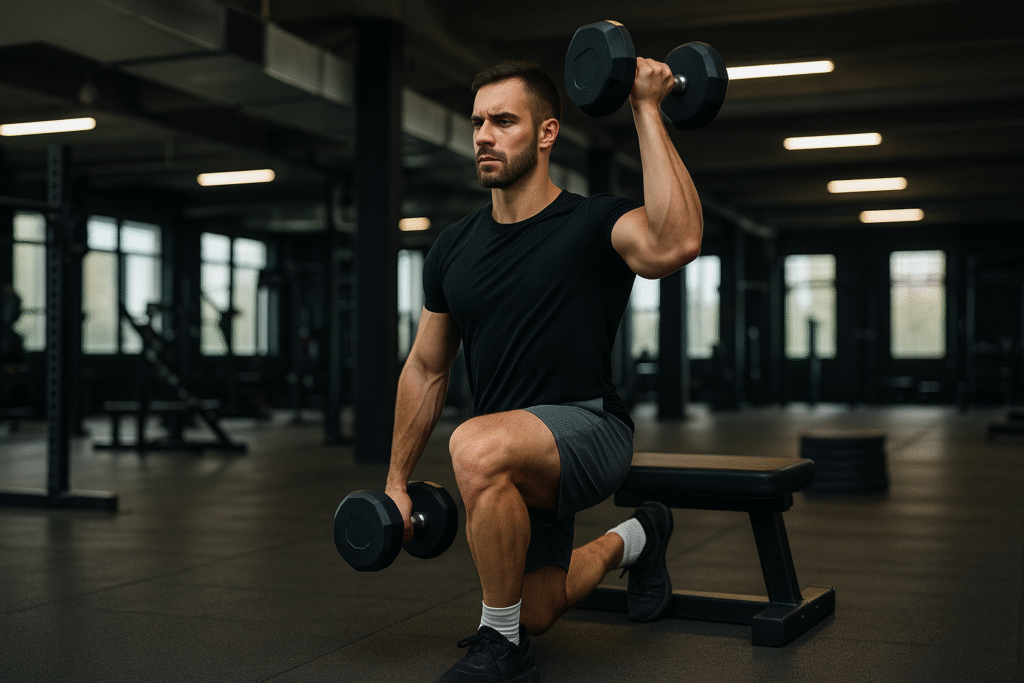
Here’s something I didn’t appreciate until I tried single-arm dumbbell presses.
My core was working overtime just to keep me from twisting like a pretzel.
That’s the hidden tax of unilateral training—you’re not just training the limb, you’re training the stabilizers.
Your obliques, deep spinal muscles, and even your hips are firing to keep you balanced.
Translation: you get an ab workout for free.
And let’s be real, who’s gonna say no to that?
Athletic carryover you don’t see coming
Most sports aren’t symmetrical.
You sprint off one leg.
You throw with one arm.
You pivot off one side of your body.
So when you train unilaterally, you’re actually practicing the way your body moves in the real world.
That’s why athletes live on split squats, lunges, and single-arm pulls.
It’s not about looking fancy—it’s about being explosive, stable, and less injury-prone when the game gets messy.
But doesn’t it waste time?
Here’s the downside: unilateral training does take longer.
Instead of banging out 10 reps, you’re now doing 10 per side.
That’s double the time.
If you’re someone who only has 30 minutes to train, going full-on single-side mode might not be the most efficient choice.
But you don’t need to replace everything.
Sprinkle it in.
Do a set of Bulgarian split squats instead of regular squats.
Throw in one-arm rows instead of both-hands-at-once cable pulls.
Even a little bit can balance things out without eating your whole workout window.
The strength transfer myth
One of the weirdest things I learned?
There’s something called “cross-education.”
Basically, if you train one side, the other side gets stronger too—without even lifting.
It sounds like gym folklore, but research backs it up.
Neurological pathways adapt, so the brain “shares” some of that strength across both sides.
It’s not as much as training both, obviously, but it’s a legit bonus if you’re injured or rehabbing one side.
How I use it without going insane
Personally, I treat unilateral work like hot sauce.
Sprinkle it on for flavor, but don’t drown the whole plate.
I’ll program single-leg hip thrusts, one-arm presses, or split squats after my big lifts.
They’re like accessory moves that clean up the sloppy edges my barbell work can’t fix.
And honestly?
Once I started mixing them in, my compound lifts actually got smoother.
My squat stopped shifting to one hip.
My bench felt less lopsided.
The carryover was real.
Practical unilateral moves to actually try
Alright, let’s get real.
Talking theory is fun, but what’s the point if you walk into the gym tomorrow and don’t know where to start?
Here are some unilateral moves that are worth adding without turning your session into a two-hour marathon:
- Bulgarian split squats
The king of single-leg torture. Prop your back foot on a bench, hold a pair of dumbbells, and kiss your quads and glutes goodbye. - Single-arm dumbbell bench press
Looks simple, but the core stability here is brutal. Keep your non-working arm straight out for balance or tuck it on your chest. - One-arm cable row
Perfect for fixing that “one shoulder sits higher than the other” look. Focus on pulling your elbow back, not just moving your hand. - Step-ups
Grab some dumbbells, pick a box that’s high enough to make you sweat but not trip, and drive through your heel. Bonus: your grip gets roasted too. - Single-leg Romanian deadlift
This one feels like yoga met weightlifting. Balance on one leg, hinge at the hip, and let your hamstrings light up. Start with bodyweight, trust me.
You don’t have to hit all of them in one workout.
Pick one or two, slide them in after your big compound lifts, and let them do their quiet magic.
The trick is not overthinking it.
Keep it simple, stay consistent, and you’ll notice the difference not just in the mirror but in how solid your lifts feel overall.
Why your joints will love unilateral work
Here’s something most lifters miss.
Unilateral training isn’t just about fixing imbalances or making your core shake like a leaf.
It’s about keeping your joints happy long-term.
When you move one side at a time, your body gets the freedom to adjust.
Your hips can rotate naturally, your knees can track where they actually want to go, and your shoulders stop fighting each other for dominance.
You’re no longer forcing both sides to follow the same rigid path — you’re letting each joint find its groove.
And that’s where the magic happens.
Your knees don’t grind, your hips don’t pop, and your lower back stops feeling like it’s paying rent for your bad habits.
Even up top, your shoulders start moving smoother because each one finally gets to do its own thing instead of being locked into a barbell’s straight line.
The best part?
You’re still building muscle, still lifting heavy, but now your joints aren’t screaming for mercy every time you rack the weights.
Unilateral work gives your body the green light to move the way it was built to move.
How to structure unilateral training for results
The way you slot in unilateral moves matters more than the moves themselves.
Put them after your big compounds.
You don’t want to fry your stabilizers before heavy deadlifts or bench.
Keep reps moderate (8–12). Going super heavy kills form and balance.
Train them 2–3 times a week. Doesn’t need to be daily—consistency beats volume here.
Pair them with core moves. One-arm presses + planks, or split squats + hanging leg raises. That combo hits stability from all angles.
How your body “unlocks” more strength when you go solo
Here’s a nerdy but cool bit: the bilateral deficit.
When you lift with both limbs at once, your brain sometimes limits total output.
It’s like the nervous system has too many tabs open and slows the whole computer down.
Train one side at a time and suddenly the “signal” is cleaner, sharper, and more intense.
That extra neurological drive carries back over when you return to heavy bilateral lifts.
It’s like practicing sprints with a weighted vest—strip it off, and suddenly you feel faster, more explosive, and oddly smoother.
How do you know if your unilateral work is actually fixing anything?
Don’t guess—test it.
- Balance check: Stand on one leg, eyes closed. If one side collapses faster, that’s your weak link.
- Overhead stability test: Hold a dumbbell overhead with one arm. Watch for torso lean or shaking. Compare sides.
- Rep match: Hit your stronger side’s max on a split squat, then try to match it on the weaker side. Any gap shows you where the imbalance lives.
- Video review: Record yourself from the front. If your hips shift or torso tilts, it’s not just in your head—you’ve got data to fix.
These mini-checkpoints make progress real instead of just “feeling balanced.”
RELATED:》》》Are adjustable dumbbells good for progressive overload if I train at home?
So, is training one side at a time really worth it after all?
If you’re chasing balance, injury prevention, and that extra bit of core work, training one side at a time is gold.
If you’re in a rush and just want to smash heavy weights, you can survive without it—but you might pay for it later.
Think of unilateral training as maintenance for your body.
Not flashy, not always Instagram-worthy, but it keeps the whole machine running longer and stronger.
So no, it’s not a waste of time.
It’s an investment.