The whole thing started with one stubborn question:
“If I only did step-ups… would that count as leg day?”
From there, everything spiraled.
Suddenly the stairs at home looked suspiciously like a workout plan.
Maybe it was the caffeine.
Maybe it was the knee pinch that shows up before my brain wakes up.
But it got me thinking… maybe those steps wanted to be my leg day.
The Real Question Behind Every Step-Up Workout
I don’t know if this happens to you, but sometimes I look at traditional leg days and wonder if we really need to go full coal miner every single time.
Romanian deadlifts.
Bulgarian split squats (which I’m convinced were invented by someone who wanted to punish humanity).
Then I look at the stairs in my house.
Silent.
Neutral.
Already there.
Always there.
It almost feels zen:
“What if… I just used these?”
So I started experimenting with step-ups as a legit alternative to a full leg day.
And I swear — something happened that I did not see coming.
Step-Up for Glutes: Way More Serious Than They Look
Step-ups look sweet and innocent.
They look like warm-up material.
They look like something you could do while thinking about lunch.
Then you do them for 3 minutes straight.
And suddenly your glutes are on fire like the first time you tried one of those “30-day booty challenges” you saved on TikTok at 2 AM.
When you drive your foot into the step, your glutes don’t just sit there.
They switch on.
They push.
They stabilize.
They actually do things.
And the best part?
Everything happens one leg at a time.
Unilateral work = zero shortcuts.
If one glute is lazy, you’ll know.
If one leg is stronger, you’ll know.
If you wobble like a confused flamingo, oh you’ll know.
This exercise puts a mirror in front of you — sometimes literally.
Step-Up and Knee Stability
Let me keep it real.
There is no magic exercise that “fixes your knees” overnight.
But.
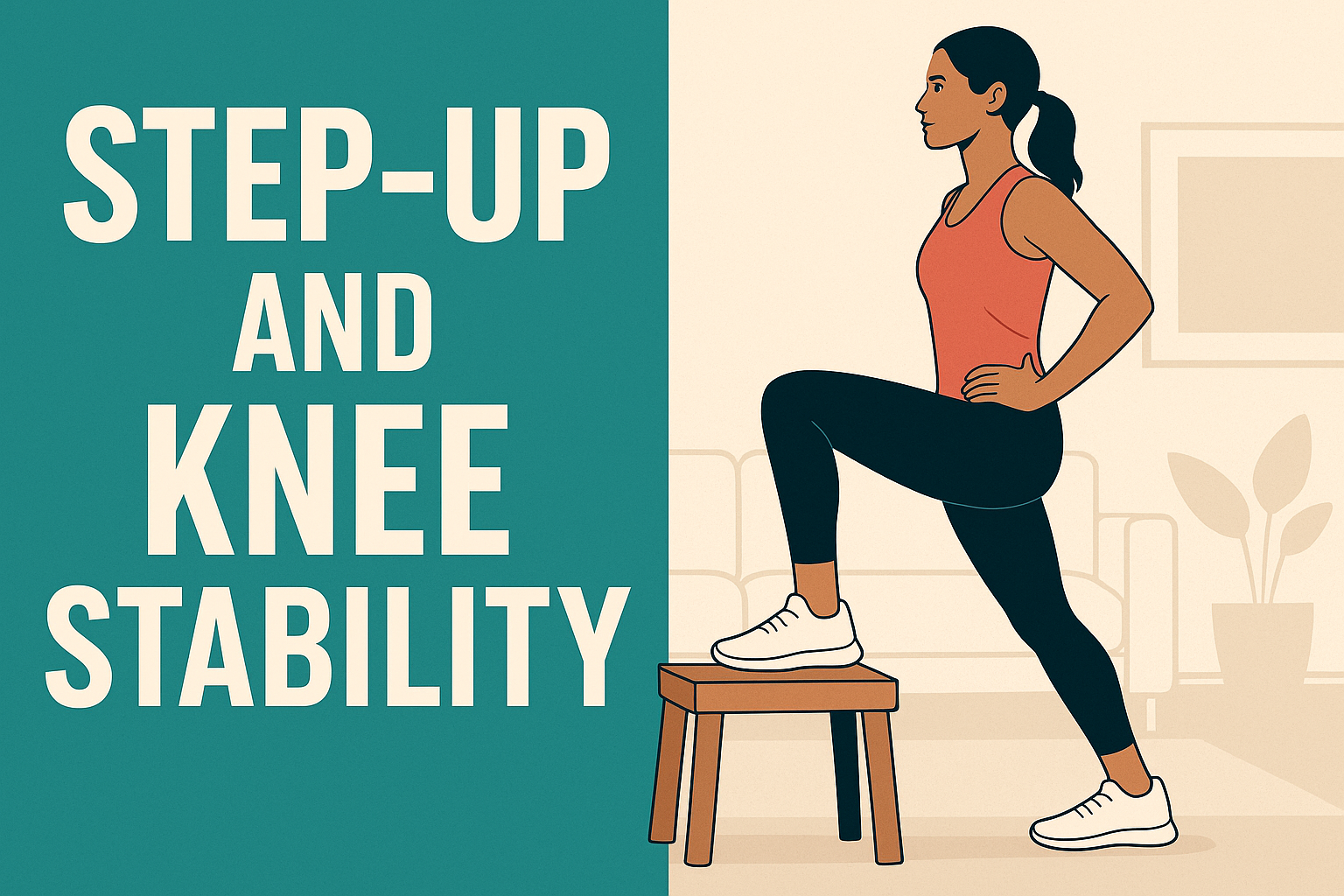
A clean, controlled step-up is like having a tiny coach correcting you every time you try to cheat.
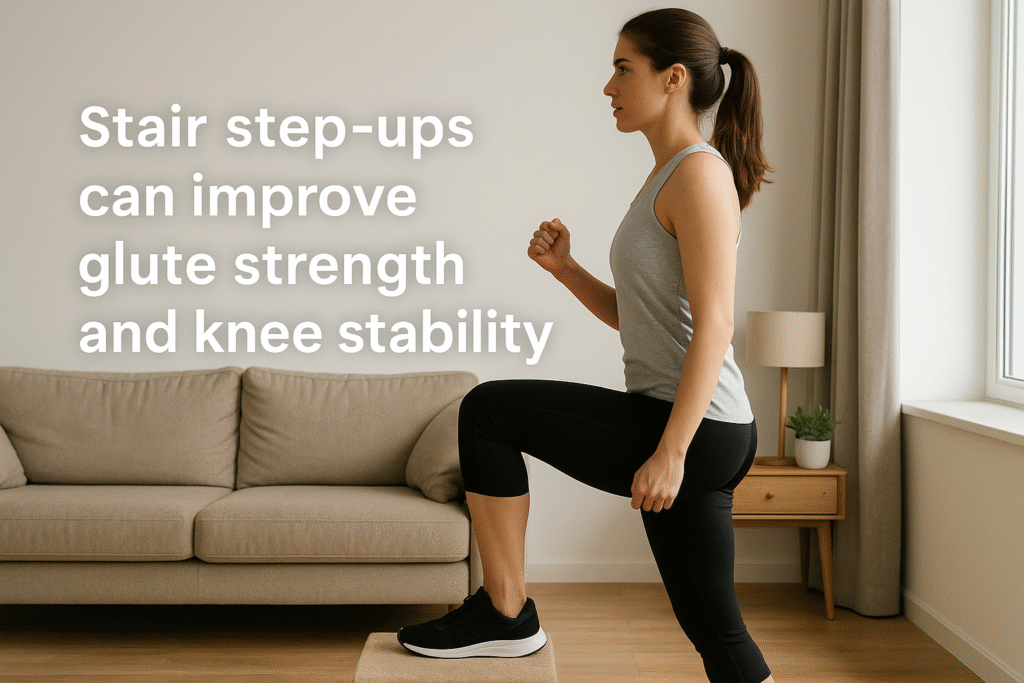
Because to do it right, you have to:
Keep your knee aligned with your toes.
Stop that inward collapse that screams “I’m about to hurt myself.”
Control the descent instead of dropping down.
Use your hip, not just your quad, to lift your body.
Engage your core even if you don’t notice it.
It’s an exercise that rewards patience and awareness.
And when the movement is that controlled, the knee feels safe.
It knows where it’s going.
It’s not surviving chaos.
Give it some time and the stability becomes very real.
Can Stair Step-Ups Replace Leg Day? Let’s Be Honest
Here’s the honest part of the conversation.
Step-ups are great.
You can do them anywhere.
They’re practical.
They’re effective.
They’re way tougher than they look.
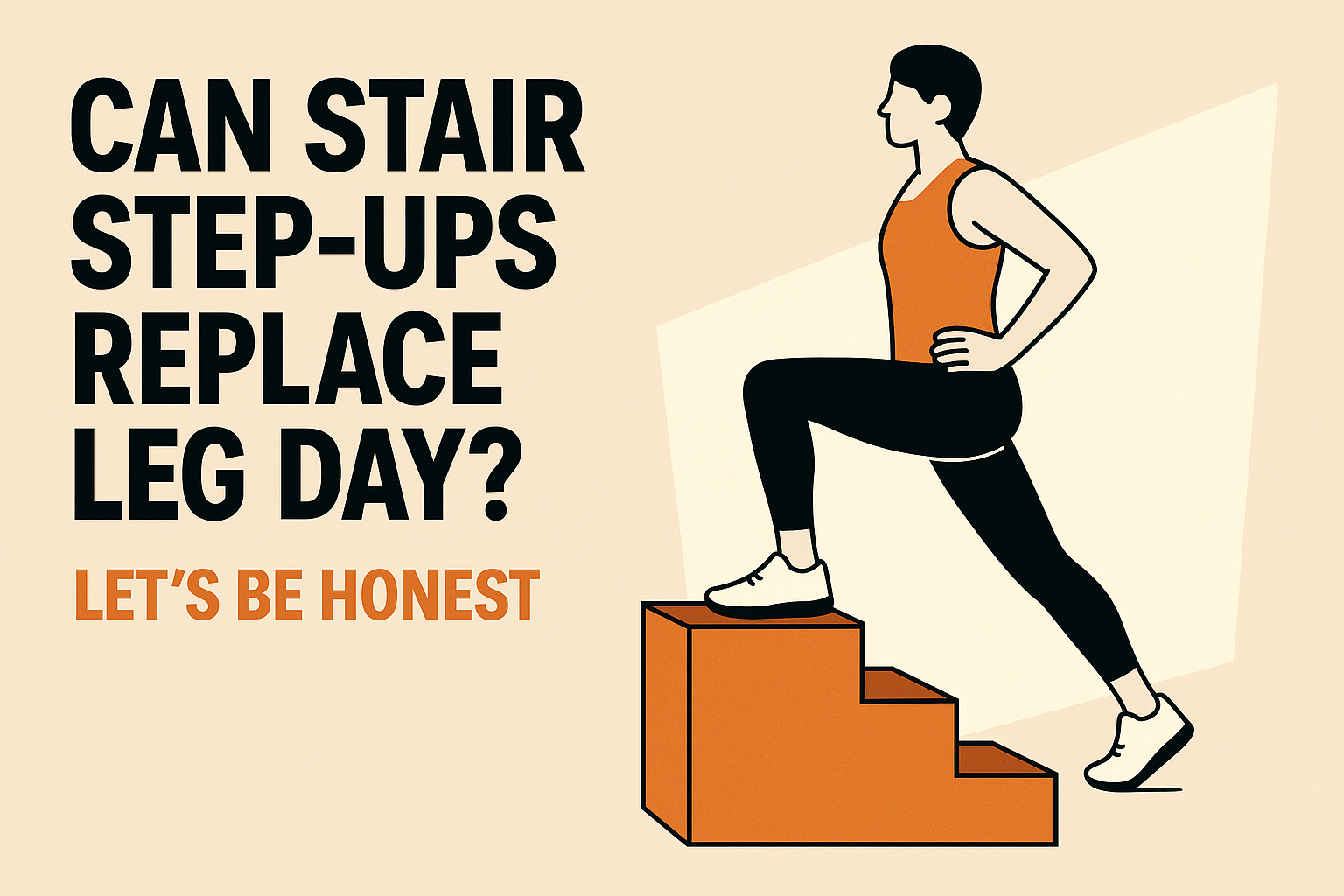
But can they replace a traditional leg day?
It depends.
And that’s not a diplomatic answer — it’s the truth.
When Step-Ups Can Replace Leg Day
When your goal is functional strength.
When you want active glutes without chasing personal records.
When you need unilateral work to fix imbalances.
When you want to be kind to your knees instead of throwing weight on them for no reason.
When home workouts are your realistic option.
When you’re in a recovery phase or just dialing intensity down.
When They’re Not Enough
If you want serious leg mass.
If you’re training explosive power.
If you want maximal strength.
If you need progressive overload that step-ups simply can’t provide.
If your leg days already include heavy squats, deep lunges, serious hip thrusts — step-ups will never replace the whole thing.
But they can become one of the smartest pieces of your week.
What Makes Step-Ups Special for Glutes and Knees
There are two things I absolutely love about step-ups.
The depth of the movement.
And the control it forces on you.
When the step height is challenging (not ridiculous, just useful), the working leg has to do something that feels like a mix between a lunge and a single-leg squat.
The difference?
The path of motion.
During step-ups the knee stays on a cleaner track.
Less wandering.
Less twisting.
More “straight line.”
That gives your glute the perfect opportunity to do its job.
Here’s a silly but accurate mental image:
A step-up feels like a “vertical single-leg hip thrust.”
Is it scientific?
No.
Does it help you understand what’s happening?
Absolutely.
Programming Step-Ups Without Treating Them Like a Warm-Up
The biggest mistake people make is treating step-ups like the side dish instead of the main plate.
But when you program them correctly, they become a full meal.
Here’s how to use them:
Slow, controlled step-ups for stability.
Higher step-ups for glute activation.
Step-ups with light dumbbells for intensity.
More explosive step-ups if you want athletic carryover.
Step-ups with a pause at the top for balance and core recruitment.
Do all this and step-ups suddenly feel like a complete exercise — not a backup plan.
A Small Change That Makes Daily Movement Feel Effortless
This part doesn’t get enough love, but it’s the one you feel the most in daily life.
After weeks of consistent step-ups I noticed:
I climbed stairs more smoothly.
I stopped tripping when stepping off curbs.
I got into my car with better control.
I accelerated quicker when I needed to sprint.
My knees didn’t crack every time I bent down.
Nobody says, “I’m training to get better at stepping into my car,” but…
We all want to move without thinking about it.
And step-ups give you exactly that.
Adding Variety
One of the best ways to keep step-ups growing with you is to vary the structure without changing the soul of the movement.
You can use:
Higher steps.
Lower steps with more explosive drive.
Light weights with slow reps.
Pauses at the top for glute and hip control.
Lateral step-up variations for diagonal stability.
Small torso rotations for core involvement.
Mini-range pulses at the top for extra burn.
These small tweaks turn step-ups into a ridiculously versatile tool — perfect for days when you want simple, smart training.
Common Step-Up Slip-Ups (and How to Fix Them Fast)
There’s one thing nobody warns you about when you start doing step-ups at home: it’s shockingly easy to mess them up without realizing it.
And the funny part?
Most of the mistakes feel “natural,” which is why people keep doing them forever.
The first big one is pushing way too much with the back foot.
It’s basically turning the exercise into an accidental hop instead of a single-leg lift.
If you feel like you’re launching yourself onto the step… yeah, that’s not the glute doing the job.
The second mistake is choosing a step that’s way too high.
I get the temptation.
High step = “harder,” right?
But if your knee is climbing higher than your ambitions, your form is probably falling apart.
Then there’s the classic forward collapse.
You know that moment when your chest leans so far ahead it looks like you’re trying to smell the step?
That’s just your hip and core checking out of the exercise.
Another sneaky error is letting the knee cave inward.
It feels tiny, but it changes everything — less glute work, more stress on the joint, and zero stability gains.
And finally, the speed trap.
Doing step-ups too fast turns the movement into pure momentum.
At that point you’re basically doing cardio disguised as strength training.
Fun? Yes.
Effective? Not really.
When you clean up these little things, step-ups hit completely differently.
You go from “kind of useful” to “wow, my glutes are actually clocked in for work today.”
Keep the movement clean, keep the pace controlled, and the exercise rewards you every single time.
Why Step-Ups Alone Won’t Make a Full Leg Program
There’s one thing people rarely mention when talking up step-ups: the structural limits of the movement.
It’s not your fault.
It’s not a weakness.
It’s just how the exercise works.
When you step onto a platform, the primary loading happens in a fairly shallow position compared to a deep squat or a long lunge.
You have less range to create heavy mechanical tension.
It doesn’t matter how hard you push.
It doesn’t matter how slow you move.
It doesn’t matter how high the step is.
A deep squat with a barbell is a different universe.
Then there’s leverage.
During step-ups the working leg stays more vertical, so there’s less force torque on the hip.
Which means less glute stress compared to hip thrusts, deep squats, long lunges, or stiff-legged pulls.
It’s not bad.
It’s just different.
And that’s why you can crank out thirty step-ups and feel fine — but three sets of barbell hip thrusts make you stare at the ceiling questioning your life choices.
It’s not lack of intensity.
It’s biomechanics.
But when you understand these limits, you can actually use them.
Step-ups become a precision movement, not a power movement.
How to Build a Full Step-Up Leg Day
This part was absolutely necessary.
Because readers want to know what to do, not just what to think.
Here’s the simplest, clearest way to build a real leg day out of step-ups.
1. Choose a height that actually challenges you
The step should force your working leg to lift you.
If the back foot helps too much… it’s too low.
If you’re jumping to get up… it’s too high.
There is a sweet spot.
2. Combine two types of step-ups
A full session uses at least two:
One slow and controlled for stability.
One more intense with a slightly higher step or light weights.
The contrast creates a complete stimulus.
3. Add one accessory that completes the workout
You don’t need a powerlifter routine.
You just need a smart complement:
Banded side steps.
Light hip hinge work.
Slow eccentric reverse lunges.
Just enough to close the loop.
4. Keep the session short but consistent
This is a home leg day, not a two-hour gym grind.
Twenty to thirty focused minutes are more than enough.
And the best part?
You don’t enter survival mode.
You train, feel your glutes working, improve your stability… and go on with your day.
The Real Difference You Feel: Step-Ups vs Gym Leg Day
This is the part nobody explains clearly.
The feeling.
Because you’ll notice a huge difference on day one.
Step-ups bring fatigue faster — but it’s neat fatigue.
Organized.
Focused.
Contained.
Gym leg days are long, metabolic, heavy, and aggressive from a loading standpoint.
Stability is different too.
During step-ups you feel like you’re “fixing” your body as you move.
During heavy leg days you feel like you’re “pushing” your body toward a limit.
The mind-muscle connection shifts as well.
In step-ups you feel the hip working cleanly.
In heavy squats your whole body joins the conversation.
So here’s a real question:
Do you need your whole body involved every time?
Not really.
And that’s where step-ups shine.
When you want a clean, precise, low-chaos movement that builds you without draining you.
It won’t turn you into a bodybuilder.
But it will turn you into a human who moves well.
And honestly, that’s worth more than most PRs.
RELATED:》》》Why Do Stairs Feel Impossible After Leg Day?
Conclusion
The answer is less dramatic than you want.
They can replace it occasionally.
They can replace it in certain seasons of your training.
They can replace it if maximal mass is not your goal.
They can replace it if you want control, balance, stability, and functional strength.
They cannot fully replace a gym-style leg day if you’re chasing heavy strength or advanced hypertrophy.
That said…
If an exercise makes you more stable, more symmetrical, stronger in everyday movement, with zero equipment and minimal space…
I’d give it a permanent spot in your weekly routine.
And on days when a full leg day feels like too much?
Step-ups are that Plan B that quietly behaves like a Plan A.