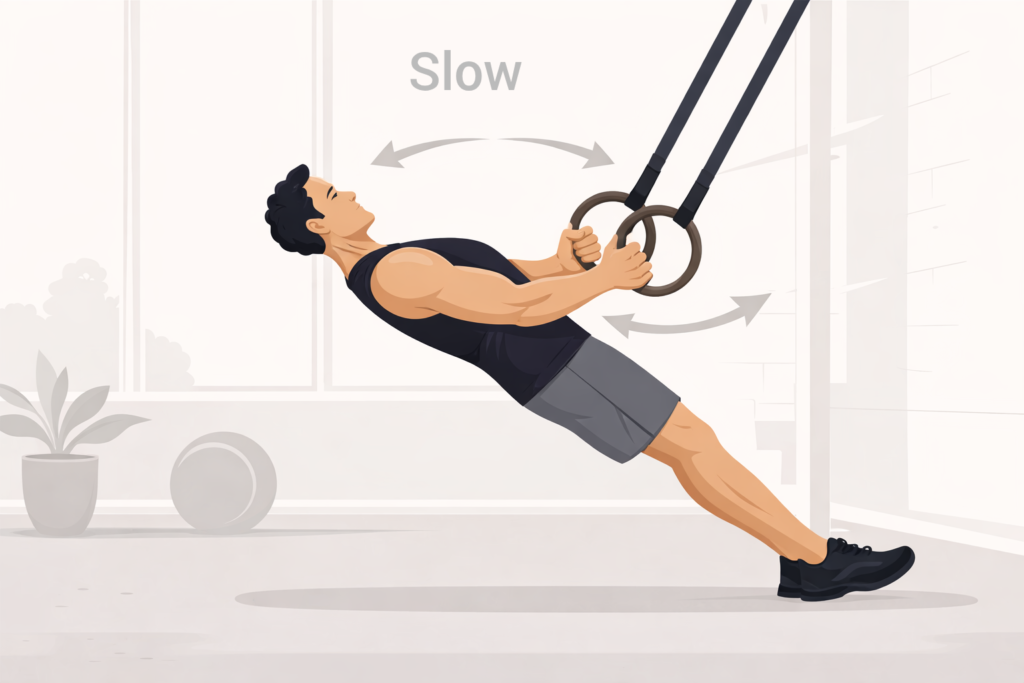
A ring row usually feels simple.
Lean back, pull your chest toward the rings, extend the arms again, repeat.
The rhythm is smooth and predictable.
Now slow that movement down.
Suddenly every part of the body stays active longer.
Your back keeps pulling.
Your core tightens to prevent the hips from dropping.
Your hands keep adjusting because the rings never stay perfectly still.
The movement hasn’t changed.
But the effort feels very different.
And there are a few clear mechanical reasons why that happens.
The Pulling Pattern Behind Ring Rows
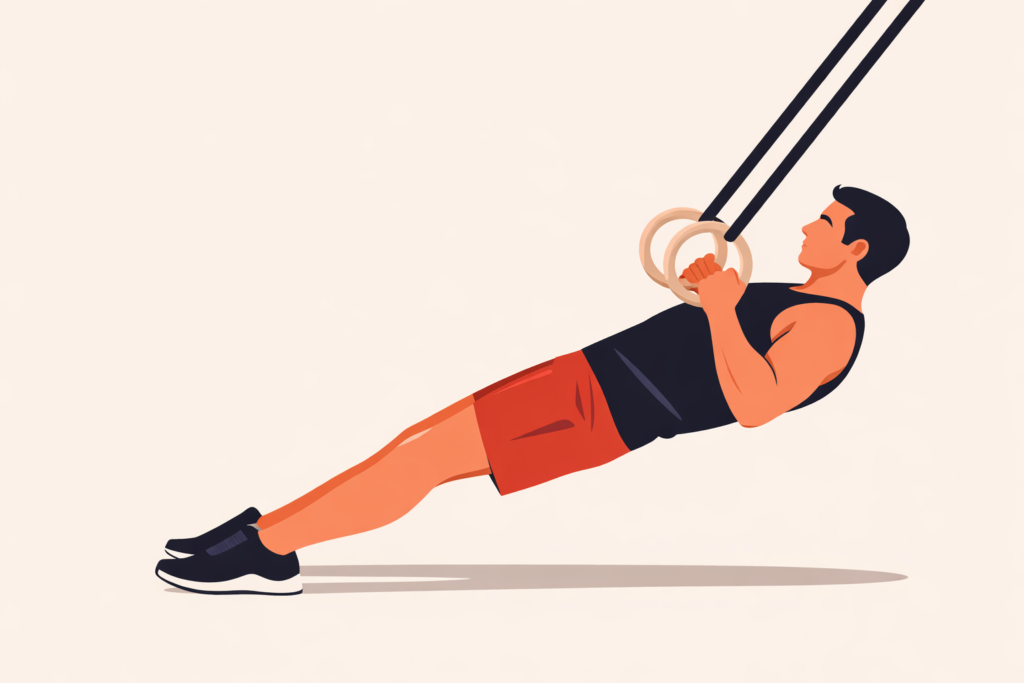
A ring row is basically a horizontal pulling exercise.
Instead of pulling your body upward like in a pull-up, you pull your chest toward a pair of gymnastic rings while your feet stay on the ground.
Picture this position:
- Rings hanging from straps or a bar
- Feet on the floor
- Body leaning back like a straight plank
- Arms extended holding the rings
From there you pull your chest toward the handles.
Then you slowly extend your arms again and return to the leaning position.
A basic beginner example looks like this:
- Rings about chest height
- Feet roughly 80–100 cm away from the rings
- Body leaning back at about a 35–45° angle
- 8 repetitions per set
- 60–90 seconds rest between sets
Each rep normally takes around 1–2 seconds up and 1–2 seconds down.
So one repetition lasts about 3 seconds total.
A slow ring row changes only one thing.
Time.
Instead of three seconds per rep, the movement suddenly lasts six or even eight seconds.
And that small change completely alters how the exercise feels.
The Rings Start Moving Everywhere
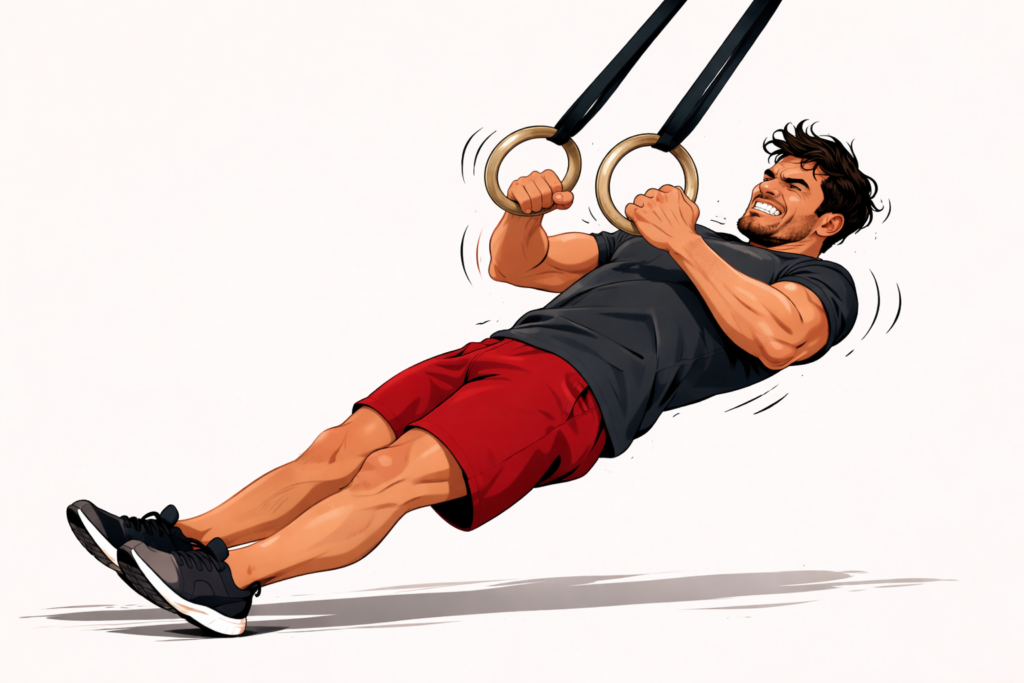
The moment I slow the motion down, the rings stop behaving politely.
They start drifting.
One ring rotates slightly outward.
The other moves a few centimeters higher.
My wrists begin adjusting automatically.
That small instability forces the muscles around the shoulders to stay active the entire time.
During a faster row, those corrections happen quickly and you barely notice them.
During a slow row, your body has to hold those micro-adjustments for several seconds.
Imagine holding two shopping bags that keep sliding slightly outward.
You can control them, but your forearms stay tense the whole time.
That is basically what happens with slow ring rows.
The handles never sit completely still, so the stabilizing muscles never get a break.
What Happens When I Time the Reps
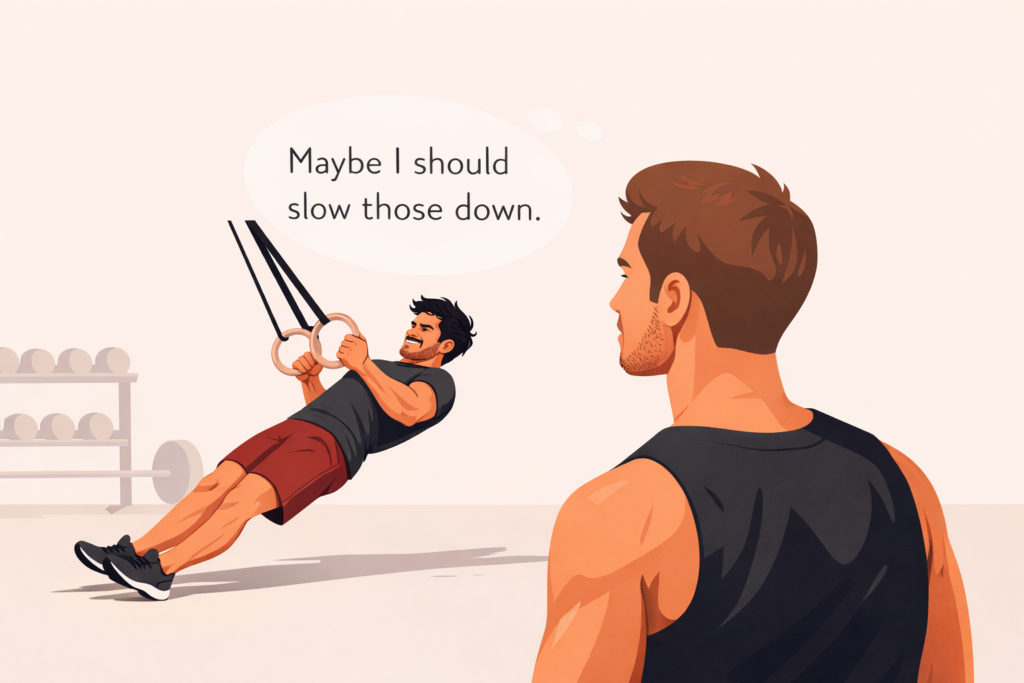
During one workout I decided to slow the movement down on purpose.
The rings were hanging from a pull-up bar in my garage.
My feet were about one meter away from the anchor point and my body leaned back roughly forty degrees.
Instead of pulling normally, I focused on moving slowly and staying in control the entire time.
Each repetition took several seconds on the way up and several seconds on the way down.
By the third repetition the movement already felt different from a normal set.
The rings started drifting slightly left and right.
My hands kept adjusting their angle to keep the handles stable.
Around the fifth rep my forearms began warming up.
The grip wasn’t failing, but I could clearly feel that my hands were working harder than during faster rows.
By the seventh repetition my upper back felt like it was holding a long plank.
The muscles between my shoulder blades stayed tight the entire time.
Instead of one quick squeeze, they were working continuously while my chest moved toward the rings.
Several muscles were clearly involved at the same time:
-
rear shoulders helping guide the pull
-
mid-back muscles squeezing the shoulder blades together
-
forearms stabilizing the rotating rings
-
abs staying tight to keep the body straight
A normal ring row set usually feels like a series of quick pulls.
This slower set felt more like holding tension the entire time while the body moved through space.
Why Slow Reps Change the Way the Muscles Work
Something interesting happens when a pulling movement slows down.
The muscles stop working in quick bursts.
Instead, they stay partially contracted for the entire repetition.
During a faster ring row, the back muscles squeeze strongly when the chest approaches the rings.
Then they relax slightly while the arms extend again.
The tension rises and drops quickly.
With slow repetitions, that rhythm changes completely.
The lats keep pulling for several seconds instead of just one moment.
The shoulder blades continue moving toward each other little by little.
The rear shoulders remain active to keep the arms stable.
At the same time, the abs stay tight so the body does not bend in the middle.
Instead of a quick contraction followed by a short break, the muscles stay engaged the whole time.
That continuous effort is what makes slow rows feel heavier even though the body position has not changed.
It’s similar to holding a heavy grocery bag with your arm straight.

The bag might not be extremely heavy.
But after ten seconds your arm begins to feel the effort building.
Nothing about the weight changed.
The muscles simply had to stay active longer.
Slow ring rows create the same situation for the pulling muscles.
The back, shoulders, arms, and core remain under tension for several extra seconds.
And those extra seconds are enough to make the movement feel far more demanding than a regular row.
The Core Suddenly Works Like A Plank
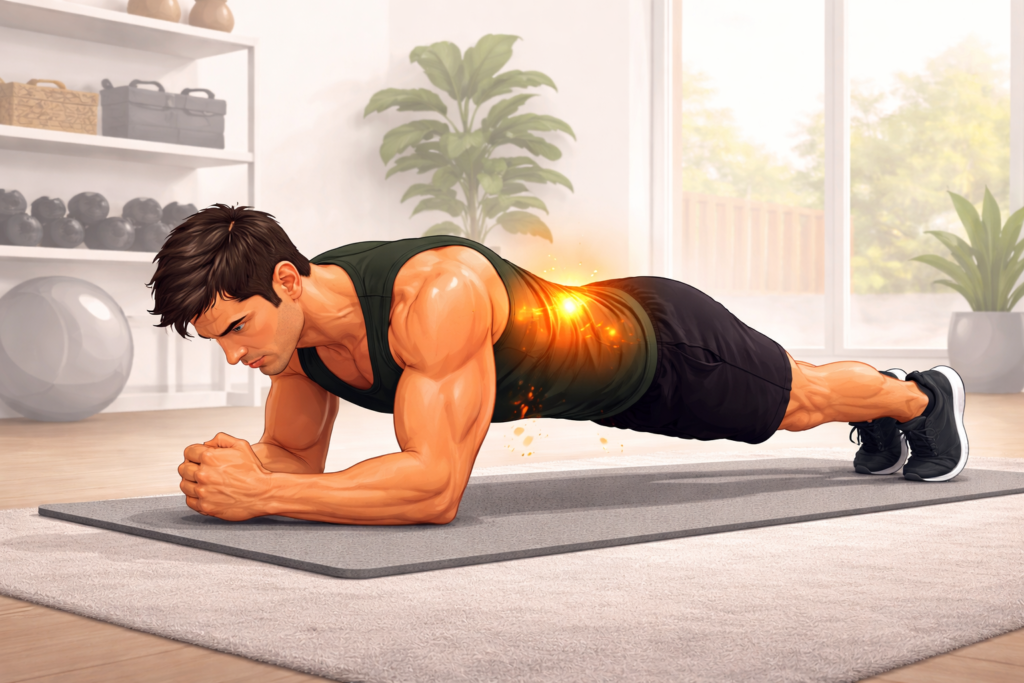
One thing I did not expect the first time was how hard my abs started working.
When the pulling phase takes four seconds, the body has to stay straight for those four seconds.
If the hips drop even slightly, the entire line of the body changes.
So the abs automatically tighten.
The glutes tighten too.
I often notice this during slower sets.
Around rep six or seven my stomach muscles start feeling like I’m doing a plank.
That happens because the body position in a ring row is basically a moving plank with pulling arms.
When the motion slows down, the plank portion becomes much more noticeable.
A Session Where I Alternate Slow and Regular Ring Rows
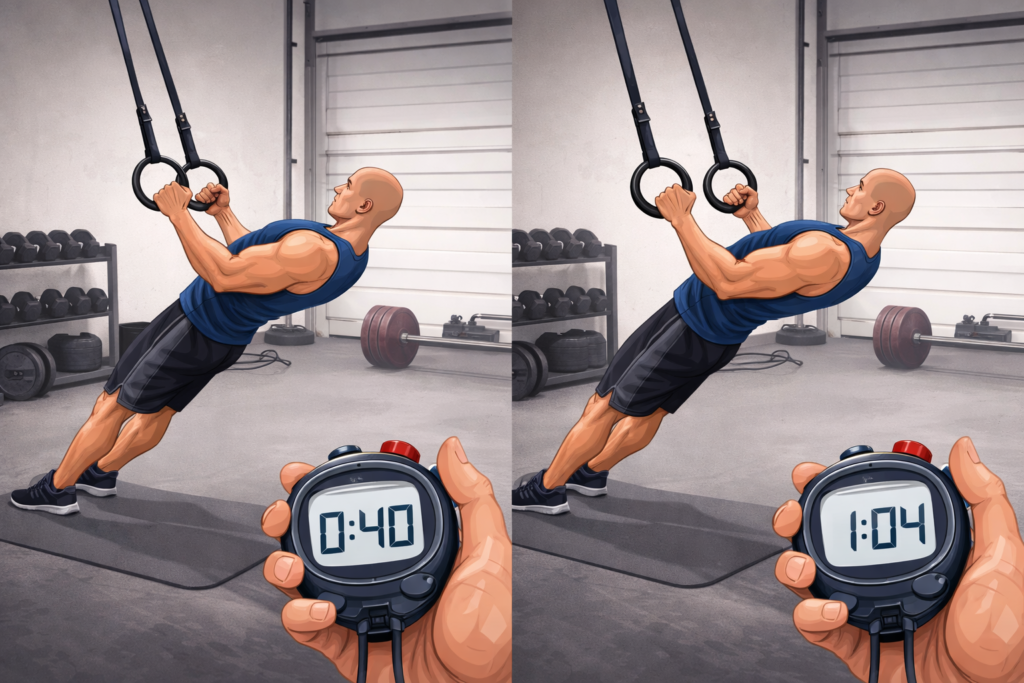
One day I did a simple comparison in my garage gym.
Nothing scientific.
Just curiosity.
First I performed a normal set:
- 10 reps
- tempo about 2 seconds up, 2 seconds down
- total time: about 40 seconds
The set felt moderate.
Breathing slightly elevated but manageable.
Two minutes later I tried a slow version:
- 8 reps
- tempo 4 seconds up, 4 seconds down
- total time: about 64 seconds
Halfway through the set my upper back already felt fully engaged.
By the last repetition I could feel tension across my entire torso.
The rings were also drifting a bit, forcing my wrists and shoulders to adjust constantly.
Same body position.
Very different sensation.
Subtle Changes That Make Slow Ring Rows Much Harder
Several tiny adjustments can make slow ring rows feel even heavier.
None of them involve adding weight.
Just mechanics.
Foot Distance
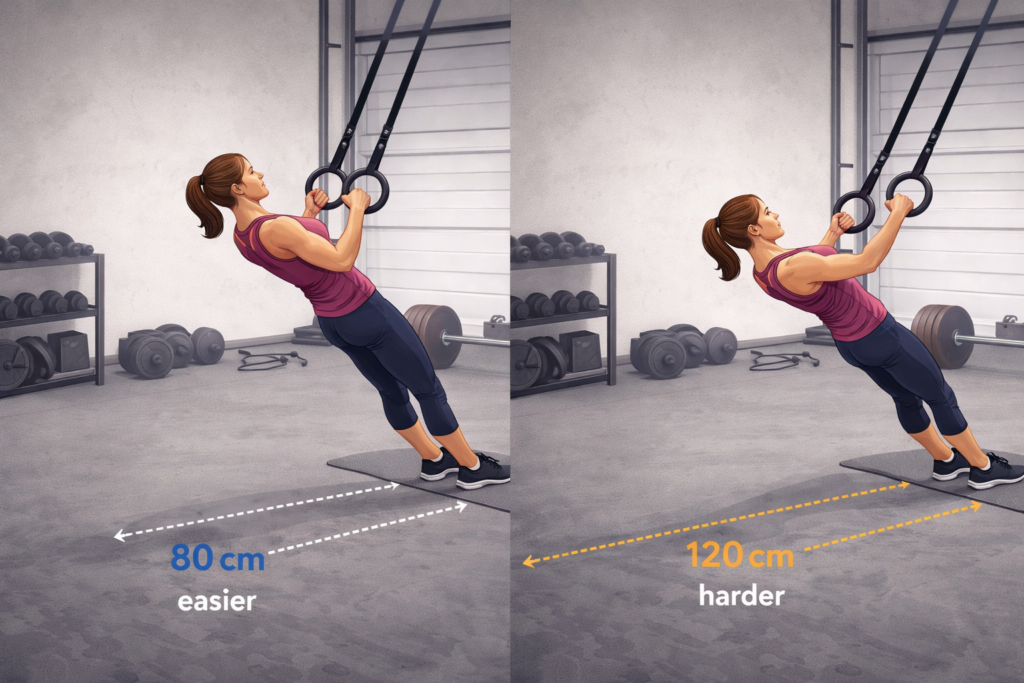
Moving the feet farther from the rings increases the body angle.
For example:
- feet 80 cm away → easier
- feet 120 cm away → harder
With slower tempo that extra distance becomes very noticeable.
Ring Height
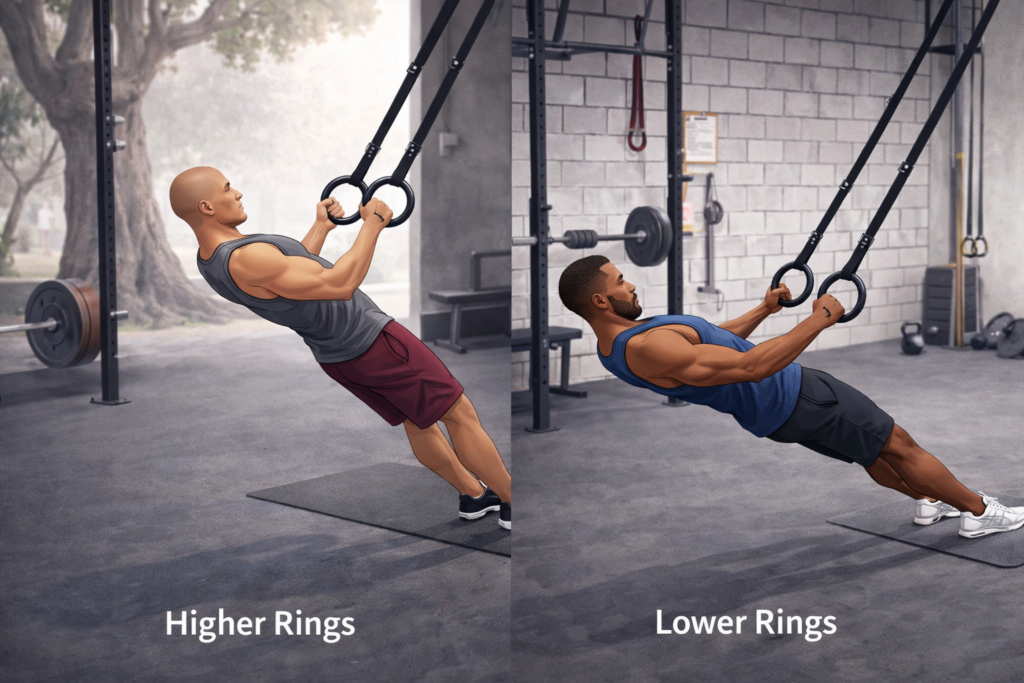
Lower rings create a flatter body position.
A flatter body means more bodyweight must be pulled.
Combining a flat position with slow tempo can turn the exercise into a serious back workout.
Pauses At The Top
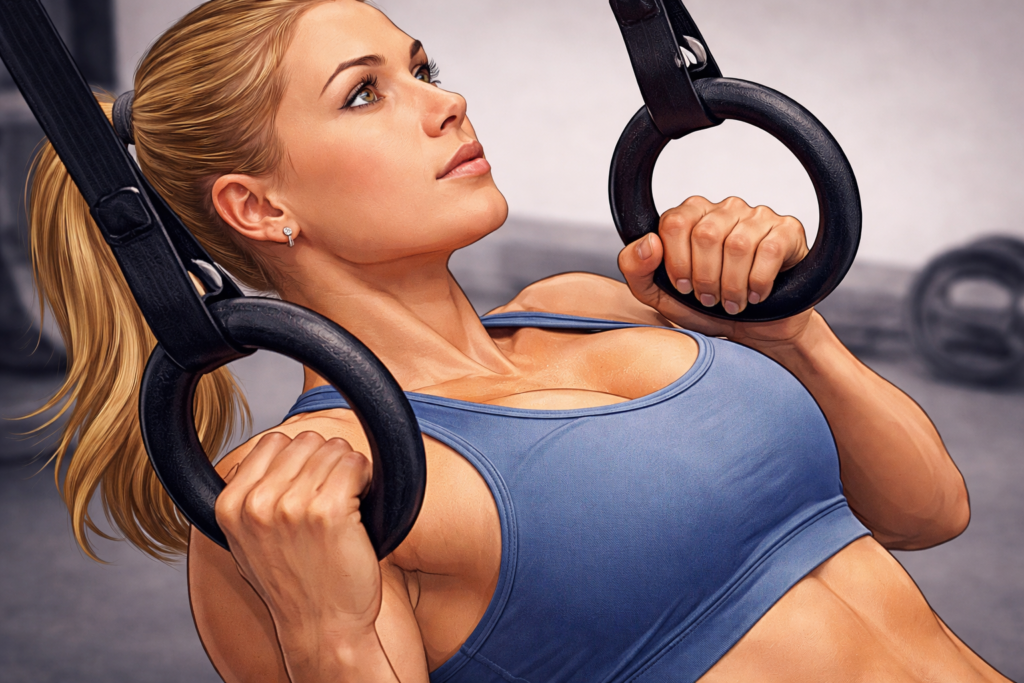
Sometimes I add a two-second hold when my chest touches the rings.
Example rep timing:
- 4 seconds pulling
- 2 second hold
- 4 seconds lowering
That turns a single rep into a 10-second effort.
Five reps already feel like a long set.
The Grip Factor Nobody Talks About
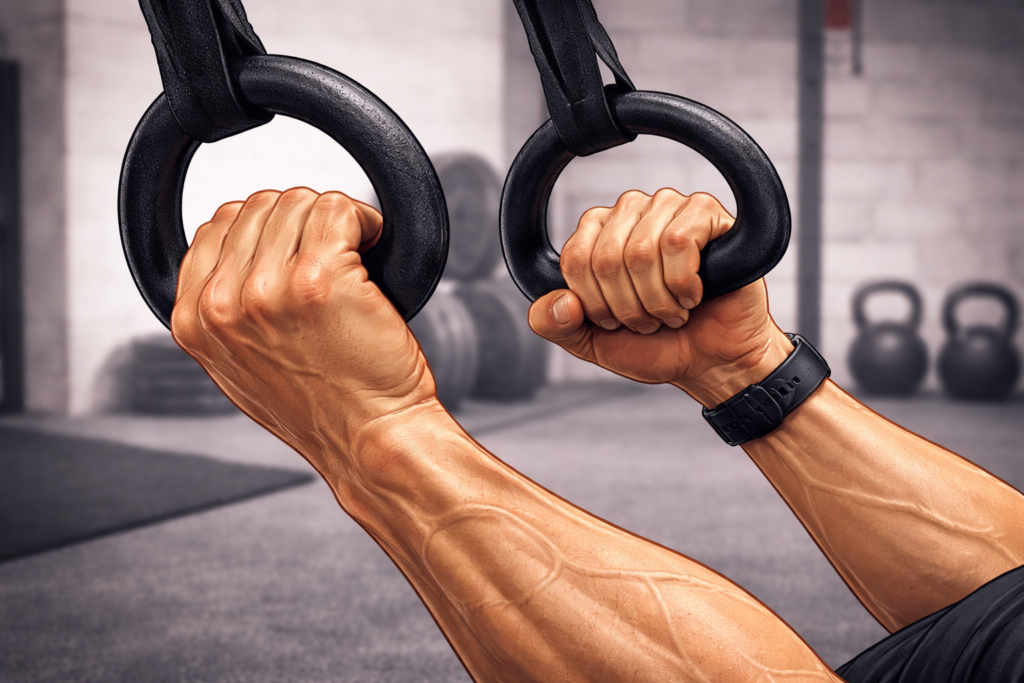
Something interesting happens to the hands during slow rows.
Because the movement takes longer, the forearm muscles stay active longer as well.
The rings rotate naturally while you pull.
Your hands adjust slightly during every repetition.
During faster rows you barely notice it.
During slow rows your forearms feel the difference quickly.
After about 50–60 seconds of pulling, the grip begins to warm up.
Not painful.
Just that familiar feeling that the hands are doing real work.
When I Prefer Slow Rows Instead Of Faster Ones
Some days I train rows faster.
Other days I intentionally slow everything down.
Slower tempo feels useful when I want to focus on how the back muscles contract.
For example:
- 4 sets
- 6 slow reps
- 2 minutes rest
That session might last only 15 minutes, but the back muscles feel fully worked.
On other days I prefer faster rows for higher repetitions:
- 3 sets
- 12 reps
- 90 seconds rest
Both styles train pulling strength.
They simply create different sensations in the body.
When the Movement Becomes Easy to Understand
The moment slow ring rows start making sense is usually when someone notices how controlled the movement becomes.
Instead of pulling quickly and dropping back down, every centimeter of the motion becomes visible.
You feel the shoulder blades move.
You feel the arms guiding the rings.
You feel the body staying rigid like a moving plank.
The exercise stops feeling like just “pulling something.”
It becomes a full-body coordination task.
That is why the intensity feels higher even though the body position hasn’t changed.
Final Thoughts
Yes.
Slow ring rows often feel much more intense than regular rows.
Not because the exercise suddenly becomes heavier.
But because the muscles stay active longer, the rings require constant stabilization, and the body must remain tight for the entire duration of each repetition.
Once you experience that difference a few times, the feeling becomes very clear.
The movement is still the same row.
The only thing that changed is the clock.
And sometimes a few extra seconds are enough to make a familiar exercise feel completely different.
FAQs:
Do slow ring rows build more muscle than faster ring rows?
They can, depending on how the exercise is used.
Slower repetitions keep the muscles active for a longer time during each rep, which increases fatigue in the back and arms.
That longer tension can stimulate muscle growth, especially when the movement is controlled and the body stays rigid.
Faster repetitions, however, allow more total repetitions and sometimes heavier body angles.
Both approaches can work well.
The main difference is how the muscles experience the effort during the set.
Should the rings touch my chest during a ring row?
Ideally the rings should come very close to the sides of your chest.
This position helps the shoulder blades move fully toward each other.
If the rings stop far away from your body, the back muscles usually don’t contract completely.
A good cue is to imagine pulling your elbows behind your body while keeping your chest lifted.
How low should the rings be for ring rows?
The lower the rings are, the flatter your body becomes.
A flatter body position means more bodyweight must be pulled.
For beginners, rings around chest height usually work well.
As strength improves, lowering the rings gradually increases the difficulty without adding extra equipment.