One evening at the gym I notice a guy warming up on the pull-up bar.
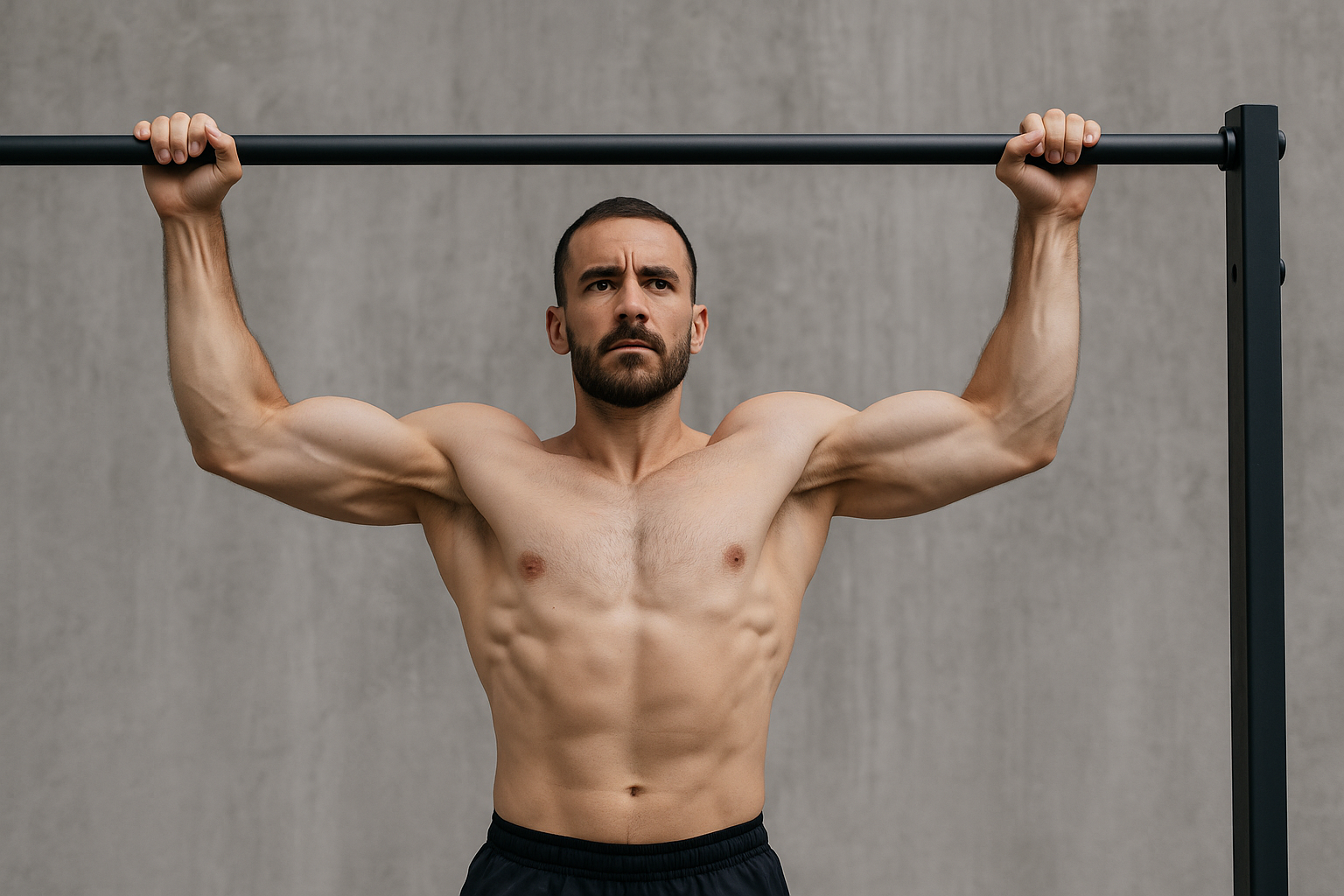
He isn’t doing pull-ups yet.
He’s just hanging there, moving up and down a few centimeters.
At first it looks strange.
His arms stay completely straight.
His elbows don’t bend at all.
But his body keeps rising and lowering slightly.
Just a small motion.
Maybe two or three centimeters.
Nothing impressive to watch.
If someone walked past the bar they probably wouldn’t even notice he’s doing anything.
But something about it catches my attention.
His shoulders look relaxed.
His neck isn’t tight.
And when he finally starts doing pull-ups, the first rep looks smooth.
Just one clean pull.
Meanwhile I’m standing a few meters away thinking about my own pull-ups.
Because my first rep almost always feels awkward.
The shoulders feel tight.
The body takes a second to organize itself.
Like the muscles need two or three repetitions before they remember what they’re supposed to do.
So I walk over to the bar after he leaves.
Hang for a moment.
And try the same tiny movement he was doing.
At that moment I’m not expecting anything special.
But that small shoulder motion ends up changing how every pull-up workout feels from that day forward.
The First 10 Seconds of a Pull-Up Session
The first ten seconds on the bar say a lot about how the rest of the workout will feel.
When the shoulders aren’t prepared, the body behaves in a predictable way.
The hang looks like this:
- shoulders rise toward the ears
- elbows rotate slightly forward
- upper traps hold tension
- lats stay quiet
Then the first pull-up begins.
Rep one usually feels stiff.
The body moves, but the motion isn’t coordinated yet.
The arms start pulling before the back joins the movement.
That’s when the shoulders often feel overloaded.
A lot of people assume the solution is more stretching.
Or more shoulder mobility drills.
But in my case, the shoulders didn’t need more flexibility.
They needed a better starting signal.
The Tiny Movement That Appears Before a Good Pull-Up
After paying attention to my pull-ups for a few sessions, I start noticing something interesting.
Whenever a rep feels smooth, the movement actually begins before the elbows bend.
The shoulders move first.
The shoulder blades slide slightly downward.
Then the elbows bend.
Then the body rises.
That small shoulder motion is exactly what scapular pull-ups train.
It’s a tiny movement.
Most people watching wouldn’t even notice it.
But inside the shoulders it feels very clear.
The back muscles start participating immediately.
Instead of the arms doing everything.
What Actually Moves When the Shoulders Start the Pull
To understand why this matters, imagine the shoulder blades like sliding plates on your upper back.
They move in several directions:
- upward
- downward
- toward the spine
- away from the spine
When hanging from a bar, gravity pulls them upward.
That’s the relaxed position.
A scapular pull-up simply reverses that motion.
You pull the shoulder blades downward and slightly inward.
Your body rises only a few centimeters.
Usually 2 to 4 cm.
The elbows stay completely straight.
That’s important.
If the elbows bend, the arms take over.
When the movement comes only from the shoulder blades, a few muscles finally wake up:
- lower trapezius
- rhomboids
- serratus anterior
- latissimus dorsi
Those muscles create the stable base for every pulling exercise.
Without them, the arms try to compensate.
Trying That Tiny Movement for the First Time
The first time I try scapular pull-ups, the motion feels surprisingly unfamiliar.
Even though the range of motion is tiny.
Here’s exactly how I perform the first set.
I hang from the bar.
Arms straight.
Body relaxed.
Then I slowly pull the shoulder blades downward.
My body rises maybe three centimeters.
I hold that position for two seconds.
Then I relax again.
That’s one rep.
After five repetitions, my upper back feels warm.
Not tired.
Just activated.
Almost like someone turned the lights on in muscles that were previously asleep.
The First Pull-Up Right After It
Now I try a regular pull-up.
The difference shows up immediately.
Before, the first rep always felt awkward.
Now the sequence feels organized.
First the shoulders move.
Then the elbows bend.
Then the body rises.
The back joins the movement earlier.
That spreads the workload across larger muscles.
Instead of the shoulders taking all the stress.
The Three-Minute Warm-Up I Use Now
Over time I settle into a simple routine that takes about three minutes.
The sequence looks like this.
Step 1 – Passive Hang
Hang from the pull-up bar.
Relax the shoulders completely.
Duration: 20 seconds
This lets the joints decompress slightly and reveals how the shoulders feel that day.
Step 2 – First Round of Scapular Pull-Ups
Perform:
- 8 repetitions
- lift the shoulders down for 2 seconds
- return slowly for 2 seconds
The body moves only a few centimeters.
No elbow bending.
Step 3 – Short Rest
Rest for 30 seconds.
Shake the arms.
Roll the shoulders gently.
Step 4 – Second Round
Another set of 8 to 10 scapular pull-ups.
The upper back now feels slightly active.
Not fatigued.
Just engaged.
Step 5 – First Pull-Up Set
Now the workout begins.
For example:
- Set 1: 6 pull-ups
- Take a short break, shake the arms, and let the breathing settle
- Set 2: 6 pull-ups
- Pause again until the forearms feel relaxed
- Set 3: 5 pull-ups
The first rep now feels completely different from before.
When the Shoulders Are Actually Ready
One thing I start paying attention to is how the shoulders feel right after the warm-up but before the first real set.
It’s a subtle difference, but it becomes very easy to recognize once you notice it a few times.
When the shoulders are ready, the hang feels quieter.
The shoulders naturally sit a little lower.
The neck feels relaxed.
The bodyweight no longer feels like it’s pulling directly on the joints.
Instead, it feels like the upper back is supporting the position.
Another sign appears during the first pull-up rep.
The body rises in one smooth motion instead of two stages.
Before adding scapular pull-ups, my first rep often had a strange rhythm.
The first half of the movement felt heavy.
Then the second half suddenly became easier.
After warming up the shoulder blades, that uneven feeling disappears.
The entire pull feels consistent from start to finish.
What Happens If You Skip This Step for Months
For a long time I trained pull-ups without ever thinking about shoulder blade movement.
The workouts still worked.
Strength increased slowly.
But a few things kept showing up again and again.
The shoulders felt irritated after high-volume sessions.
The first two sets always felt clumsy.
And the upper traps did far more work than they should.
Those small signals are easy to ignore.
They don’t stop the workout.
But over months they accumulate.
The body slowly learns inefficient pulling patterns.
The arms take over.
The shoulders lift toward the ears.
The back joins the movement too late.
Scapular pull-ups fix that pattern before it even begins.
How the Movement Changes Your Awareness on the Bar
Another unexpected benefit appears after practicing scapular pull-ups for several weeks.
Your awareness of shoulder position improves.
While hanging from the bar, you begin noticing tiny changes in shoulder placement.
You can feel when the shoulders drift upward.
You can feel when the lats engage.
You can feel when the shoulder blades slide down the back.
That awareness carries into every pulling movement.
Pull-ups feel more controlled.
Inverted rows feel more stable.
Even simple dead hangs feel more comfortable.
The body learns how to organize tension around the shoulder joint instead of letting the arms absorb everything.
The Version I Use on High-Volume Pull Days
On days where I plan to do many pull-up sets, I extend the warm-up slightly.
Not by much.
Just enough to keep the shoulders calm during the session.
The routine becomes:
Passive hang – 25 seconds
Scapular pull-ups – 10 reps
Rest – 30 seconds
Scapular pull-ups – 8 reps
Rest – 30 seconds
Light pull-ups – 4 reps
Then the main workout begins.
That extra minute of preparation often prevents the shoulders from feeling overloaded during the final sets.
Conclusion
Strength training usually focuses on big movements.
Heavy squats.
Pull-ups.
Deadlifts.
Dips.
Those exercises build strength and muscle.
But the small supporting movements often determine how smoothly those exercises feel.
Scapular pull-ups belong to that category.
The movement is tiny.
The range of motion is only a few centimeters.
Yet that tiny shift in shoulder blade control changes the entire pulling sequence.
The back engages sooner.
The shoulders stay stable.
And the first rep of the workout finally feels like a real pull-up instead of a warm-up attempt.
Sometimes the most useful adjustment in training isn’t adding something complicated.
It’s simply noticing the small movement that should have been there from the beginning.
FAQs:
Do scapular pull-ups actually increase pull-up strength or are they just a warm-up trick?
They can absolutely improve pull-up strength, but not in the way most people expect.
Scapular pull-ups don’t make the arms stronger.
They teach the body how to start the pull correctly.
When the shoulder blades initiate the movement, the lats begin working earlier in the rep.
That means the arms don’t need to carry the entire load.
Over time this usually results in:
- smoother pull-up technique
- less shoulder fatigue
- more consistent reps across sets
Many people suddenly gain one or two extra clean reps simply because the pull-up sequence becomes more efficient.
Not because the muscles suddenly grew stronger overnight.
But because the body finally pulls in the right order.
Why do my shoulders crack or pop during scapular pull-ups?
Small popping sounds in the shoulder blades are surprisingly common.
In many cases the noise comes from tiny adjustments in the joint capsule or tendons sliding over nearby structures.
When people start doing scapular pull-ups, they are often moving the shoulder blades in ways they rarely practice.
That unfamiliar motion can create temporary clicking sensations.
In most cases the sound disappears after a few sessions once the shoulders get used to the movement.
However, pain is a different story.
If the popping is sharp, painful, or associated with instability, it’s a signal to stop and evaluate the movement pattern.
Are scapular pull-ups better than dead hangs for shoulder health?
They serve different purposes.
A dead hang mostly allows the shoulder joint to decompress under bodyweight.
Scapular pull-ups actively train the muscles that control the shoulder blades.
Think of it like this:
Dead hangs relax the shoulders.
Scapular pull-ups teach the shoulders how to organize tension.
Many experienced lifters combine both in the same warm-up.
First a short passive hang to relax the joints.
Then scapular pull-ups to activate the upper back.
Why do scapular pull-ups feel harder than normal pull-ups sometimes?
This happens more often than people expect.
The reason is simple.
During a normal pull-up, several muscles can compensate for each other.
The arms can pull harder.
Momentum can help.
The body can swing slightly.
But scapular pull-ups remove all those shortcuts.
The elbows stay straight.
Momentum disappears.
The movement relies almost entirely on the small stabilizing muscles of the upper back.
That’s why a movement of only two or three centimeters can sometimes feel surprisingly demanding.
Can scapular pull-ups fix shoulder pain from pull-ups?
They can help in many situations.
Especially when the discomfort comes from poor shoulder blade control.
If the shoulders rise toward the ears during pull-ups, the joint often experiences unnecessary stress.
Scapular pull-ups train the opposite behavior.
They teach the shoulders to stay depressed and stable.
For many people this reduces irritation during pulling exercises.
However, they are not a universal cure.
Pain caused by tendon injuries, impingement, or serious structural issues requires proper evaluation.
Is it possible to build muscle using only scapular pull-ups?
Not really.
The range of motion is too small to stimulate significant muscle growth.
Scapular pull-ups function more like a neural activation drill than a hypertrophy exercise.
They prepare the muscles to work efficiently during full pull-ups, rows, and other pulling movements.
Think of them as turning on the engine before driving.
They don’t replace the journey.
But they make the drive smoother.