The first time I grabbed a pair of gymnastic rings, I thought I was about to do something majestic — like a slow-motion muscle-up from a movie.
What actually happened looked more like a caffeine-deprived octopus trying to escape gravity.
My arms shook, my shoulders panicked, and for a solid ten seconds I questioned every decision that led me to this moment.
If you’ve ever touched rings before, you know that feeling.
That trembling chaos isn’t just weakness — it’s your nervous system screaming, “Hey, we’ve never done this before!”
And that’s exactly why people can’t stop arguing about this:
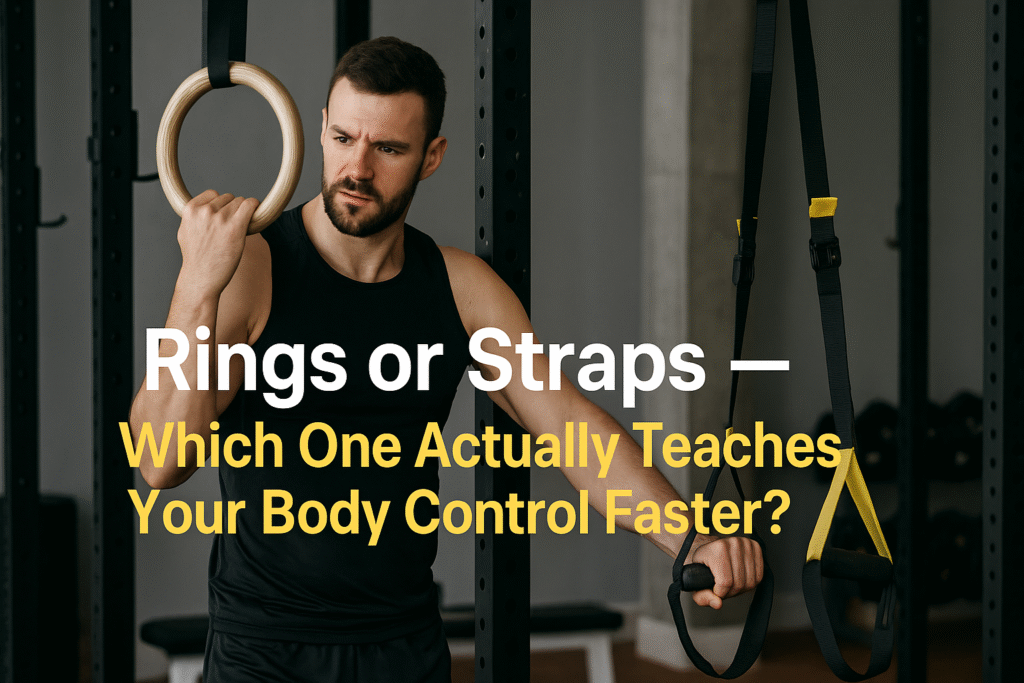
If you want to build body control, should you train with rings or straps?
Let’s break it down.
The wild difference between rings and straps
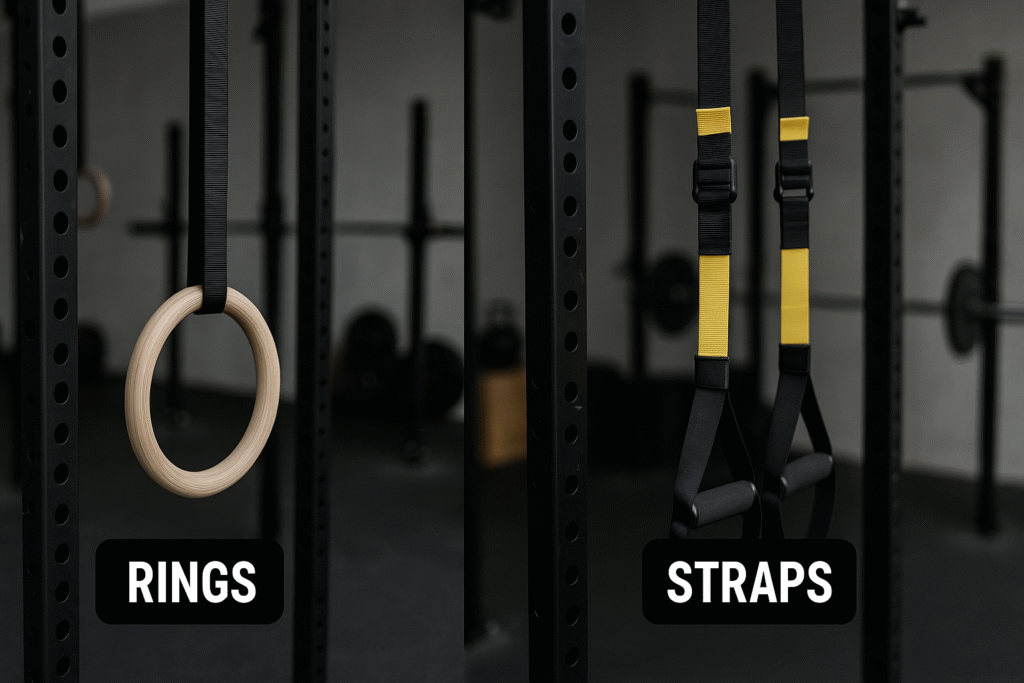
Straps (or suspension trainers like TRX) are like the friendly version of gymnastic rings.
They’re adjustable, padded, and let you cheat a little.
You can move the handles independently, but the attachment point usually keeps things pretty balanced.
Rings?
They don’t care about your feelings.
They spin, twist, and mock you if your stabilizers aren’t awake yet.
That instability is exactly what turns them into a body control bootcamp.
When you train on rings, your nervous system has to fire like it’s trying to defuse a bomb — constantly adjusting, micro-correcting, and learning where “center” actually is.
Straps, on the other hand, guide you.
They give you support in the same way training wheels do.
You’re still working hard, but the system keeps you from tipping over completely.
From a technical perspective: rings introduce multi-axis instability (rotational, translational, oscillatory) whereas straps mostly introduce plane instability (mostly front-to-back or side-to-side).
That means rings require greater joint stiffening, scapular control, and core bracing just to deliver a clean rep.
One Reddit user put it simply:
“Rings will last forever… they just beat you up, but you get stronger.” (Reddit)
That nails the feeling.
Why Real Control Starts Where Strength Ends
When people talk about control, they often picture balance or coordination.
But body control is more like your internal GPS.
It’s your brain and muscles speaking the same language under pressure.
It’s knowing exactly where your limbs are — even when your eyes are closed or your body’s upside down.
This is called proprioception, and it’s what separates a decent push-up from a clean, floating ring dip.
Every shake, every unstable rep, is your body collecting data.
Rings just give you more data, faster.
That’s why even experienced lifters who switch from bar dips to ring dips suddenly realize their “strength” had a few blind spots.
If you’ve dealt with weird pain or compensations in your calisthenics work, I’ve actually written about this in “Common Calisthenics Problems.”
Because control isn’t just moving; it’s moving well.
Why rings speed up the learning curve
Here’s the secret: rings create chaos.
And chaos makes your body smarter.
Every time the rings drift away from your center line, your stabilizers — rotator cuff, scapular muscles, forearms — jump in to fix the mess.
That’s why gymnasts don’t just look strong; they move with surgical precision.
Their joints don’t just hold positions; they own them.
If you can hold a perfect support on rings for 10 seconds, you’ve already taught your body more about control than a dozen perfect cable flyes ever will.
From a technical lens: ring training enhances dynamic stability, segmental stiffness, and intermuscular coordination.
When your core sees instability, it recruits deeper stabilizers (like the multifidi, transverse abdominis, serratus anterior) faster than when the load is stable.
Data: ring use increases EMG activation of stabilizer muscles compared to fixed-handles.
Where Straps Shine the Most
Now, let’s be fair.
Rings aren’t always the hero.
If you’re coming back from injury, or just starting out, straps can be a safer middle ground.
They reduce the instability enough for you to focus on movement quality — not survival.
Plus, straps are usually easier to anchor anywhere.
Door frames, trees, hotel rooms — they’re like the portable gym you actually remember to use.
And if your goal is high-rep endurance or functional conditioning, straps give you more consistency.
They help build a solid base before you throw your shoulders into the chaos of ring work.
From a program design view, straps are great for:
• Tempo training (slow eccentric on rows or push-ups)
• Conditioning circuits (less risk of destabilization fatigue)
• Initial rehabilitation of shoulder/elbow before higher instability work
How Ring Work Rewires Your Focus
Here’s something that surprised me.
When I started training on rings consistently, my focus improved — not just in workouts, but everywhere else.
You can’t rush through a ring support or a slow eccentric dip.
Your mind has to be there, fully locked in.
That mental stillness carries over.
Suddenly, even when lifting or sprinting, you move with intention instead of brute force.
You start feeling in control, instead of just working hard.
That’s the kind of progress no mirror selfie can capture.
And if you’ve ever dealt with “mind-body disconnect” in your training (yeah, I’ve written about that one too) you already know why this matters.
Who Takes the Crown — Rings or Straps?
If we’re talking pure body control speed, rings take the crown.
They throw you into deep water and make you learn to swim — fast.
But if we’re talking long-term training, the best answer is both.
Use straps to groove patterns, then use rings to stress-test your coordination.
It’s not about what looks harder.
It’s about what makes you move better, more efficiently, and with purpose.
Progress isn’t linear, and your body will reward adaptability more than ego.
Anchors, Angles, and All the Stuff Nobody Checks
Let’s level up with a practical drill-kit setup guide because many articles gloss over this.
Here’s how to make sure your training environment supports control—without risking injury.
Anchor height & angle matters:
For straps: when feet are grounded, straps angled around 30-45° to anchor provide optimal horizontal pulling.
For rings: anchor height around hip-to-waist level for rows, chest-height for push work, overhead for pull-ups.
But more crucially: the greater the anchor height above your handles, the greater the instability — use this to intentionally scale difficulty.
Strap length & body angle:
Shorter straps = more vertical body orientation = more load, less instability.
Longer straps = more horizontal body orientation = less load, more instability.
Use this scaling to turn straps into a control tool before rings.
Tree-branch vs rig vs ceiling anchor:
Rings hung from tree branches introduce natural sway (good!).
But check branch diameter (> 20 cm), surface roughness, and treat for moisture.
Indoor rigs provide predictable environment — good for early ring training.
Make sure clearance: minimum 1m around your swing arc, 2m height clearance.
Grip width & hand position:
On rings: experiment between neutral grip (palms facing) and turned out grips (RTO) for support holds.
Each demands different neuromuscular control.
On straps: generally fixed handles reduce grip variability, making it easier to learn movement patterns initially.
Progressive instability protocol:
Week 1: Use straps, anchor low, narrow grip, 8-12 reps, focus on form and tempo (3-1-3 tempo).
Week 2: Increase strap length, wider body angle, reduce reps to 6-8, increase instability.
Week 3: Move to rings, low anchor, perform ring rows & push-ups, 5-8 reps.
Week 4: Raise anchor, widen grips, start ring supports and dips, 3-5 reps.
Week 5+: Alternate, track control not just reps — hold 2-3 second supports, tempo eccentrics, micro-pauses at end range.
The Untold Side of Rings and Straps Mastery
Energy Systems & Neural Fatigue in Instability Training
Most fitness articles talk about muscles but skip how rings impact your nervous system.
Instability training triggers high afferent input (nerve signals from joints, tendons), which floods your central nervous system (CNS).
If you train rings every day heavy, you’ll burn out faster than you think — not because your muscles give out but because your CNS hits a throttle limit.
That’s why planning deloads and mixing tools avoids burnout.
Joint Health & Long-Term Control Gains
Control isn’t just for performance — it’s for injury prevention.
When you train with rings, you force scapulothoracic rhythm, humeral external rotation, and wrist supination/pronation control.
These are the same joint mechanics that protect you during big lifts, pushing work, and even daily movements (like reaching overhead).
By integrating ring work alongside straps, you build not just strength but resilient movement patterns.
Transfer to Other Lifts & Real-World Movement
Here’s where many write-ups stop, but we go further.
The control you build on rings transfers to:
Deadlifts: better core tightness and hip drive because you’ve learned whole-body coordination.
Overhead pressing: your scapula moves cleaner, less shoulder hitch.
Running and sports: your body orientation and joint stability from rings carry over into dynamic movement.
That means what you learn on rings doesn’t stay on rings — it upgrades your whole movement library.
Final thoughts
Rings teach you humility.
Straps teach you structure.
Together, they build the kind of control that doesn’t just make you strong — it makes you precise.
You stop chasing numbers and start mastering positions.
And once you feel that kind of awareness, regular machines start to feel… boring.
So next time you’re deciding between rings or straps, remember this:
Control isn’t given.
It’s earned — one shaky rep at a time.
And once you’ve got it… you’ll move different.
You’ll move better.
Frequently Asked Questions (FAQ)
Can I only use rings and never do straps?
Technically yes. But most people hit plateaus or hit joint fatigue sooner. Straps let you build base control first, then rings let you sharpen.
How long until rings “feel normal”?
Everyone’s different. For many with solid strength and no shoulder issues, 4-6 weeks of consistent ring work yields noticeable control gains. But deeper mastery (front lever, muscle-up transitions) takes months.
Will straps ever “beat” rings?
No, if your goal is max control and skill work. Straps are great — but rings allow full 360° movement, inverted, above/below the bar, transitions that straps cannot replicate nearly as well. (Calisthenics – Master your body)
My wrists hurt when I use rings — is that normal?
It can be if you’re forcing heavy movement before your wrists and forearms built up stabilizer strength. Go lighter, focus on support holds, change grip width, invest 5-10 minutes of wrist/forearm prep daily.