
Anyone who has ever hovered a couple inches above the ground in a push-up knows the feeling.
Chest low, elbows tucked, everything shaking like a Wi-Fi connection during a storm.
And at some point, the same question shows up:
“Is this doing anything… or is the body just melting into the floor like a sad pancake?”
So let’s talk about it, trying to understand why this slightly masochistic choice might actually be worth it.
And yes — it really is.
The bottom-push-up hold and why it feels so brutally effective

That hold hits differently.
Not the top of the push-up, not the halfway point — the bottom.
Down there, your chest is stretched.
Your shoulders are loaded.
Your triceps feel like they’re negotiating their life choices.
And even though it looks simple, it’s basically a full-body isometric under tension.
Muscles don’t just work concentrically and eccentrically.
They also grow from isometric tension — especially when that tension happens in a stretched or disadvantageous position.
That’s exactly what the bottom of a push-up is.
You’re holding your bodyweight in a spot where the lever is terrible and gravity is laughing at you.
This alone is enough to stimulate muscle fibers that usually get a “free ride” during fast reps.
Why the chest and shoulders light up during a bottom-push-up iso hold
When you hover at the bottom, your pecs are slightly lengthened.
That stretch increases mechanical tension, which is one of the main drivers of hypertrophy.
Your anterior delts join the party because they stabilize your humerus and stop everything from collapsing forward.
Your serratus gets involved to prevent your shoulder blades from winging out like dollar-store costume wings.
Everything is working.
Everything is fighting.
And the best part?
You’re not cheating the rep.
You can’t bounce.
You can’t rush.
You can’t use momentum.
The hold forces you to face your weak link.
And that’s where growth comes from.
How holding the bottom helps you build real strength for full reps
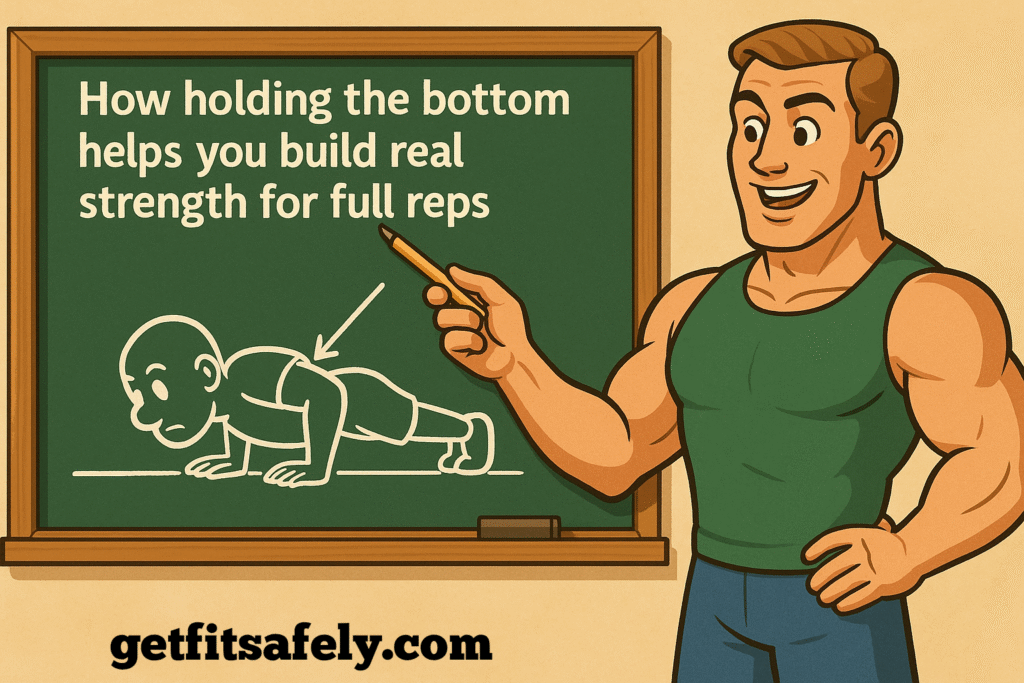
This isn’t just “pump work.”
It builds usable strength.
When you pause at the bottom of a push-up, you strengthen the exact portion of the movement where most people fail.
If you’ve ever done a push-up and felt like the floor had a magnetic pull on your chest, this is why.
The bottom position demands:
- More mid-range chest strength
- More shoulder stabilization
- More triceps control
- More core tension
- Better scapular positioning
In other words, it reinforces the same technical foundations that make every rep smoother, stronger, and less reliant on momentum.
But can holding the bottom alone build muscle?
Short answer: yes — up to a point.
If the hold is challenging enough, long enough, and done frequently enough, you can absolutely stimulate hypertrophy.
But — and here’s the honest part — isometrics have a limit.
You need progressive overload.
So if you’re holding the bottom position, you have to progress it over time by adjusting things like:
- Longer hold durations
- Slower descents into the hold
- Added load (backpack, plates, weighted vest)
- Reduced rest between rounds
- Harder angles (feet elevated, closer hands, rings, parallettes)
The moment it becomes too easy, the gains slow down.
Your body adapts.
Adaptation is great for survival, not so great for muscle growth.
How often should you do bottom push-up holds?
Most people never ask this directly, but it’s the one thing that makes the biggest difference.
If your goal is strength or skill control:
2–3 times a week is perfect.
If your goal is hypertrophy or endurance:
3–5 times works well because isometrics are joint-friendly and don’t require insane recovery.
Place them:
-
At the start of your session to “wake up” your pushing muscles
-
In the middle to challenge stability
-
At the end for a spicy finisher that takes 20 seconds and ruins your soul in a good way
RELATED:》》》 Why Your Floor Push-Ups Stop Building Muscle After Week Three
Safety tips for shoulders and wrists
Lots of people avoid the bottom position because it “feels sketchy.”
Totally normal.
Here’s how to make it safer instantly:
Keep your elbows tucked about 30–45 degrees.
Don’t let your hips sag — it dumps pressure into the shoulders.
Grip the floor lightly with your fingers so your wrists don’t fold inward.
Actively push the floor “away” without rising to activate your serratus.
If anything feels sharp (not burny, but sharp), elevate your hands or try incline holds first.
Bottom holds should feel intense, not painful.
Progressions if the bottom is too hard
If you can’t hold the bottom yet, don’t worry — almost no one can at first.
Try this ladder:
- Knee push-up bottom hold
- Incline bottom hold on a table or bench
Standard bottom hold - Slow eccentric + bottom pause
- Feet-elevated bottom hold
- Ring or parallettes bottom hold (this is PhD-level misery)
Follow the ladder and you’ll get strong fast.
Bottom holds vs regular push-ups
People always ask which is better.
Bottom holds build:
-
Iron stability
-
Control
-
Strength in the sticking point
-
Cleaner technique
Regular push-ups build:
-
Full-range hypertrophy
-
Pump
-
Endurance
-
Higher training volume
You don’t choose one.
You combine them.
How bottom holds improve your regular push-ups
The best part of this whole bottom-push-up-hold thing is that it fixes your form automatically.
You don’t need to cue anything complicated.
You don’t need to think about fifteen different alignment tips.
When you’re in the bottom position, your body naturally finds the “safe, strong place” because anything else feels terrible.
You learn to:
- Keep the elbows closer to the body
- Stay tight through the core
- Pull the shoulder blades into a stable position
- Maintain tension all the way through
You’re basically teaching your body to stay strong exactly where it usually panics.
What the research says
Studies on isometric training show increases in muscle size when the contraction is long enough and intense enough.
There’s also evidence that isometrics in stretched positions can amplify hypertrophy even more.
The bottom of a push-up fits that description perfectly.
You don’t have to geek out on the data to understand the feeling.
You know in three seconds whether you’re working hard enough.
Your body tells you loud and clear.
How to add bottom-push-up holds into a home routine
Here’s a clean, simple way to make it work.
Nothing fancy.
Just what actually gets results.
Option A: Strength-focused holds
- 10–15 second hold at the bottom
- Rest 60–90 seconds
- 4–6 rounds
Option B: Hypertrophy-focused burn
- 6–8 second descent
- 3–4 second pause at the bottom
- Push back up
- Repeat for 6–10 reps
Option C: Mixed routine for both strength and control
- Hold 10 seconds
- Do 5 push-ups
- Hold 10 seconds
- Do 5 push-ups
- Repeat 3–4 times
This stuff hits.
Don’t say I didn’t warn you.
When bottom holds stop working
Like anything else, you’ll adapt.
If your muscles stop shaking, your shoulders stop trembling, and your cat walks under you while you hold the position without fear of collapsing — it’s time to level up.
You can progress by:
- Elevating your feet
- Wearing a backpack with books
- Using push-up handles to increase range
- Moving your hands closer together
- Going full gym-nastics mode on rings
The idea is simple:
If your body gets too comfortable, give it something slightly uncomfortable.
That’s how growth happens.
RELATED:》》》 Is it better to do slow or explosive push-ups for arm growth?
Final note
Bottom-push-up holds can help you build muscle.
They can get you stronger.
They can clean up your form.
They can reveal weak spots you didn’t know you had.
But you still need variety.
Overload.
Different angles.
Regular reps.
Full-range movements.
Use them when you want to challenge your body in a new way.
Use them on days you can’t do a full workout.
Use them to break plateaus or build confidence in the toughest part of the rep.
Most importantly — use them as a reminder that sometimes the hardest position is exactly where the good stuff happens.