
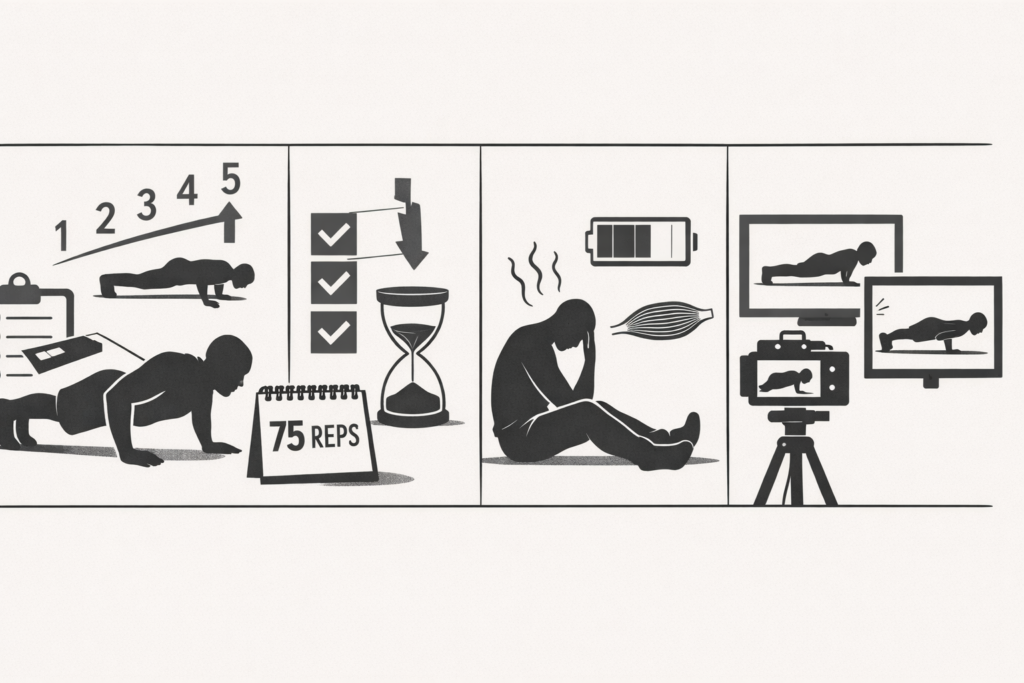
I started doing push-up ladders every day because it felt “clean.”
No equipment.
No complicated plan.
Just me, the floor, and that quiet confidence that simple things always work.
Then my reps started doing something weird.
They went up fast, then got sloppy, then dipped, then bounced back in a way that made zero emotional sense but a lot of physiological sense.
The exact ladder I did (so this isn’t vague gym poetry)
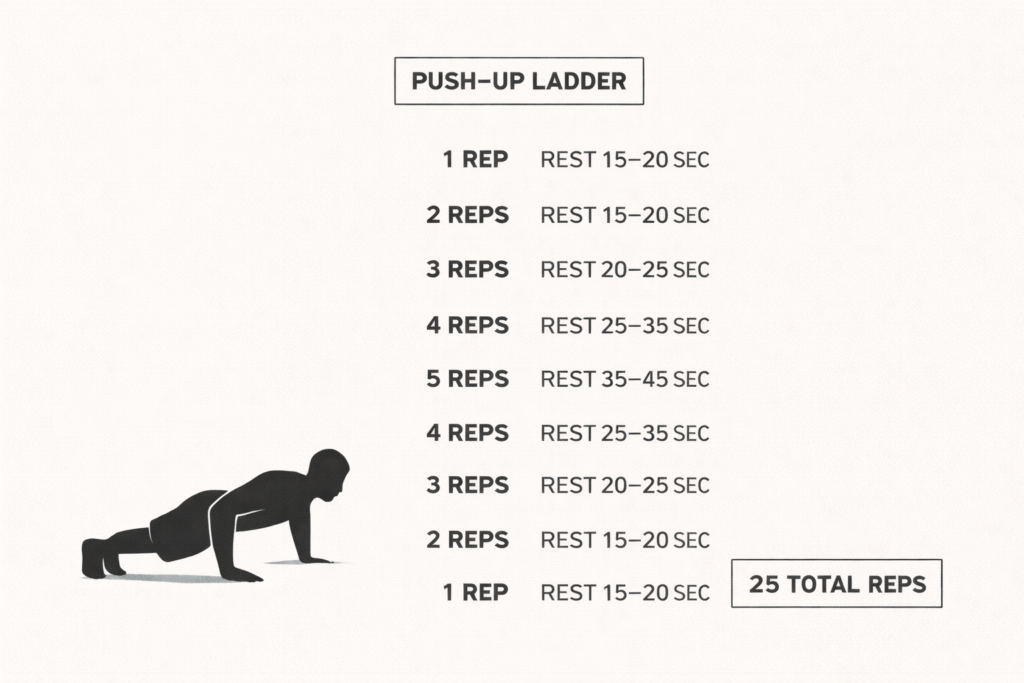
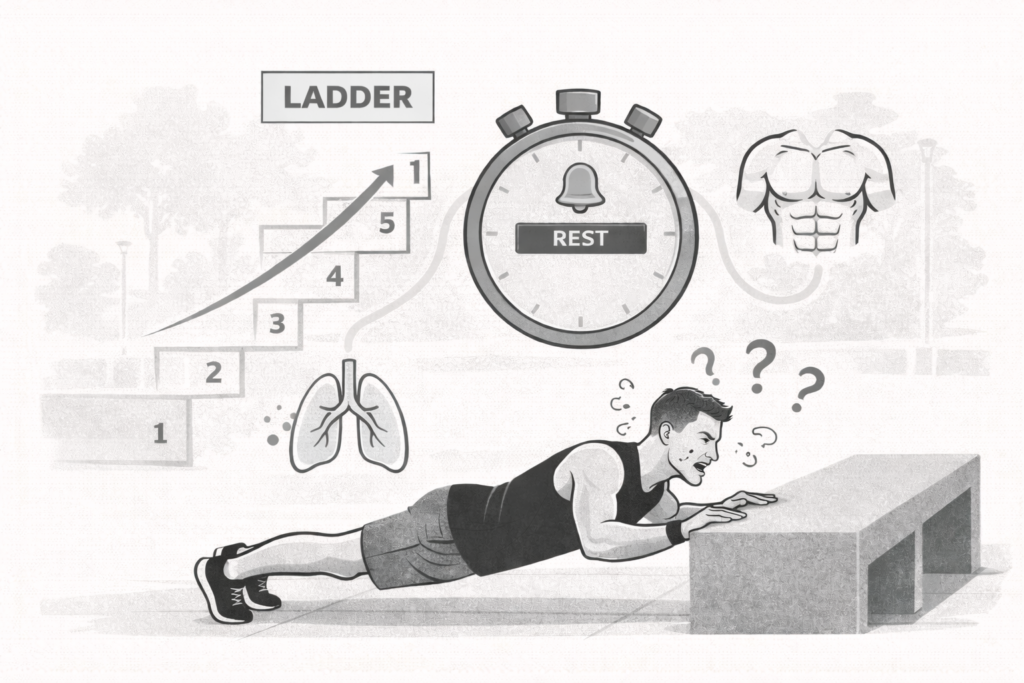
A “push-up ladder” is when the reps climb rung by rung, then usually climb back down.
Think of it like walking up stairs, touching each step, instead of jumping straight to the top and dying.
The ladder I used most often looked like this:
- 1 rep
- rest 15–20 seconds
- 2 reps
- rest 15–20 seconds
- 3 reps
- rest 20–25 seconds
- 4 reps
- rest 25–35 seconds
- 5 reps
- rest 35–45 seconds
- 4 reps
- rest 25–35 seconds
- 3 reps
- rest 20–25 seconds
- 2 reps
- rest 15–20 seconds
- 1 rep
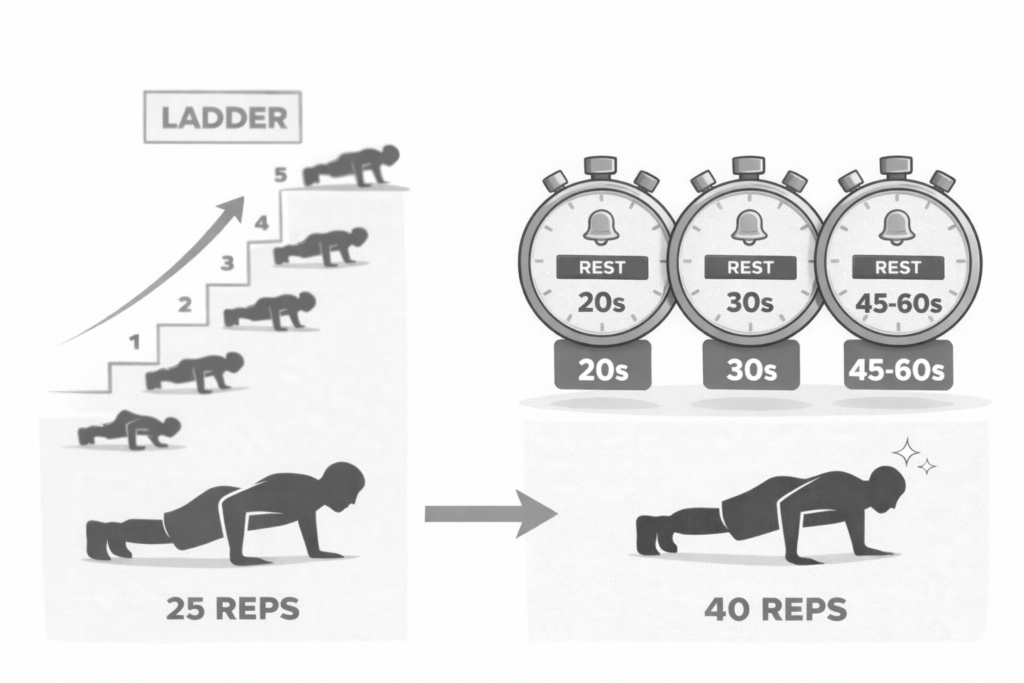
That’s 25 total reps.
I repeated that whole ladder 3 times most days.
So the daily total was usually 75 reps.
On “feels-good” days I did 4 ladders for 100 total reps, and I acted like that meant something deep about my character.
It did not.
How each rep was performed (because a push-up is not “just a push-up”)
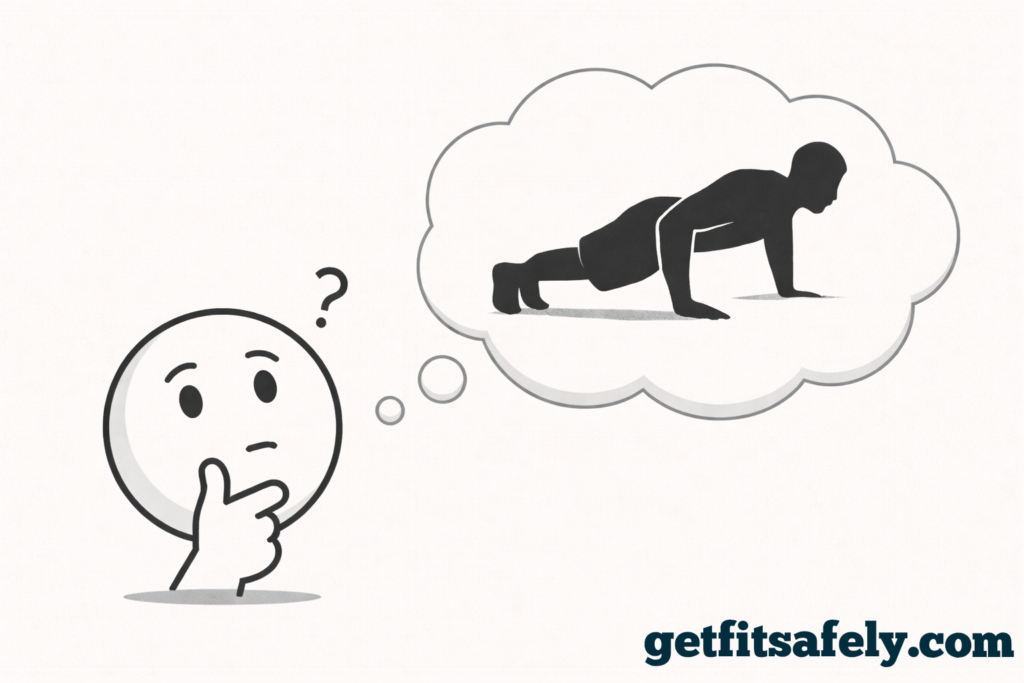
A push-up is basically a moving plank where the arms push the body away from the floor.
If the midsection sags, the shoulders take a weird angle, and suddenly the push-up becomes a shoulder shrug with dramatic lower-back involvement.
My default rep was this:
- Hands just wider than shoulder width
- Fingers spread, palm pressure even (not all on the wrist crease)
- Legs straight, glutes lightly squeezed (not a hard cramp, just “on”)
- Ribs down (so the chest isn’t flaring like I’m trying to show off to a mirror)
- Lower until the chest is about a fist-width from the floor
- Press up until elbows are straight, without locking and hanging on the joints
Tempo mattered more than I expected.
Most reps were done with a controlled lowering of about 2 seconds, then a smooth push up of about 1 second.
So each rep was roughly “2 seconds down, 1 second up.”
That sounds small, but if the lowering turns into a free fall, the elbows and shoulders notice.
My baseline max reps (the number I was chasing without admitting it)
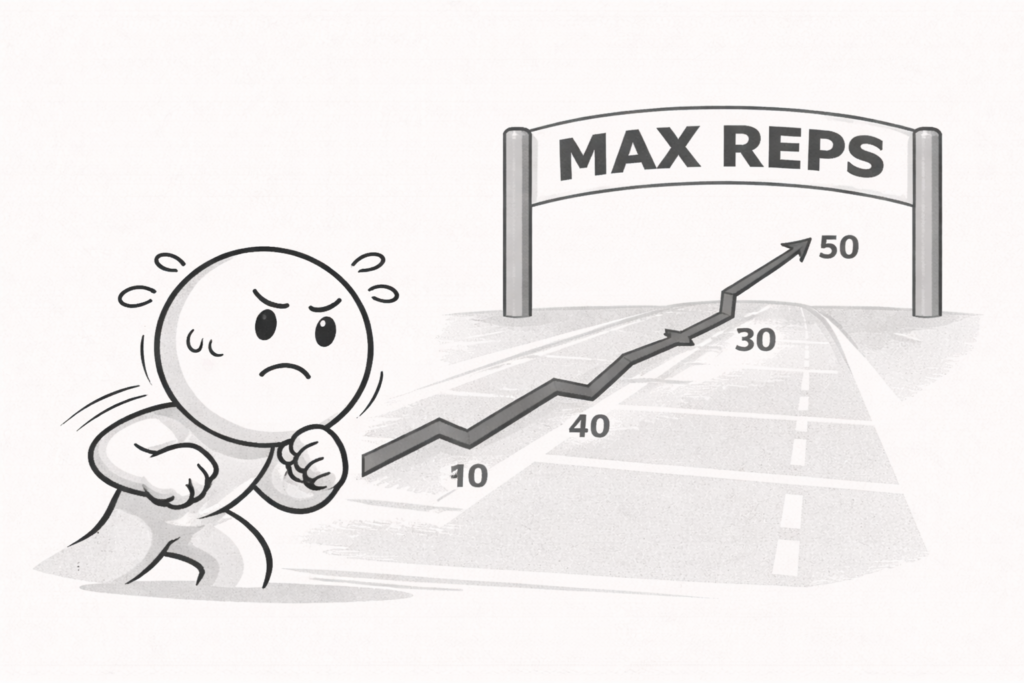
Before the ladder habit, my “fresh max set” was pretty consistent.
After a normal warm-up, I could hit 28 clean push-ups.
Rep 1–18 felt strong.
Rep 19–24 had that “okay, breathing is now a personality trait” feeling.
Rep 25–28 were slow, but still looked like actual push-ups instead of a fish flopping on a dock.
So 28 was my honest number.
That number is important because ladders feel productive even when they quietly change what “productive” means.
The first surprise: my total volume exploded, but my max set didn’t move much
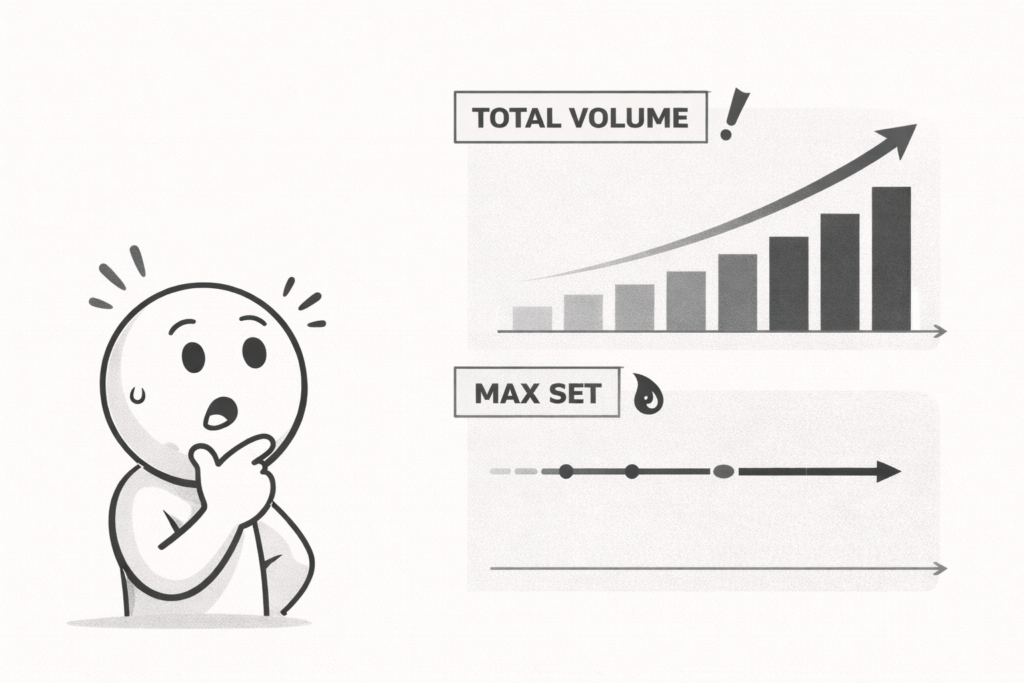
Within a short stretch of doing ladders daily, 75–100 reps started feeling normal.
My breathing stayed calmer.
My shoulders felt warmer faster.
My push-ups looked cleaner at “medium effort.”
So I expected the max set to jump.
Instead, when I tested a fresh max, I got… 29.
Not bad.
Not magical either.
It was like my body said, “Congrats, you learned to be comfortable at reps you already owned.”
That was the first lesson.
Ladders made me better at doing push-ups in a controlled, repeatable way, not necessarily better at surviving one big ugly set.
Why ladders can improve “repeatability” without boosting the big max
A ladder gives you frequent practice without pushing into the messy failure zone every time.
That’s great for skill, coordination, and keeping form consistent.
It’s like practicing free throws instead of playing a full game until you collapse.
But a max set is a different beast.
A max set is partly strength, but also pain tolerance, breathing control, and the ability to keep technique from falling apart while fatigue is screaming.
My ladders were training:
- clean reps
- short rests
- lots of total reps
- not much grinding
My max set required:
- longer continuous effort
- more burn in chest and triceps
- more “staying tight” while breathing gets chaotic
So I was improving a real quality, but not the exact one I kept emotionally measuring.
The second surprise: my max reps dipped… while I felt “more trained”
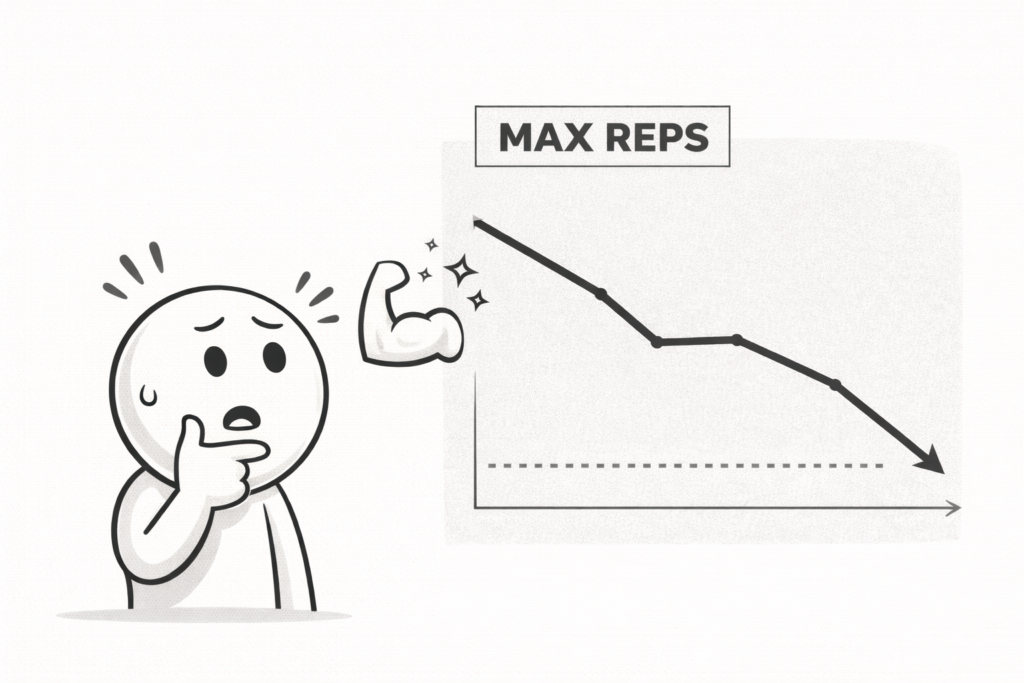
This is the part that annoyed me.
One morning I felt warm, ready, confident, and slightly smug.
I did my usual quick ramp-up: 5 easy reps, rest 60 seconds, then went for max.
I hit 24.
Twenty-four.
Not 28.
Not 29.
Twenty-four, and rep 18 already felt like rep 24 used to feel.
My first thought was, “Did I forget how push-ups work overnight?”
My second thought was, “Okay, something is quietly stealing recovery.”
Because the weirdest part wasn’t the number.
The weird part was how “heavy” my body felt.
Not sore.
Not injured.
Just… less springy.
Like the floor had a tiny magnet in it.
What “daily ladders” were doing to my body even when I felt fine
Daily push-up ladders are deceptive because they rarely wreck you in a single session.
They just stack fatigue in the background like unopened mail.
A few things were happening at the same time.
My elbows and wrists were never truly “fresh,” even if they didn’t hurt.
My triceps had a low-level tired feeling that didn’t show up until I asked for a max set.
My shoulders were doing a little extra stabilizing work every single day, especially on the last rungs when my form started drifting.
That drift was subtle.
My hands would inch forward a couple centimeters.
My elbows would flare slightly more.
My ribcage would pop up a bit.
Those tiny shifts change leverage.
They make the rep feel harder without you realizing why.
The form drift I didn’t notice until I filmed myself
I finally filmed a ladder set from the side because numbers were confusing me.
The video was rude, but fair.
Early rungs looked solid.
Later rungs showed two giveaways:
- My hips rose first on the way up (so the push started turning into a partial “worm”)
- My head reached forward before my chest moved (like I was trying to lead with my chin)
Those two things reduce how much the chest does and increase how much the shoulders and elbows get stressed.
It also makes reps less consistent.
So even though I was doing “the same ladder,” I wasn’t doing the same movement.
My body was finding the cheapest way to finish the rung.
Which is normal.
It’s also how daily volume turns into daily practice of slightly worse reps.
The third surprise: fixing my rest times changed my reps more than adding rungs
At first I treated rests like an inconvenience.
If I rested too long, it felt like I was “ruining the ladder.”
So I kept rests short even when breathing was climbing.
Then I tried something simple.
I made the rests boringly consistent:
- 20 seconds after 1–2 reps
- 30 seconds after 3–4 reps
- 45–60 seconds after 5 reps
Nothing heroic.
Just enough that the next rung started with control, not panic breathing.
That one change made the ladders feel easier.
And a few days later, my fresh max popped back to 28–30.
Not because I got stronger overnight.
Because I stopped turning the ladder into a daily semi-max grind without realizing it.
The exact “reset” I used when the ladder started stealing my max
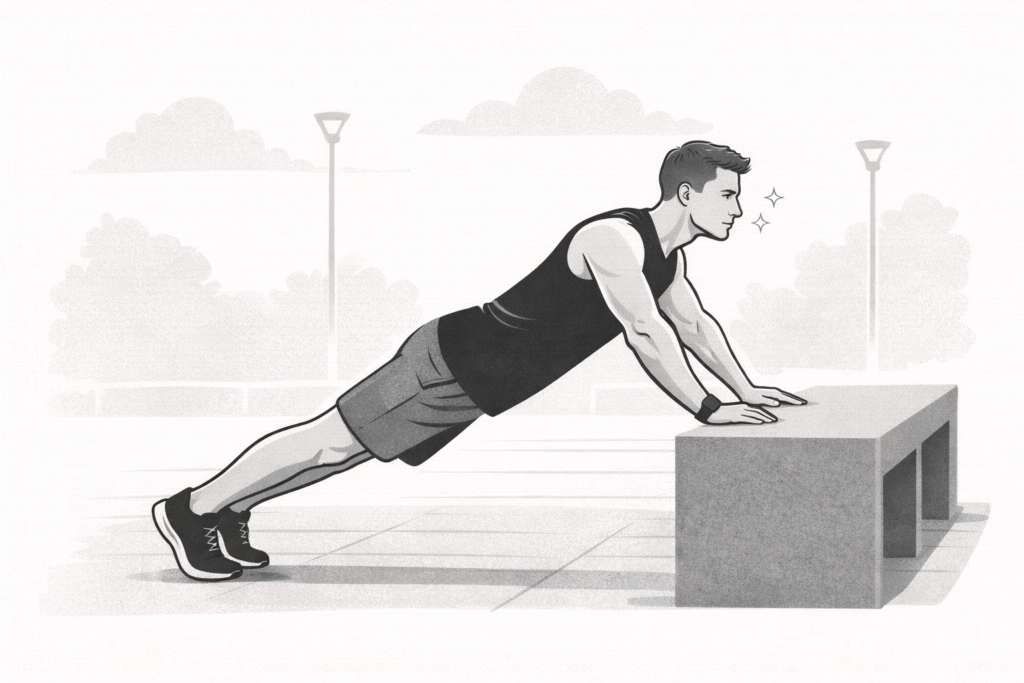
When my max dipped and my reps felt heavy, I didn’t quit push-ups.
I changed the version of push-ups for a bit so the joints and nervous system got a break while the pattern stayed familiar.
This was my reset menu:
- Incline push-ups with hands on a bench or sturdy table
- Same ladder structure, but with rungs capped at 4 instead of 5
- Tempo slowed to 3 seconds down, 1 second up
- Total ladders reduced to 2 instead of 3
That meant the daily total went from 75 reps to 40 reps.
And yes, my ego complained.
My elbows, however, shut up completely.
After that reset stretch, flat push-ups felt springier again.
The max set came back without drama.
How incline push-ups work (and why they aren’t “the easy version”)
An incline push-up is the same movement, but the hands are higher than the feet.
That reduces the percentage of bodyweight you’re pressing.
It also makes it easier to keep the ribs down and the hips aligned, because you’re not fighting the floor as hard.
Setup is simple:
- Hands on a bench, box, table edge, or railing
- Body straight like a plank
- Lower chest toward the edge
- Press back up without losing the straight line
The goal isn’t to “do the baby version.”
The goal is to keep perfect reps so the ladder becomes clean practice again, not daily survival.
The moment I realized ladders were training my breathing more than my chest
One evening I did a ladder after a long day with low sleep and too much coffee.
The push-ups weren’t the problem.
My breathing was the problem.
I was holding my breath on the way down.
Then exhaling too late.
Then rushing the next rung like I was trying to finish a test before the teacher collected it.
So I changed one thing.
I inhaled on the way down.
I exhaled as I pressed up.
Every rep.
Immediately the whole set felt smoother.
Same strength.
Different engine.
And when the engine is better, reps stop dying early for dumb reasons.
The “hidden workload” that made daily ladders heavier than they looked on paper
Here’s the part I wish I understood earlier.
Daily ladders don’t just create muscle fatigue.
They create stabilization fatigue.
Your shoulders are constantly trying to keep the upper arm bone centered in the socket.
Your forearms and hands are constantly managing pressure and wrist angle.
Your core is constantly preventing sagging or piking.
That’s a lot of small muscles doing a lot of quiet work.
So even if your chest feels fine, the support system can be tired.
When the support system is tired, the reps feel worse.
And when reps feel worse, form leaks.
And when form leaks, the ladder becomes “practice of survival,” not practice of skill.
What my reps looked like across a normal day (numbers + feelings)
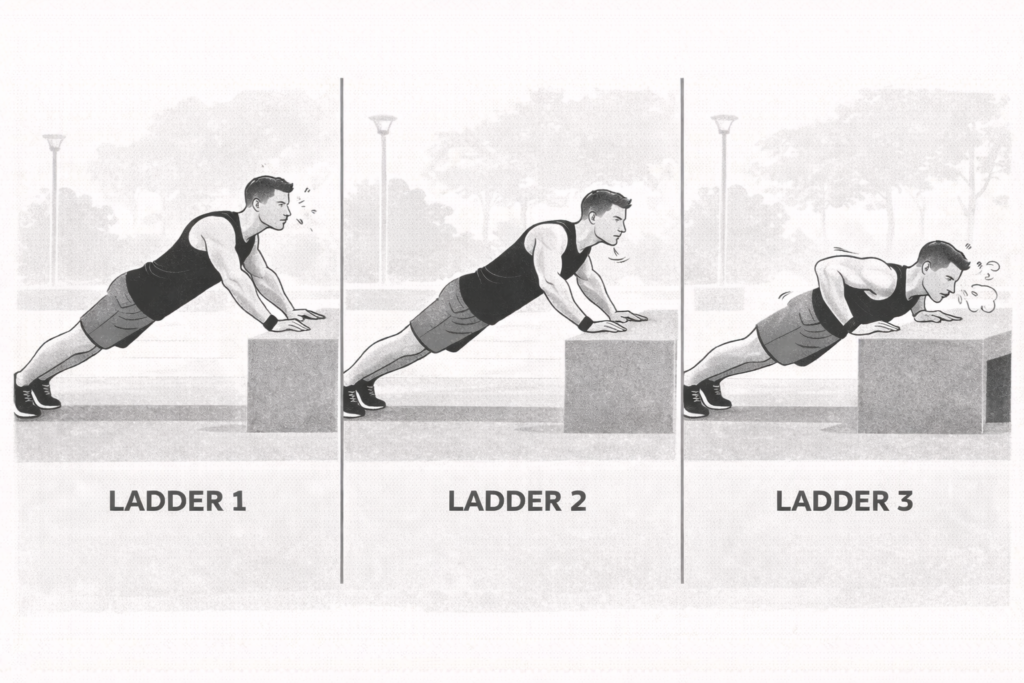
On a decent day, this was typical:
I’d do Ladder #1 and feel smooth.
Breathing stayed calm.
Wrist pressure felt even.
On Ladder #2, rung 5 felt slower, but still clean.
On Ladder #3, I’d start feeling a mild burn in triceps around the second climb.
Nothing scary, just that “okay, the arms got the message” feeling.
When I was stacking too much fatigue, it looked like this instead:
Ladder #1 felt fine, but my shoulders felt oddly “busy.”
Ladder #2 had tiny elbow flare that I didn’t intend.
Ladder #3 turned into me chasing the clock between rungs, breathing louder, pushing faster, and finishing with reps that technically counted but didn’t match the earlier ones.
That was always the signal.
Not pain.
Not soreness.
Just reps that stopped looking like themselves.
The habits that stopped my ladders from falling apart
These cues sound simple, but they kept me from sliding into sloppy autopilot.
I used them like a quick checklist before each rung:
- Screw the hands into the floor (imagine twisting palms outward without moving them)
- Elbows track about 30–45 degrees from the body, not straight out to the sides
- Chest and hips rise together, like one stiff board
- Pause for half a second at the bottom on the higher rungs if speed starts getting messy
- Stop the rung if the push-up stops looking like your earlier push-up
That last one mattered most.
The ladder isn’t a law.
It’s a tool.
If the tool starts building bad reps, it’s not being “tough,” it’s being sloppy.
So what actually surprised me the most
I expected daily ladders to give me a straight line upward in max reps.
What I got was something more realistic.
My medium-effort push-ups became smoother and more repeatable faster than I expected.
My max set didn’t jump much until I stopped turning the ladders into quiet daily grinding.
Then my max dipped when fatigue and form leaks stacked up invisibly.
Then my reps came back when I treated rest, tempo, and rep quality like the actual workout instead of treating them like annoying details.
RELATED:》》》Perfect Form vs High Volume — The Results Surprised Me
Where I landed with ladders (the version I’d keep long term)
If I could go back and give myself the simplest “do this, not that” without turning it into a lecture, it would be this.
Ladders work best when they stay crisp.
So I’d keep them like this:
- Cap the ladder at a rung that stays clean (for me, 4–6 depending on freshness)
- Keep rests consistent enough that breathing doesn’t hijack form
- Use a controlled lowering tempo so the joints don’t take a daily beating
- Rotate in incline push-ups whenever the reps start feeling heavy and weird
That version kept my push-ups improving without the random “why do I feel weaker?” mornings.
And honestly, it also made push-ups feel like training again instead of daily paperwork.