
Someone once spent three months training with nothing but a coin and a questionable sense of curiosity.
Heads meant upper body.
Tails meant legs.
If it somehow landed on the edge — rare but legendary — that was a rest day (and usually an excuse for a big bowl of cereal).
It started as a joke.
But somewhere between sweat and surprise came a real question: could randomness actually work as a way to structure home training?
Could progress still happen without a rigid plan — and without the usual burnout or recovery crashes?
Turns out, the answer might not be as crazy as it sounds.
Why We Crave Unpredictability When We Train Alone
Let’s be real — training at home long enough turns even the most disciplined plan into Groundhog Day.
Push-ups, squats, pull-ups, repeat.
You start scrolling halfway through your warm-up just to “check the timer.”
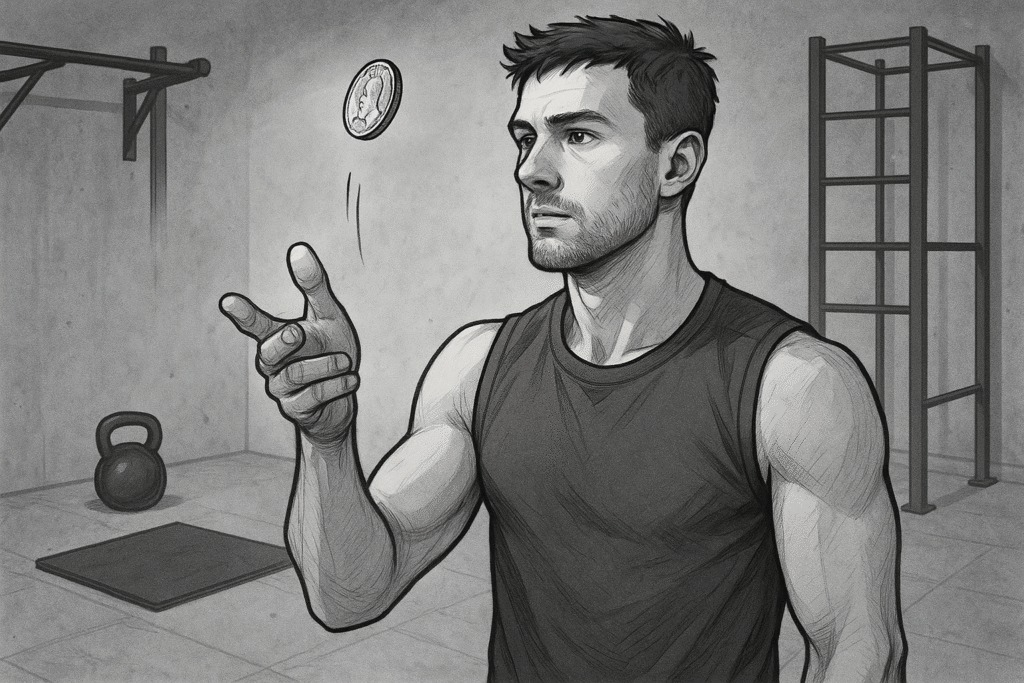
That’s when I started flipping coins.
It gave me back a sense of surprise.
I didn’t wake up already knowing what was coming — and that made me want to train again.
The coin added uncertainty, and that uncertainty added engagement.
Because here’s the thing: people don’t quit home workouts because they’re too hard.
They quit because they’re too predictable.
So if tossing a coin keeps you consistent?
You’re already ahead of 90% of people.
Consistency beats perfection every time.
The Myth of “Perfect Periodization”
Periodization gets thrown around like it’s some secret sauce only pros understand.
Linear, undulating, block, wave — it sounds like algebra disguised as fitness.
But at its core, it’s just the smart management of three things:
- Intensity (how hard you push)
- Volume (how much total work you do)
- Recovery (how well you bounce back)
If those three evolve over time, you’re periodizing.
You don’t need to live inside a spreadsheet.
Even with a coin-flip system, you can periodize intuitively.
You just have to pay attention to your trend lines, not your daily randomness.
Think of it like driving through traffic — it doesn’t matter if the lights turn red or green at random, as long as you’re still headed in the right direction.
How to Build Real Structure Into Unplanned Training

If your plan is pure luck, you’ll quickly end up with overworked shoulders or forgotten hamstrings.
So instead of letting randomness fully take the wheel, use it as a driver’s assist.
Here’s how:
- Set Weekly Targets
- Pick a total set range for each muscle group (10–20 sets/week).
- Track how often the coin gives you that muscle group.
- Adjust next week if something got too much or too little love.
- Keep Load Progression Intentional
- Add reps, resistance bands, or tempo changes within those sessions.
- The coin chooses the day — you choose the effort curve.
- Cycle Difficulty Every Few Weeks
- Week 1–3: Gradual overload.
- Week 4: Pull back slightly.
- Repeat.
How Your Energy Naturally Periodizes You
You don’t need an Excel sheet to “wave load” your training.
Your energy already does it for you.
Some days, you wake up feeling unstoppable — that’s a high-intensity day.
Other days, you’re sluggish — that’s a deload day in disguise.
Instead of forcing performance when your battery’s empty, ride the wave.
This kind of autoregulation (adjusting based on how you feel) is what most seasoned lifters learn the hard way after years of overtraining.
It’s how you keep progress linear in the long run instead of linear for two weeks and then flatlined for a month.
So yes — you can make random choices day to day, as long as your effort curve follows a rhythmic pattern of push, coast, recover, repeat.
That’s real-world periodization — minus the buzzwords.
When Randomness Becomes a Superpower
You know what happens when you stop overthinking your plan?
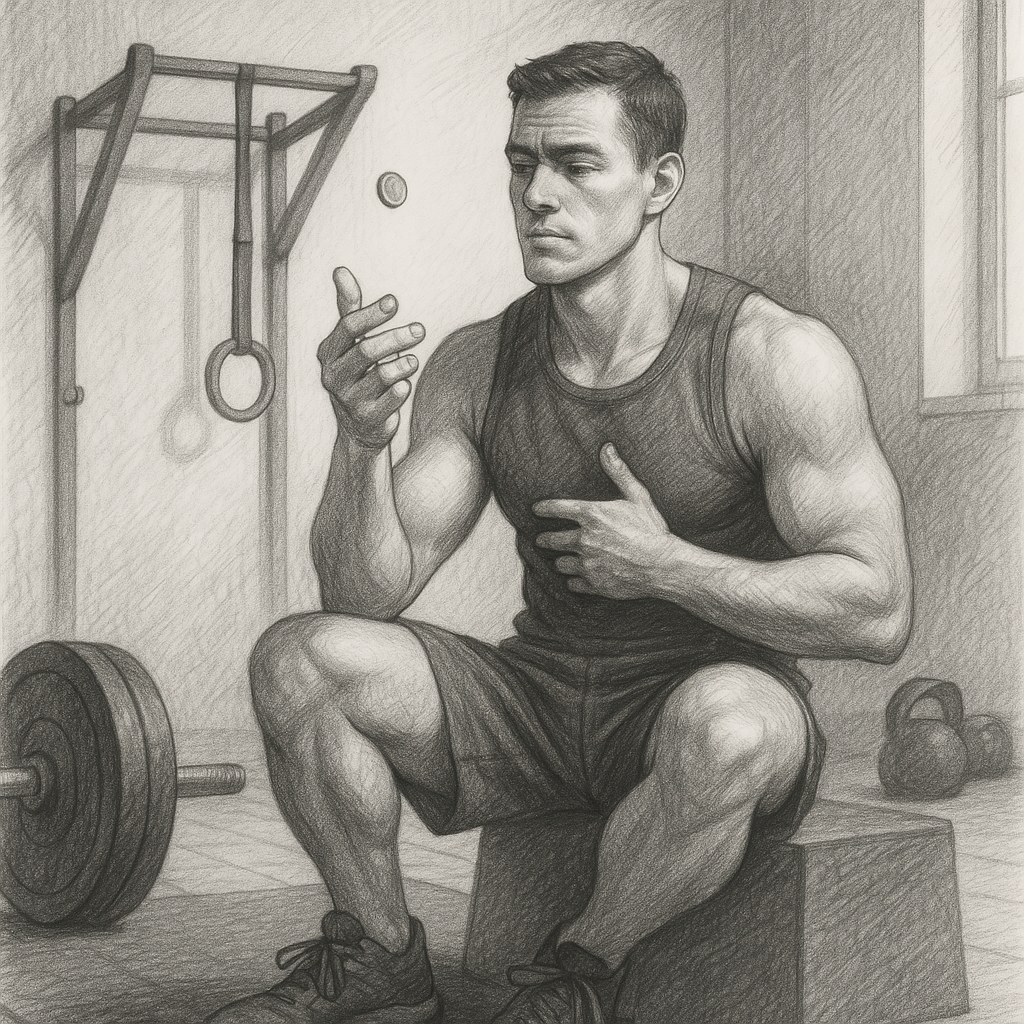
You start paying attention to your body.
You notice small things — shoulder tightness, lower-back fatigue, how your breathing shifts between sets.
Randomized training forces you to adapt — and adaptation is the root of all progress.
Because when every workout is slightly unexpected, your nervous system can’t get lazy.
It has to stay awake.
That’s the hidden benefit of chaos — it sharpens body awareness while keeping you mentally fresh.
And that matters more than any “optimal” split written by a guy who’s never seen your living room.
The Safety Factor
The biggest risk with randomness isn’t overtraining.
It’s imbalance.
Your joints don’t care that a coin told you to do push-ups four days in a row.
They only care about load management.
So track your soreness, your sleep, and your mobility patterns.
If you’re getting nagging aches in the same place twice a week, that’s your sign to rebalance the deck.
Rotate patterns — push, pull, hinge, squat — not just body parts.
Your connective tissue thrives on variety with intention, not chaos for the sake of it.
If something feels off, regress or rest.
Why “Fun” Is Actually Scientific
There’s psychology behind this too.
Research shows that novelty increases dopamine and long-term adherence to exercise programs.
That’s why you can push through coin-flip chaos longer than you could a 12-week “by-the-book” routine.
It keeps you curious.
Curiosity creates momentum.
And momentum — not motivation — is what keeps home training alive after the first month.
So don’t underestimate the “fun factor.”
It’s not just play; it’s brain chemistry working in your favor.
How to Measure Progress Without Losing the Game
Without a set plan, how do you even know if you’re progressing?
Simple.
Track performance patterns, not days.
- Can you do more total reps in your push-up variation?
- Can you hold your planks longer without shaking?
- Are your pull-up pauses cleaner or deeper?
- Do you feel less drained between sessions?
That’s linear progress, even if your calendar looks like a coin toss simulator.
Progress doesn’t need to look pretty to be real.
It just needs to be consistent enough to compound.
When to Retire the Coin (Temporarily)
There comes a point when randomness stops being productive.
If your goals become skill-based — like getting your first muscle-up or improving handstand control — randomness kills progress.
Those require motor pattern repetition, not chance.
So when precision becomes the priority, press pause on the coin.
Switch to a structured progression block.
Once the skill sticks, bring the coin back for maintenance and fun.
Think of it as your off-season training partner — great for staying fit, not for chasing records.
How to Turn Coin-Flip Training Into Real Progress Cycles
Unpredictable training doesn’t mean you can’t plan.
It just means your plan happens in layers, not daily checklists.
Think of it like driving across the country with no GPS — you still know which direction you’re heading, even if every turn feels random.
Here’s how to keep that sense of direction through structured cycles while still letting the coin call the daily shots.
Cycle 1 (Weeks 1–3): The Adaptation Phase
Start light.
Every coin flip decides the workout, but your goal here is consistency and joint prep, not ego.
Stay around 6–7 RPE, about 10 sets per muscle group per week.
Slow down the tempo, focus on control, and build tolerance.
By week three, your form will feel sharper and your recovery faster — that’s the cue you’re ready to ramp things up.
Cycle 2 (Weeks 4–6): The Overload Phase
Now it’s time to push.
Still flip the coin, but start adding resistance — bands, weighted backpacks, longer range of motion.
Total weekly volume should climb about 15–20%.
You’ll probably notice patterns (maybe three “heads” in a row or a leg-heavy week).
Instead of fighting them, just balance the next week’s volume to even things out.
You’re training within randomness, not against it.
Cycle 3 (Week 7): The Reset Week
Think of this as a pressure valve, not a vacation.
Keep the flips going, but cut your total sets in half and stay at a calm 5–6 RPE.
Use the extra time for stretching, mobility, or activation drills you usually skip.
You’re not losing gains — you’re cashing them in through recovery.
This “reset” is what keeps the long-term line moving upward instead of burning out mid-cycle.
Cycle 4 (Weeks 8–10): The Rebuild Phase
Time to sharpen the edge again.
Same coin-flip logic, but higher intensity and tighter control.
Bring back tougher variations — pike push-ups, single-leg squats, weighted pull-ups — and refine movement quality under fatigue.
Here, randomness meets precision.
You’re still guessing the muscle group each day, but now every session feels dialed-in, not chaotic.
That’s what real periodization looks like when you disguise it as fun.
Final Thoughts
The biggest thing that coin-flip training taught me?
You can have structure without rigidity.
You can chase progress without losing joy.
And you can make randomness safe and effective by keeping three principles sacred:
- Balance the total load each week.
- Ride your natural energy cycles.
- Pay attention to feedback before numbers.
That’s it.
It’s not sexy, but it’s sustainable.
So if your training feels stale, go ahead — flip that coin.
FAQs About Coin-Flip Home Training and Safe Progress
1. Can random home workouts really build muscle over time?
Yes — as long as you control the total volume and intensity each week.
Your body doesn’t care if a coin picks your session; it only cares about progressive overload and recovery.
2. Is flipping a coin before workouts safe for beginners?
Totally, if you set some boundaries.
Beginners should limit total sets per muscle group and keep at least one rest or light recovery day each week to avoid overtraining.
3. How do I make sure my random workouts stay balanced?
Track your muscle group frequency.
If your coin keeps giving you upper body twice as often, throw in an intentional leg or pull day to balance your weekly load.
4. Can coin-flip training replace structured periodization?
It can for general fitness and consistency, but not for skill-specific goals.
Once you aim for handstands, muscle-ups, or max strength targets, switch to a more structured phase.
5. How do I know if I’m making linear progress with randomness?
Watch your performance trends, not your calendar.
If you’re getting stronger, lasting longer, or recovering faster — that’s linear progress, no spreadsheet required.
6. What’s the biggest risk of random home training?
Neglecting recovery and symmetry.
Your joints will remind you when something’s off, so listen to feedback before chasing another coin flip.
7. Can I still periodize my effort with random training?
Absolutely.
Use energy-based waves — push harder when you feel great, go lighter when you’re tired.
That’s intuitive periodization, and it works surprisingly well at home.
8. What equipment works best for coin-flip home workouts?
Keep it simple: resistance bands, pull-up bar, adjustable dumbbells, and bodyweight variations.
Variety is your best friend when randomness is part of the plan.