Low-back discomfort has a special talent for showing up right when confidence is finally improving.
Mine loved appearing after “pretty normal” things like picking up a laundry basket, leaning over a sink, or doing a deadlift warm-up that used to feel easy.
Nothing extreme ever happened, which was almost worse, because there was no clear reason to blame.
So I stopped chasing random stretches and started focusing on one thing: whether I actually knew how to hinge at the hips.
Hip Hinge 101: The Move Everyone Does Wrong at First
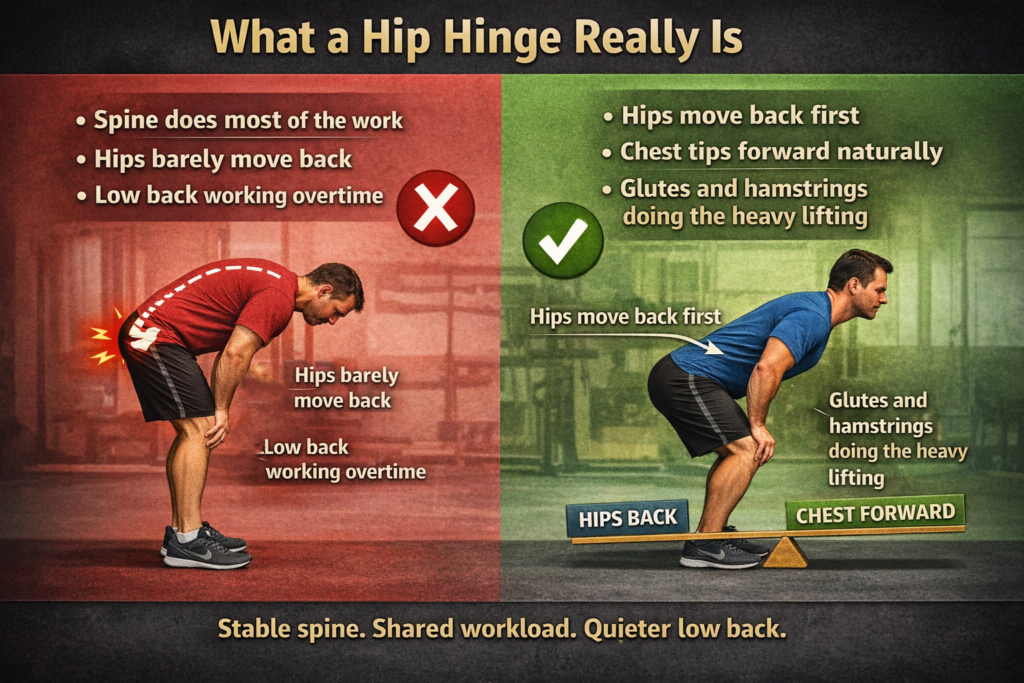
A hip hinge is bending from the hips while the torso tips forward, without turning the movement into a spine-folding contest.
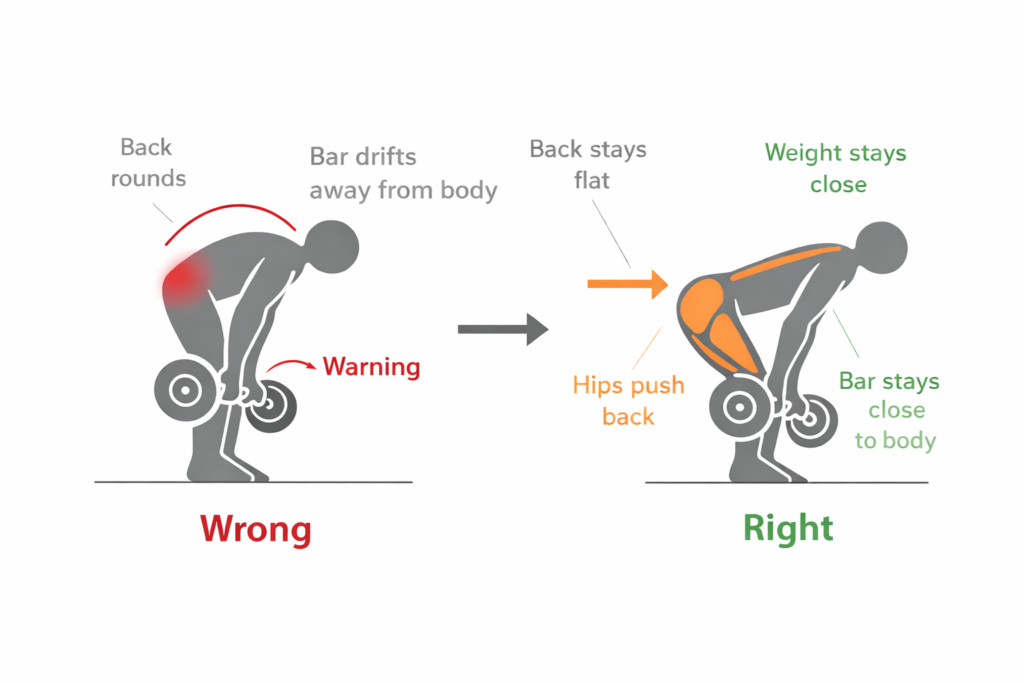
The goal is that the hips move backward as the chest goes forward, like a seesaw pivoting at the hip joints.
Knees can bend a little, but the star of the show is the hips shifting back, not the knees traveling forward.
If squatting is “down,” hinging is “back,” and that mental picture alone cleared up half my confusion.
A hinge is what you do in a deadlift, a Romanian deadlift, a kettlebell swing, and even when you pick up a box the way your future self won’t regret.
It’s also the pattern your body uses when it says, “Let the glutes and hamstrings do the heavy work, please.”
When that pattern is missing, the low back often tries to be helpful and ends up doing overtime.
And the low back does not get paid enough for that job.
Why the Low Back Complains When the Hinge Is Missing
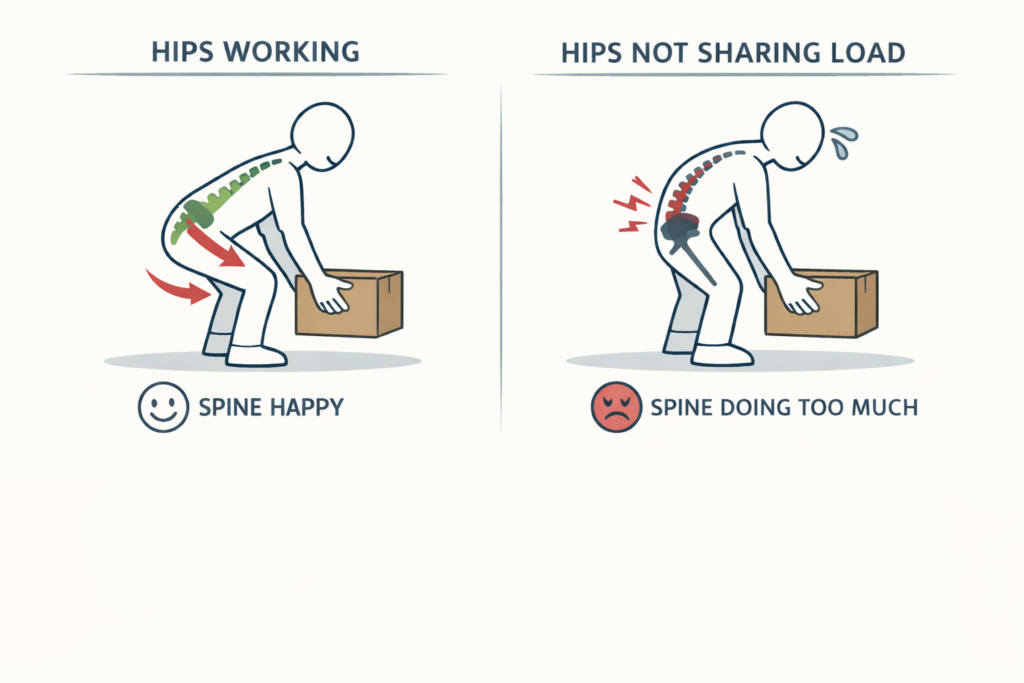
When the hips don’t move well, the spine usually moves more than it should to make up the difference.
That extra motion can be tiny, but under repeated reps or daily life bending, it adds up like small charges on a credit card.
The low back muscles also tend to stay tense because they’re trying to stabilize a position you’re not really owning.
So you get that familiar combo: stiffness, fatigue, and a weird “tight” feeling that stretching sometimes makes angrier.
The hinge is basically load-sharing.
If the hips take their portion of the work, the spine can stay stable and calm.
If the hips don’t show up, the spine becomes the main mover and the main stabilizer at the same time.
That’s like asking one employee to both drive the truck and lift all the boxes, then acting surprised when they quit.
When a Simple Bend Forward Exposed My Fake Hip Hinge
I started with a simple test:
I tried bending forward to reach my shins while keeping my knees only slightly bent.
When I did it “naturally,” I felt the pull mostly in my low back, and my hips barely moved backward at all.
That was my first clue that my default pattern was more “spine fold” than “hip hinge.”
It wasn’t about flexibility, it was about strategy.
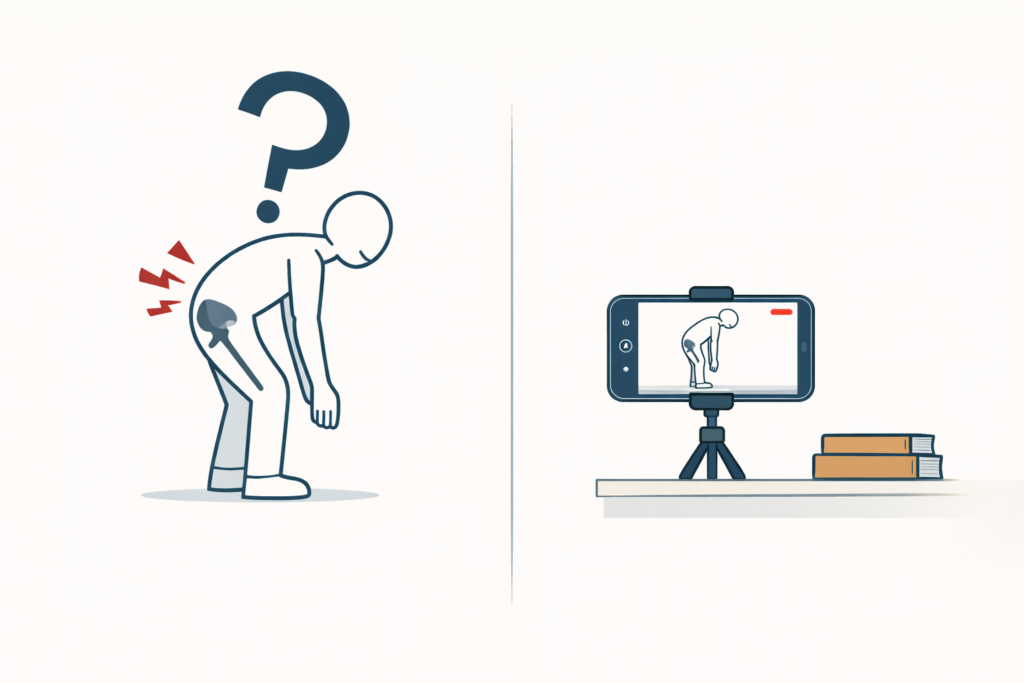
Then I filmed myself from the side with my phone propped on a shelf, because nothing builds humility like seeing your own form.
What I thought was a hip hinge was actually my ribs dropping forward, my lower back arching, and my hips drifting back only at the last second.
In my head I looked like a clean biomechanics diagram.
On video I looked like a question mark.
The “Wall Tap” Test That Exposed My Cheating
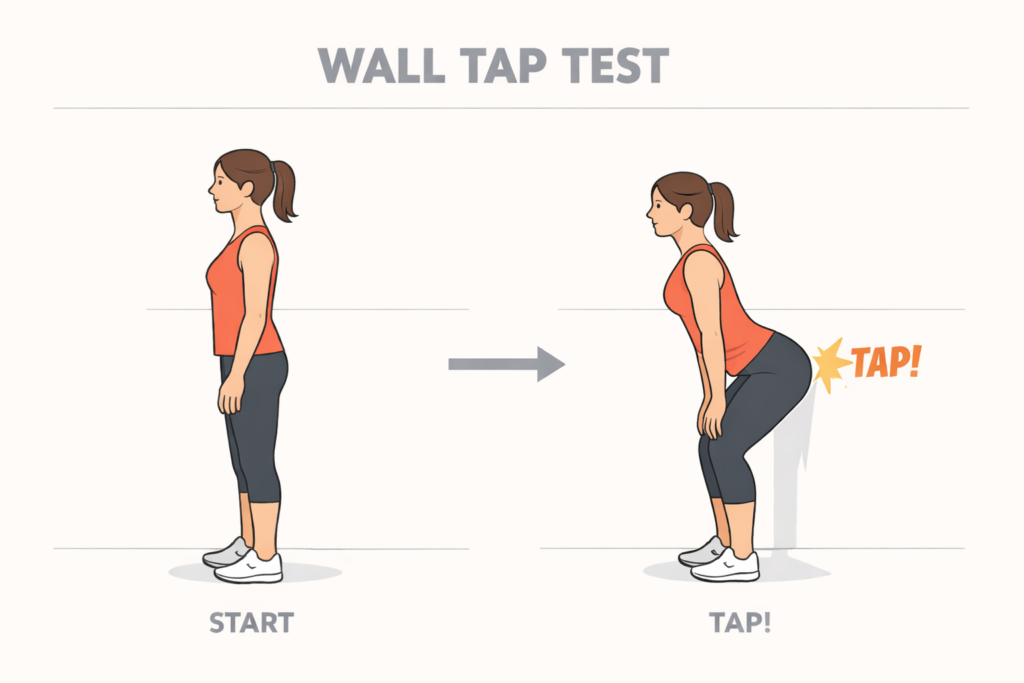
This one is almost embarrassing in its simplicity, which is why it works.
Stand about a foot away from a wall with your back facing it, feet about hip-width apart, and knees slightly soft.
Now try to push your hips back until your butt gently taps the wall, without turning it into a squat.
If you can’t reach the wall without bending a ton at the knees or rounding your back, the hinge pattern is probably not your default.
When I did it the first time, my knees shot forward like they were trying to win a race.
My hips barely moved back, and my low back felt like it was taking over again.
So I moved my feet closer, made the goal easier, and treated it like skill practice instead of a pass-or-fail exam.
That one adjustment made the drill feel like learning, not like failing.
The Dowel Drill That Made My Back Stop “Helping”
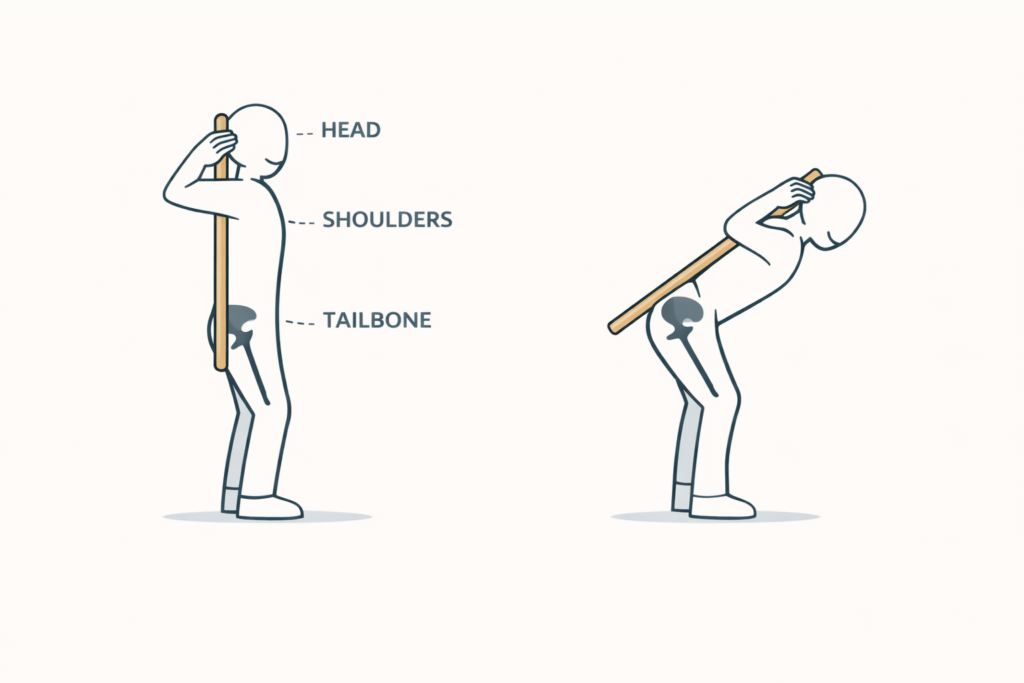
This drill looks like something a physical therapist invents on a slow afternoon.
You take a broomstick or dowel and hold it along your spine so it touches three points: the back of your head, the space between your shoulder blades, and your tailbone.
One hand holds the stick behind your neck, the other hand holds it behind your lower back, so it stays glued in place.
Then you hinge by pushing the hips back while keeping those three contact points.
The stick is basically a lie detector.
If you round your upper back, your head loses contact.
If you arch your lower back too much, your tailbone contact changes and you feel the stick shift.
When I finally got a few smooth reps where the stick didn’t wobble, my body instantly understood what “stable spine” actually felt like.
My Favorite “Beginner Hinge” Setup That Didn’t Trigger the Low Back
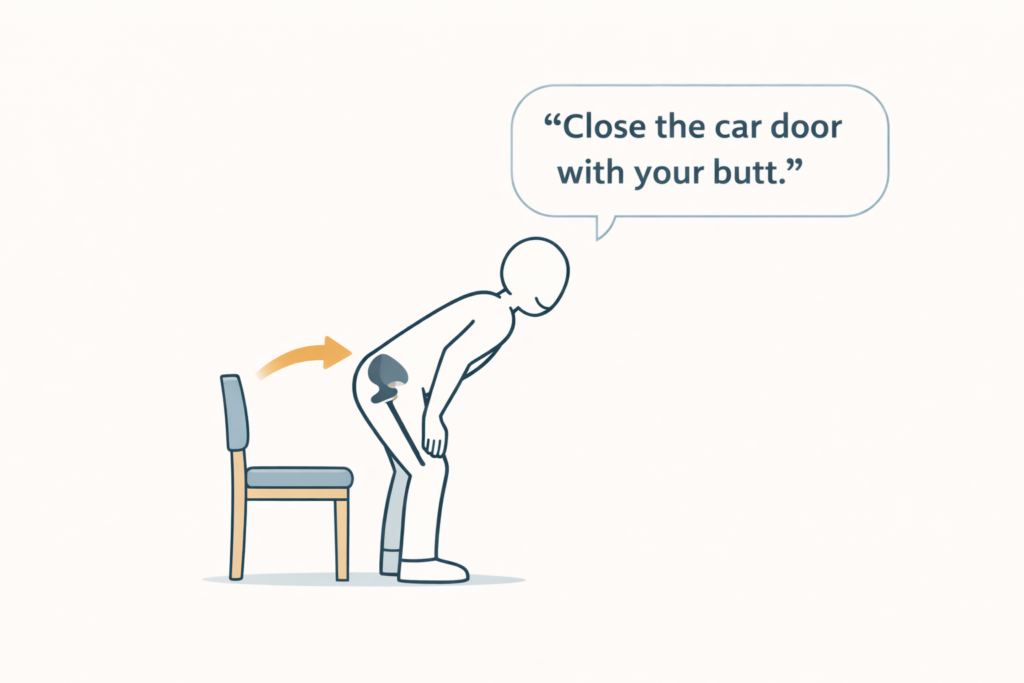
Even with the dowel drill, I needed a way to translate it into real movement.
What worked best was hinging to an elevated target, like a chair seat or the edge of a couch behind me.
The goal was to touch the target lightly with my hips, then stand back up by driving the hips forward.
That made the range of motion predictable and removed the urge to dive forward with my chest.
The cue that clicked for me was “close the car door with your butt.”
Not violently, not like a cartoon.
Just enough backward hip motion that you could imagine nudging something shut behind you while your torso tips forward naturally.
Once that cue landed, my hamstrings started to feel involved for the first time in months.
How I Learned to Feel the Right Muscles Without Guessing
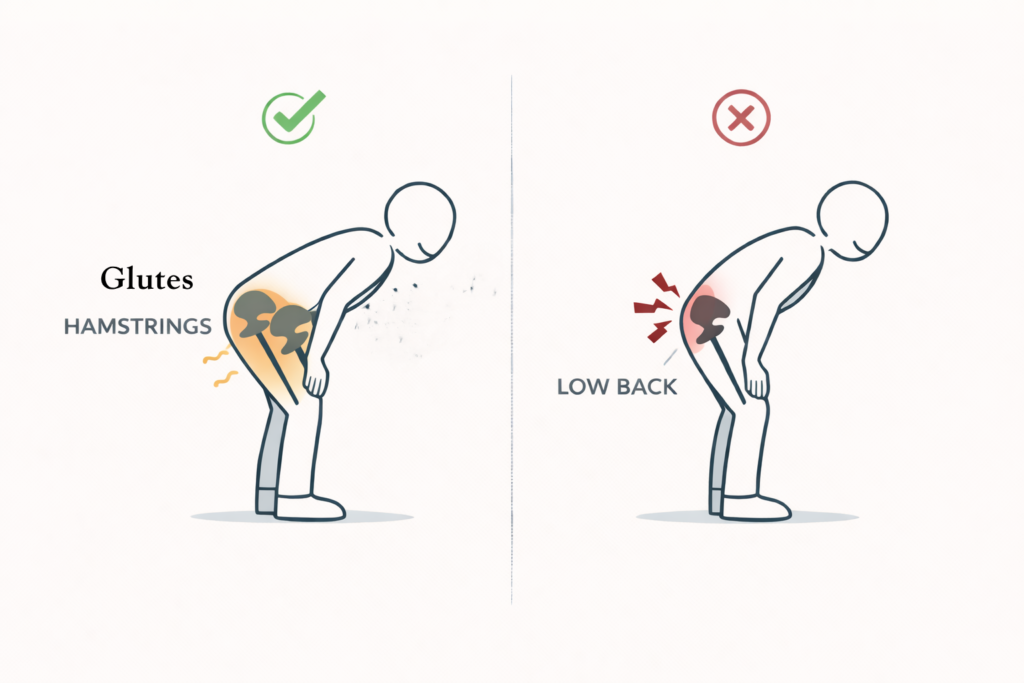
At first I kept asking, “Should I feel this in my hamstrings or glutes?”
The honest answer is: both, but not in a vague, mystical way.
In a hinge, hamstrings usually feel like they’re lengthening under tension as the hips go back.
Glutes usually feel like they’re driving you back to standing as the hips come forward.
The low back should feel present, but not dramatic.
More like a steady support beam, not like the main engine.
When the hinge was right, I felt a firm tension around my midsection and a strong stretch through the back of my thighs.
When it was wrong, I felt “pinchy” effort in the low back and almost nothing in the hamstrings.
Low-Back Relief Signals That? Told Me I Was On the Right Track
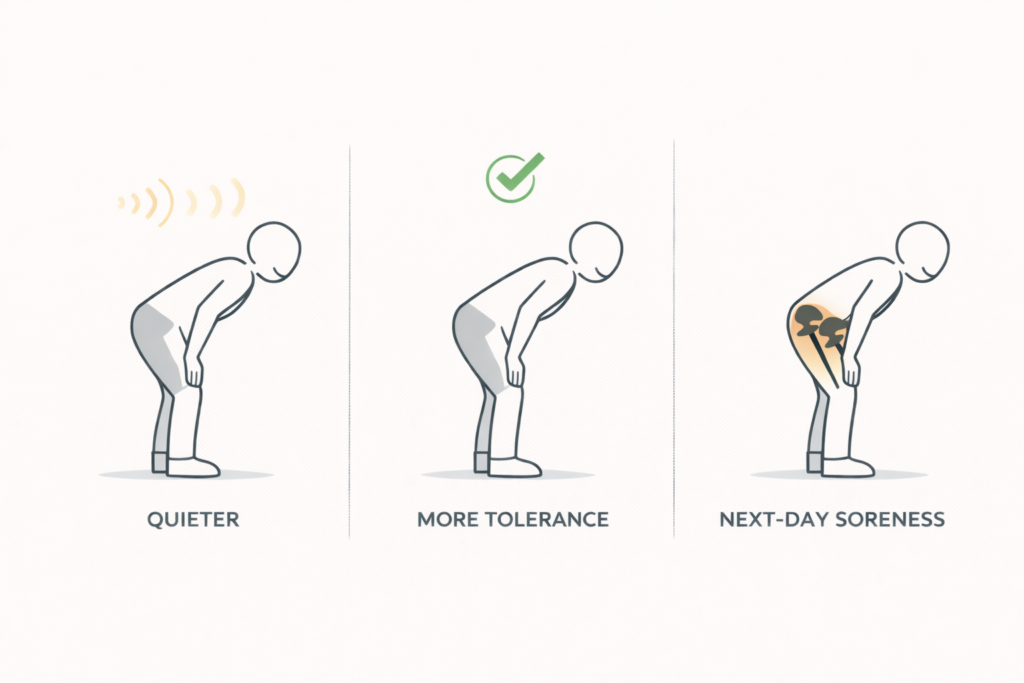
The first relief signal was weirdly simple: bending over started to feel quieter.
Not “magically healed,” just less noisy, like the movement had fewer complaints built into it.
When I hinged correctly, my low back didn’t tighten immediately afterward like it was bracing for impact.
Instead, I felt worked in the hips and legs, and my back felt… normal, which is an underrated feeling.
The second signal was improved tolerance.
I could do more reps of hinge drills, or hold the hinge position longer, without that creeping sense of low-back fatigue.
It felt like the load moved from a sensitive area to a sturdier one.
That shift is basically the whole point.
The third signal was next-day feedback.
After a good hinge practice session, my hamstrings might feel mildly sore in a “training” way, and my glutes felt like they actually participated.
My low back didn’t feel stiff in the morning like it was made of cold plastic.
That difference helped me trust the process more than any motivational quote ever could.
The Breathing Detail That Changed Everything (Without Being “Woo”)
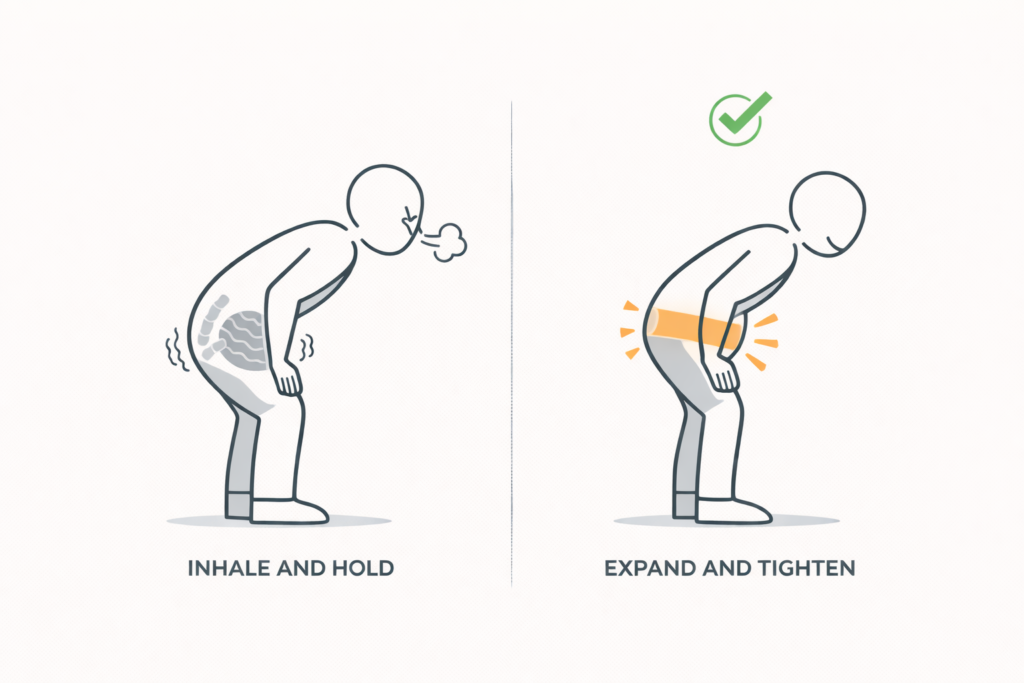
I used to brace by inhaling and holding my breath like I was preparing for a trampoline accident.
That made me rigid, but not stable.
What worked better was learning to breathe “into the belt area,” even without a belt.
Think of expanding the ribcage and abdomen gently in all directions, then tightening as if you’re about to cough, but at about a 6 out of 10 effort.
The goal is not a permanent crunch.
It’s a supportive cylinder that helps the spine stay steady while the hips move.
When I did this right, my hinge instantly felt smoother and less back-dominant.
It was like upgrading from balancing a book on your head to using a proper shelf bracket.
Drills I Kept Coming Back To (Because They Actually Helped)
The wall tap stayed in my routine because it was quick and brutally honest.
A handful of slow reps reminded my body that hips go back first, not knees, not spine.
I treated it like practicing a guitar chord: clean reps mattered more than more reps.
That mindset kept me from turning drills into another workout I’d “win” by rushing.
The dowel hinge stayed because it taught me spinal control without overthinking.
A few reps before training made my deadlift setup feel more organized.
If the stick stayed stable, I knew my spine was doing its job and could stop micromanaging.
Less micromanaging is basically my lifelong goal.
The elevated target hinge stayed because it built confidence.
It gave me a safe range, a consistent bottom point, and a clear way to stand up using the hips.
Once that felt good, I lowered the target gradually over time, but only when the low back stayed calm.
No calm back, no deeper range, and that rule saved me from my own enthusiasm.
How I Gradually Reintroduced Loaded Hinges Without Angering My Back
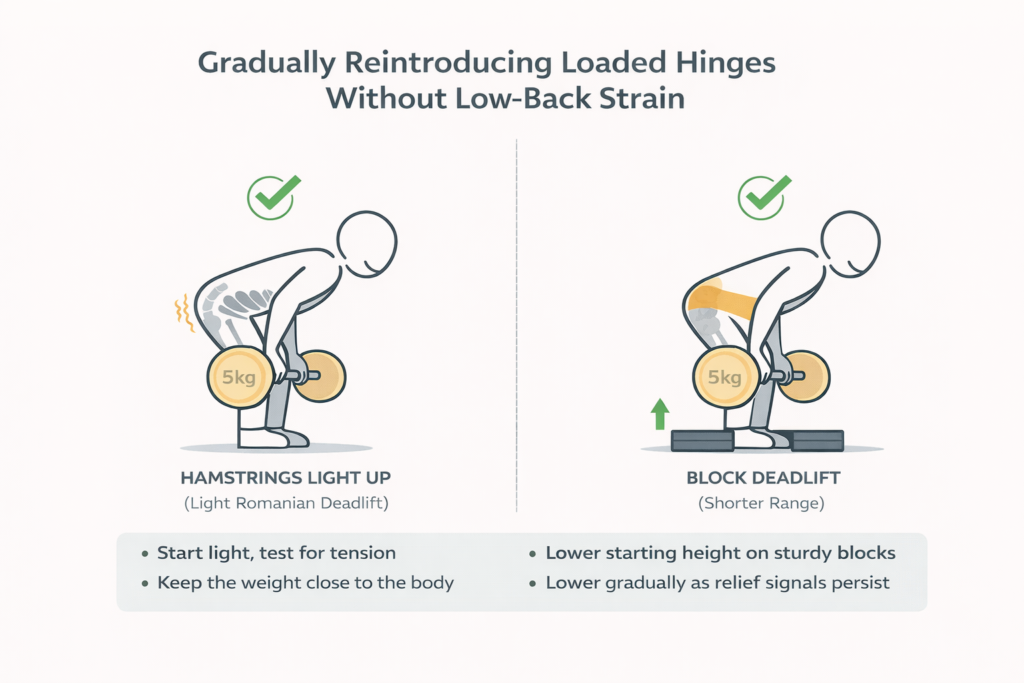
I started with very light weight, sometimes laughably light.
That was not a moral failure, it was data collection.
If a light Romanian deadlift pattern still made my low back feel tense and cranky, heavier weight wasn’t going to “fix it with confidence.”
So I earned load by earning clean reps.
A Romanian deadlift is a hinge where you hold a weight and slide it down the thighs toward the knees or shins while pushing hips back.
Knees stay slightly bent, shins stay mostly vertical, and the spine stays stable while the hips move.
The weight should stay close to the body like it’s on a rail, not drifting forward like you’re offering it to the room.
When I kept it close and moved slowly, hamstrings lit up and my back stayed quiet.
I also used a “deadlift from blocks” idea, meaning I raised the weight on sturdy supports so I didn’t start from the floor.
That reduced the range and made it easier to keep position.
Starting higher let me own the hinge without collapsing into a rounded back at the bottom.
Then I lowered the starting height only when the relief signals stayed consistent.
The Small Signals That Told Me My Hinge Was Off
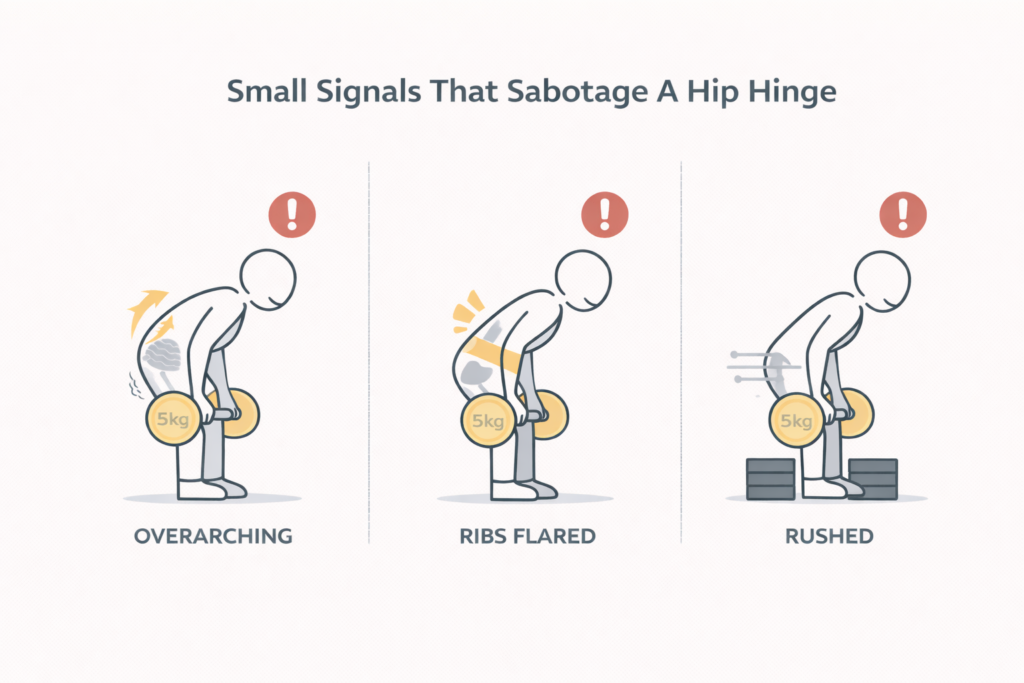
What felt wrong at first wasn’t pain.
It was how much effort it took just to keep each rep together.
Everything felt busy instead of solid.
That’s usually a sign the pattern isn’t doing its job.
One clear signal was how hard I was arching my lower back to “stay neutral.”
The hinge looked stable, but it felt stiff and overcontrolled.
Once I stopped forcing the arch and found a comfortable middle position, the hips started moving more freely.
The back immediately stopped trying to dominate the rep.
Another signal came from my ribcage.
Whenever things felt awkward, my ribs flared up as if lifting my chest would fix it.
It didn’t.
It just disconnected my brace and pushed more work into the low back.
The last signal was speed.
Rushing the descent made everything vague.
Slowing down brought back hamstring tension, kept the bar close, and made the hinge feel intentional again.
A good hinge didn’t need attention — it rewarded patience.
A Simple Checklist I Used Mid-Rep
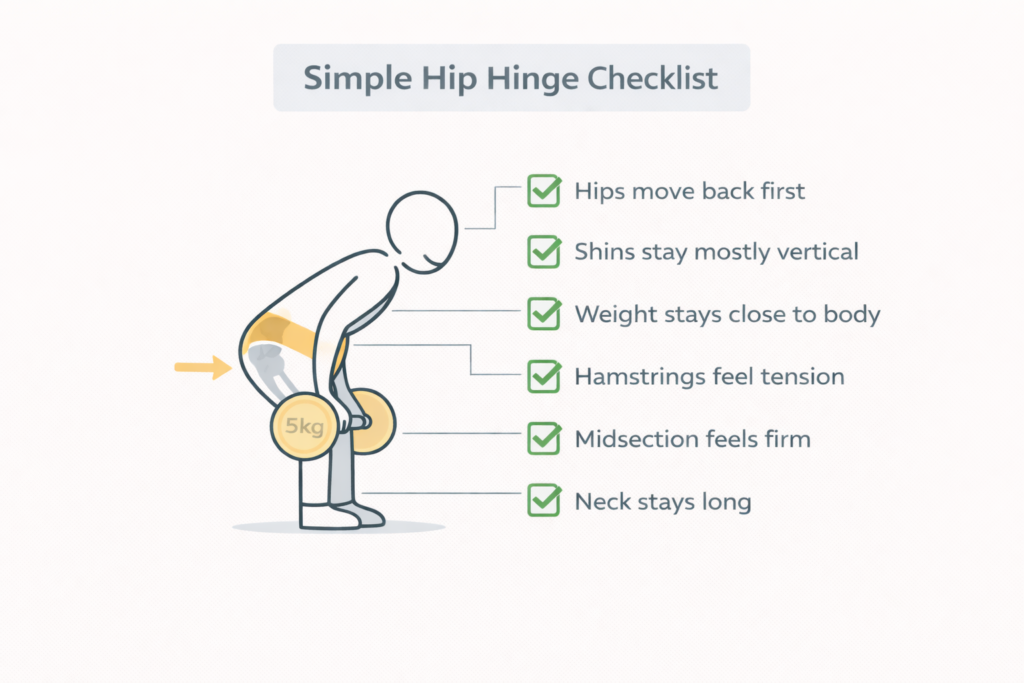
Hips move back first.
Shins stay mostly vertical.
Weight stays close to the body.
Hamstrings feel tension building as I go down.
Midsection feels firm, like a supportive belt.
Back feels steady, not strained.
Neck stays long, not cranked up like I’m searching for ceiling secrets.
Standing up feels like hips driving forward, not like yanking with the back.
If two or three of those points disappeared, I treated it as a sign to reduce range, reduce load, or stop.
Not because I’m fragile, but because I wanted the hinge to become reliable.
Reliable beats heroic.
Heroic reps are how the low back ends up writing angry emails.
How I Learned to Read a Rep While It Was Happening
I stopped trying to remember cues and started noticing how a rep felt.
If the hips didn’t move back right away, the rep usually felt noisy.
When things were working, my shins barely moved and the weight stayed close without effort.
Tension built gradually through the hamstrings, not suddenly in the back.
My midsection felt firm but not clenched.
The spine felt supported, not locked.
Standing up told the truth.
If the hips drove the movement, the rep felt clean.
If my back yanked me upright, it felt borrowed.
When several of those sensations disappeared at once, I stopped.
Not because I’m fragile, but because I wanted the hinge to be reliable.
Reliable reps built confidence.
Heroic reps just gave my low back something to complain about later.
When I’d Stop Self-Testing and Talk to a Pro
If pain is severe, persistent, or getting worse, guessing games stop being cute.
If symptoms travel down the leg, include numbness or weakness, or affect bladder or bowel control, that’s not “tight muscles,” that’s a medical conversation.
Even without scary symptoms, a good physical therapist can spot patterns you can’t see.
A hinge is a simple idea, but bodies are wonderfully complicated machines.
RELATED:》》》 I Trained With Perfect Form, Then Pushed Volume — Here’s What Broke (and What Didn’t)
Closing Thoughts: The Win Isn’t Perfect Form, It’s Predictable Relief
The biggest change for me wasn’t becoming a hinge robot with flawless angles.
The change was that my back stopped feeling like a fragile alarm system.
I learned what positions calmed it down, what cues brought the hips online, and what signals meant “yes, this is helping.”
That’s realistic progress, and it’s honestly the kind that lasts.
If the low back has been doing too much, learning to hinge is like finally assigning tasks to the right department.
It’s not instant, and it’s not glamorous, but it’s empowering in a quiet way.
Keep reps controlled, keep expectations sane, and let the relief signals guide you instead of ego.
Your back will probably still be dramatic sometimes, but at least it won’t be doing everyone else’s job.