I learned about the towel-push-up thing in the most random way possible.
One morning at the gym, a guy next to me was doing push-ups like he was trying to start a lawnmower.
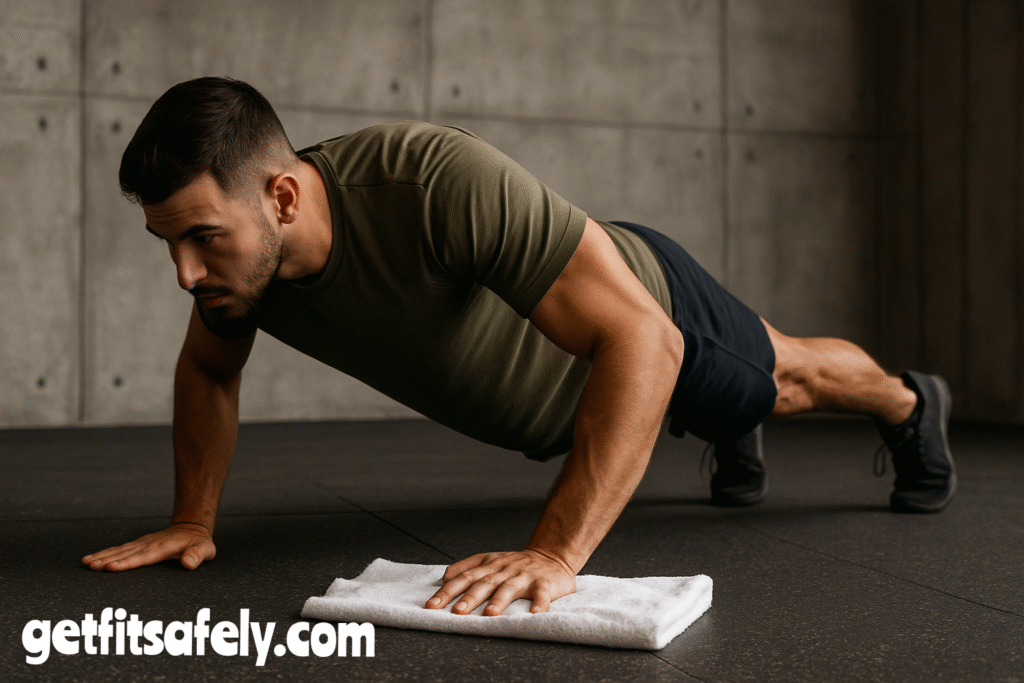
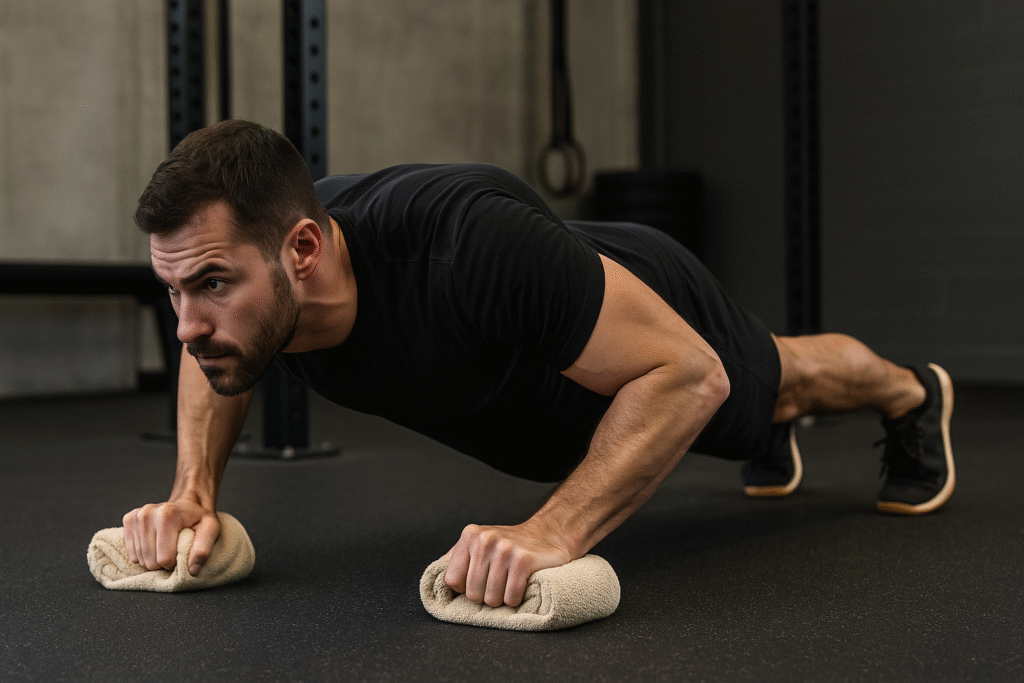
Hands wrapped around two rolled towels.
Knuckles white.
Forearms popping like he was auditioning for an anatomy chart.
And he just goes, “Bro, try it. Trust me.”
So obviously I tried it.
And yes… it hits differently.
But let’s break down why, without getting too nerdy or sounding like a walking textbook.
Forearm Activation in Push-Ups: What Actually Changes?
When you do a standard push-up, your hands are flat.
Your fingers spread out.
Your palms carry part of the load.
Your forearms stabilize, sure… but they’re chilling.
They’re not exactly clocking in for overtime.
Now wrap your hands around a towel.
Suddenly your grip becomes a priority.
You’re not just pushing your body away from the floor.
You’re squeezing something while pushing, which changes the whole vibe.
That little squeeze forces your forearm flexors and wrist stabilizers to join the party.
In biomechanics terms, you’re increasing isometric demand in the hand and forearm because you’re resisting the towel slipping out.
It’s like turning a regular handshake into a “my uncle does construction” handshake.
Why Squeezing the Towel Creates That Extra Engagement
Picture your body as one long chain.
When one link tightens, the whole chain reacts.
By gripping something during a push-up, you create radiant tension — kind of like when you brace your core harder just because you squeeze your fists.
It’s the same trick lifters use when they crush a barbell before pressing.
Your nervous system loves efficiency, so when your hand grips harder, it sends a signal down the chain that stabilizes the wrist, the elbow, and even the shoulder.
More tension = more muscle recruitment.
Simple as that.
But here’s the catch.
More tension also means more fatigue.
So don’t be shocked if your set numbers drop faster than your motivation on leg day.
When Towel Push-Ups Decided to Humble Me in 10 Seconds
I went in overconfident.
I thought, “Eh, I do push-ups every damn week. What’s this gonna change?”
Then I wrapped the towels, planted my hands, and started rep one.
Instant forearm pump.
By rep six, I felt like I was squeezing two vipers trying to escape.
By rep ten, my forearms were begging for a union break.
And weirdly… I loved it.
It felt like someone handed me a tiny upgrade without forcing me to learn a whole new exercise.
Just a towel.
A towel.
The cheapest forearm accessory ever.
A Smooth Transition: What Towel Grip Push-Ups Actually Teach Your Body
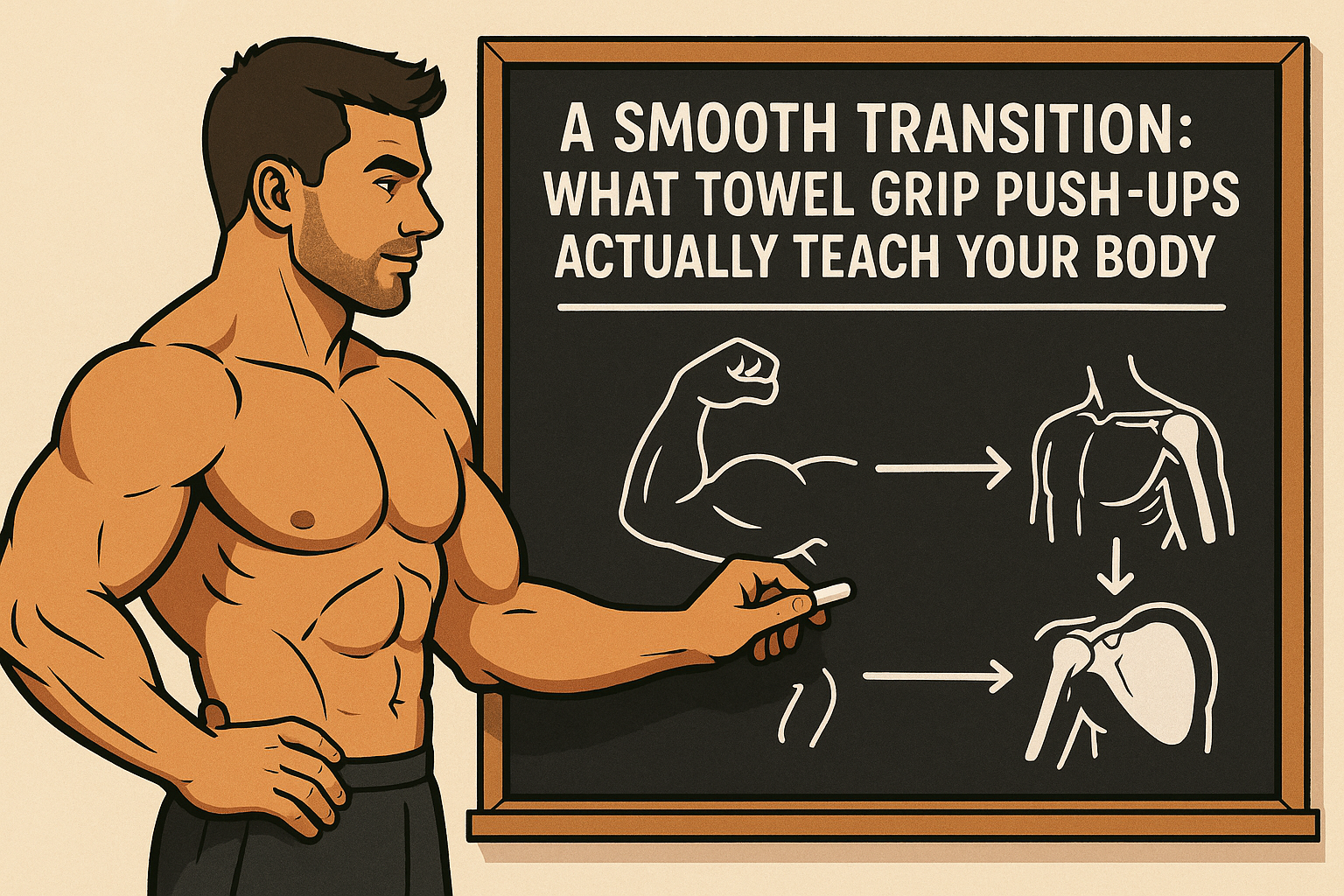
Another thing I noticed over time was how much more stable my wrists started to feel.
If you ever feel wrist strain during push-ups, gripping a towel shifts the stress point.
Instead of dumping load into that passive, bent wrist position, you create a neutral wrist angle — kind of like holding a dumbbell.
Neutral = happier joints.
Happier joints = more reps.
It also teaches your forearms to stay “switched on,” which carries over to other movements:
- Pull-ups feel steadier
- Rows feel stronger
- Handstands feel less shaky
- Even farmer’s carries feel cleaner
It’s one of those subtle training tweaks that sneaks into everything else.
When Towel Grip Push-Ups Are Actually Worth Doing
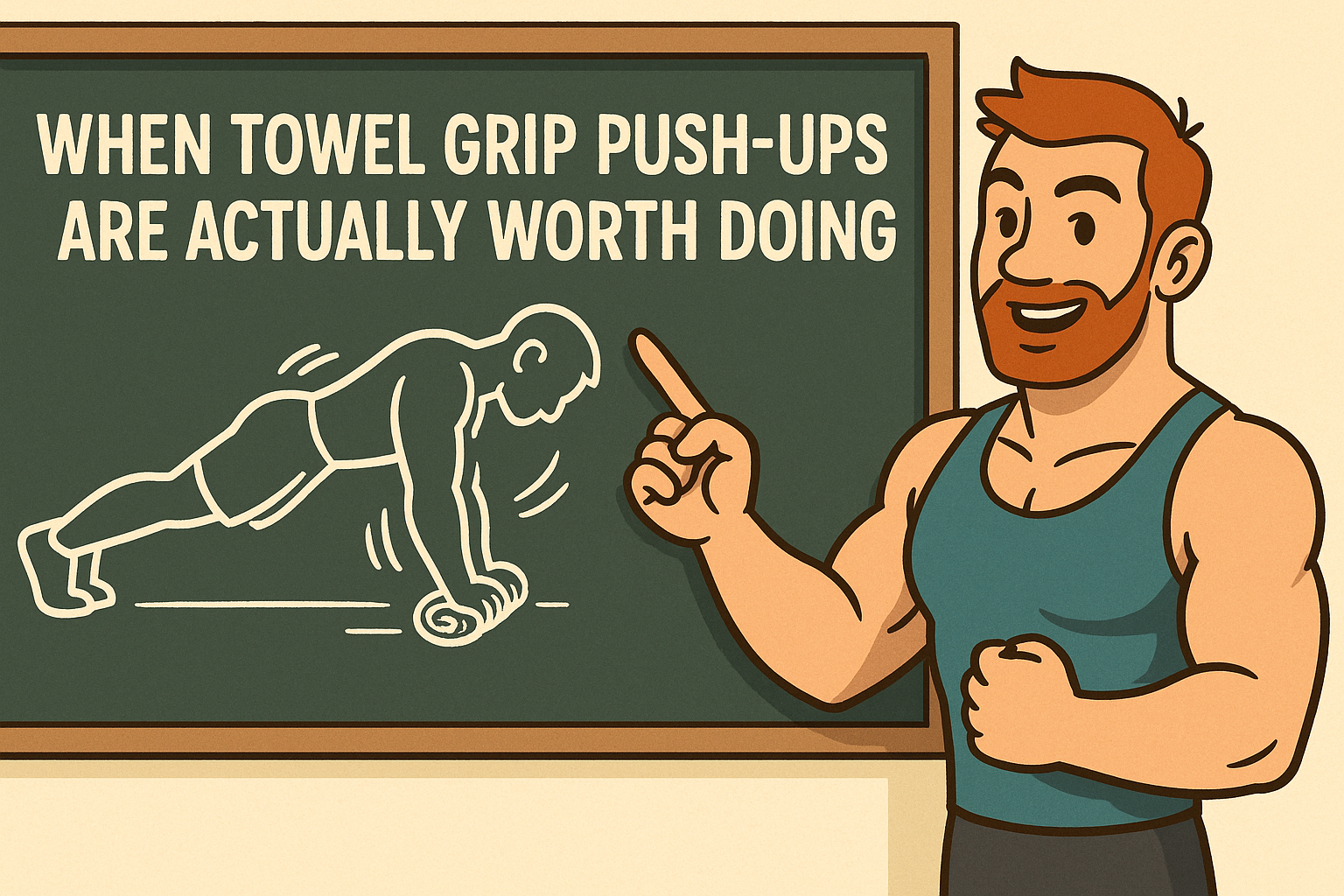
Not every variation is worth keeping long-term.
But this one earns its spot if:
- Your forearms are a weak link
- Your wrists hurt in regular push-ups
- You want more grip stamina without adding extra isolation work
- You do calisthenics and need stronger wrist control
- You want a small challenge without overcomplicating your routine
It’s basically a two-for-one deal.
Push-up + grip work at the same time.
No extra equipment.
No excuse.
Keeping It Honest: A Simple Trick, Not a Superpower
I’ll be straight with you.
Towel grip push-ups won’t suddenly turn your forearms into steel cables.
They probably won’t give you Popeye forearms on their own.
And they don’t replace real grip training like dead hangs, heavy rows, or fat-grip work.
But they do offer something unique:
A way to wake up muscles that usually coast through push-ups.
A way to test your wrist strength without pain.
A way to make a bodyweight staple feel fresh again.
What’s Actually Going On Inside the Movement
When your hands squeeze, the flexor digitorum superficialis, flexor digitorum profundus, and flexor carpi radialis fire hard to hold the towel.
Meanwhile your wrist stabilizers lock in to keep the towel from twisting.
This reinforces co-contraction, which is just a fancy way of saying both sides of the joint are working together to keep you from wobbling.
That added stability gives your shoulders a smoother platform to press from.
And if you’ve ever had a shoulder tweak from sloppy push-ups, you’ll know how valuable that is.
Basically, better grip → better joint alignment → better pressing.
All from a towel.
I still can’t get over that.
RELATED: »» Can a Push-Up Hold Actually Increase Muscle Gains?
How to Add Towel Grip Push-Ups to Your Training
You don’t need to go crazy.
Start with one set.
Even half a set.
Your forearms will tell you when they’ve arrived at the party.
A simple approach:
- Do your normal push-ups first
- Add 1–2 sets of towel grip versions after
- Keep reps moderate (6–12 is plenty)
- Stop before form gets sloppy
If you want extra spice, try elevating your feet or slowing down the eccentric.
But honestly?
Even the basic version hits plenty hard.
Do They Boost Strength or Just Burn Your Forearms Out?
Both, technically.
The added squeeze creates more neural drive — meaning your muscles respond faster and fire harder.
But the limiting factor becomes endurance.
Your forearms will tap out before your chest does.
That’s not a bug.
That’s the feature.
So if you want your push-ups to turn into a forearm-first battle, you’re in the right place.
If you want pure chest work, stick to the classics.
Comparing Other Grip Variations
A while back I started comparing the towel version with other grip-heavy push-up styles just to see how big the difference really was.
Because over the years I’ve done them all — knuckles, fingertips, parallettes, thick handles… you name it.
And each of them hits in a slightly different way.
Knuckle push-ups put your wrist in a comfortable neutral position, but the grip isn’t doing much.
You’re balancing, not squeezing.
Fingertip push-ups light up the hands, sure, but they’re a different beast.
You’re pushing with the ends of your fingers, not clamping around something.
Parallettes and fat-grip handles give you stability and a nice neutral wrist angle, and a thicker handle does challenge the grip…
But not in that “don’t let this thing slip out of my hands” kind of way.
And that’s the magic of the towel.
It moves a little.
It twists a little.
It feels alive in your hands.
That tiny instability forces your forearms to stay present — not just supporting, but actively working every second.
It’s like the difference between holding a solid metal bar…
and holding a sandbag that shifts just enough to make you pay attention.
How Much Does Forearm Activation Actually Increase? A Straight, Honest Answer
So let’s answer the real question people actually have.
“Does gripping a towel really increase forearm activation? And by how much?”
There’s no official percentage.
No EMG chart.
No PhD treadmill lab where someone measured towel squeeze dynamics.
But here’s what we do know — from biomechanics, from coaching, and from real-world experience:
- Activation goes from “background noise” to “this is legit work”
- The forearms become the first muscle group to fatigue
- The squeeze creates constant tension instead of passive contact
- Stabilizers fire earlier and stay on for the entire set
- Neural drive increases because your brain interprets slipping as a threat
In simpler words:
Yes, gripping a towel boosts forearm activation — enough that you feel the difference immediately and your set ends because of grip, not chest.
That alone is already proof.
Is it life-changing?
No.
Is it a smart, simple, brutally effective tweak to wake up your grip during a familiar exercise?
Absolutely.
RELATED: »» Progressive Push-Up Steps for Calisthenics
And What About Towel Pull-Ups?
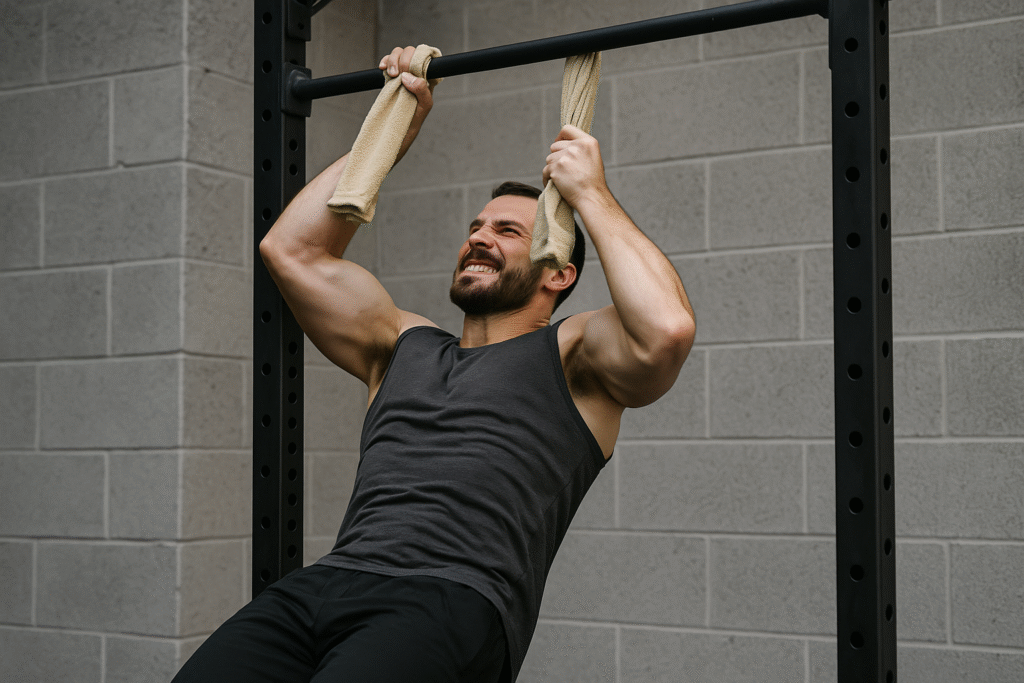
And honestly, once you start playing with towel grip push-ups long enough, there’s always that moment where you look at the towel and think,
“Okay… but what if I pull with this thing too?”
That’s how towel pull-ups enter the chat.
They’re not a replacement for the push-up variation — they’re the dramatic cousin that shows up with way more intensity than anyone asked for.
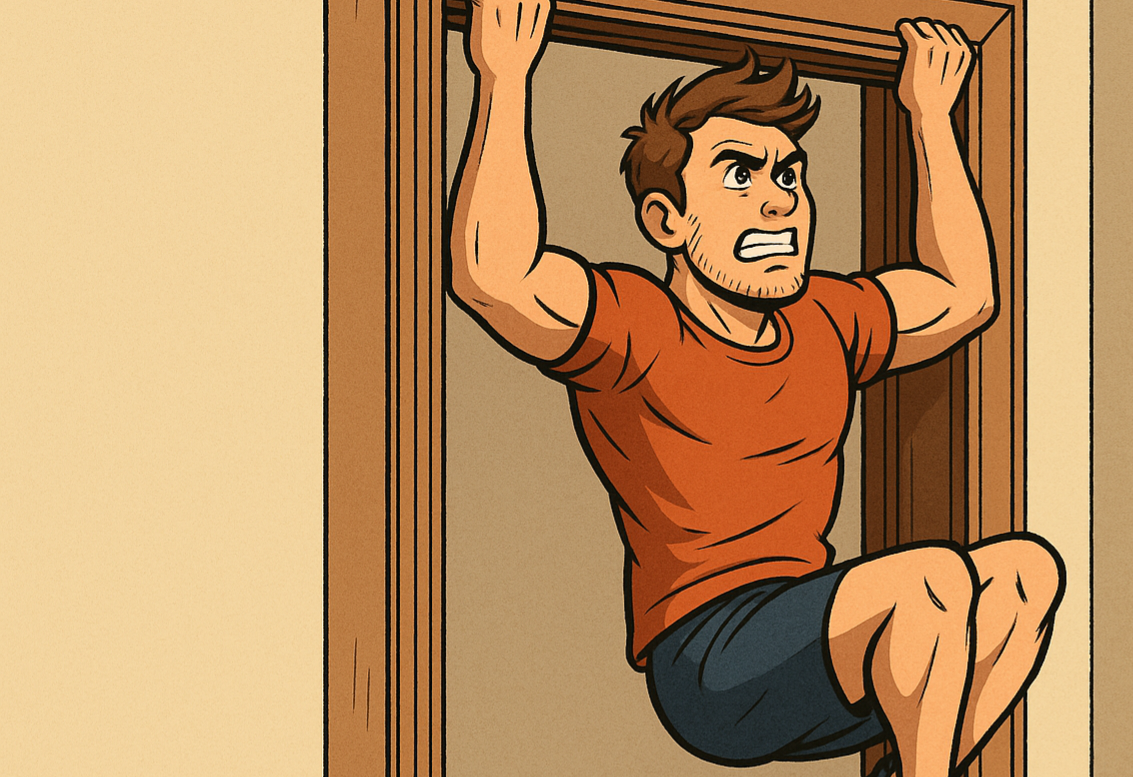
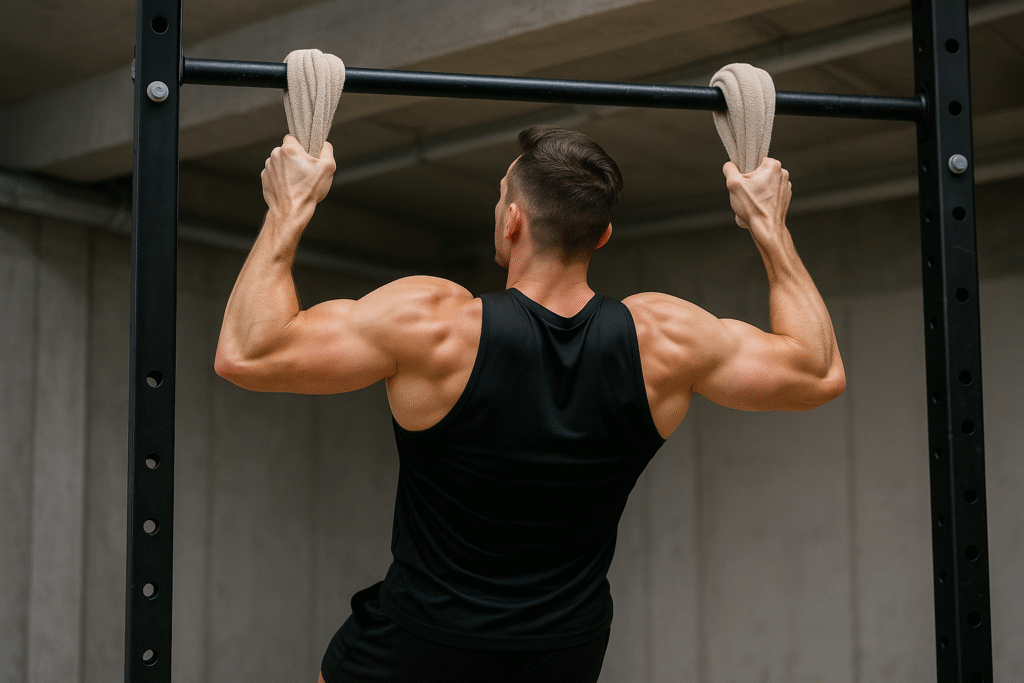
You grab the towel.
You hang.
And instantly your forearms behave like they’re auditioning for a firefighter test.
The towel doesn’t sit still.
It rolls.
It folds.
It shifts just enough to make every rep feel like you’re trying to hold onto something that’s trying to escape.
Compared to the slow, steady burn of towel push-ups, towel pull-ups are pure “grip or fall.”
Push-ups teach control.
Pull-ups teach commitment.
Put the two together and suddenly your forearms respond differently in everything you do — rows, hangs, carries, climb-style movements.
Curious Little Moments You Only Get With Towel Pull-Ups
The First-Rep Shock
Your brain instantly realizes this is not a bar.
You feel every wrinkle of the towel.
Every slip of the fabric.
Every micro-adjustment your wrist has to make.
You’re not just pulling — you’re negotiating.
That Rope-Climb Flashback
Towel pull-ups feel like adult rope-climbing without the gym-class trauma and the itchy fibers.
It’s primal.
Instinctive.
And surprisingly humbling.
The “My Grip Isn’t Ready For This” Realization
Even strong lifters tap out fast the first time.
Your forearms send a memo that says:
“Hey, we were not informed about this meeting.”
Practical Towel Pull-Up Exercises You Can Add Right Now
Here’s where the towel actually becomes fun.
These variations make your forearms wake up without needing extra equipment.
Standard Towel Pull-Ups
Loop a towel over the bar.
Grab both ends tight.
Pull yourself up like you mean it.
Two or three good reps feel like ten on a normal bar.
Alternating Grip Towel Pull-Ups
Grab the towel with one hand.
Grab the bar with the other.
Pull.
Switch sides each rep.
Your dominant side will pretend everything is fine.
Your weaker side will immediately file for help.
Towel Neutral-Grip Pull-Ups
Fold the towel so the ends hang down like two handles.
Grab both ends close to your chest.
Pull up with a neutral grip.
This hits a different forearm chain and feels like half pull-up, half tug-of-war.
Towel Pull-Up Holds
Get to the top of the pull-up.
Hold for 3–5 seconds.
Lower slowly.
Repeat for 3–5 reps.
This builds grip toughness in a way bars simply don’t replicate.
Partial Towel Pull-Ups
Do a small range of motion — even half reps or quarter reps.
The forearm activation is still absurd.
Perfect for beginners or anyone just trying to “taste” the movement.
Towel Dead Hangs
Grab the towel.
Hang for 5–12 seconds.
Rest.
Repeat.
It’s simple and evil at the same time.
Extra Towel-Based Exercises to Build a Full Grip Routine
If you want to combine towel push-ups and towel pull-ups into a weekly routine, these extra moves blend perfectly with both.
Towel Assisted Archer Push-Ups
Hold the towel with both hands.
Shift your weight side to side.
Each side stabilizes independently.
Single-Arm Towel Push-Up Hold
Grab the towel with one hand.
Lower and hold the bottom position.
It’s pure forearm fire.
Standing Towel Reverse Curls
Wrap a towel around a dumbbell.
Grab the ends.
Curl with control.
This nails the brachioradialis in a way bars don’t.
Towel Push-Up Walkouts
Grip the towel.
Walk your hands forward.
Walk them back.
Forearms + core = chaos.
Low Bar Towel Rows
Loop the towel on a low bar.
Row your body upward.
The vertical grip angle changes the entire feel.
Towel Farmer Carries
Wrap a towel around a heavy dumbbell.
Grab the ends.
Walk.
Your fingers work overtime.
Conclusion
Here’s the part I love most about this variation.
You don’t need to reinvent your program.
You don’t need to learn a whole new movement pattern.
You just add a towel, grip it like it owes you money, and feel your forearms light up.
Small change.
Big impact.
And in a world where everyone is hunting for the next “wild new exercise,” sometimes the best upgrades are the quiet ones that slip under the radar.
So throw a towel on the floor next time.
Give it a squeeze and feel the difference.
FAQs — Towel Grip Push-Ups & Forearm Activation
Do towel grip push-ups actually increase forearm activation?
Yes.
The squeeze forces your forearm flexors and wrist stabilizers to work harder than in a flat-hand push-up.
Most people feel the increase immediately because the forearms become the first muscle group to fatigue.
Are towel push-ups good for people with weak wrists?
They can be.
Wrapping your hands around a towel creates a more neutral wrist angle, similar to gripping a dumbbell, which often reduces discomfort.
But if you already have pain, start slow and test how your wrists respond.
Do towel push-ups build more hand strength?
They build functional grip tension, not maximum strength.
They teach your hands to stay “on” during a movement, which carries over nicely to calisthenics, rows, and pressing stability.
Are towel grip push-ups better than regular push-ups?
Not better — different.
They’re great if you want extra forearm engagement or a variation that feels more “alive” without changing the whole exercise.
Regular push-ups are still king for chest and shoulder volume.
How often should I include towel grip push-ups?
2–3 times per week is more than enough.
Use them as an accessory, not as your main push-up variation.
Can towel grip push-ups improve my pull-up performance?
Indirectly, yes.
Stronger forearms and better grip endurance translate into cleaner pull-ups, especially in higher rep sets or longer holds.
Are towel pull-ups better for forearms than towel push-ups?
They hit harder.
In towel pull-ups you’re supporting your entire bodyweight, so the forearm flexors work at near-max intensity from the first second.
Push-ups create continuous tension, but pull-ups create maximal tension.
Do towel pull-ups help with rock climbing or calisthenics?
Totally.
Climbers love them because they simulate rope holds.
Calisthenics athletes use them to build the crushing strength they need for advanced pull variations.
Is it normal for towel pull-ups to feel way harder than bar pull-ups?
Very normal.
You’re gripping a soft, shifting surface instead of a rigid bar.
Your stabilizers work overtime just to keep you from peeling off the towel.
Should I combine towel pull-ups and towel push-ups in the same program?
Absolutely.
Push-ups train continuous forearm tension.
Pull-ups train max grip strength.
Together they give your forearms a more rounded stimulus without needing extra isolation work.