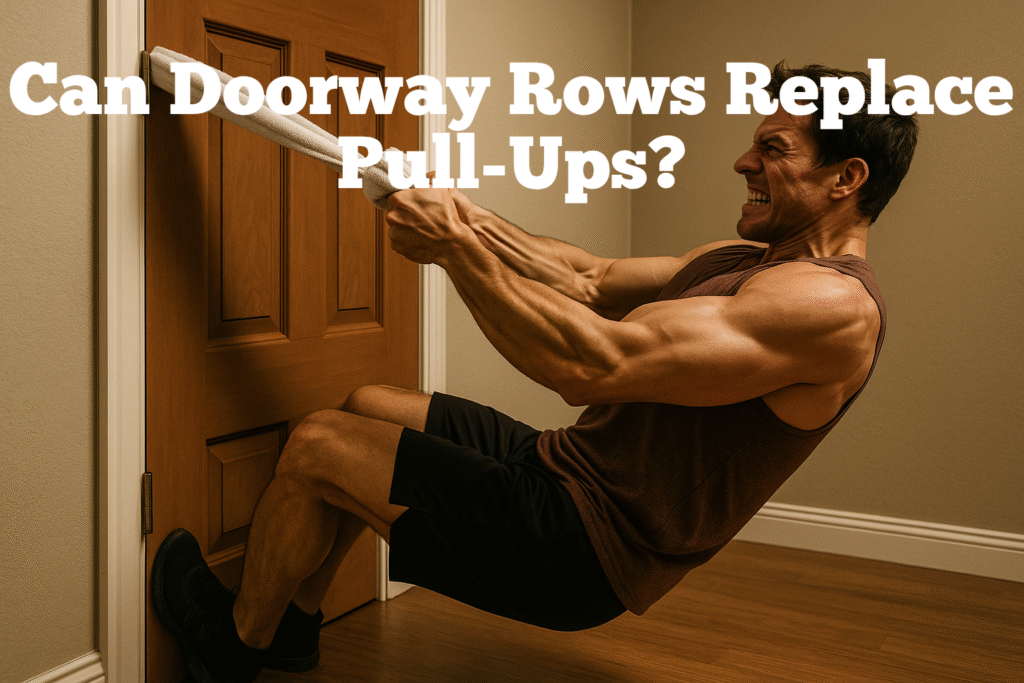
Picture someone gripping a towel wedged in a doorframe, leaning back, and pulling like their life depends on it.
It’s an oddly heroic sight — half MacGyver, half Rocky Balboa — and somehow, it works.
No gym, no pull-up bar, just pure determination and a bit of faith in the strength of that door hinge.
Doorway rows became a home workout legend during lockdowns, and for good reason.
They’re simple, effective, and kind of fun.
But can they actually replace pull-ups for the long haul, or are they just a temporary fix for desperate times?
That’s the real question.
Doorway rows: the low-tech back builder
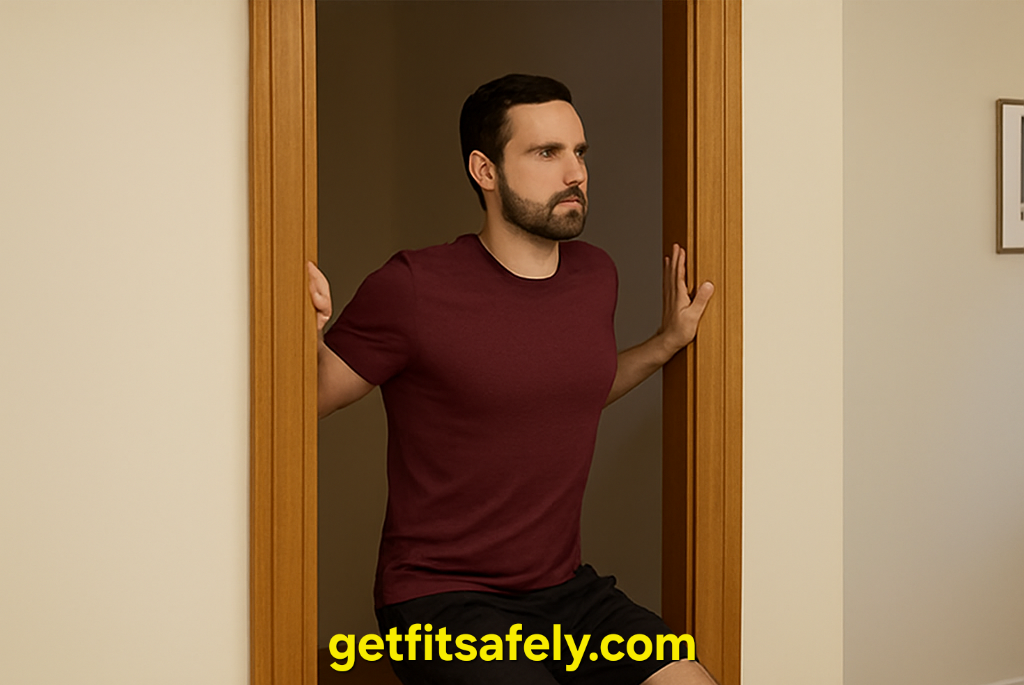
All that’s needed is a towel, a solid door, and enough courage to trust your bodyweight on it.
Hook the towel on the hinge side, grab both ends, lean back, and start pulling your chest toward the door.
That’s it.
It’s a horizontal row — the body moves back and forth instead of up and down.
It hits the lats, traps, rhomboids, and biceps — the same squad that fires during pull-ups.
But the angle changes everything.
Pull-ups challenge the body vertically against gravity, maximizing tension through the lats.
Doorway rows shift the effort horizontally, reducing load but improving control.
In plain English: you’re still working hard, but you’re not lifting your full weight.
Muscles worked in doorway rows
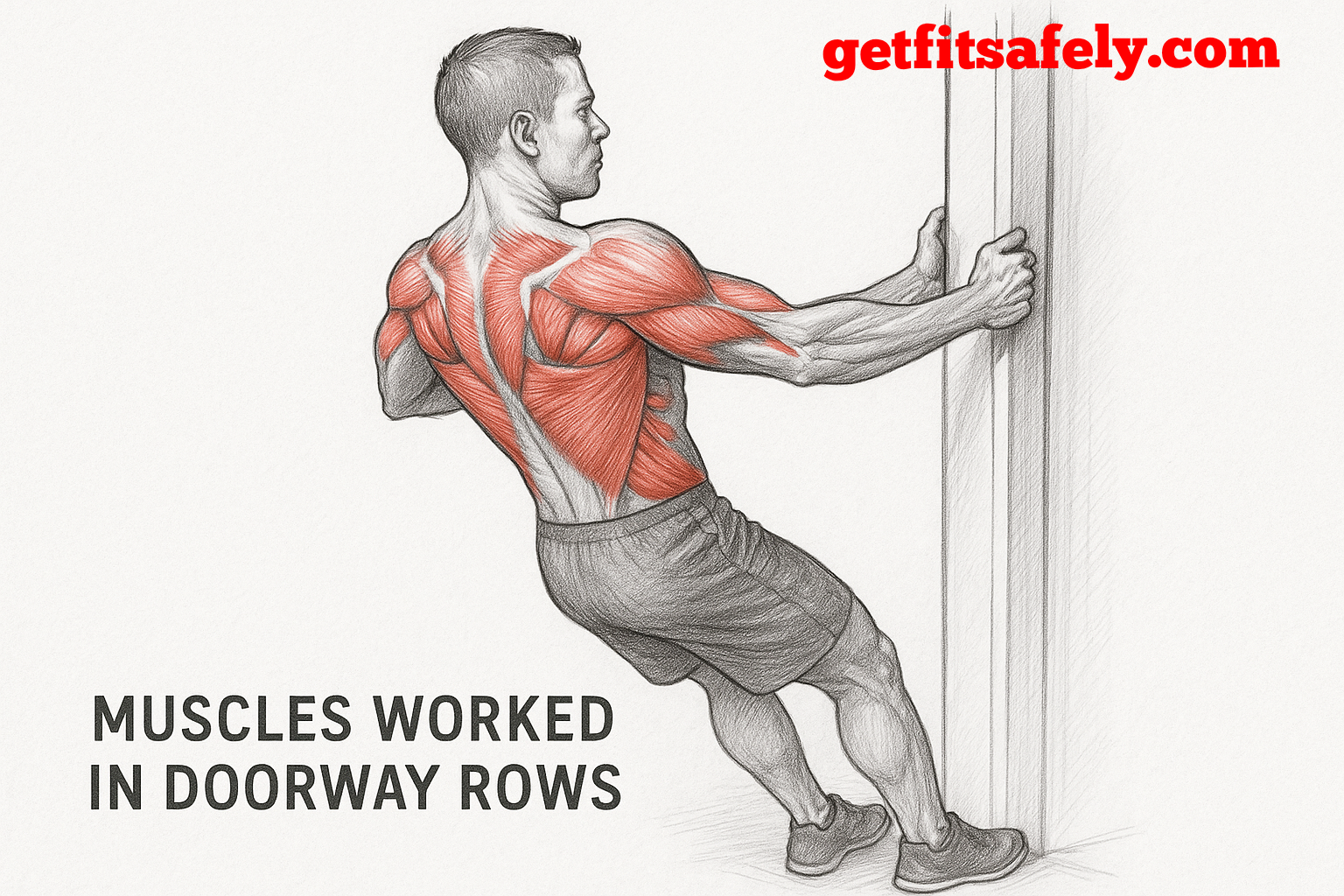
Doorway rows mainly target the latissimus dorsi, rhomboids, and trapezius, while the rear delts and biceps assist every pull.
Unlike pull-ups, which emphasize the lower lats and teres major, doorway rows shift more effort to the mid-back and scapular stabilizers.
That makes them great for posture, shoulder control, and balanced pulling strength — especially for beginners who can’t perform a full pull-up yet.
Why doorway rows actually feel great at first
For beginners or anyone returning from injury, doorway rows feel amazing.
They’re easy to adjust — step back for more resistance, step in to make it easier.
The movement builds stability, improves posture, and spares the shoulders from the sharp strain that pull-ups can trigger.
Grip strength skyrockets, too.
And there’s something satisfying about training with nothing but a door and determination.
For a while, it feels like the perfect hack.
Then, the plateau hits.
Where doorway rows start to fall short
The problem isn’t the movement — it’s the limitation.
After a few weeks, the body adapts.
You start doing 20 reps per set, but the challenge disappears.
There’s only so far you can lean before gravity stops caring.
Pull-ups load your full bodyweight every rep.
Doorway rows rely on leverage, and that leverage eventually runs out.
Without external resistance, strength and muscle growth stall.
At that point, doorway rows become maintenance — not progression.
Doorway row progression for long-term gains
Once the movement starts feeling easy, try scaling it like this:
- Change the angle: step farther back to increase leverage.
- Add external load: backpack, vest, or resistance bands.
- Play with tempo: 3-second negatives and 1-second holds.
- Pair smartly: mix with towel pull-downs or resistance band work.
- Move to one-arm rows: for strength symmetry and control.
This structure turns doorway rows into a scalable exercise rather than a temporary fix.
Pull-ups vs doorway rows
Pull-ups and doorway rows train the same muscles, but in different directions.
One is vertical pulling — straight up and down.
The other is horizontal — body parallel to the floor.
Both are essential movement patterns.
Think of them as the yin and yang of back training.
Pull-ups give width and power.
Rows build depth and control.
You need both if the goal is a strong, balanced upper body.
So instead of trying to replace pull-ups, doorway rows are better used to support them.
Other pull-up alternatives at home
If doorway rows start feeling too easy, try mixing in these options:
- Table inverted rows: slide under a sturdy table and pull your chest toward the edge.
- Towel pull-downs: simulate vertical pulling using a towel anchored high on a door.
- Resistance band lat pulls: simple, light, and joint-friendly.
- Negative pull-ups: use a chair to start at the top and lower yourself slowly.
These moves target similar muscles and bridge the gap until real pull-ups become part of the routine again.
Pros and Cons of Doorway Rows
Pros:
- Easy setup, zero equipment.
- Joint-friendly and adjustable.
- Great for endurance and grip.
- Perfect for travel or recovery phases.
Cons:
- Limited resistance.
- No vertical pulling stimulus.
- Difficult to overload consistently.
- Won’t maximize lat hypertrophy.
They’re the minimalist’s best friend — just not the powerlifter’s dream.
| 💡 RELATED: Pull-Up Bars for Renters: How to Train Without Drilling or Cracking Walls |
Final takeaway
Doorway rows can’t truly replace pull-ups long-term — but they can keep your back game alive when equipment isn’t available.
They’re simple, accessible, and surprisingly effective for what they are.
Just don’t expect them to build the same dense, wide back that comes from hanging and pulling vertically.
Still, any movement that keeps you consistent is worth doing.
FAQs About Doorway Rows
1. Can doorway rows help improve posture if I sit all day?
Yes. Doorway rows strengthen the mid-back and postural muscles that become weak from hours of sitting.
They help counteract rounded shoulders and forward head posture by training scapular retraction — something pull-ups don’t focus on as much.
2. Are doorway rows safe for people with lower back pain?
When done correctly, yes.
The movement doesn’t compress the spine like heavy lifting, and it encourages core engagement for stability.
Just keep your knees slightly bent and avoid arching your back.
If pain persists, it’s best to check with a physical therapist.
3. Do doorway rows activate the core muscles too?
Absolutely.
Your abs, obliques, and lower back work isometrically to stabilize the body during each pull.
That makes doorway rows a sneaky core exercise — especially if you maintain a straight line from head to heels.
4. Can doorway rows be part of a full-body workout routine?
Definitely.
They pair well with push-ups, squats, and planks to create a balanced at-home workout.
By combining horizontal pulling (doorway rows) with pushing and lower-body moves, you cover all major muscle groups without needing gym equipment.