At some point in your training journey, it happens to everyone.
You go through your usual set of crunches, wait for that familiar burn, and… nothing.
No real challenge.
No meaningful stimulation.
No sense of progress.
It feels less like a core exercise and more like a routine your body has completely figured out.
That’s usually when people start looking for alternatives — variations that promise a deeper contraction, a better range of motion, or simply a way to wake up muscles that no longer respond to the basics.
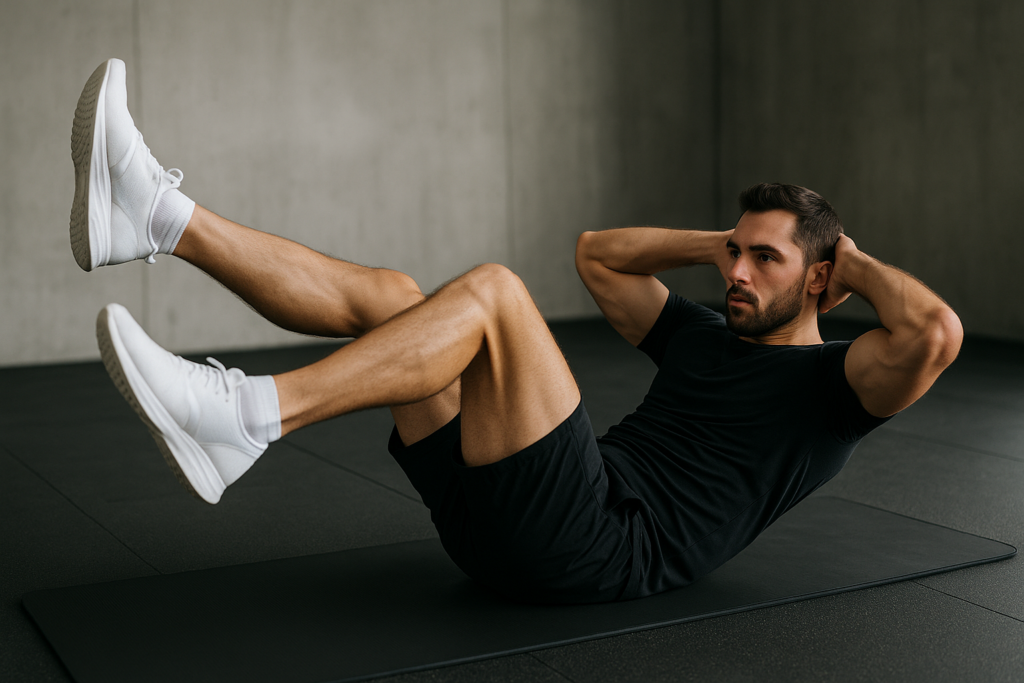
Enter the crunch kick: a hybrid movement that blends the mechanics of a traditional crunch with the dynamic extension of a controlled leg kick.
And naturally, the question follows:
“Is this variation actually more effective than regular crunches, or just another attempt to reinvent a simple exercise?”
Let’s take a measured approach.
No hype, no shortcuts, and no unrealistic expectations about overnight abs.
Just clear reasoning and what the exercise genuinely offers.
What Really Changes Between Crunch Kicks and Regular Crunches?
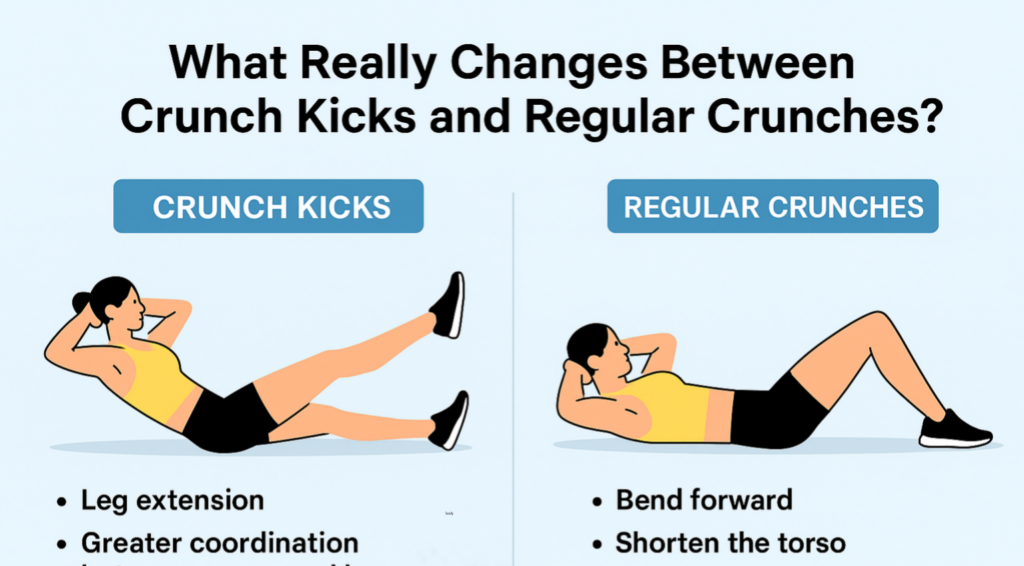
The classic crunch is simple.
Bend forward, shorten the torso, feel the abs tighten, done.
The crunch kick, however, adds two things:
a leg extension
greater coordination between the upper and lower body
It’s like going from riding a regular bike to an electric bike with turbo mode: you’re still doing the work, but the management isn’t as linear.
This variation changes the entire way your core behaves.
Do Crunch Kicks Really Work More?
It depends.
And yes, I know that’s the most annoying answer ever, but it’s also the most honest.
Crunch kicks activate more muscles, that’s for sure:
the rectus abdominis (the “six-pack”)
the obliques
the transverse abdominis
the hip flexors
the stabilizing core muscles to balance the movement
Just that alone makes the movement more “complete.”
But the real point is something else:
The crunch kick prevents you from cheating.
In a traditional crunch, you can push with your neck, you can rock back and forth, you can use momentum like an old rusty punching machine.
With the crunch kick, if you cheat… you notice immediately.
You lose coordination.
Your legs go wherever they want.
You look like a misaligned robot.
It’s an exercise that forces real control, not the “gym-distracted imitation crunch” version.
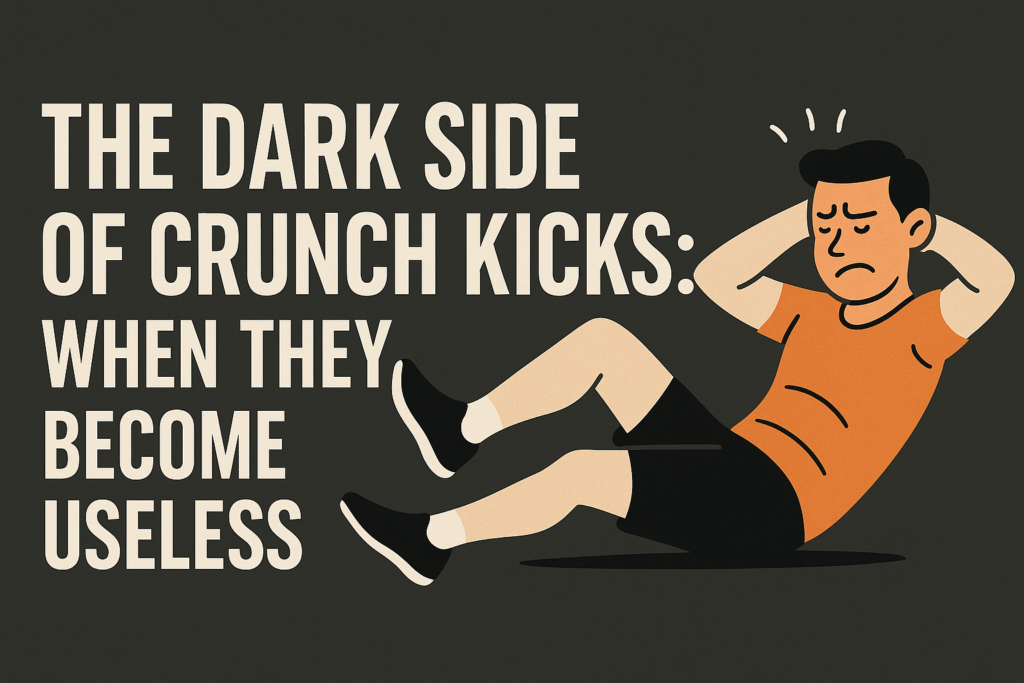
The Dark Side of Crunch Kicks: When They Become Useless
Yes, that exists too.
The crunch kick can become a spectacular exercise… or a useless one.
It depends on three extremely common mistakes:
1 — Too much tension in the hip flexors
If the flexors steal the spotlight, you’re not training the core: you’re just performing a stiff-leg demonstration.
2 — Low lumbar mobility
If your lower back is overly tight or you can’t control it, the movement becomes a losing battle.
Typical sensation: “I feel everything in my legs, nothing in my stomach.”
3 — Speed without control
A rushed crunch kick is like trying to text while falling off a diving board.
Not elegant.
Not useful.
Not effective.
So… Are They Better or Not?
Here’s the simple answer:
Crunch kicks are better for what they’re meant for.
And traditional crunches remain better… for what they’re meant for.
Let’s put it this way:
Want an easy-to-execute, isolated exercise that lets you focus only on abdominal shortening? → Traditional crunch.
Want a movement that involves more abdominal areas, forces control, and requires more coordination and stability? → Crunch kick.
Want more “functionality,” meaning a core that reacts better to full-body movements? → Crunch kick.
Want a “finisher” exercise after a tough workout? → Crunch kick all the way.
Have zero control over your hip flexors and your lower back activates before your abs? → Traditional crunch while you fix the rest.
No dogmas.
No “one is superior to the other.”
Just different contexts.
Why Crunch Kicks Burn More (But Don’t Always Build More)
The “burning sensation” is not a reliable indicator.
Crunch kicks burn because:
the movement is longer
the lever is more disadvantageous
the body has to stabilize
more coordination is required
But burning doesn’t mean “better stimulus.”
It only means “different stimulus.”
It’s like ironing with a heavier iron: you feel the effort, but it doesn’t guarantee a smoother shirt.
You still need technique.
You still need awareness.
You still need quality.
When Crunch Kicks Become a Core Superpower
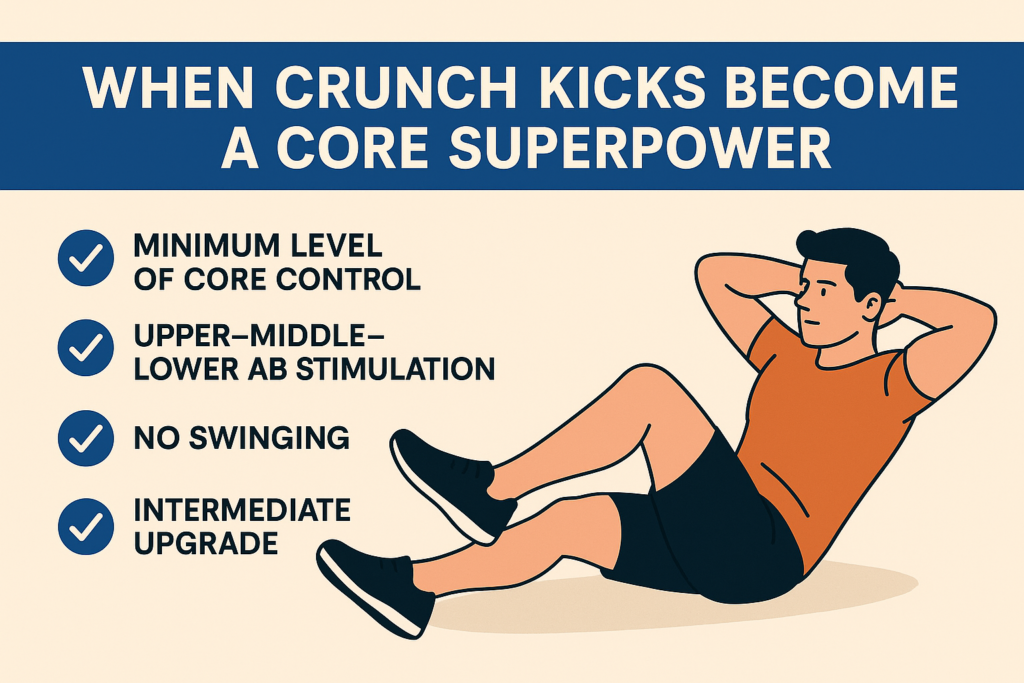
They are incredibly useful when:
you already have a minimum level of core control
you want to stimulate the “upper–middle–lower” abs in the same movement
you want an exercise that forces you not to swing
you’re looking for something more dynamic than classic crunches
you want an “intermediate upgrade” between crunches and more advanced movements
If performed well, they become a perfect bridge toward:
V-ups — a full-body fold where your torso and legs rise together, meeting in a V shape. Requires coordination and strong hip flexors.
Jackknives — similar to V-ups but with slower tempo and a deeper focus on controlled extension and contraction.
Hollow rocks — a rocking motion in a hollow-body position; you keep your lower back glued to the floor while your arms and legs create a stable arc.
Hanging leg raises — lifting straight legs from a bar without swinging, relying entirely on core strength and pelvic control.
Signs Crunch Kicks Aren’t the Right Choice (for Now)
Lower-back pain during the lift
Difficulty maintaining a neutral spine
Dominant hip flexors
Abs that simply don’t “switch on”
Poor leg-to-torso coordination
In this case, don’t insist.
It’s not an exam.
It’s not “if you fail, you don’t have abs.”
It’s just technical feedback.
Go back to basic crunches, reverse crunches, and planks.
Then come back here.
Crunch Kick Variations That Improve Control
1 — Bent-Knee Crunch Kicks
Lie down with your knees bent at 90°.
Lift your torso slightly in a short crunch.
Bring your knees toward your chest as you rise.
Extend your legs forward while keeping your lower back stable.
Return to the initial position and repeat smoothly.
2 — Slow-Motion Crunch Kicks
Lie down with your legs raised.
Perform the crunch and leg extension very slowly (3–4 seconds).
Keep your lower back steady and your core engaged throughout.
Control both the upward and downward phases without using momentum.
3 — Alternated-Leg Crunch Kicks
Start in a crunch position with your legs lifted.
Lift your torso and extend one leg at a time in alternation.
Keep the other leg bent toward your chest.
Switch sides while keeping your core consistently active.
4 — Extended-Hold Crunch Kicks
Begin as you would for a normal crunch kick.
Rise into the crunch and hold your legs fully extended for 1–2 seconds.
Control your lower back and breathe as you maintain the position.
Pull your legs in and repeat.
RELATED:》》》 Are sit-ups worse than leg raises for core strength?
Bottom Line
Here’s the most practical answer possible:
Try both.
Notice what happens. Evaluate without judging yourself.
Then:
If the crunch kick gives you a clean, controlled sensation → keep it.
If it’s too unstable → go back to the basic crunch and progress gradually.
If you want a more “functional” core and not just an aesthetic one → use them in combination.
The core is not a muscle you choose “either black or white.”
It’s a system.
An ecosystem.
And it needs different stimuli — not the hunt for the perfect exercise.