
A “home gym” like this is hard to forget.
It wasn’t a gym.
It was a couch, three worn-out college textbooks, and a hopeful attempt to build a chest that didn’t look deflated.
No bench in sight.
No adjustable dumbbells lying around.
Not even decent lighting — just a judgmental lamp flickering in the corner during every rep.
And yet… the internet was full of people claiming that a serious chest could be built with push-ups alone.
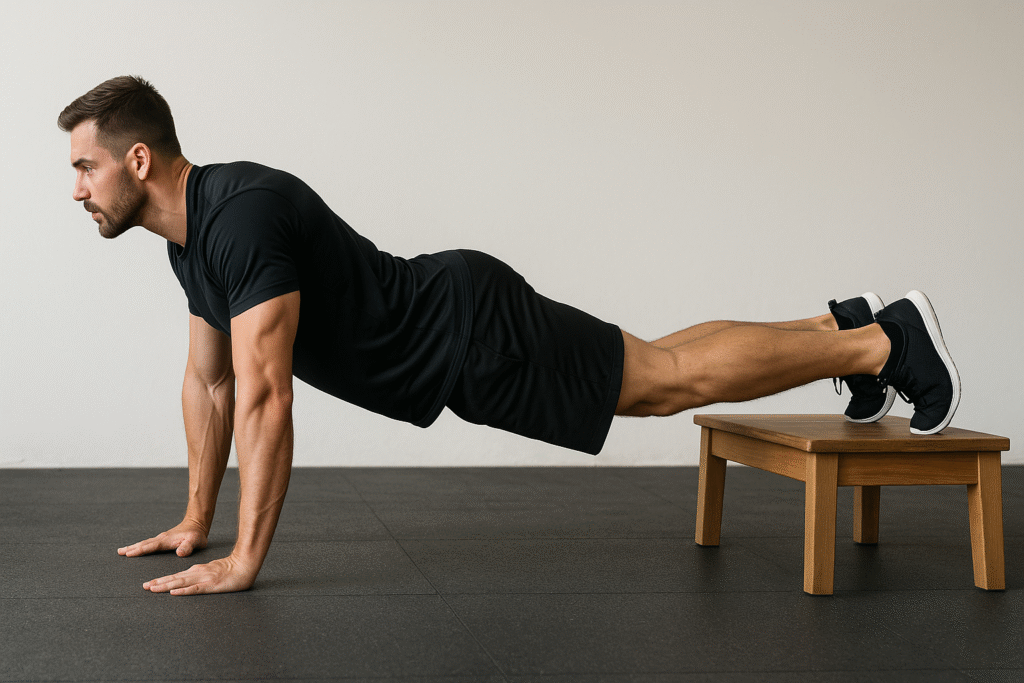
Feet elevated on the couch.
Hands pressing into a stack of dusty textbooks.
No fancy setup.
Which leads to a very real question:
Can this really build a proper chest?
Time to break it down — no PhD or $3,000 home gym required.
Understanding Chest Activation with Elevated Push-Ups

The first surprise I got when I actually tried this stuff was simple:
Elevated push-ups hit different.
The angle changes everything.
When you lift your feet up and push your hands slightly higher, you shift more loading into the upper chest and anterior delts in a way regular floor push-ups never quite manage.
Is it the same as incline benching?
No.
But does your chest get way more involved than the classic push-up you did in middle school gym class?
Absolutely.
My pecs were talking the next morning.
Not whispering — complaining.
And soreness isn’t everything, but it’s one sign that the movement is forcing muscles to do real work.
Then there’s the stretch.
When your hands are elevated, you naturally move through a deeper bottom position.
That gives you more range of motion, which increases mechanical tension, the main driver of muscle growth.
Most EMG research on chest exercises shows the same pattern: deeper stretch = more pec fibers involved.
So even if you’re using a couch and textbooks, you’re still manipulating the same variables that matter in real training.
Why the Setup Actually Matters More Than the Equipment
I used to think the specific objects mattered.
Like maybe my textbooks weren’t the “right kind” of textbooks, as if hypertrophy only comes from engineering books and not literature.
But the truth is way simpler:
You’re not training the book.
You’re training the angle.
When your hands are elevated, you increase the depth of the push-up.
That deeper stretch forces your pec fibers to work through a longer range of motion.
More stretch.
More tension.
More stimulus.
Your couch and textbooks don’t know they’re not gym equipment.
Your chest doesn’t know either.
Your muscles only know tension, angle, and effort.
How to Actually Feel Your Chest During These Push-Ups
Here’s the mistake most people make.
They crank out reps like they’re trying to outrun a sandstorm.
Chest barely activating.
All shoulder.
All triceps.
Zero pec squeeze.
I did that for years without realizing it.
What helped me the most was focusing on just a few tweaks:
- Think about “pushing the floor away” with your palms
- Imagine your elbows hugging inward slightly
- Keep your upper arm at about 30–45°
- Let your chest sink deep at the bottom
- Push up without locking the elbows aggressively
The deeper the stretch and the more you control the descent, the more your pecs will light up.
Slow reps aren’t glamorous, but they work.
Why Chest Gains Are Possible Even with “DIY” Equipment
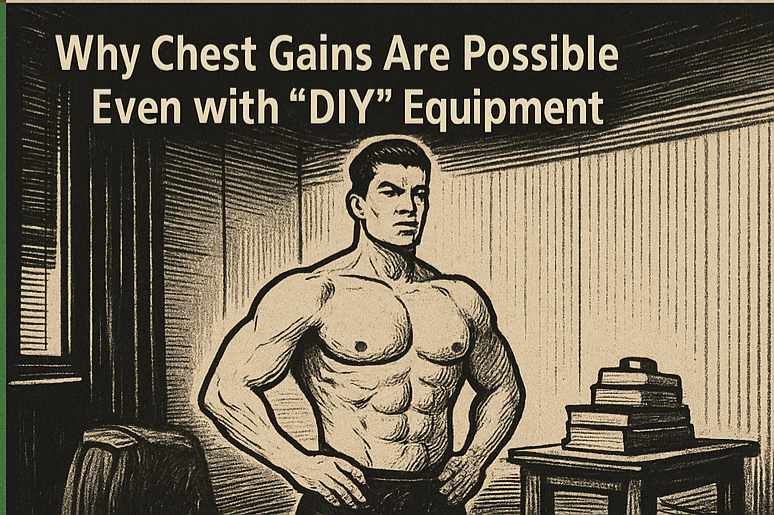
I used to think muscle growth came from fancy machines, futuristic handles, and chrome-coated plates that smell like a commercial gym at 6 PM.
But the more I trained at home, the more I started trusting something else: consistency.
Push-ups give you:
- Horizontal pressing load
- Full scapular freedom
- Deep stretch at the bottom
- Natural progression options
And when you elevate your feet and hands correctly, you mimic an incline press pattern surprisingly well — especially if you’re early or intermediate in training.
You don’t need glowing dumbbells or stainless steel benches.
You need tension.
You need angles.
You need progression.
I’ll say this clearly because I wish someone told me earlier:
You can absolutely build your chest with these push-ups, as long as you treat them like a real exercise — not a warm-up ritual.
When Push-Ups Become Legit Chest Builders
Something funny happens when you start taking push-ups seriously.
You stop thinking of them as “easy.”
You stop thinking of them as “just bodyweight.”
You start noticing your chest showing real density.
You start feeling stronger on other lifts.
Your shoulders get more stable.
Your reps slow down because you stop chasing numbers and start chasing tension.
That’s when the gains kick in.
That’s when a basic exercise becomes a legit hypertrophy tool.
And yes — it can absolutely happen in a living room with squeaky floorboards and textbooks that cost more than your monthly groceries.
Where Push-Ups Start Hitting a Wall (And How to Bust Through It)
Here’s the honest reality I learned the hard way.
Push-ups — even the elevated, fancy-looking ones — eventually become too easy.
The body adapts fast, especially to patterns like horizontal pressing.
One day you feel like you’re folding space-time with your chest.
Next week you’re breezing through 25 reps and barely feeling alive.
When that happens, your gains slow down unless you do one of these things:
- Add load with a backpack
- Increase the deficit
- Slow down the tempo
- Pause at the bottom
- Use single-arm push-up progressions
- Increase total weekly volume
That’s when you stop doing random reps, and start applying real progressive overload.
Comparing Elevated Push-Ups and Weight Training
Push-ups can build your chest — absolutely — but they aren’t the same tool as a barbell.
With weights, you overload through simple jumps in load.
With bodyweight pressing, you overload through:
- angle
- leverage
- tempo
- volume
- depth
It’s slower but smooth and surprisingly effective.
Here’s the vibe:
- Regular push-ups build base endurance.
- Feet-elevated push-ups shift load to the upper chest, like a poor-man’s incline press.
- Deficit push-ups give you a stretch even dumbbells struggle to match.
- Bench press offers the highest overload potential, period.
All four can build a chest.
They just do it differently.
RELATED:››› Complete Push-Up Progression 👈 👈 👈
Learn how to progress from beginner push-ups to advanced variations
with structured steps and form cues.
A Practical St
ep-by-Step Home Progression
If you want a clean home chest workout progression, here’s how to make elevated push-ups actually work:
Step 1 — Master the bottom position
Slow descent.
Deep stretch.
Step 2 — Add a pause
One second at the bottom.
Step 3 — Slow the tempo
Three seconds down.
One second pause.
Explode up.
Step 4 — Add reps weekly
Small jumps = big gains.
Step 5 — Add sets weekly
One extra set every week or two.
Step 6 — Add load
Backpack with books.
Simple, effective.
Step 7 — Increase the angle
Higher feet = harder reps.
This is progressive overload without weights.
So… Does Anyone Really Build Their Chest This Way? (The Direct Answer)
Yes.
People do it every day.
And here’s exactly who sees the best results:
- Beginners
- Intermediates
- Anyone who slows the reps
- Anyone who trains consistently
- Anyone who actually applies progression
How long does it take?
- 4–8 weeks → first visual changes
- 2–3 months → stronger, fuller upper chest
- 3–6 months → legit transformation
What adaptations happen?
- Pec thickness increases
- Upper chest looks fuller
- Scapular control improves
- Shoulders stabilize
- Push-up strength skyrockets
Final Thoughts
A full gym isn’t required.
Chrome dumbbells aren’t required.
A fancy incline bench isn’t required either.
What truly matters are the basics: angles, tension, patience, and steady progression.
Take elevated push-ups seriously and the chest will respond.
Maybe not with Mr. Olympia volume, but with strength, shape, and noticeable fullness.
A solid, confident chest is absolutely within reach.
And it all begins in the living room — one deep, controlled rep at a time.