I used to think you couldn’t.
Like, if your feet never touched a squat rack or your hands didn’t smell like metal and chalk, you weren’t “really” training.
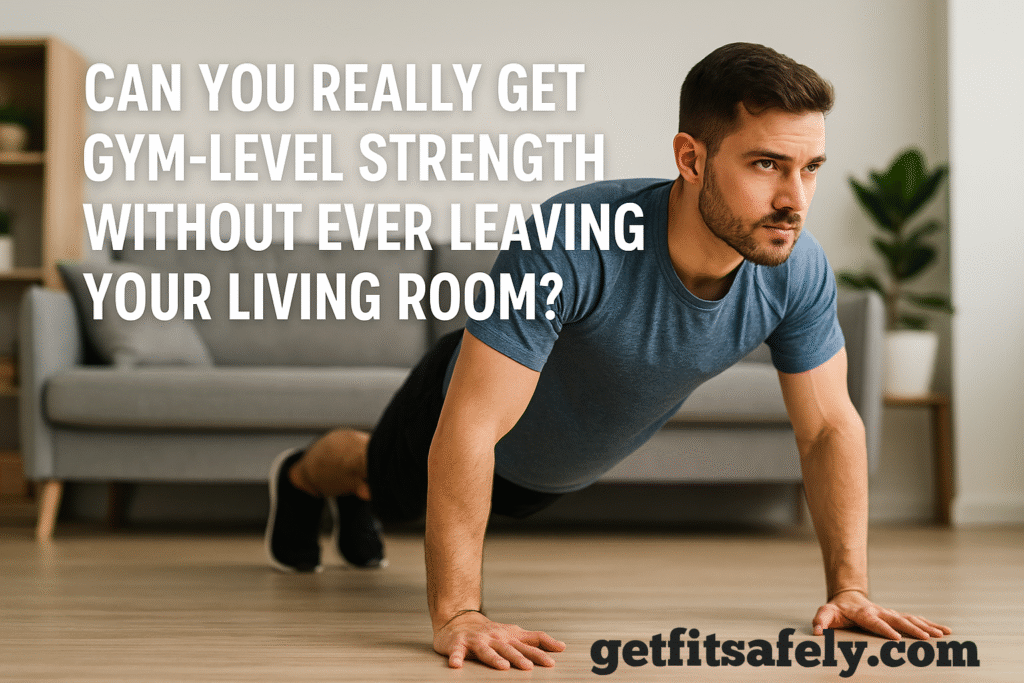
Then one day, I found myself doing floor push-ups next to a pile of laundry.
I was using a backpack full of books for resistance.
Halfway through the set, I realized I was sweating harder than most guys I used to see in commercial gyms.
Turns out, home training isn’t the downgrade most people think it is.
It’s just different physics, different mindset.
And if you do it right, your living room can turn into a legitimate strength lab.
The Real Difference Between Gym Training and Home Training
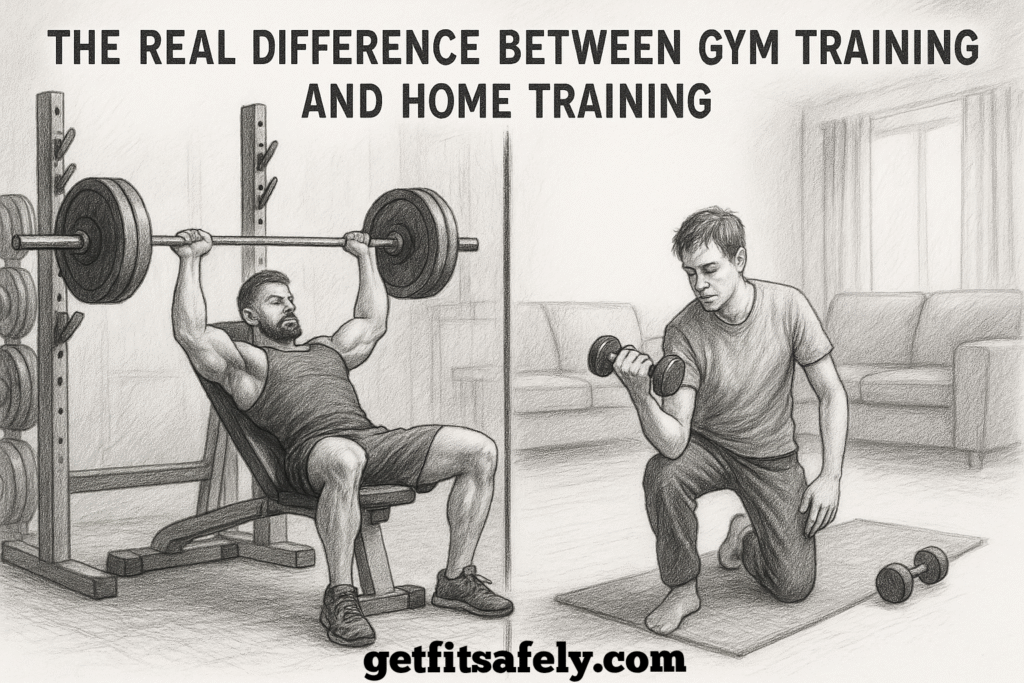
Most people think the gym is what makes them strong.
But it’s not the place — it’s the principles.
A gym just gives you external load, structured space, and accountability.
At home, you have to create all three by yourself.
That’s the real challenge.
You don’t have plates to slap on a bar — you have to manipulate leverage, tempo, and intensity.
Slow eccentric push-ups?
That’s your squat rack.
Isometric holds?
That’s your loaded carry, minus the dumbbells.
Strength isn’t about where you train — it’s about how efficiently you push your nervous system to adapt.
And yeah, your floor can absolutely do that.
When you train without external load, your body still follows the same adaptation principles: mechanical tension, muscle damage, and metabolic stress.
The difference is that at home, you control those variables through body position instead of weights.
That’s why slow negatives or unilateral work are so effective — they increase tension time, forcing your nervous system to fire harder.
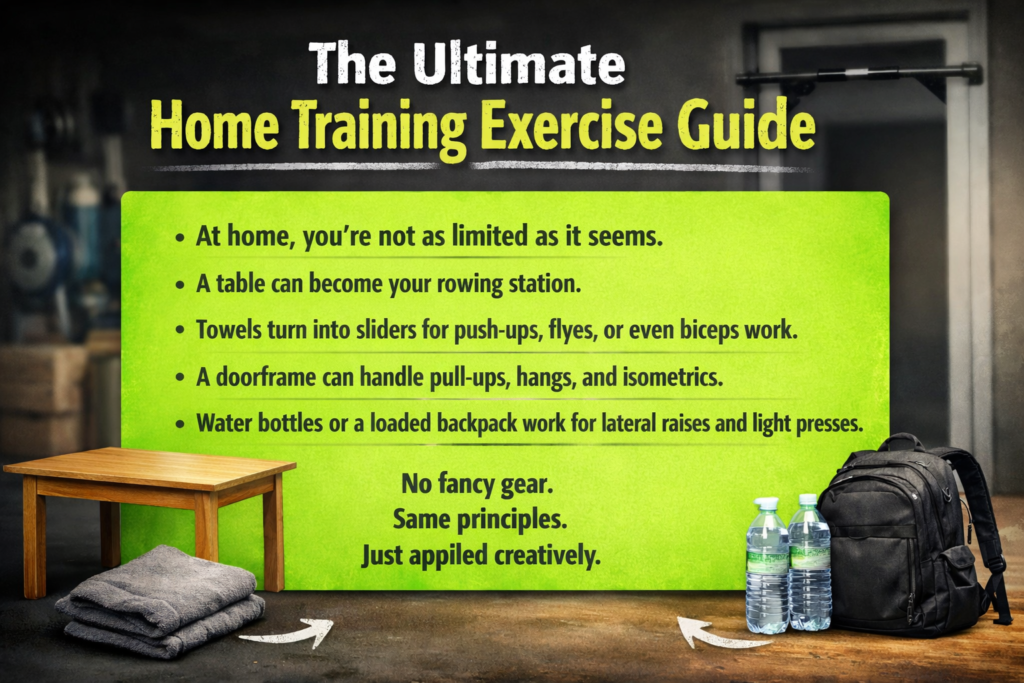
| At home, you’re not as limited as it seems.
A table can become your rowing station. Towels turn into sliders for push-ups, flyes, or even biceps work. A doorframe can handle pull-ups, hangs, and isometrics. Water bottles or a loaded backpack work for lateral raises and light presses. No fancy gear. Same principles. Just applied creatively. |
Why Home Training Fails for Most People
Here’s the truth: it’s not that home training doesn’t work — it’s that most people never treat it like real training.
They start a 10-minute YouTube circuit, skip the warm-up, and call it a day.
They chase sweat, not progress.
The missing piece?
Structure.
At home, you need progression even more than in a gym — because you can’t just “add weight.”
You have to outsmart your own body.
That means:
- Manipulating rep tempo (3 seconds down, 1 up).
- Playing with angles (elevate your feet, shift your hands).
- Using isometric pauses to build joint control.
- Increasing time under tension, not just reps.
Once you start thinking like that, you stop “working out” and start training.
That mental shift is where progress begins.
Turning Your Home Into a Performance Zone
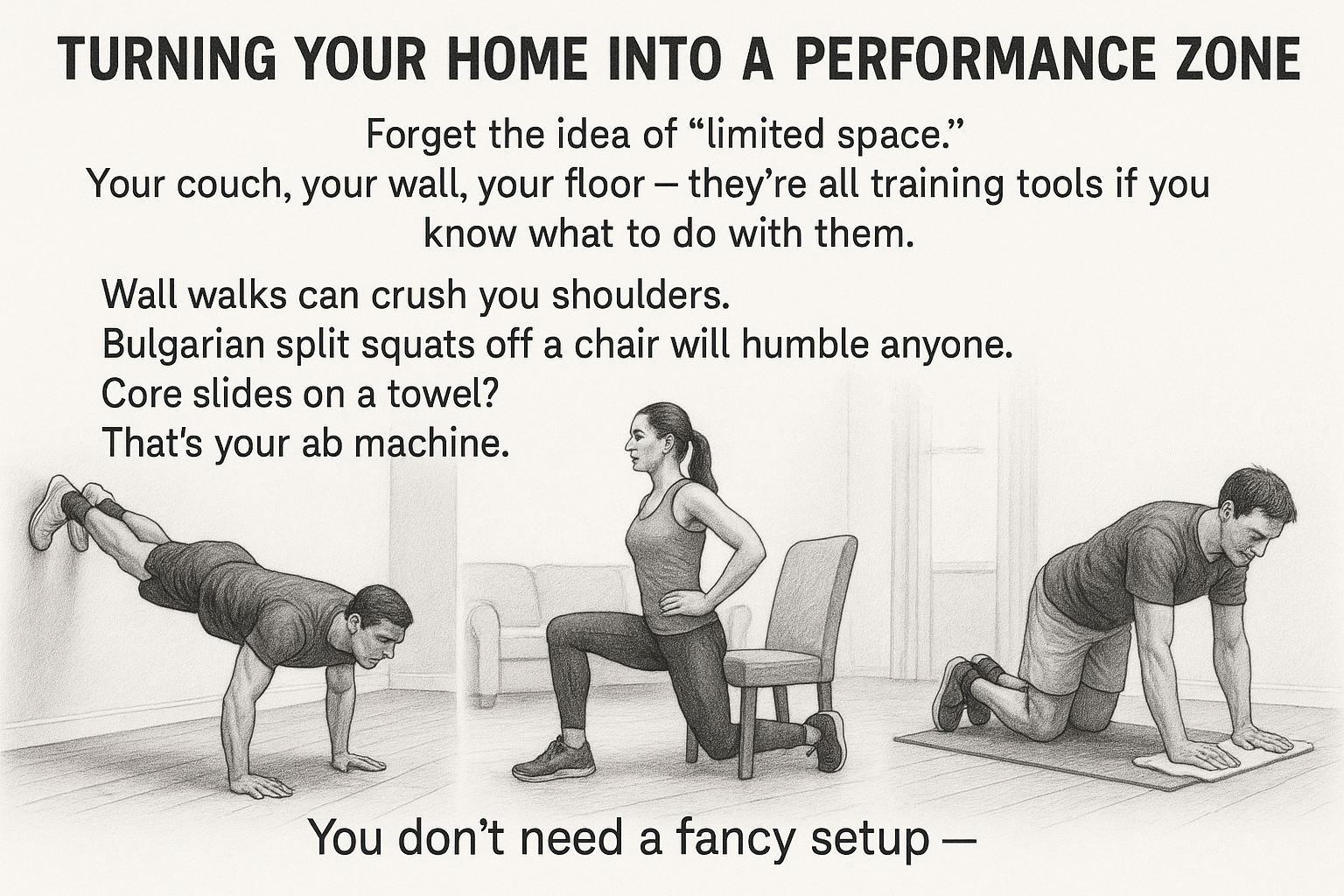
Forget the idea of “limited space.”
Your couch, your wall, your floor — they’re all training tools if you know what to do with them.
Wall walks can crush your shoulders.
Bulgarian split squats off a chair will humble anyone.
Core slides on a towel?
That’s your ab machine.
You don’t need a fancy setup — you need creativity.
One of my favorite “gym replacements” was using a broomstick and resistance bands for rows.
It looked ridiculous, but the burn was real.
The secret is understanding mechanical tension — your muscles don’t care if it’s a dumbbell or a backpack full of oatmeal.
They care about force, duration, and control.
If you keep that in check, you can build legit performance from your living room floor.
Building Strength Without Equipment (Yes, It’s Possible)
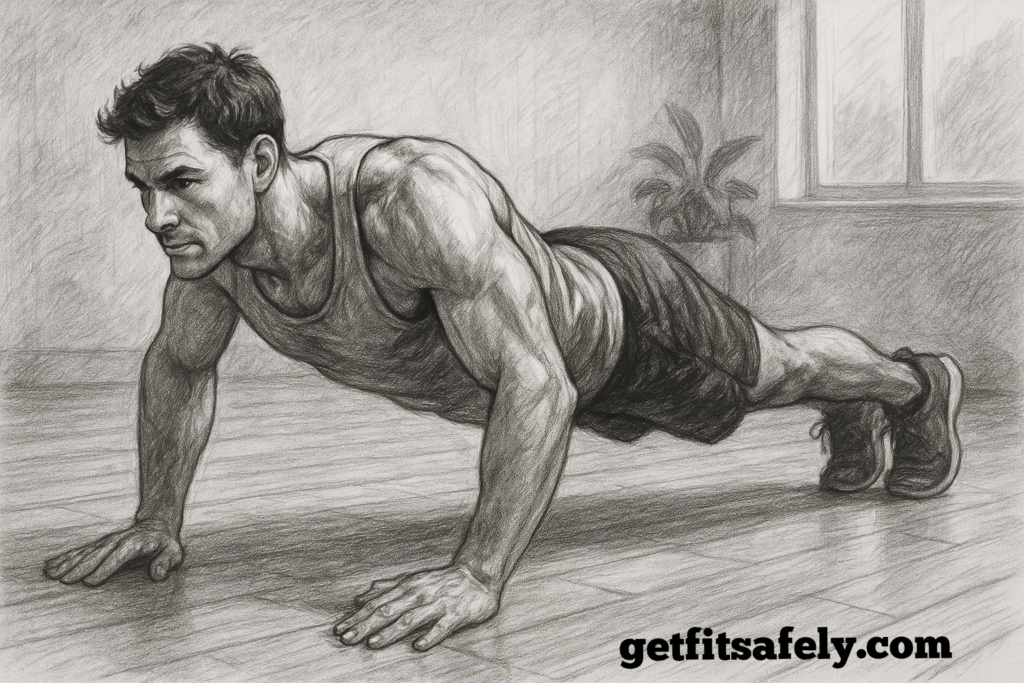
You’ve probably heard someone say: “You can’t build strength without weights.”
Not true — you just can’t build infinite strength without them.
Bodyweight mechanics let you build functional, athletic strength — the kind that makes you move better, not just lift heavier.
Here’s what matters most:
- Progressive overload through leverage. Shorten your lever arms to make moves harder.
- Isometric control. Holding a position increases neural drive and stability.
- Eccentric training. Slowing down the lowering phase builds raw strength and resilience.
The goal isn’t to “mimic” the gym — it’s to master your own resistance.
Once you learn that, a push-up becomes a system, not a move.
Studies comparing calisthenics and traditional weight training show surprisingly similar improvements in strength and muscle mass — as long as the bodyweight work is progressive and close to failure.
In short, intensity matters more than equipment.
Strength Starts with How You Move
Training at home forces you to notice things the gym hides — like how tight your hips are or how your scapula barely moves.
When you start integrating mobility with strength (think Cossack squats, deep squat holds, scapular push-ups), something wild happens: you move better and feel stronger at the same time.
That’s because mobility isn’t just about flexibility — it’s about active range control.
It’s the difference between being able to drop into a deep push-up and push out of it with power.
At home, this integration happens naturally — no mirrors, no machines, just feedback from your body.
Mobility and strength aren’t separate — they’re teammates.
No Crowd, No Excuses
Here’s the underrated part of home training: it’s all on you.
No gym noise.
No one watching.
No energy to feed off of.
That’s both terrifying and liberating.
When you train alone, you face discipline head-on.
There’s no “pre-workout social hype” — it’s just you and your own consistency.
I used to struggle with that.
Then I realized it’s exactly what made my training real again.
When you learn to push yourself in silence — with no audience — that’s true strength building.
And weirdly enough, it carries over to life outside the living room too.
The Ultimate Home Training Exercise Guide
Home training works when execution and progression are intentional.
Every exercise below can be scaled for weeks or months without adding gym equipment.
Each muscle group includes four core movements.
Each movement includes one clear variation and multiple progression options.
Chest
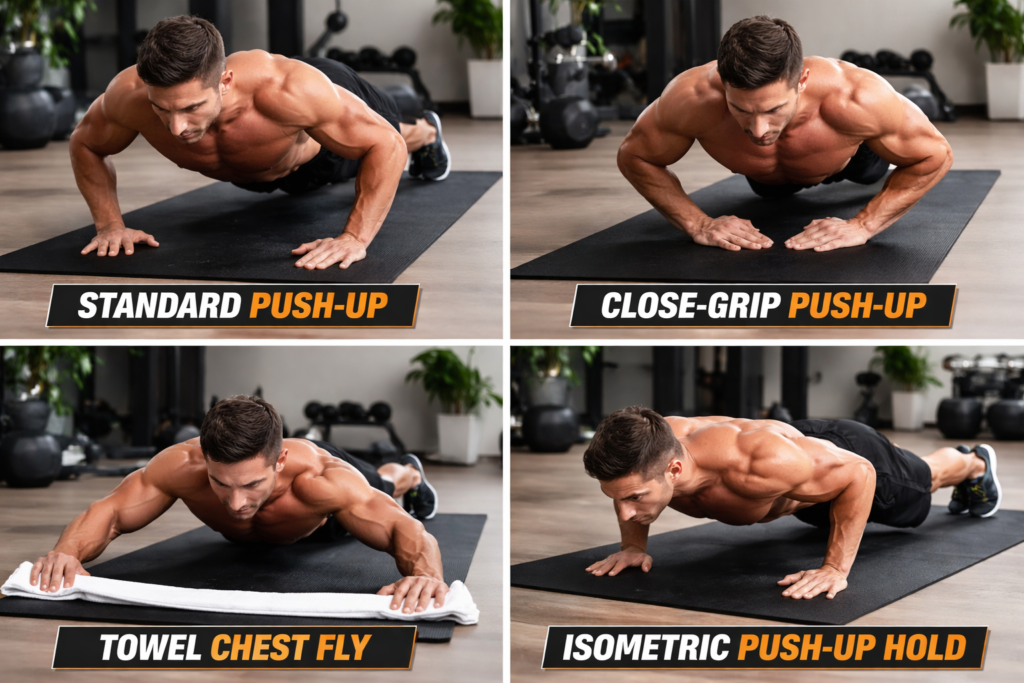
Standard Push-Up
Hands slightly wider than shoulder-width.
Body aligned from head to heels.
Lower the chest under control and press the floor away.
Variation – Decline Push-Up
Place feet on a chair or couch.
Maintain the same body line while lowering chest toward the floor.
Progressions:
- Slow the eccentric to 4–5 seconds.
- Add a 1–2 second pause at the bottom.
- Increase foot elevation height.
- Wear a loaded backpack.
Close-Grip Push-Up
Hands close together under the chest.
Elbows stay tucked as you lower.
Press through palms focusing on triceps and inner chest.
Variation – Close-Grip Isometric Hold
Lower halfway and hold the position under tension.
Keep elbows close and core braced.
Progressions:
- Increase hold duration gradually.
- Combine slow reps with isometric holds.
- Add backpack resistance.
Towel Chest Fly
Push-up position with hands on towels.
Slide arms outward slowly with slight elbow bend.
Pull hands back together using chest tension.
Variation – Fly to Push-Up Combo
Perform one fly, then immediately one push-up.
Maintain control throughout the transition.
Progressions:
- Increase range of motion gradually.
- Slow both opening and closing phases.
- Add pauses in the stretched position.
Isometric Push-Up Hold
Lower into a mid-range push-up position.
Hold with full-body tension.
Breathe slowly without collapsing.
Variation – Bottom Position Hold
Hold just above the floor instead of mid-range.
Progressions:
- Increase hold time from 15 to 45 seconds.
- Perform multiple holds per set.
- Add backpack load.
Triceps
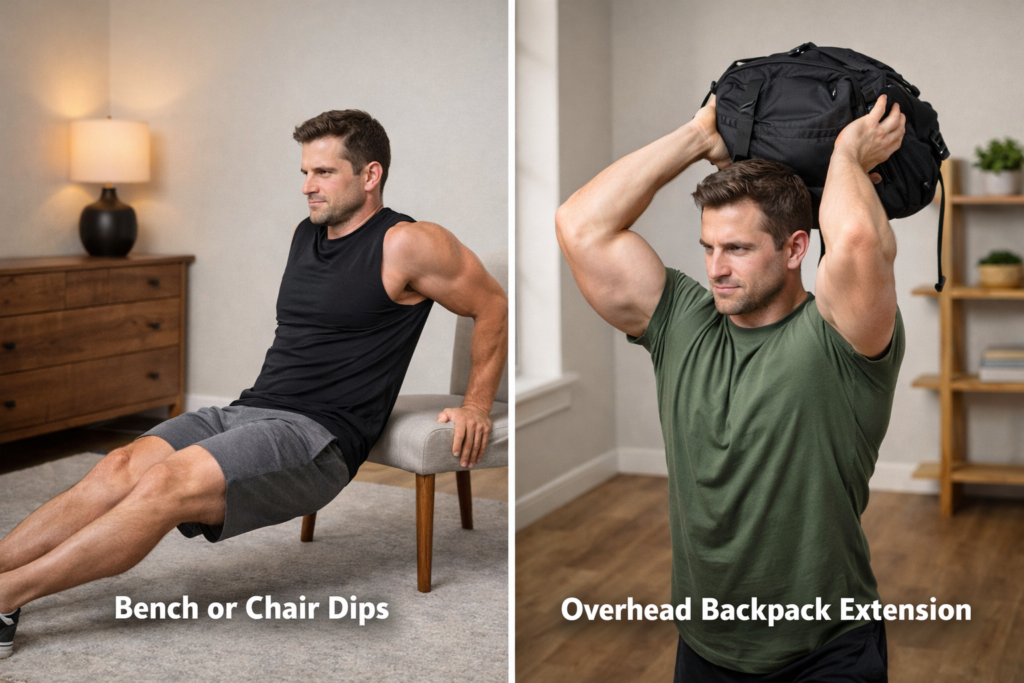
Bench or Chair Dips
Hands on chair behind hips.
Lower body straight down keeping elbows close.
Press back up to full extension under control.
Variation – Bent-Knee Dip
Keep knees bent to reduce load.
Progressions:
- Slow the eccentric phase.
- Add a pause at the bottom.
- Elevate feet on a second chair.
Overhead Backpack Extension
Hold backpack overhead with both hands.
Lower behind the head keeping elbows tucked.
Extend arms fully without flaring elbows.
Variation – Single-Arm Backpack Extension
Use one arm while the other stabilizes the load.
Progressions:
- Increase backpack weight.
- Add pauses in the stretched position.
- Slow controlled eccentrics.
Back
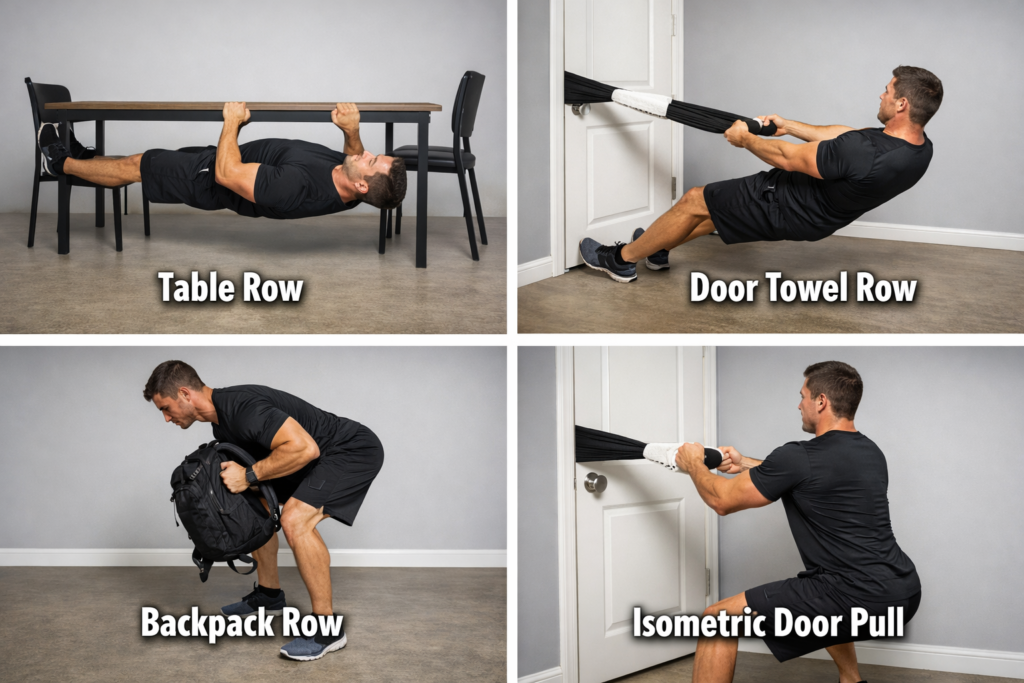
Table or Chair Row
Position body under a table or between chairs.
Keep heels on the floor and body rigid.
Pull chest toward hands while squeezing shoulder blades.
Variation – Feet-Elevated Row
Place feet on a chair to increase resistance.
Maintain straight body alignment.
Progressions:
- Walk feet farther away.
- Add 2–3 second pauses at the top.
- Slow the eccentric phase.
Door Towel Row
Loop a towel behind a closed door.
Lean back with arms extended and chest tall.
Pull yourself forward by driving elbows back.
Variation – Single-Arm Assisted Towel Row
Pull mainly with one arm while the other assists lightly.
Switch sides between sets.
Progressions:
- Increase body angle.
- Add slow eccentrics.
- Hold the top position isometrically.
Backpack Row
Hold a loaded backpack.
Hinge at the hips with neutral spine.
Pull the backpack toward lower ribs.
Variation – Single-Arm Backpack Row
Support one hand on a chair.
Row with the opposite arm under control.
Progressions:
- Increase backpack weight.
- Add pauses at peak contraction.
- Slow the lowering phase.
Isometric Door Pull
Pull hard against a towel without movement.
Focus on scapular retraction and full-body tension.
Variation – Low-Angle Isometric Row
Lower towel anchor closer to hip height.
Pull horizontally instead of vertically.
Progressions:
- Increase hold duration.
- Increase pulling intensity.
- Perform multiple holds per set.
Shoulders
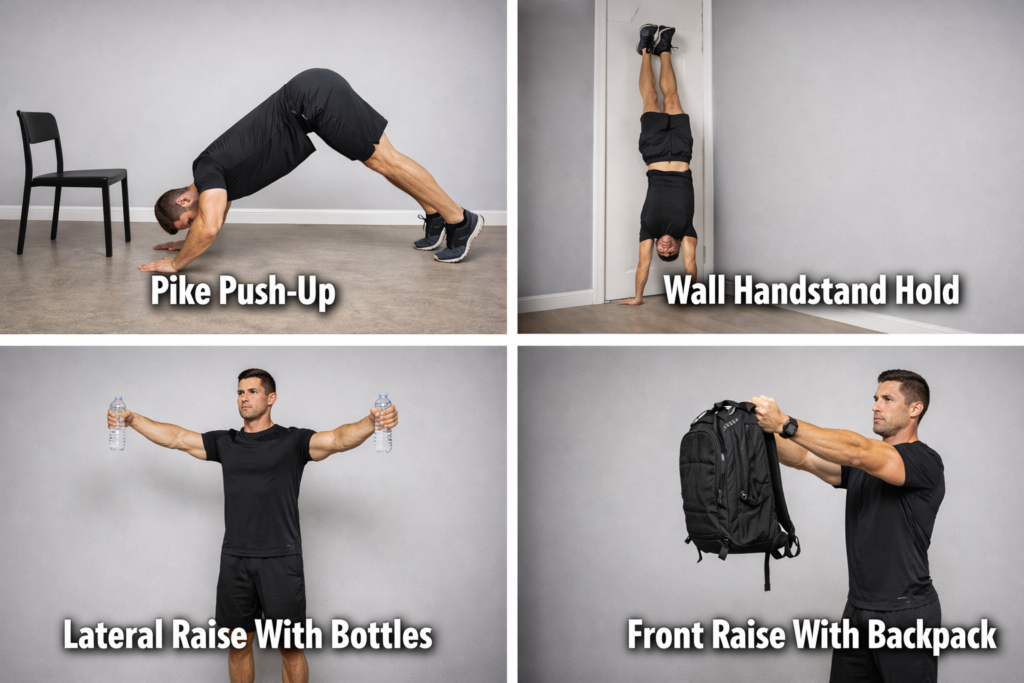
Pike Push-Up
Start with hips high and arms straight.
Lower head between hands.
Press upward through shoulders.
Variation – Feet-Elevated Pike Push-Up
Place feet on a chair to increase vertical loading.
Progressions:
- Slow eccentric reps.
- Increase range of motion.
- Add pauses at the bottom.
Wall Handstand Hold
Hands on floor, feet against wall.
Push tall through shoulders.
Keep ribs down and core tight.
Variation – Single-Foot Wall Balance
Lift one foot slightly away from the wall.
Progressions:
- Increase hold duration.
- Actively shrug shoulders.
- Reduce wall support gradually.
Lateral Raise With Bottles
Hold bottles at sides with slight elbow bend.
Raise arms to shoulder height.
Lower slowly without swinging.
Variation – Isometric Lateral Hold
Hold arms at shoulder height under tension.
Progressions:
- Increase hold time.
- Slow tempo reps.
- Add partial reps at the top.
Front Raise With Backpack
Hold backpack in front of thighs.
Raise to eye level under control.
Lower slowly.
Variation – Alternating Front Raise
Lift one arm at a time while holding backpack.
Progressions:
- Add pauses at the top.
- Increase time under tension.
- Add controlled partial reps.
Biceps

Bottle or Band Curl
Elbows close to sides.
Curl without swinging.
Lower slowly.
Variation – Isometric Curl Hold
Hold curl at 90 degrees under tension.
Progressions:
- Increase hold duration.
- Slow eccentric reps.
- Add partial reps at top.
Towel Curl Under Feet
Stand on towel ends.
Curl upward while resisting with legs.
Adjust leg pressure manually.
Variation – Single-Arm Towel Curl
Curl one arm while other rests.
Progressions:
- Increase leg resistance.
- Add pauses at peak contraction.
- Extend set duration.
Backpack Hammer Curl
Hold backpack with neutral grip.
Curl upward keeping wrists neutral.
Lower under control.
Variation – Alternating Hammer Curl
Curl one arm at a time.
Progressions:
- Slow eccentric phase.
- Increase reps.
- Add isometric holds.
Isometric Biceps Pull
Pull against immovable object at 90 degrees.
Maintain maximal tension.
Variation – Multi-Angle Isometric Pull
Change elbow angle slightly each set.
Progressions:
- Increase effort intensity.
- Increase hold time.
- Perform repeated short holds.
Legs
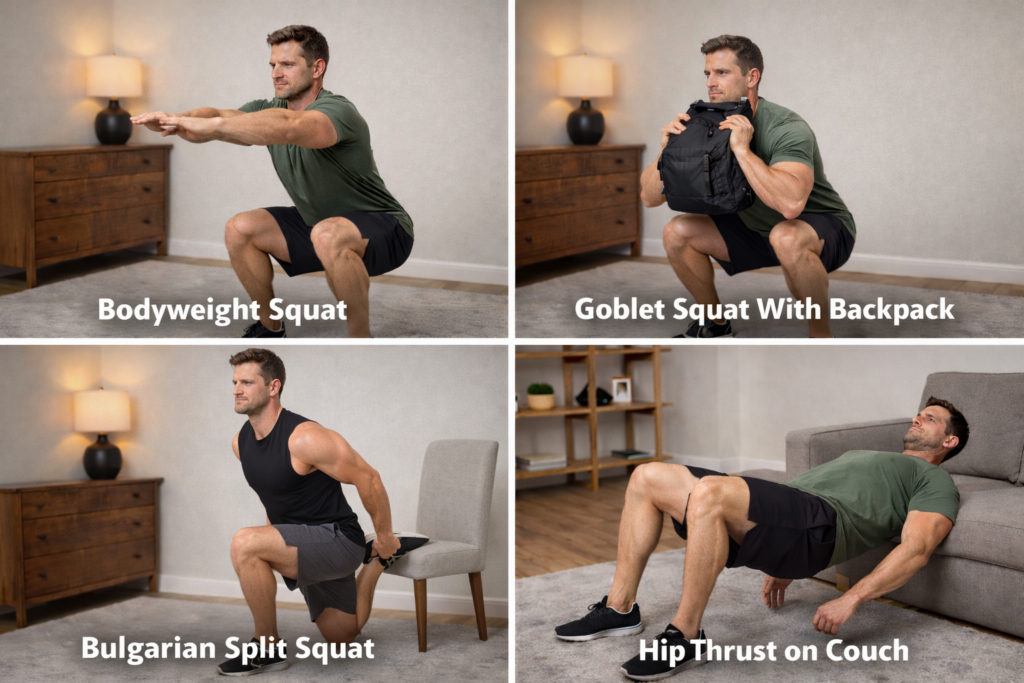
Bodyweight Squat
Feet shoulder-width apart.
Sit between hips.
Drive through mid-foot.
Variation – Pause Squat
Pause at the bottom before standing.
Progressions:
- Increase pause duration.
- Slow descent.
- Increase total reps.
Goblet Squat With Backpack
Hold backpack close to chest.
Keep torso upright.
Squat under control.
Variation – Heels-Elevated Goblet Squat
Elevate heels on a book or wedge.
Progressions:
- Add backpack load.
- Slow eccentric reps.
- Increase depth.
Bulgarian Split Squat
Rear foot on chair.
Lower vertically.
Push through front leg.
Variation – Forward-Lean Split Squat
Lean torso slightly forward to emphasize glutes.
Progressions:
- Increase depth.
- Add pauses.
- Slow tempo.
Hip Thrust on Couch
Upper back on couch.
Drive hips upward squeezing glutes.
Lower slowly.
Variation – Single-Leg Hip Thrust
One foot on floor, one leg extended.
Progressions:
- Add backpack load.
- Increase pause duration at top.
- Increase reps.
Core
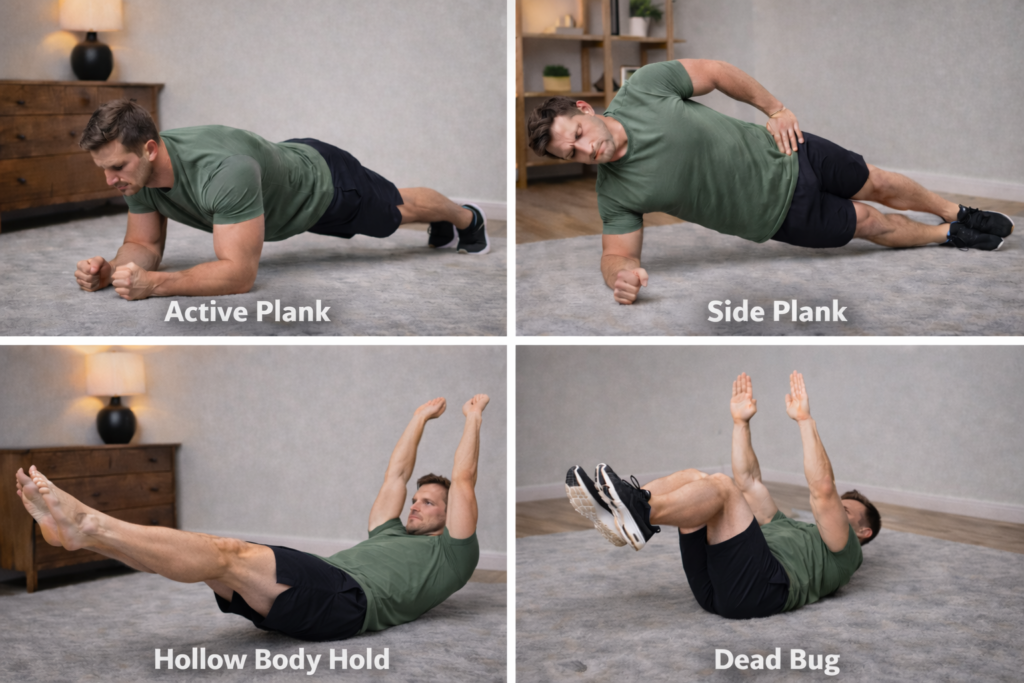
Active Plank
Variation – Plank Shoulder Taps
Tap opposite shoulder without rotating hips.
Progressions:
- Increase hold time.
- Slow tap speed.
- Add pauses.
Side Plank
Lie on one side with the elbow under the shoulder and legs stacked.
Lift the hips so the body forms a straight line from head to feet.
Maintain tension and breathe while holding the position.
Variation – Side Plank With Leg Raise
Lift top leg while holding position.
Progressions:
- Increase hold duration.
- Add slow reps.
- Reduce base of support.
Hollow Body Hold
Lower back pressed into floor.
Arms and legs elevated.
Hold tension.
Variation – Bent-Knee Hollow Hold
Bend knees to reduce difficulty.
Progressions:
- Extend limbs gradually.
- Increase hold time.
- Add small rocks.
Dead Bug
Start lying on your back with arms extended toward the ceiling and knees bent at 90 degrees.
Brace the core and press the lower back into the floor.
Slowly lower the opposite arm overhead and the opposite leg toward the floor, under control.
Variation – Paused Dead Bug
Pause briefly at full extension.
Progressions:
- Slow tempo.
- Increase pause duration.
- Increase reps.
How to Progress Without Weights
Progression at home is about control, not chaos.
Increase difficulty by changing one variable at a time:
- tempo
- range of motion
- leverage
- duration
If one of these improves, you are getting stronger.
Why Home Training Might Be Safer — If You Do It Right
One big advantage of training at home: you control the environment.
No one’s dropping weights near you.
No rushed ego lifting.
No skipping form checks.
When you slow down and focus on alignment, you train your stabilizers — the muscles that keep joints happy.
And that, in the long run, prevents more injuries than any “perfect” gym machine ever could.
If you’re smart about volume, your body adapts fast.
And you’ll find your shoulders, wrists, and knees start to feel stronger, not just look better.
Hybrid and Creative Home Training
Here’s where home training gets fun — when you start mixing systems.
Do shadowboxing as active rest.
Try “contrast sets” — slow push-ups followed by explosive ones.
The variety keeps your nervous system guessing and your motivation alive.
You don’t have to choose between structure and freedom — your living room can give you both.
That’s what makes it so sustainable.
|
If you’re into building strength with gym equipment or simple home setups, |
Conclusion
You don’t need a gym full of chrome and mirrors to build muscle or mobility.
You need structure, intensity, and patience — the same ingredients that build strength anywhere.
When your home becomes your lab, every rep teaches you something new about your body.
Every floor push-up is feedback.
Every towel row is data.
That’s the difference between “just exercising” and actually training for performance.
So yeah — you can absolutely build gym-level strength without leaving your living room.
But you have to respect the process.
Because once you do, your walls won’t feel like boundaries anymore — they’ll feel like part of the workout.
FAQs About Home Training Performance
1.Can home training improve your posture better than gym workouts?
Yes — if you do it intentionally.
At home, you spend more time controlling slow, bodyweight-based movements, which naturally activate stabilizers and postural muscles that machines often bypass.
When you rely on your own balance and proprioception, your body learns alignment — not just output.
That’s why many people notice shoulder and lower back pain disappearing once they start taking home training seriously.
2. Why does home training sometimes boost sleep quality?
Because home workouts often include more autonomic balance.
When you train in a quiet environment, you tend to regulate your breathing and stress levels without realizing it.
Less adrenaline, fewer bright lights, and more calm repetition — all of which help your parasympathetic nervous system recover faster at night.
3. Can home workouts reduce anxiety or mental fatigue from remote work?
Surprisingly, yes — and not only because of endorphins.
Short, structured training at home acts as a psychological boundary between “work mode” and “personal mode.”
It resets cognitive load.
That’s why doing 15 minutes of structured movement at home often clears brain fog better than a long cardio session at the gym.
4. Is there a way to measure progress at home without mirrors or scales?
Definitely.
Track performance indicators, not just appearance:
- Number of controlled reps (e.g., perfect 3-second push-ups).
- Range of motion improvements (how low you can squat or lunge).
- Balance stability (timed single-leg holds).
Those numbers reflect real neuromuscular adaptation — the kind that sticks, even when you eventually go back to a gym.
5. Can home training improve tendon health compared to weight training?
It often does — when programmed with controlled eccentric and isometric work.
Because you’re not rushing through heavy reps, your tendons adapt to gradual tension over time.
Think of it as “teaching” your connective tissue to handle load instead of shocking it.
6. What’s the best way to warm up if you don’t have space for dynamic drills?
Focus on micro-movements.
You can activate everything you need in one square meter:
- scapular circles for shoulders,
- ankle pumps for mobility,
- cat-cow sequences for spine activation.
Warm-ups don’t need space — they need intent.
If you can’t move big, move deep.
7. Why do some people get stronger faster when training barefoot at home?
Because barefoot training improves feedback between your feet and nervous system.
When your feet grip the floor directly, you engage stabilizers from the ground up — especially in hips and core.
This boosts force transfer and balance, which translates into better overall movement quality.
8. Can you periodize home training without fancy spreadsheets or apps?
Yes — through energy-based periodization.
Instead of tracking percentages or load, use your perceived recovery and readiness as a guide.
For example:
- “Heavy” weeks → focus on slower, harder variations.
- “Medium” weeks → maintain volume with stable control.
- “Deload” weeks → active mobility and stability focus.
9. Can you build explosive power at home without jumping or heavy loads?
Yes — through velocity control and short-burst contractions.
Try this combo: slow eccentric push-up → pause → fast concentric press.
The transition teaches your nervous system to produce power efficiently, even without big jumps or weights.
Explosiveness isn’t about impact — it’s about rate of force development.
10. How do I keep home training exciting long-term?
Gamify your progression.
Instead of chasing random numbers, chase mastery milestones:
- first 30-second L-sit,
- 10 perfect single-leg squats,
- 60-second wall handstand.
Progression that feels like “unlocking skills” instead of “adding sets” keeps motivation high and boredom low.
11. Can home workouts improve proprioception and coordination more than machine work?
Yes — that’s actually one of their hidden strengths.
Machines stabilize you artificially.
At home, you stabilize yourself.
That constant micro-adjustment trains your nervous system to react faster and more precisely, improving coordination far beyond what fixed-path equipment can offer.
That’s why gym athletes often feel “weirdly unstable” the first time they switch to home training — they’ve lost the reflex work.