I love backbends.
That moment when you open your chest toward the sky, stretch out like your heart is reaching for the sun, and for a second you feel like… a zen warrior with a bendy spine.
But then it happens.
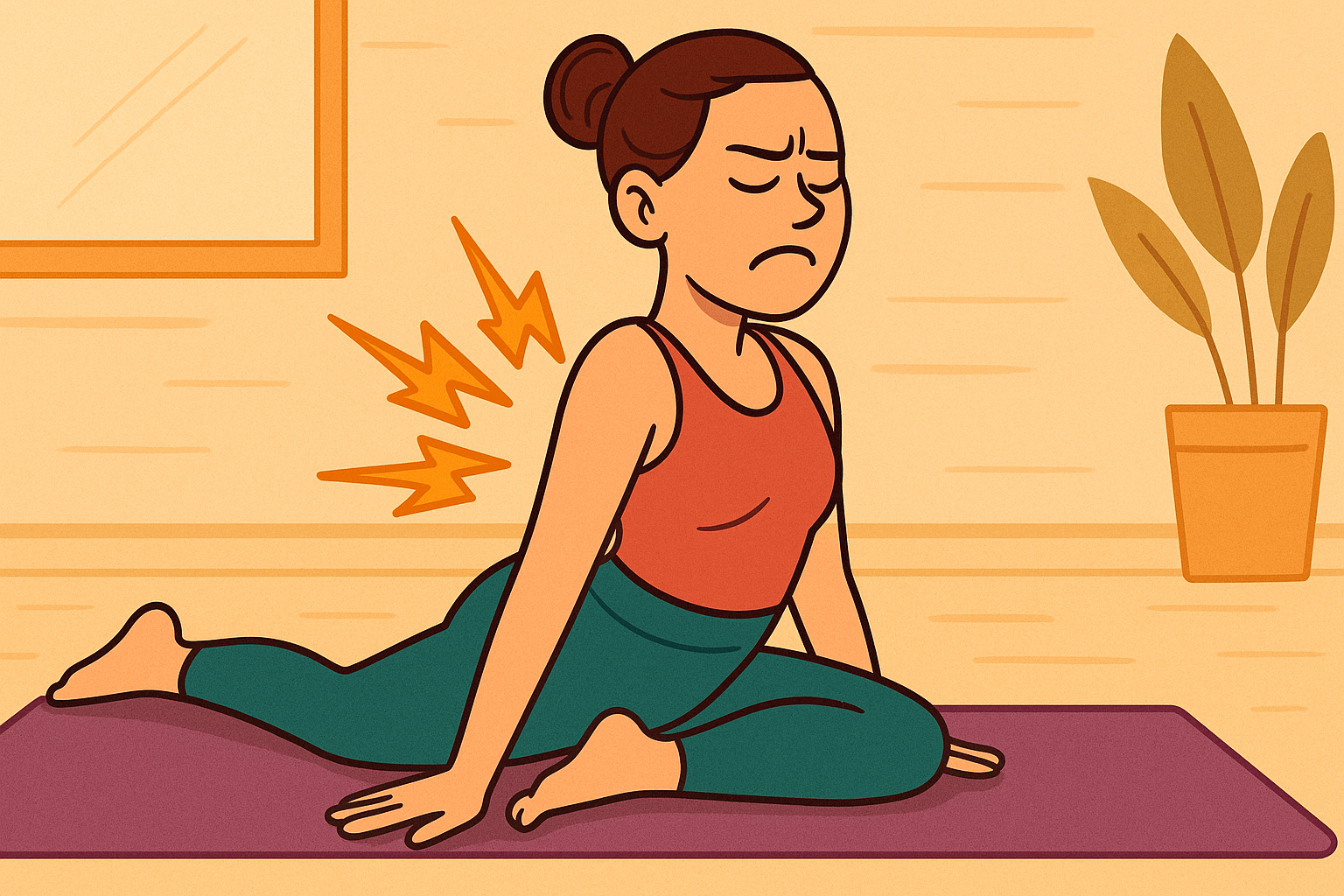
A dull, throbbing pain.
Right behind your eyes.
Like someone shoved two wedges into your frontal sinuses and is trying to crank them open with a jack.
And that’s when the doubt creeps in: “Is this my crown chakra opening… or am I about to pass out?”
Spoiler: it’s not (just) spiritual.
You’re not weird, you’re just human
If you’ve ever had this post-backbend experience, you’re not alone.
And no, it doesn’t mean you’re doing yoga wrong — or that you need to quit wheel pose or camel forever.
There are very real (and physical) reasons why some poses trigger a cranial meltdown.
And understanding them can literally save you from ending your yoga session on the couch with an ice pack.
Pressure, breath, and your neck: a toxic triangle
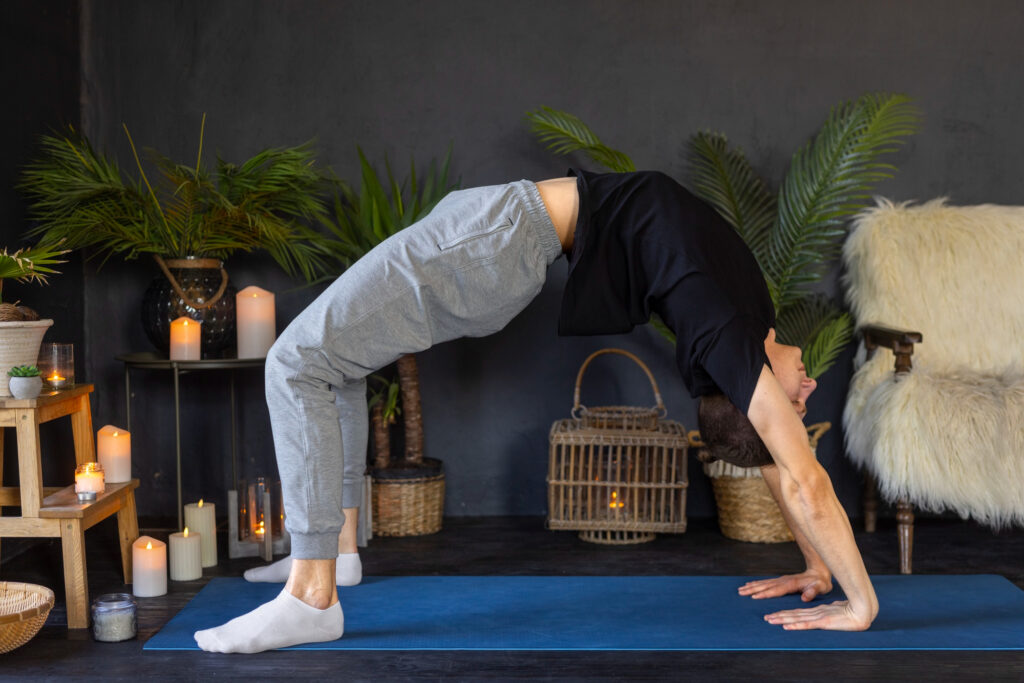
When you do a pose like wheel (chakrasana), camel (ustrasana), or even just a deeper upward-facing dog, you’re setting up a specific combo:
- You arch your spine and open your chest
- You tilt your head back
- And you often hold your breath without realizing it
That mix alters intracranial pressure.
In simple terms, the blood flow to your head increases, but the return flow (the blood that should go back down to the heart) slows down.
The result?
Higher pressure inside your skull, which can cause that dull pain behind the eyes or in the forehead.
On top of that, the cervical vertebrae often get compressed.
Many people bend their neck back more than necessary, thinking they need to “look up” or “let go” in the pose.
But if your muscles aren’t well-prepped (especially relaxed traps and lats), you’re just compressing nerves, muscles, and blood vessels in a super delicate area.
When nerves complain (and they do it loudly)
There’s one nerve that might be the silent culprit behind your yoga headache: the occipital nerve.
This nerve starts in your cervical spine and travels up to the back of your head — and guess what?
It passes right where your head “connects” to your neck.
In many backbends, we compress it without even noticing.
The result is a localized, throbbing sensation that can radiate behind your eyes or toward your temples.
If you already have tension in that area (like from working at a computer all day or having a classic “turtle neck” posture), you’re even more at risk.
The breath factor (that we forget way too often)
One of the most common — and underrated — issues during intense asanas is unintentional breath holding.
Maybe you’re super focused on nailing the perfect pose shape… and you literally forget to breathe.
It happens to everyone.
But holding your breath, even for just a few seconds, while you’re stretching your body and compressing certain areas, can suddenly drop oxygen levels in the brain.
And your brain, being the dramatic diva that it is, rings the alarm bell — in the form of a headache.
It’s not punishing you.
It’s telling you to slow down.
Watch your hydration, caffeine, and… post-sweat hangover
Another variable few people think about: how hydrated are you?
During a strong yoga session (especially hot yoga), you lose a ton of fluids.
And if you walked in already dehydrated — or just had coffee and nothing else in your system…
Bingo: you’ve got the perfect cocktail for a lovely behind-the-eyes headache.
Add in an empty stomach, a detox phase (aka no caffeine), or worse — you showed up to class hungover… your body’s already on high alert.
Put it all together, and it’s no wonder your head’s pounding like a Tibetan drum.
It’s not just about “form” — it’s about prevention
Yeah, I know — sounds like something a zen teacher would say: “Align the body, protect the mind.”
But posture here isn’t just aesthetic. It’s functional.
If you go into a backbend without engaging your core, without warming up your shoulders, without prepping your lats… all the strain lands on your lower back and neck.
And that’s where the trouble starts.
So yes, “engage your core” isn’t just a random cue.
Squeeze those glutes.
Let your thoracic spine breathe.
Let your head follow the movement of the chest — without being the main star of the bend.
What you can start doing right now to avoid backbend headaches
Here are a few practical tips that actually work:
- Always warm up your shoulders, upper back, and neck properly
- Try gentler backbends (like sphinx or baby cobra) before going into wheel
- Breathe deeply and regularly, even if it feels weird or “too loud”
- Use props: blocks, blankets, and straps can save your neck
- Don’t force your head backward — often just looking up is enough
- Avoid clenching your jaw or throat (many people grind their teeth without realizing)
- Drink water before and after your class
- If you feel “off” or dizzy after a pose: sit down, breathe, and don’t feel guilty
An unexpected tip (that totally changed my practice)
You know what reduced my headaches more than anything?
Doing a little less.
Yep, seriously.
Instead of chasing the deepest backbend every time, I started chasing the smartest one.
Sometimes a simple bridge pose with a block under my pelvis gives me more openness, breath, and peace than a poorly executed full wheel.
And guess what?
The headache doesn’t show up anymore.
When the headache hits after the practice (not during)
Not every headache shows up mid-pose.
Sometimes you feel great during class, maybe even super energized… and then, an hour later — boom.
Headache right behind the eyes or in the forehead.
In this case, it’s often not just mechanical, but metabolic.
During practice, your body releases endorphins and activates the autonomic nervous system.
Then, when everything suddenly “shuts down,” your vascular system can temporarily dysregulate.
It’s like going on a rollercoaster and getting off too fast.
Solution?
- Always end your session with a slow, gradual cool down (don’t skip savasana — ever!)
- Replenish with water and electrolytes afterward, not just fluids
- Don’t skip meals post-yoga: your brain needs sugar to stay balanced
Watch your eyes: yes, vision matters
It sounds silly, but we often underestimate how much vision impacts posture and cranial tension.
Staring at a point that’s too high or too far back (like when your gaze goes beyond your head in a pose) can activate deep eye muscles.
And those, in turn, trigger tension in the trigeminal nerve and the fascia around the eyes.
Result: pain right behind the eyes.
If this happens to you often, try:
- Keeping a neutral gaze, even with your eyes closed
- Using a soft, blurry focus — no “forced” staring
- Avoiding an upward gaze that goes beyond your natural line of sight, especially in deep backbends
Sometimes just changing where you look changes how you feel in the pose.
When yoga literally changes your brain (science agrees)
Here’s where it gets wild — those backbends, those deep breaths, that slow steady savasana at the end of class… they might not just make you feel better.
They might actually be reshaping your brain.
No, not in a “woo-woo manifest your perfect life” kind of way.
I’m talking real, MRI-detected, lab-coat-approved brain changes.
Researchers have been sticking long-term yoga practitioners into brain scanners and finding some seriously juicy stuff:
- A bigger, beefier hippocampus — the brain’s memory HQ
- Thicker prefrontal cortex — the area that helps you focus, plan, and make decisions
- Happier, calmer amygdala — the drama queen of your emotional system
- A default mode network that works like it’s still in its twenties — yes, that’s a good thing
What does that mean in real life?
Better memory.
Better emotional control.
And maybe a little extra resistance to the whole “forgetting where you put your keys” situation as you get older.
And here’s the kicker — the biggest benefits didn’t just show up in 20-year-old Instagram yogis.
Some of these changes were found in people in their sixties and seventies who’d been practicing for years.
RELATED:》》》 Why does doing yoga outside make me dizzy but inside I’m fine?
Conclusion
If you get that weird behind-the-eyes headache after backbends, don’t ignore it…
But don’t freak out either.
It doesn’t mean you have to give up yoga.
It means you can learn to listen better.
You can become more aware, more prepared, more aligned.
And maybe — ironically — thanks to that discomfort, you’ll discover a smarter, more sustainable practice for your body.