Maybe it’s happened to you too — you hop on a different stationary bike and suddenly everything feels wrong.
The pedals feel too far.
The resistance knob seems to be playing some kind of prank — half a turn too soft, half a turn too cruel.
Even the seat angle makes your quads light up like they just discovered fire.
You’ve been using bikes for years, but this one feels like a completely different species of machine.
That weird feeling?
It’s not just in your head.
It’s biomechanics, physics, and a little bit of human stubbornness — all pedaling in different directions.
The Secret Behind That “Weird” Feeling on Different Stationary Bikes
Every stationary bike is basically trying to mimic the same motion — push, pull, repeat — yet they all feel different.
And that difference can completely change which muscles do the heavy lifting.
Some bikes make your quads scream in ten seconds flat.
Others barely wake them up.
It’s not about your fitness level or consistency.
It’s about geometry — the invisible math behind your seat, crank, and pedal angles.
Think of it like borrowing someone else’s sneakers.
They technically fit, but your stride feels off.
The same happens when your knees, hips, and ankles don’t line up the way your body’s used to.
Tiny shifts — even a few degrees — can completely redirect where the power comes from.
And that’s why “comfort” isn’t just about the seat cushion.
It’s about mechanical alignment.
When the geometry clicks, your legs fire in sync, and the ride feels buttery smooth.
Pedal Angle and the Quad–Hamstring Battle
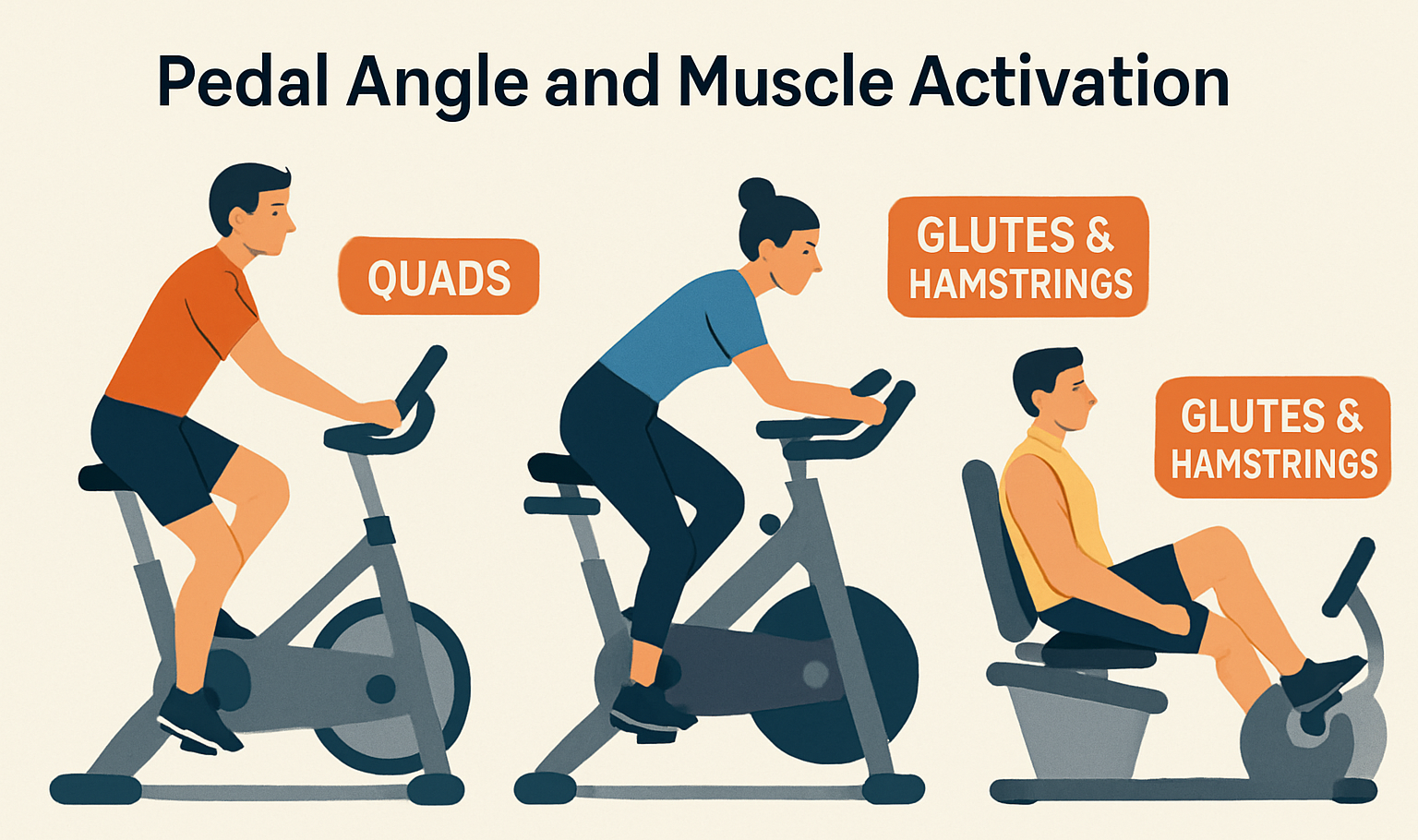
Here’s the simplest way to picture it:
The more vertical your torso and the more your knees push forward, the more your quads dominate.
The more your hips hinge back, the more your glutes and hamstrings join the effort.
That’s why upright bikes — the kind you see at hotels or smaller gyms — are quad-heavy.
They put your knees almost directly above the pedals.
It’s efficient for endurance, but it’s also why your thighs burn fast and your hamstrings take a nap.
Now, take a spin bike — lower handlebars, forward lean, slightly larger crank circle.
That lean shifts your center of gravity backward.
Suddenly, your posterior chain (glutes, hamstrings) starts pulling its weight.
Then you’ve got recumbent bikes, where you’re practically in a recliner.
There, your legs push horizontally rather than vertically, forcing your glutes and hamstrings to stabilize while the quads handle extension.
It’s a totally different muscle activation pattern.
In one EMG study published in the Journal of NeuroEngineering and Rehabilitation (2014), the rectus femoris fired earlier and longer in upright positions, while biceps femoris dominated during recumbent cycling.
So when someone says, “I don’t feel my glutes on this bike,” the real answer might be: “You’re just sitting on the wrong geometry.”
Flywheel Weight and Resistance Type: What You’re Really Pushing Against
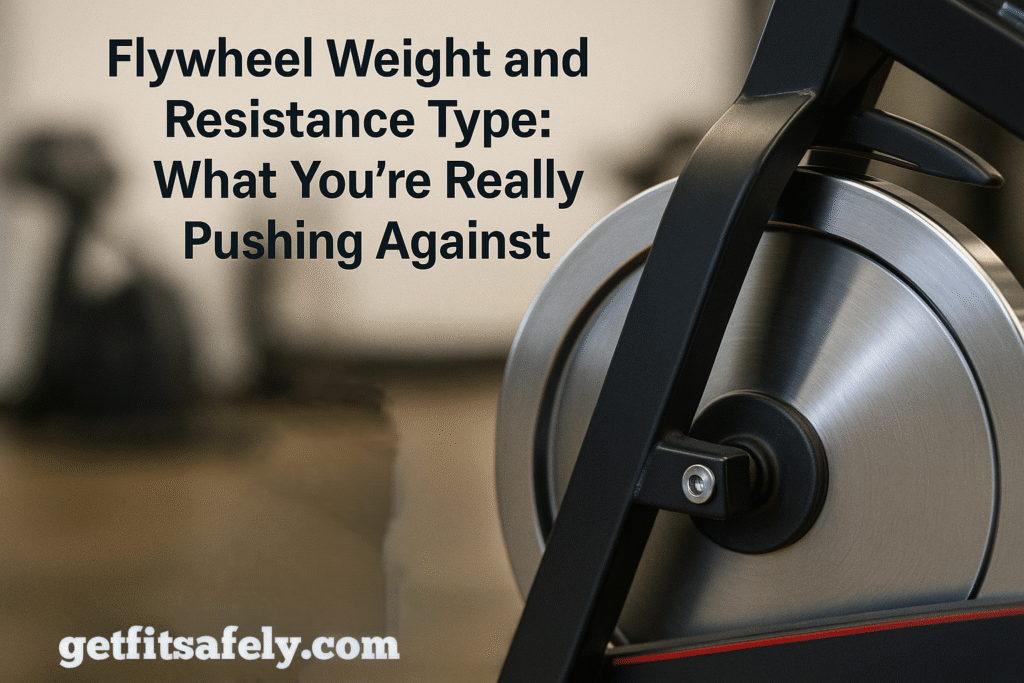
Let’s talk about the thing nobody notices until it’s too late — the flywheel.
That big round disk decides how your effort feels.
A heavy flywheel (30–40 lbs) builds momentum once you start pedaling, creating a smoother, inertia-driven ride.
It rewards rhythm.
Once it’s spinning, you’re surfing momentum.
That’s why spin bikes feel addictive — it’s all about maintaining that flow.
A light flywheel loses speed quickly.
It’s more reactive.
It forces constant control and micro-adjustments from your stabilizers.
You’re not coasting; you’re balancing tension every second.
And that’s where magnetic vs. friction resistance matters.
Magnetic resistance is smooth and progressive — like pedaling through calm water.
Friction resistance uses brake pads pressing the wheel — gritty, raw, unpredictable.
One feels like water, the other like grinding gravel.
Both build strength but activate your legs differently.
In friction setups, you get more isometric stabilization; magnetic systems promote steady concentric control.
That’s why your leg fatigue might double even at the same wattage.
Seat Height, Posture, and Leg Recruitment
You can have the fanciest indoor bike in the world, but if your seat height is wrong, nothing else matters.
Too low, and your knees dominate.
Too high, and your hips rock side to side.
Both waste energy and stress your joints.
The ideal height?
When the pedal’s at its lowest point, your knee should have a slight bend — 25–35°.
Your hips stay level, your shoulders relaxed.
Handlebar position matters, too.
Too high kills glute engagement; too low strains your lumbar spine.
That “sweet spot” feels natural, effortless — like your body’s autopilot kicked in.
That’s when your nervous system stops micromanaging and starts performing.
As one sports-biomechanics paper put it: “Optimal saddle height maximizes mechanical efficiency by aligning hip-knee-ankle extension vectors.”
Translation: Get the seat right, and every watt counts.
Why Some Bikes Make Your Legs Burn Faster (Even if You’re Fit)
You can ride five days a week and still get destroyed by a new bike setup.
That’s not weakness — that’s neuromuscular adaptation.
Each geometry demands new coordination.
Your brain has to re-learn firing order and rhythm.
That “why am I dying already?” feeling is your nervous system rebooting.
Once it adapts, fatigue fades and efficiency returns.
That’s why cyclists obsess over fit — even a 5 mm seat change can cut efficiency by 10–15%.
When the angles are off, energy leaks.
You push harder for less speed.
So if a random gym bike feels twice as hard, don’t panic — it’s muscle memory, not cardio collapse.
And that’s good news.
Varied setups make your legs smarter, not weaker.
You’re building new coordination pathways every time you adjust.
👉 Shop Magnetic Stationary Bikes for Home on Amazon
The Rhythm That Makes Every Ride Click

Cycling isn’t just legs — it’s rhythm and feel.
When bike geometry, cadence, and resistance align, you hit that meditative flow state where effort disappears.
You stop checking the clock.
But when angles or pressure feel off, time slows down painfully.
You overthink every stroke.
That mental friction drains you as fast as bad resistance.
The perfect fit makes the bike vanish.
You’re no longer “riding a machine”; you’re just moving.
That’s what separates exercise from training.
Exercise fights you.
Training flows with you.
And the right fit makes that difference possible.
How to Choose (or Adjust) a Stationary Bike That Fits Your Legs
Here’s the practical takeaway: you don’t need a pro fitting session.
You just need to understand how your setup affects your movement.
Start simple:
- Seat height: When you sit on the saddle, place your heel on the pedal at its lowest point. Your leg should be almost straight. When you pedal normally (ball of the foot on the pedal), that gives you a perfect slight knee bend.
- Seat fore/aft position: Your knee should be directly above the pedal axle when the pedal is at 3 o’clock. If your knee is ahead of it, slide the seat back a bit.
- Handlebar height: Level with or slightly below your seat if you want more glute involvement. Higher for comfort.
- Resistance test: Spin for 30 seconds. If it feels like air, you’re wasting time. If your form collapses after a minute, too heavy. You want smooth tension, not grinding misery.
Once you find your setup, take a photo or note the adjustments.
That’s your baseline.
Because the next time you hop on a random gym bike, you can recreate that magic instead of guessing.
And if your gym bikes are all slightly different?
That’s okay too.
Use it as variety.
Ride the upright one for quad focus days.
Hit the spin bike for full-leg activation and glute engagement.
Mixing positions keeps your muscles adaptable — and your rides from turning into autopilot boredom.
When “Different” Becomes an Advantage
Here’s the funny thing about all this:
The differences that frustrate you at first — awkward angles, new resistance curves, fresh muscle fatigue — are actually gifts.
Each new setup challenges your neuromuscular coordination.
You recruit different fibers, balance slightly differently, and strengthen supporting muscles that your go-to bike ignores.
It’s like cross-training without changing machines.
Your quads stop dominating.
Your glutes learn to join the party.
And your pedaling becomes more rounded — literally and figuratively.
If every bike felt identical, you’d never adapt beyond that one groove.
So yes, sometimes variety is the best strength program.
Just like lifting, where you change grip or tempo to hit new fibers — cycling variety builds balance, stability, and endurance in ways that one “perfect” setup never could.
When Your Core Slacks Off, Your Legs Pay the Price
Your core stability dictates how much power your legs can transfer.
On lower-bar spin bikes, your abs and obliques stabilize every push.
That turns you into a connected kinetic chain.
On upright bikes, your core takes a break, and your quads burn out faster.
If your legs fatigue quickly, check your trunk engagement.
Think of your abs as the anchor that lets your legs launch force.
Strong core = smooth pedal stroke.
Wobbly core = energy leak.
Comfort Isn’t Weakness — It’s Efficiency
In fitness culture, we tend to glorify discomfort.
“Feel the burn.” “No pain, no gain.”
But when it comes to cycling ergonomics, comfort actually signals alignment.
A bike that feels “right” isn’t just cozy — it’s efficient.
Your joints are stacked correctly, your energy goes into motion instead of micro-adjustments, and your nervous system can focus on endurance rather than survival.
If you can ride longer, harder, and smoother, that’s not taking it easy.
That’s mastering efficiency.
Pain and awkwardness aren’t badges of honor; they’re mechanical red flags.
So if your stationary bike feels like it’s fighting you — it probably is.
Fix the setup, not your attitude.
Advanced Tweaks for Experienced Riders
If you’ve been riding for a while, small upgrades go a long way.
- Crank length: Shorter cranks (165 mm) favor high cadence; longer ones (175 mm) boost torque and glute engagement.
- Single-leg drills: Improve symmetry and spot weak phases of your pedal stroke.
- Power meters: Track left/right balance and efficiency scores — use them like mirrors for your technique.
Each tweak builds control and reveals weak points your usual ride hides.
Integrating Stationary Cycling Into a Full Training Program
Use different bikes strategically across your week.
- Spin bike days: Build lower-body power and anaerobic capacity.
- Upright bike sessions: Steady endurance and active recovery.
- Recumbent rides: Rehab or core-focused stability work.
Mixing them keeps your neuromuscular system sharp and prevents plateau.
For hypertrophy goals, aim for moderate resistance (60–70 RPM) with seated climbs of 30–60 seconds.
For recovery, use light resistance at 90+ RPM and focus on smooth form.
👉 Find Your Next Indoor Stationary Bike on Amazon
Injury Prevention and Longevity
Bad alignment isn’t just inefficient — it’s risky.
Common issues:
- Knee pain: Seat too low or resistance too heavy.
- Hip discomfort: Overreaching handlebars.
- Lower-back strain: Weak core or excessive lean.
Quick fixes:
- Foam-roll your quads pre-ride.
- Stretch hip flexors after long sessions.
- Strengthen glutes twice a week to stabilize your pelvis.
Cycling longevity is about joint care, not mileage.
Why Some Stationary Bikes Last for Years — and Others Fall Apart When Training Gets Serious
The Bottom Line
Every bike has a personality.
Some are smooth talkers, others temperamental.
But once you find that sweet spot — the right seat, the right rhythm — everything clicks.
You stop staring at the numbers and start feeling the spin.
Your breath steadies, your legs glide, your mind quiets down.
That’s when the bike stops being equipment and turns into space —
a small, spinning sanctuary where movement clears your head.