
I always treated warm-ups like the “Terms and Conditions” screen.
Skim.
Click accept.
Pray nothing breaks.
Then I got older, a little smarter, and way more annoyed by tiny aches that show up uninvited.
So I ran an 8-week experiment on myself.
Not a lab study.
Not a “trust me bro” motivational montage.
Just real training, real notes, and a very honest question.
Do short warm-ups actually work, or am I quietly sabotaging my sessions.
And on the flip side, do long warm-ups help performance, or do they just eat time and turn me into a lightly sweaty philosopher who never actually lifts.
The question I actually cared about
A lot of warm-up advice is either extreme.
One camp says, “Just do a few arm circles and go.”
The other camp wants you to complete a 12-step mobility ritual that looks like you’re trying to exorcise your hips.
What I wanted was practical.
Which warm-up length helps performance and consistency in normal training.
Which one reduces those “uh oh” sensations in joints and tendons.
Which one feels sustainable when life is busy and motivation is average.
Because most training plans fail for boring reasons.
Not because the rep scheme is wrong.
They fail because the plan doesn’t fit real life.
Quick definitions so we’re on the same page
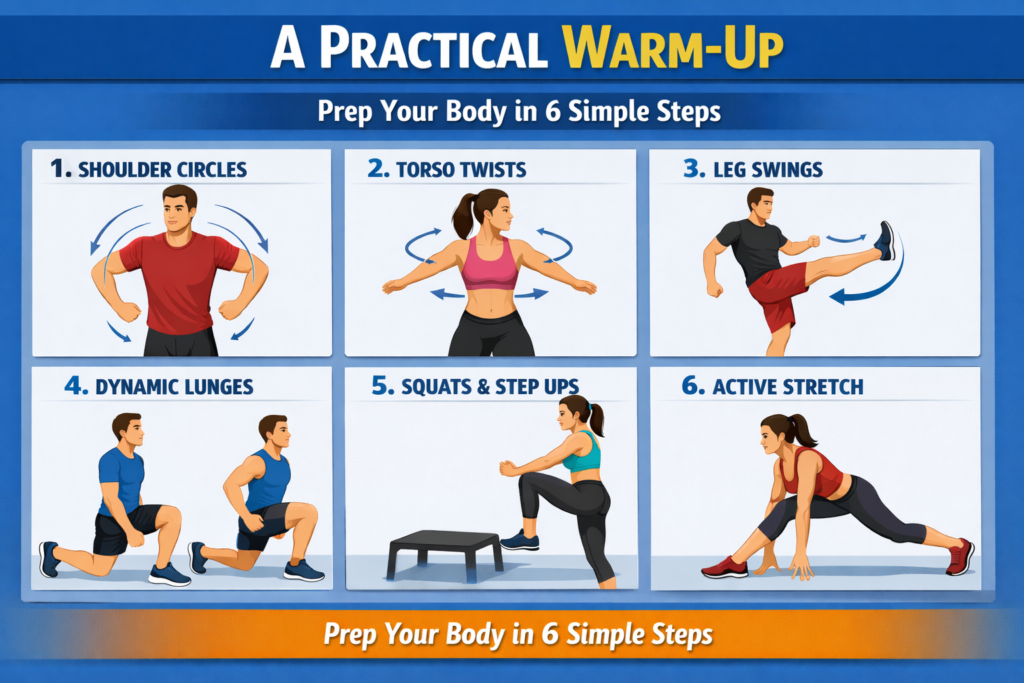
A warm-up has three jobs.
1. Increase temperature.
2. Prepare joints and tissues for the ranges of motion you’re about to use.
3. Prime the nervous system for the effort level you’re about to demand.
That’s it.
Everything else is decoration.
Sometimes useful decoration.
Sometimes just decoration that makes you feel like a serious athlete.
Which is fine, but only if it actually helps you train.
My two warm-up styles
I compared two approaches.
Short warm-up.
Long warm-up.
I kept them consistent, because otherwise this becomes an 8-week improv show.
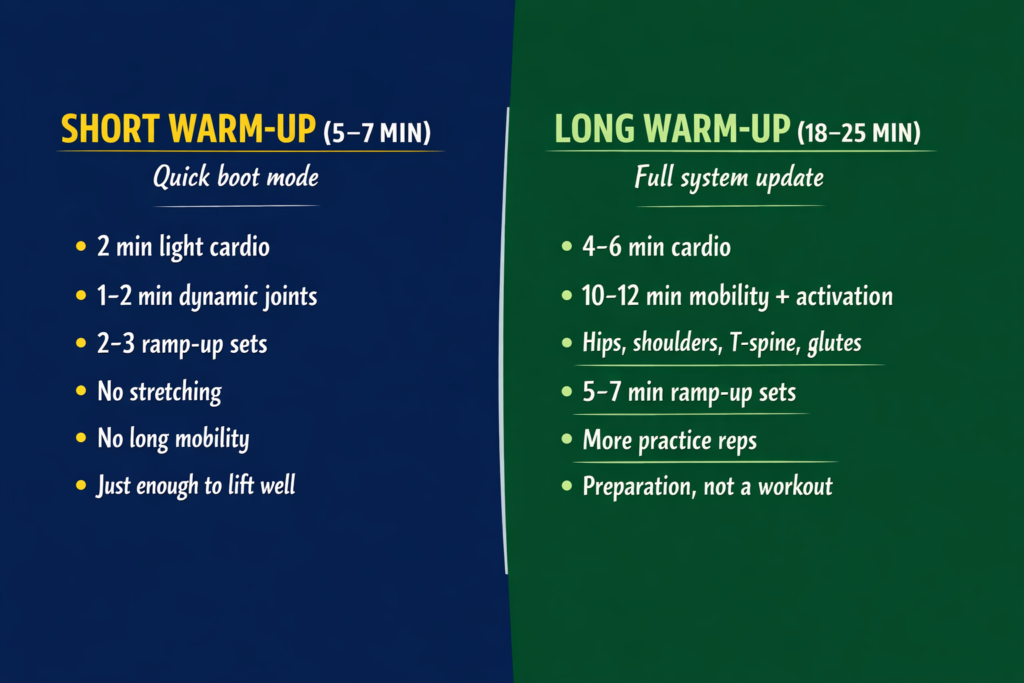
The short warm-up template
Total time: about 5–7 minutes.
I treated it like a phone’s “quick boot.”
Enough to get functional, not enough to rewrite the operating system.
It looked like this.
2 minutes of light cardio or movement.
Usually incline treadmill walk, easy row, or brisk step-ups.
1–2 minutes of dynamic joint prep.
Leg swings, arm circles, hip hinges, scap circles, ankle rocks.
2–3 ramp-up sets for the first main lift.
Empty bar or light load, then two gradual jumps.
No long stretching.
No extended mobility circuits.
No laying on the floor for ten minutes negotiating with my hip flexors.
The long warm-up template
Total time: about 18–25 minutes.
I treated it like a PC that insists on updating before you can do anything.
Sometimes that update is genuinely helpful.
Sometimes you just stare at the screen wondering why you started.
It looked like this.
4–6 minutes of light cardio.
10–12 minutes of mobility and activation.
Hips, ankles, T-spine, shoulders, glutes, scap stability.
Think world’s greatest stretch, 90/90 flows, deep squat pry, band pull-aparts, dead bugs, glute bridges, clamshells, face pulls.
Then 5–7 minutes of ramp-up sets for the main lift.
More gradual jumps than the short version.
More time under “practice reps.”
Still no aggressive static stretching right before heavy sets.
Not because it’s evil.
Because I wanted the warm-up to feel like preparation, not a separate workout.
The training plan I used for the 8 weeks
I trained 4 days per week.
Two lower days.
Two upper days.
This was not a “new plan every week” situation.
Same core lifts, same structure, same progression style.
I wanted warm-up length to be the main variable, not everything changing at once.
Lower day A.
- Squat pattern as the main lift.
- Then hinge accessory.
- Then unilateral legs.
- Then calves or trunk.
Lower day B.
- Deadlift pattern as the main lift.
- Then squat accessory.
- Then hamstrings.
- Then trunk.
Upper day A.
- Bench or weighted dips as the main lift.
- Then row pattern.
- Then shoulders.
- Then arms.
Upper day B.
- Overhead press as the main lift.
- Then pull-ups or lat work.
- Then chest accessory.
- Then arms or upper back.
How I alternated warm-up types
I didn’t alternate day to day.
That would make every session feel different in a way that’s hard to compare.
Instead I did blocks.
Weeks 1–4: Short warm-ups for every session.
Weeks 5–8: Long warm-ups for every session.
That order wasn’t “scientific perfection.”
It was practical.
I started with the time-saving method I suspected I’d prefer.
Then I switched to the longer method and tried to be fair.
Would reversing the order change things.
Possibly.
Self-experiments are messy.
Still, the patterns were clear enough that I’d bet a good post-workout meal on them.
What I tracked

I tracked what mattered to me as a normal person who likes progress.
- Performance.
- Session quality.
- Pain and “warning signals.”
- Consistency.
- Energy and motivation.
So I wrote down:
- Top set performance on the main lift.
- How long it took to reach my first working set.
- Perceived readiness on a 1–10 scale.
- Perceived joint comfort on a 1–10 scale.
- Any sharp pain, pinches, weird clicks, or tendon grumbles.
- Whether I felt stiff during the first two working sets.
- Total session time.
I also tracked sleep and stress in a simple way.
“Good, okay, bad.”
Because those are the invisible hands that move the barbell when you’re not looking.
Week 1 reality check
Week 1 with short warm-ups felt amazing.
Not because my performance exploded.
Because it was easy to start training.
That matters more than people admit.
Starting is the hardest rep.
With a 5–7 minute warm-up, there was no mental negotiation.
I didn’t have time to overthink.
I just moved, ramped up, and trained.
Squats felt slightly stiff in the first working set.
Not scary stiff.
More like my knees were saying, “Oh, we’re doing this already.”
By set two, everything felt normal.
Bench felt totally fine.
Deadlift felt fine once my hinge pattern woke up.
Overhead pressing was the first place I noticed a downside.
My shoulders felt “cold” for the first few sets.
Not painful.
Just not smooth.
Weeks 2–4 with short warm-ups
Here’s what improved.
Consistency went up.
I hit all four sessions every week without drama.
Session time was compact.
Most workouts stayed under 70 minutes, including accessories.
Momentum was strong.
I rarely felt like skipping.
Readiness scores were surprisingly decent.
Most days I rated 7–8 out of 10 by the time I hit working sets.
Now the trade-offs.
Lower body stiffness showed up more often.
Especially after long sitting days.
Squats took longer to feel “fluid.”
Deadlifts were fine, but the first heavy set sometimes felt like stepping onto the highway a little too quickly.
Shoulders were the biggest variable.
On pressing days, I had more “first set feels awkward” moments.
Again, not pain.
Just less coordination at the start.
The joint comfort score was the key metric here.
It wasn’t terrible.
It just wasn’t consistently great.
If I had to summarize short warm-ups in one line, it would be this.
Short warm-ups are like starting a car on a cold morning and driving gently for the first few minutes.
Totally workable.
Just not always elegant.
The first week of long warm-ups

Week 5 was my “fine, I’ll do the whole ritual” week.
Warm-ups took longer, obviously.
Yet something unexpected happened.
My first working set felt better.
Not stronger.
Better.
Better bar path.
Better groove.
Better confidence.
That’s hard to quantify, but it showed up as higher readiness scores.
I was hitting 8–9 out of 10 more often.
Squats felt like my hips and ankles had already agreed to cooperate.
Deadlifts felt more predictable off the floor.
Overhead press felt smoother sooner.
It was like the movement quality dial got turned up.
Still, the time cost was real.
A “normal” session became 85–95 minutes.
That sounds fine on paper.
In real life, it can be the difference between training and not training.
Weeks 6–8 with long warm-ups
This is where the story got interesting.
Because long warm-ups helped my body.
But they challenged my schedule and my brain.
Let’s break it down by outcomes.
Performance outcomes
I didn’t get magically stronger from long warm-ups alone.
That’s important to say out loud.
Warm-ups are not a strength program.
However, I did see small improvements in top set quality.
Not always in weight.
Sometimes in reps at the same weight.
Sometimes in speed.
Sometimes in confidence.
On squats, the first heavy set felt less like “finding the groove.”
It felt like “continuing the groove.”
That meant my best set was more likely to happen on set one or two, not set three.
On deadlifts, I noticed fewer “weird” reps where the bar drifted or my hips shot up early.
On pressing, especially overhead work, the shoulder comfort improved the most.
The long warm-up made my shoulders feel like they belonged to someone who actually takes care of them.
Which was a nice temporary fantasy.
Joint comfort and “warning signals”
This was the biggest difference.
Long warm-ups reduced the little warning signals.
Less knee crankiness in early squat sets.
Less hip tightness turning into compensation.
Less shoulder stiffness on pressing days.
Even my elbows felt calmer on pulling movements.
Nothing in the short warm-up block caused an injury.
Still, I had more “this feels slightly off today” moments.
Long warm-ups turned many of those into “this feels normal.”
That’s not glamorous, but it’s valuable.
It’s like running antivirus software.
You don’t notice it when it works.
You notice it when you skip it and your computer starts doing weird things at 2 a.m.
Consistency outcomes
Here’s the inconvenient part.
I missed more sessions during the long warm-up block.
Not because I didn’t want to train.
Because the sessions demanded more time.
One missed workout per month might not sound like much.
But over a year it adds up.
Consistency is the real supplement.
Short warm-ups made training easy to start.
Long warm-ups made training feel better once I started.
That tension is the heart of this whole debate.
Energy and motivation outcomes
Long warm-ups sometimes boosted motivation.
Because I felt “ready” and athletic.
Other times they drained motivation.
Because the warm-up itself felt like a chore.
If I was stressed or tired, a 20-minute warm-up felt like a separate appointment.
Short warm-ups were easier to do even on low-energy days.
They lowered the activation energy.
And that matters.
A perfect warm-up that you don’t do is just a nice idea.
What surprised me most
The biggest surprise was that both approaches were “right,” depending on the day.
Some days I needed the long warm-up.
Other days it was unnecessary.
What I really learned is that warm-up length should match context.
Your body’s context.
Your day’s context.
Your training context.
Treating every day like it requires the same ritual is like wearing a winter coat in summer because “it worked great in January.”
When short warm-ups worked best for me
Short warm-ups were best when:
- Time was tight.
- Stress was high.
- Motivation was average.
- Training goal was simply to show up and get quality work done.
- My body already felt decent that day.
- I wasn’t doing a high-skill lift at near-max intensity.
In those situations, short warm-ups felt like a cheat code for consistency.
Not because they were “optimal.”
Because they were doable.
When long warm-ups worked best for me
Long warm-ups were best when:
- I was lifting heavy or pushing top sets.
- I had any hint of stiffness in the hips, ankles, shoulders, or T-spine.
- The main lift required precision, like squats and overhead pressing.
- I had slept well and had time.
- I wanted the session to feel smooth and strong, not just completed.
They also helped when I had been sitting a lot.
Desk days made my hips feel like they were folded into a different person.
Long warm-ups unfolded me back into something usable.
The middle path that actually makes sense
After week 8, I didn’t “choose a winner.”
I built a hybrid system.
Because the real answer isn’t short versus long.
The real answer is flexible warm-ups with a clear minimum and a clear upgrade path.
So here’s what I do now.
I start with the short warm-up every time.
Then I “earn” the long warm-up only if my body asks for it.
That sounds fluffy, but it’s practical.
It’s decision-making based on feedback, not vibes.
My current warm-up system
Step 1: Two minutes of easy movement.
Walk, row, bike, step-ups, anything that raises temperature.
Step 2: Two minutes of joint prep.
I choose three movements that match the lift.
For squat day, that’s usually ankle rocks, hip hinges, and a squat pry.
For deadlift day, it’s hip hinges, hamstring sweeps, and a few deep breaths in the bottom position of a hinge pattern.
For bench day, it’s scap circles, band pull-aparts, and a few push-ups or light dumbbell presses.
For overhead press day, it’s T-spine rotations, band face pulls, and a controlled overhead reach pattern.
Step 3: Ramp-up sets.
I do enough sets to make the first working set feel like a continuation, not a shock.
Some days that’s two ramp sets.
Other days it’s four.
Step 4: The “stiffness test.”
If my first ramp sets feel clunky, I add 6–10 minutes of targeted mobility and activation.
Not a full-body circus.
Just the bottleneck areas.
Then I ramp again briefly and go.
The stiffness test that saved me from overthinking
Here are the signals I use.
Bar path feels inconsistent on empty bar or very light weight.
Joint feels “pinchy” in a specific range.
Breathing feels tight and braced positions feel unstable.
I feel cold even after a few minutes of movement.
If none of those happen, I keep it short.
If one or two show up, I upgrade the warm-up.
That keeps me from doing a 25-minute warm-up on a day when I’m already fine.
It also keeps me from pretending I’m fine on a day when I’m clearly not.
What “targeted mobility” actually means
Targeted mobility is not random stretching.
It’s finding the one or two limiting factors that affect today’s lift.
Then addressing them with movement that looks like the lift, but easier.
For squats, my usual suspects are ankles and hips.
So I do ankle rocks, deep squat holds with gentle shifting, and a few goblet squats.
For deadlifts, it’s usually hamstrings and hip hinge patterning.
So I do hinge drills, light RDLs, and controlled hip airplanes if I feel unstable.
For bench, it’s shoulder positioning and upper back tightness.
So I do band pull-aparts, face pulls, and a few pause push-ups.
For overhead pressing, it’s T-spine extension and scap control.
So I do wall slides, T-spine rotations, and light overhead carries if I have space.
Nothing fancy.
Just specific.
The mistake I made early on
During the long warm-up block, I occasionally turned the warm-up into a workout.
That’s the trap.
Activation work can feel productive.
Mobility flows can feel athletic.
Then you realize you’ve spent 25 minutes “preparing” and your actual session now has to be rushed.
A warm-up should leave you more capable, not more tired.
If your warm-up makes your accessories weaker, it’s too much.
If it makes you want to skip the session because it feels long, it’s too much.
If it feels like a requirement rather than a tool, it’s too much.
The performance myth I stopped believing
I used to think, “If I don’t do a long warm-up, my strength will suffer.”
My 8 weeks taught me a more nuanced truth.
If I don’t warm up enough for the day I’m having, my performance suffers.
If I warm up more than I need, my schedule and consistency suffer.
Strength is not just what your muscles can do.
Strength is what your routine can sustain.
Who should probably lean short
Short warm-ups are a great default if:
- You’re a beginner who needs more time practicing the actual lifts.
- You’re consistent only when sessions are simple.
- You train during a lunch break or tight schedule.
- You don’t have recurring joint grumbles.
- Your main goal is building the habit and progressing steadily.
In those cases, a short warm-up plus good ramp-up sets is often enough.
The ramp-up sets are the underrated hero here.
They are specific practice.
They teach your body the movement pattern under gradually increasing load.
That’s warm-up and skill work in one package.
Who should probably lean long
Long warm-ups make more sense if:
You’re lifting heavy relative to your strength.
You’re older, stiffer, or both.
You have recurring “warning signal” areas.
You’re training highly technical movements.
You sit a lot and feel locked up.
You actually have the time and it doesn’t threaten consistency.
Also, if you love long warm-ups and they keep you injury-free, that’s a valid reason.
Training is not a purity contest.
It’s a long-term relationship.
Do the version that keeps you showing up.
The small detail that mattered more than warm-up length
Breathing and bracing practice mattered a lot.
On squat and deadlift days, taking a few slow breaths during ramp-up sets improved everything.
Not meditation.
Just controlled breathing to find stable ribcage and core position.
That made the first working set feel less chaotic.
It also reduced the tendency to rush.
Rushing is the silent killer of good training sessions.
A warm-up is partly about slowing down enough to move well.
Short or long, that principle still applies.
RELATED:》》》 Can a Short Warm-Up Improve Your Run?
Conclusion
If you want a clean headline answer, here it is.
Short warm-ups helped me train more consistently and start sessions easily.
Long warm-ups made my body feel better and my first heavy sets feel smoother.
Neither one is “best” in all situations.
The best warm-up is the one that matches your day and still leaves time for the actual work.
So if you’ve been skipping warm-ups entirely, don’t jump straight to a 25-minute routine.
Start with 6 minutes.
Add ramp-up sets.
Pay attention to how your first working set feels.
Upgrade only when you need it.
That approach is realistic.
It’s also sustainable.
And sustainability is where the real gains live.
Because the strongest program in the world is useless if you can’t stick to it.
Show up.
Warm up enough to move well.
Then do the work.
Repeat long enough, and you won’t need a dramatic warm-up debate anyway.
You’ll just be the person who trains consistently and feels good doing it.