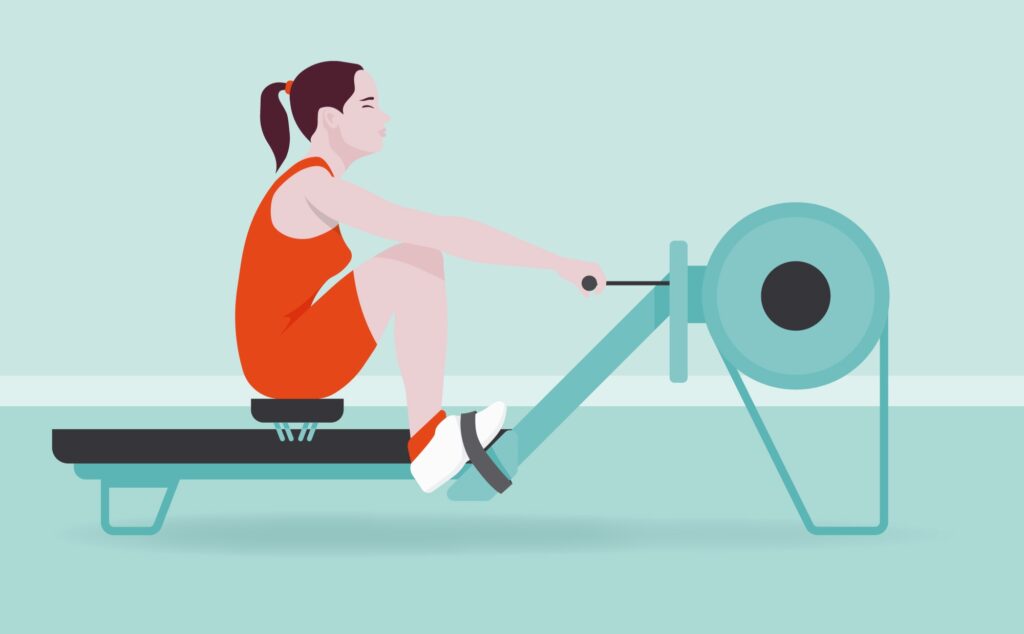
There’s something suspicious about how quiet the rowing machine is.
No flashing lights.
No clanking plates.
Just the soft swirl of water and the sound of your own breath syncing with motion.
Maybe that’s why people underestimate it — they think it’s too calm to matter.
But here’s the truth: the calmer it looks, the harder it hits.
While treadmills scream for attention and bikes buzz with noise, the rower sits in the corner like the introvert who secretly dominates every test.
It doesn’t need flash. It just delivers.
And if you’ve been ignoring it, you might be missing out on one of the most efficient fat-burning full-body workouts you can possibly do.
Why rowing is different from other cardio machines

Let’s be real — most cardio options are one-trick ponies.
Running is leg-heavy. Cycling is quad-dominant. Ellipticals feel like moving through molasses on autopilot.
Rowing, though, doesn’t pick sides.
Each stroke is a synchronized movement using your legs, glutes, core, lats, traps, shoulders, and arms all at once.
That means nearly 90% of your muscles are working together.
You’re not just moving — you’re generating coordinated power from the ground up.
That’s why rowing burns more calories per minute than almost any other low-impact cardio exercise.
You’re not isolating effort; you’re distributing it across your entire body.
Think of it like splitting the bill among ten friends instead of two — you can go longer, harder, and more efficiently without burning out as fast.
The hidden calorie furnace: understanding the afterburn
Let’s talk science — the fun kind.
Every time you pull, your VO₂ (oxygen uptake) skyrockets.
The body scrambles to deliver oxygen to every major muscle group in motion, and that oxygen debt doesn’t go away when you stop rowing.
This is where EPOC — Excess Post-Exercise Oxygen Consumption — kicks in.
It’s the fancy term for your body continuing to burn calories after you’re done working out.
It’s the same principle behind HIIT workouts, except rowing gives you that afterburn effect without wrecking your joints or your soul.
So even after you rack the handle and collapse on the floor, your metabolism is still hustling — repaying oxygen debt, restoring glycogen, repairing muscle tissue.
Translation: you’re still burning fat hours after your session ends.
Why it feels meditative — until it doesn’t
There’s a rhythm to rowing that hooks you in.
The sound of the water, the seat sliding, the breathing in sync — it feels almost therapeutic.
It’s your brain’s version of white noise with muscle involvement.
Then, somewhere around minute seven, that calm starts to fade.
Your grip burns.
Your lungs revolt. Your legs start drafting a complaint letter.
That’s when you realize: this peaceful glide is actually a full-body ambush in disguise.
Every stroke is both cardio and resistance training.
It’s like doing a deadlift and a plank at the same time — hundreds of times in a row.
And because it’s low-impact, your body can recover faster than it would from running, which means you can train more often — a key advantage for sustainable fat loss.
The calorie math: what the numbers really say

A 155-lb person rowing at a steady pace burns about 520–600 calories per hour.
Go harder — say, interval-style — and that number can hit 800–900 calories per hour, depending on stroke rate and drag factor.
But calories alone don’t tell the full story.
Because rowing uses both aerobic and anaerobic systems, it builds metabolic flexibility — your body’s ability to switch between burning carbs and fat efficiently.
That metabolic shift is what makes rowing such a powerful fat-loss tool.
It trains your body to stop depending on quick glucose spikes and start using stored fat as a reliable energy source.
And over time, that effect doesn’t just change your body composition — it changes how your body handles energy altogether.
Fat oxidation vs. carb burn: how rowing teaches your body efficiency
Let’s get one thing straight: your body always uses a mix of carbs and fats for fuel.
But here’s the key — the ratio changes depending on intensity.
At lower intensities (60–70% max HR), rowing helps your body rely more on fat oxidation — literally teaching your metabolism to prefer fat as its main source of energy.
That’s the zone where you’re sweating, breathing heavy, but not gasping.
The sweet spot for fat burning and endurance building.
Push intensity higher (80–90% HR) and your body taps into carb metabolism, burning glycogen for quick energy.
That’s great for short bursts, but it’s not where the long-term fat loss happens.
Which is why smart rowers mix both: steady-state sessions to train fat metabolism and sprints to boost VO₂ and EPOC.
That combo builds an engine that can do it all — burn efficiently, recover faster, and stay lean without burnout.
Technique: the secret weapon most gym-goers ignore
The difference between “meh” rowing and “holy hell” rowing isn’t the resistance — it’s the technique.
The magic order is: legs → core → arms on the drive, then reverse it — arms → core → legs — on the recovery.
Get that wrong and you’ll end up yanking with your arms while your powerhouse (your legs) just goes along for the ride.
That means fewer calories, more frustration, and possibly an appointment with your chiropractor.
When you nail the timing, though, everything clicks.
The drive feels explosive but smooth.
The recovery feels like a breath before another wave.
That’s when rowing stops being cardio and becomes flow.
Find that rhythm and you’ll notice your pace even out, your splits improve, and your fatigue set in slower — because your whole body is sharing the work instead of one part taking the hit.
Damper setting, stroke rate, and resistance control
Let’s kill a myth: higher damper doesn’t mean harder workout — it just means heavier resistance.
Set it too high and you’ll muscle through each pull like you’re dragging an anchor.
Too low, and you’ll spin with no real force output.
The goal is to find that middle ground — where you can maintain smooth rhythm at 26–30 strokes per minute with consistent split times.
Power + rhythm = maximum calorie burn.
That’s why elite rowers don’t “max the damper” — they optimize it for efficiency and endurance.
Rowing and muscle preservation during fat loss
Here’s a fat-loss paradox: too much cardio can eat into muscle mass if you’re not careful.
But rowing doesn’t fall into that trap, because every stroke combines concentric and eccentric strength work across multiple joints.
You’re not just moving air — you’re generating resistance through water or air drag that challenges the posterior chain, stabilizers, and even the grip.
That constant mechanical load tells your body, “Hey, we need this muscle,” even while you’re in a calorie deficit.
That’s how rowing burns fat without flattening your physique.
When combined with proper protein intake and recovery, it becomes one of the few cardio methods that actually helps preserve lean mass while cutting down body fat.
Curious how to balance cardio and lifting without hitting a recovery wall?
Check out this guide on mixing rowing and strength training for smarter programming.
Heart rate pacing and fat-loss zones
If you’re rowing purely by how hard it feels, you’re guessing.
And guessing rarely beats science.
To target fat specifically, stay in the 65–75% max HR range — that’s where fat oxidation peaks.
Use a heart rate monitor or even a smartwatch to track it.
You should feel challenged but in control — breathing heavy, not gasping.
For metabolic boosts and conditioning, add short bursts at 85–90% HR — 30–60 second sprints followed by easy rowing for recovery.
That blend hits both aerobic and anaerobic systems, triggering EPOC and teaching your body to recover faster.
Rowing smarter beats rowing harder every time.
The mind-body focus that keeps you consistent
Most people don’t realize how much of fat loss depends on consistency — not intensity.
Rowing, oddly enough, makes that consistency possible.
The rhythm, the sound, the motion — it’s addictive in the healthiest way.
The more you fall into it, the easier it becomes to show up for it.
There’s something deeply meditative about syncing your breath with each drive.
The chaos of the day fades into the background as your focus narrows to just one thing: the next pull.
That’s when rowing shifts from exercise to therapy.
And guess what happens when your stress drops?
Your cortisol levels balance, your hunger cues normalize, and your recovery improves.
Translation: lower stress equals smarter metabolism.
That’s not “woo-woo” wellness talk — that’s physiology.
Stress hormones directly affect fat storage, especially around the midsection.
So while other workouts push you to exhaustion, rowing finds the rare balance between intensity and calm — and your body rewards you for it.
Your weekly rowing + lifting structure for steady fat loss
To turn the science into visible results, structure matters.
Here’s a simple yet powerful way to combine rowing and strength training without crashing your recovery:
- Monday – Endurance Row: 40 minutes steady at 65–70% HR. Focus on breathing rhythm and stroke control.
- Tuesday – Lower Body Strength: Squats, lunges, glute bridges. Optional 10-minute recovery row at low resistance.
- Wednesday – Interval Row: 8 × 500 m at 85–90% HR with 90 seconds rest. Keep stroke rate around 28–30 spm.
- Thursday – Upper Body Strength: Pull-ups, presses, face pulls. Finish with 15 minutes easy row to flush the muscles.
- Friday – Power Row: 5 × 5-minute segments hard, 2-minute recovery between. Target consistent split times.
- Weekend – Recovery / Light Row: 20 minutes gentle pace or outdoor walk. Prioritize sleep and hydration.
This setup gives you five high-quality sessions per week — enough to build endurance, strength, and metabolic balance without frying your system.
The 4-week rowing challenge for fat loss and focus
Here’s how to lock in real progress without burning out.
Think of this as your “starter engine” — four weeks to build the habit, the base, and the burn.
Week 1 – Get the rhythm
3 sessions, 25–30 minutes each. Focus on form, not speed. Keep stroke rate at 24–26 spm and heart rate around 65% max. You’re building the foundation.
Week 2 – Add control
4 sessions. Two steady-state (35 minutes), one interval (6×500 m), one recovery row (15 minutes). Learn to control breathing under effort.
Week 3 – Turn up the power
4 sessions. Mix strength and cardio: alternate between 500 m sprints and 1-minute push-ups or air squats. Your lungs will hate you, your metabolism will love you.
Week 4 – Benchmark and reflect
Test a 2K row. Record your split, stroke rate, and HR recovery at 1 and 2 minutes. Then repeat Week 1 pace and feel the difference — that’s measurable progress.
After four weeks, you’ll notice two things: better endurance and a sharper mindset.
You’ll start craving that rhythm.
And that’s when fat loss becomes easy — because you’re not fighting consistency anymore.
When showing up feels natural, results stop feeling accidental.
Why rowing works better than running for long-term fat loss
Let’s settle a classic debate.
Running burns calories too, no doubt.
But the joint impact, recovery time, and high injury rate make it hard to stay consistent long-term.
Rowing delivers equal or higher calorie burn with far less joint strain, and it builds more muscle in the process.
More muscle = higher resting metabolic rate.
It’s a slow snowball that compounds over time.
Plus, the water-like resistance of rowing means your effort automatically adjusts — push harder, and it pushes back.
You’re never over- or under-doing it.
That’s why rowing doesn’t just torch fat — it keeps your body in the game for years.
Want to know if rowing can also help you build visible muscle — not just burn calories?
Read this deep dive on rowing and muscle growth next.
Rowing and hormonal balance
Most people chasing fat loss only focus on calories.
But hormones are the hidden puppeteers behind the whole show.
Regular rowing sessions improve insulin sensitivity, which means your body manages carbs more efficiently instead of storing them as fat.
At the same time, it lowers baseline cortisol (stress hormone) and boosts natural endorphins, which help control appetite and mood.
And when your hormonal profile stabilizes, your metabolism becomes predictable.
You stop bouncing between energy crashes and cravings.
A calm metabolism burns cleaner than a chaotic one.
Common rowing mistakes that kill your fat-burning potential
- Poor posture: rounding your back turns every stroke into a backache, not a workout.
- Skipping the leg drive: your legs are the engine — if you pull with just your arms, you lose 70% of your power output.
- Over-rowing daily: recovery matters; without it, you’re teaching your body to survive, not adapt.
- Setting the damper too high: this is not CrossFit punishment — it’s rhythm and efficiency that burn fat, not brute force.
- Ignoring stroke rate: control it; wild pulling ruins your pacing and burns you out early.
Fix those, and you’ll double the effectiveness of every workout without adding a single extra minute.
Rowing is a skill — and skill multiplies results.
The quiet revolution of the rowing machine
While the world argues about which treadmill incline burns more, the rowing machine sits quietly in the corner — doing its job.
No fancy metrics needed. No crowds. Just effort, rhythm, and reward.
Rowing builds strength, endurance, coordination, and calm all in one motion.
That’s rare in fitness.
It’s the kind of training that makes you feel powerful, not punished.
So the next time you walk into a gym, maybe skip the treadmill. Slide onto that lonely rower, feel the water move, and remember:
Every stroke is shaping a stronger engine — inside and out.