

This didn’t start with an injury, and that’s probably why it took me so long to take it seriously.
No sudden pop.
No sharp pain that forced me to rack the bar.
No obvious red flag screaming “stop training now.”
It started as something much more subtle and, honestly, much more dangerous because of that.
Every push day felt slightly off.
Bench press felt heavy in the shoulder even when the load was well within my comfort zone.
Incline pressing made that sensation more noticeable, especially as sets progressed.
Dips were fine at first, then slowly irritating.
Overhead work felt stiff, not weak, just strangely restricted.
What made the situation confusing was that strength never really dropped.
Reps were still there.
Bar speed looked normal.
Lockouts felt solid.
From the outside, everything looked fine.
From the inside, push day felt like driving a perfectly tuned car with the steering wheel slightly misaligned.
You can still move fast, but something is constantly asking for your attention.
Why the Weakness Explanation Never Fully Convinced Me

Like most lifters, my first instinct was to assume weakness somewhere along the chain.
That explanation is comforting because it gives you something concrete to attack.
Weak triceps? Train them harder.
Weak shoulders? Add volume.
Upper back not supporting the press? More rows.
The problem was that none of the classic weakness indicators were actually present.
I wasn’t missing reps.
I wasn’t losing control under load.
Fatigue wasn’t spiking abnormally.
If this were a pure strength issue, something should have cracked under pressure.
It didn’t.
In my experience, when pain shows up without a clear performance drop, it’s rarely about how much force you can produce.
It’s more often about how confident your body feels producing that force in a specific position.
And confidence, at the joint level, has very little to do with muscle size or max strength.
Why I Decided to Run a Proper Test Instead of Guessing

At some point, I realized that guessing was the real problem.
Every small tweak I considered felt like another variable muddying the water.
So I decided to treat this like an experiment rather than a rehab phase or a panic response.
Thirty days.
One change only.
Everything else stayed intentionally boring and predictable.
I kept the same weekly split.
The same main push movements stayed in place.
Volume and loading patterns didn’t change.
Rest times between sets remained consistent.
No new cues.
No exercise swaps.
No sneaky deload disguised as “listening to my body.”
If my shoulder felt different after thirty days, I wanted to know exactly why.
The only thing I added was daily mobility work, targeted specifically at the shoulder complex and the structures that influence pressing mechanics.
What Mobility Meant in This Context
This is where I need to slow down, because mobility is one of the most misunderstood terms in training.
This wasn’t flexibility work.
I wasn’t chasing extreme ranges or trying to become more “loose.”
I wasn’t forcing stretches or holding painful positions hoping something would magically unlock.
The goal was restoring movement options and coordination.
I focused heavily on thoracic spine movement, because a stiff upper back forces the shoulder to compensate during pressing.
I worked on scapular mobility, not just strength, because a shoulder blade that doesn’t move properly turns every press into a joint-centric movement.
Internal and external rotation work was done slowly, with control, and without fatigue chasing.
No burning.
No grinding.
No “feel the stretch” obsession.
Sessions were short and repetitive.
Most of the time they felt underwhelming, which made them psychologically harder to respect than heavy lifting.
Looking back, that lack of drama was probably the point.
The Exact Mobility Routine I Ran for 30 Days
To keep this experiment clean, I followed the same structure every single day, including rest days.
Each session lasted about 15–20 minutes, never more, because the goal was consistency, not exhaustion.
The order never changed, because each block prepared the next one.
1. Thoracic Spine Mobility – Creating Space Before Forcing Movement
This part always came first, every single day, because I learned very quickly that pressing mechanics fall apart if the upper back can’t move.
Before starting this experiment, I thought my thoracic spine was “fine” simply because I could row heavy and keep decent posture under load.
What I didn’t realize was how little actual movement I had there once the bar was in my hands.
Thoracic Extensions on a Bench

This was my main drill.
I sat at the edge of a flat bench with my feet firmly on the floor, placed my upper back against the bench, and lightly engaged my glutes to keep my lower body stable.
From that position, I crossed my arms in front of my chest and slowly leaned back over the bench, focusing on extending through the upper back rather than arching the lower spine.
The key cue for me was keeping my ribs down.
If my ribs flared upward or my lower back took over, the movement was wrong.
I wasn’t trying to drop my head as far back as possible.
I was trying to move one vertebra at a time, slowly and under control.
I performed 2 sets of 8–10 reps, taking about 3–4 seconds to move into extension and the same amount of time to return to the starting position.
No bouncing.
No forcing range.
If the movement felt jerky or rushed, I slowed it down even more.
Quadruped Thoracic Rotations

Extension alone wasn’t enough, so I paired it with rotation.
I got into a hands-and-knees position on the floor, with hands under shoulders and knees under hips.
One hand stayed planted on the ground while the other rested lightly behind my head.
From there, I rotated my upper body by opening the elbow toward the ceiling, keeping my hips completely still and my lower back neutral.
If my hips shifted or my lower spine twisted, I reset the rep.
The movement came entirely from the upper back.
I focused on rotating as far as I could without forcing the range, then slowly returning to the starting position while exhaling fully at the top.
I used 2 sets of 6–8 slow reps per side, treating each rep like practice rather than exercise.
Almost immediately, this drill exposed clear left-to-right differences in how my upper back moved, and those differences matched perfectly with the side where my shoulder discomfort showed up during pressing.
That connection alone made this part of the routine non-negotiable for me.
2. Scapular Mobility – Teaching the Shoulder Blade to Move Again
This was the real turning point of the entire experiment, mostly because it forced me to realize something uncomfortable.
My scapulae were strong, but movement-wise they were lazy.
They liked to lock down and stay there, which feels incredibly stable under load but slowly grinds the shoulder joint over time.
The goal here wasn’t to strengthen anything.
It was to remind the shoulder blades that they’re supposed to move.
Scapular Push-Ups
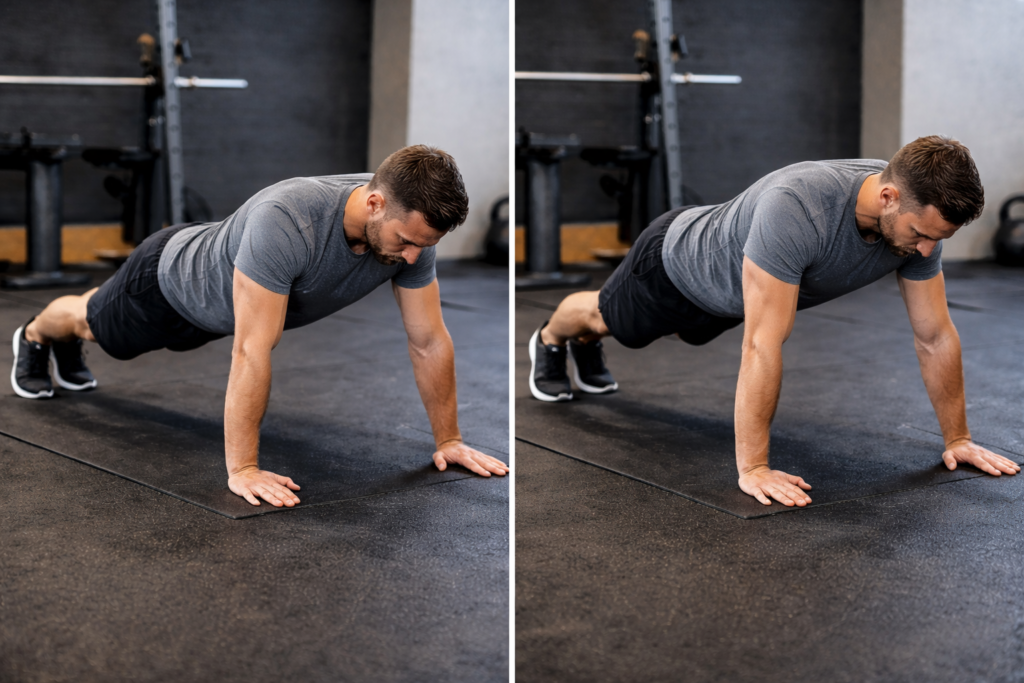
For this drill, I set up in a standard push-up position on the floor.
Hands under shoulders.
Arms completely straight.
Core lightly braced, but not rigid.
From that position, I didn’t bend my elbows at all.
Instead, I let my chest sink slightly toward the floor by allowing the shoulder blades to come together, then I pushed the floor away and spread the shoulder blades apart as far as I could.
The arms stayed locked the entire time.
If the elbows bent, the rep didn’t count.
If my head dropped or my lower back sagged, the rep didn’t count.
I moved slowly, focusing on feeling the shoulder blades slide along the ribcage rather than “pushing hard.”
I performed 2–3 sets of 10–12 controlled reps, resting just enough to stay relaxed and precise.
At first, the movement felt awkward and surprisingly tiring, which was a clear sign that this pattern had been neglected.
Wall Slides with Lift-Off

This drill exposed compensations I didn’t even know I had.
I stood with my back, glutes, and upper back pressed gently against a wall.
Feet were a few inches away from the wall to avoid arching the lower back.
Arms were bent at roughly ninety degrees, with elbows and forearms touching the wall.
From there, I slowly slid my arms upward, keeping my forearms in contact with the wall as long as possible.
At the top of the movement, I lifted my hands just a few centimeters off the wall, then slowly returned them before sliding back down.
The lift-off was small on purpose.
If my ribs flared, my lower back arched, or my shoulders shrugged toward my ears, I had gone too far.
I kept this to 2 sets of 6–8 slow reps, focusing entirely on smoothness and control instead of range or fatigue.
Within two weeks, this drill alone changed how stable and organized my shoulders felt during unracking, which told me I was finally addressing the right problem.
3. Shoulder Rotation – Restoring Trust, Not Chasing Burn

I always left shoulder rotation for last, and that choice was deliberate.
By the time I got here, my upper back was already moving better and my scapulae were no longer locked in place, which meant the shoulder joint didn’t feel exposed or fragile anymore.
Only then did rotation make sense.
For external rotation, I used a very light resistance band anchored at elbow height.
I stood sideways to the anchor point, kept my elbow gently pressed against my ribcage, and bent it to roughly ninety degrees, so the forearm started across my stomach.
From there, I slowly rotated the forearm outward, keeping the elbow glued to my side the entire time.
No leaning.
No twisting the torso.
No letting the shoulder drift forward.
If the elbow moved away from my ribs or my body started compensating, the rep didn’t count.
The movement was small on purpose.
I focused on control, not range, and stopped the moment tension started pulling me out of position.
I used 2–3 sets of 10–15 slow reps per side, resting enough to stay relaxed, and always stopping well before fatigue.
If I felt a burn, I had already gone too far.
The goal wasn’t to tire the muscle.
It was to remind the joint that this movement was safe.
For internal rotation, I simply turned around so the band was pulling my forearm outward instead of inward.
Same setup.
Same elbow position, still close to my side.
From there, I slowly rotated the forearm back toward my stomach, again without letting the shoulder roll forward or the torso rotate.
This part required even lighter resistance than external rotation.
I kept it intentionally slow and controlled, almost treating each rep like a rehearsal rather than an exercise.
I did 2 sets of 10–12 reps, focusing entirely on smoothness and precision.
No rushing.
No momentum.
No grinding through tension.
By week three, these rotations stopped feeling awkward or threatening and started feeling oddly reassuring, like the shoulder finally trusted that it could move without needing to lock everything down.
That sense of trust carried directly into pressing, and it was one of the clearest signs that the mobility work was doing its job.
How I Integrated This Into Actual Push Days
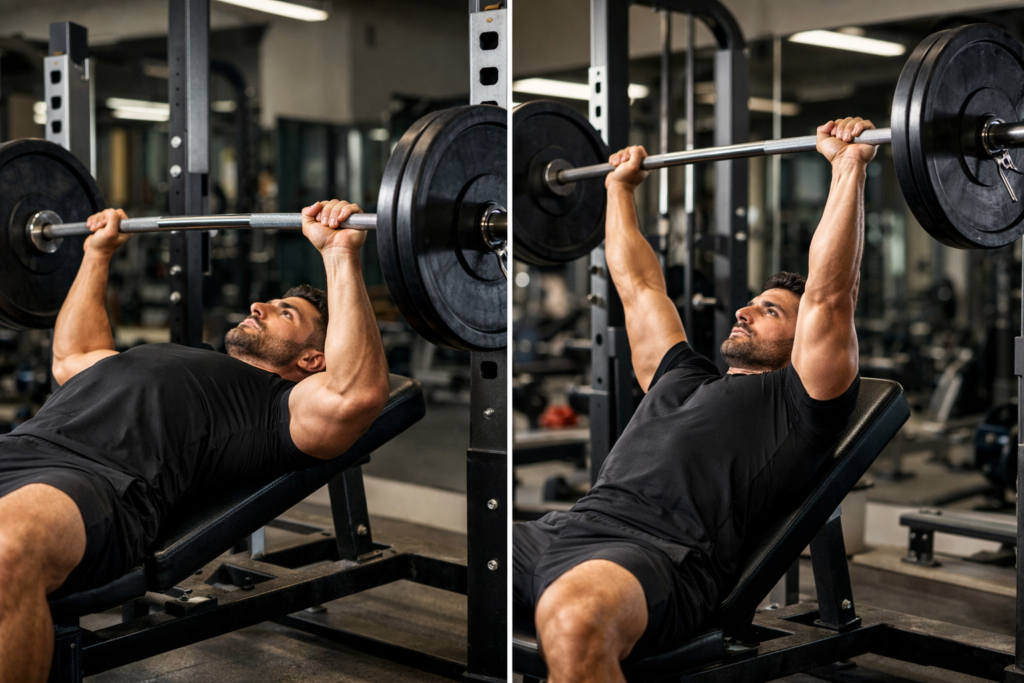
Mobility didn’t live in isolation.
If it only worked away from the barbell, it wouldn’t matter.
Before every push session, I used a shortened 5–7 minute version of the routine.
Usually one thoracic drill, one scapular drill, and one light rotation exercise.
No fatigue.
No stretching.
Just a reminder to my nervous system that the shoulder had options.
The full 15–20 minute sessions stayed outside training, often later in the day or on rest days, so mobility supported strength instead of competing with it.
Week 1: Pain Stayed, Tension Changed
If I judged week one purely by pain levels, I would’ve said nothing worked.
Bench still felt uncomfortable.
Incline pressing still triggered that familiar front-shoulder pressure.
Nothing disappeared.
But something subtle changed in how the shoulder behaved before the pain showed up.
The joint felt warmer, less guarded, less braced.
Scapulae started moving instead of freezing the moment I unracked the bar.
The discomfort was still there, but the nervous tension around it was lower.
That alone told me I wasn’t wasting my time.
Week 2: The Pain Lost Its Authority
During the second week, the pain didn’t vanish, but it stopped controlling the session.
It appeared later.
It stayed quieter.
It no longer hijacked my focus from the first working set.
Bench felt less compressed in the bottom position.
Incline pressing no longer felt like the shoulder was being pushed forward into a position it didn’t trust.
The joint still wasn’t “happy,” but it stopped acting like it was under threat.
That psychological shift mattered more than I expected.
Week 3: Strength Didn’t Increase, Access to It Did
This was the most eye-opening phase of the entire experiment.
Weights stayed exactly the same.
No PRs.
No sudden performance jump.
And yet, sets felt easier to control.
Stability improved.
Bar path felt cleaner.
Lockouts felt less forced and more natural.
I wasn’t stronger.
I simply stopped fighting my own shoulder to use the strength I already had.
Week 4: Pain Became Feedback, Not a Threat
By week four, pain only showed up when something broke down.
Flared elbows brought it back.
Rushed eccentrics brought it back.
Loss of control brought it back.
Clean, controlled reps kept it quiet.
That’s the ideal outcome.
Pain stopped feeling like a warning siren and started behaving like information.
Why This Worked When Strength Was Never the Real Issue
Mobility didn’t make my shoulder stronger.
It changed how the joint perceived load.
Better movement options meant better force distribution.
Better coordination reduced unnecessary stress on irritated tissues.
The nervous system stopped hitting the brakes every time I pressed.
Pain, in this case, wasn’t a sign of fragility.
It was a sign of confusion.
Why Push Days Are a Perfect Storm for This Kind of Issue
Push workouts load the shoulder heavily in internally rotated, anterior-biased positions.
Bench.
Incline.
Dips.
Even fly variations.
If thoracic extension is limited and scapular movement is restricted, stress accumulates fast.
Nothing explodes immediately.
Instead, discomfort slowly builds until it becomes “normal.”
Who This Experience Applies To (And Who It Doesn’t)
This experience is relevant if:
- Strength is stable.
- Pain is vague or inconsistent.
- Discomfort appears mainly under load.
It does not apply if pain is sharp, worsening, or present in daily life.
Those situations deserve professional evaluation, not experiments.
RELATED:》》》 Are wide push-ups biomechanically doomed to be a front-delt dominant movement?
The Real Takeaway After 30 Days
The biggest lesson from these thirty days is simple but uncomfortable.
Push day pain isn’t always weakness.
Sometimes it’s a coordination problem hiding behind decent numbers.
Mobility didn’t fix my shoulder.
It made my shoulder stop interfering.
And once that happened, pressing felt natural again instead of negotiated.
If push day feels like a constant argument with your joints, adding more load may not be the solution.
Sometimes the smartest move is making sure your body actually knows how to use what it already has.