Let’s be honest.
The decline bench is like that relative at Christmas parties nobody invites, yet always shows up.
Some people think it’s essential.Others pretend it doesn’t exist.
The big question floating around gym rats is simple:
Can you build a solid lower chest without using that decline bench that feels like a water slide?
Quick answer: yes.
But let’s break it down properly, unpacking the topic like a gym bag that… smells worse than expected.
| So What Actually Replaces the Decline Bench? Let’s Get Practical |
| Dumbbell press on flat bench with hips slightly raised |
| Elevated-feet push-ups |
| Weighted dips with a forward lean |
| High-to-low cable flys |
| Standing diagonal cable press |
| Band decline press with anchor point high behind you |
The Decline Bench Myth That Just Won’t Die
There’s something magical about the golden era of bodybuilding.
Mostly because everything that happened back then became “mandatory” forever.
If Arnold or Franco touched it, it became sacred gym lore.
So people assumed:
“Decline bench = lower chest or die.”
But here’s the truth no one wants to say out loud.
Your pec fibers do not care about the name printed on the equipment.
They care about direction.
They care about tension.
They care about how you press, not what you press on.
Yes — decline angles do slightly shift tension toward the sternocostal fibers of the pec major.
But slightly is the key word here.
It’s like owning a Ferrari to get to work.
Cool.
Sexy.
But completely unnecessary.
A normal car still gets you there.
Your Chest Works Like a Fan — Change the Angle, Change the Emphasis
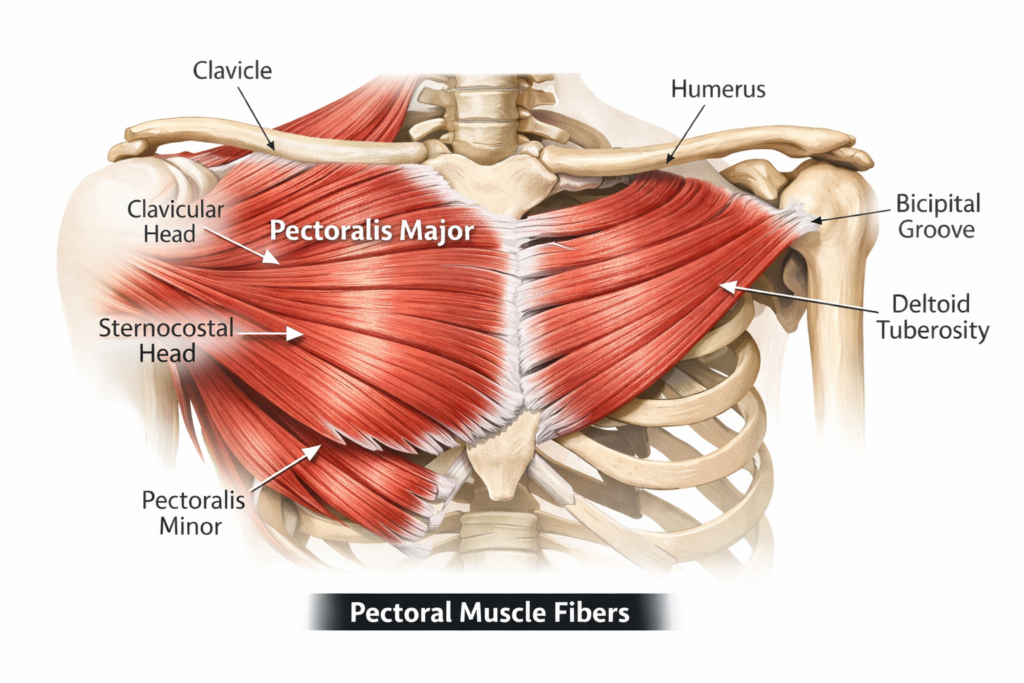
Visualize your pec fibers like a handheld fan opening up.
The fibers run from your sternum out toward the arm.
Press in a downward-ish direction, and you hit the lower portion more.
Press upward, you hit the upper portion.
Press straight out, you hit the middle.
This is basic biomechanics, not divine gym commandments.
And the best part?
You can easily recreate a “decline-style” force angle without ever touching a decline bench.
Here are the most effective alternatives:
- Dumbbell press on flat bench with hips slightly raised
- Elevated-feet push-ups
- Weighted dips with a forward lean
- High-to-low cable flys
- Standing diagonal cable press
- Band decline press with anchor point high behind you
None of these require sliding into a position where your face is lower than your butt.
A Bit of Science — Without Putting You to Sleep
Whenever online coaches want to sound smart, they throw around the word “EMG.”
Electromyography.
Electrodes on muscles.
Colorful graphs that make you feel guilty for not studying biology.
But here’s what matters:
EMG studies consistently show that dips and high-to-low cable movements often match or outperform decline bench for lower-chest activation.
That’s right.
It’s just one option in a kingdom full of smarter, more accessible movements.
Your chest doesn’t have GPS.
It doesn’t go:
“Oh wow, finally, the decline bench — now I can grow!”
It responds to direction, tension, and effort.
Why Most People Actually Hate the Decline Bench but Won’t Admit It
Let’s be brutally honest.
The decline bench feels weird.
Some people love it, but most of us tolerate it.
Getting into position feels like mounting a roller coaster you’re not fully sure is safe.
Your head is lower than your hips.
Your neck compresses.
Re-racking the bar becomes a trust exercise you never asked for.
And heaven forbid you’re short — because reaching the hooks will feel like long-distance relationship level effort.
My body simply didn’t vibe with it.
My shoulders felt uncomfortable.
My neck didn’t enjoy the angle.
My sinuses hated the inversion.
So I ditched it.
And nothing bad happened.
Actually, everything got better.
Dips + cables = chef’s kiss.
That lower-chest line?
Sharp.
Visible.
Consistent.
Turns out the body doesn’t care about your equipment loyalty.
It cares about mechanics.
The Lower Chest: What It Actually Is and What It Isn’t
Here’s the deeper truth (the kind most coaches on TikTok forget to mention).
You cannot isolate the lower chest the same way you isolate, say, the biceps short head.
The pec major is one big muscle with two main regions:
- clavicular (upper)
- sternocostal (middle/lower)
You can emphasize regions, not turn them on and off.
So a “lower-chest workout” should be seen as:
a chest workout with movements biased toward downward fiber angles.
Not isolation.
Not magic.
Just emphasis.
Common Lower-Chest Training Mistakes (And Why Your Results Stall)
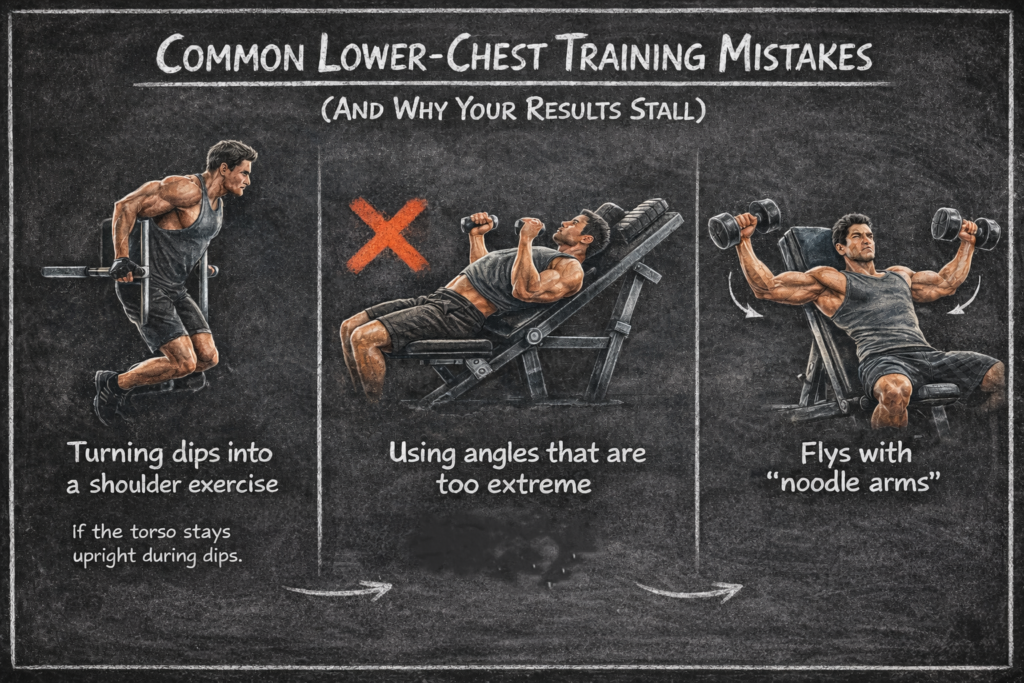
If there’s one thing the gym teaches us, it’s that tiny mistakes compound into big frustrations.
Most people fail at lower chest training because of these:
1. Turning dips into a shoulder exercise
If your torso isn’t leaning slightly forward, congrats — you’re training triceps and front delts, not chest.
2. Using angles that are too extreme
Over-arching the back, over-raising the hips, or over-inclining/declining kills targeting.
3. Flys with “noodle arms”
If your arms move but your chest doesn’t stretch, you’re basically doing interpretive dance.
4. Rushing the squeeze at the bottom
Lower-chest bias requires crisp, controlled contraction — not momentum.
5. Forgetting about shoulder depression
Pulling the shoulders down turns on the pec fibers more effectively.
Once people fix these, lower-chest gains usually explode.
The Body-Fat Reality No One Wants to Hear
Even the best routine won’t give you that crisp “under-pec” line if your body fat isn’t low enough to reveal it.
For most:
- 14–16% → line appears
- 12–14% → it sharpens
- 10–12% → it pops
- under 10% → superhero mode
You can build the muscle at any body fat.
You just won’t see it the same way.
That’s not an exercise problem.
It’s just physics + biology + maybe a few late-night snacks.
Practical Lower-Chest Moves That Beat the Decline Bench Anyway
Here are the most powerful replacements — and the “why” behind them.
1. Weighted Dips (with forward lean)
This is the king.
Period.
The torso angle lines up with lower pec fibers beautifully.
The stretch is deep.
The tension is continuous.
The progression is simple.
2. High-to-Low Cable Fly
This is the sculptor’s tool.
Slow.
Precise.
Devastating.
You’re literally mimicking the fiber direction.
3. Elevated-Feet Push-Ups
Don’t laugh.
You want lower-chest activation?
Raise your feet 30–45 cm and push.
You’ll feel it instantly.
4. Standing Diagonal Cable Press
Imagine slamming a heavy medieval wooden door shut.
That’s the motion.
And your chest loves it.
5. Band Decline Press
Great if you train at home.
Anchor a band high behind you and press downward.
Boom — decline without decline.
The New Era of “Secret Moves” Trainers Are Using
Instagram coaches keep inventing spicy new variations.
Surprisingly?
Some of these are actually phenomenal.
Here’s the cream of the crop:
- Dip Plus → dip + exaggerated chest squeeze at the top
- Straight-Bar Dips → more chest stretch, more tension
- Jackhammer Pushdown → lean in and press down like crushing asphalt
- Kneeling X-Press → cables cross under your sternum
- High Cable Fly 2.0 → slower, deeper, more diagonal
- Band Decline Hybrid → band + dumbbell for constant tension
These all share one theme:
Downward push.
Forward lean.
Conscious squeeze.
Advanced Athlete Moves (When You Want to Go Full Monster Mode)
If you’re more experienced — or just enjoy suffering — these are upper-level options:
- Weighted straight-bar dips with slow eccentrics
- Single-arm high-to-low cable press
- Ring low-fly with controlled forward lean
- Decline ring push-ups
- Diagonal landmine press
These challenge stability, tension, and direction all at once.
How to Build a Complete Lower Chest Routine (Gym Version)
Here’s a sample you can run twice per week:
1. Weighted Dips — 4×6–8
2. High-to-Low Cable Fly — 4×10–12
3. Diagonal Cable Press — 3×8–12
4. Elevated-Feet Push-Ups — 2×max
This combo hits every angle the decline bench dreams of covering.
Home Version (No Cables, No Machines)
1. Elevated-Feet Push-Ups — 4×max
2. Band Decline Press — 4×12–15
3. Forward-Lean Dips (chairs or rings) — 3×8–12
4. Decline Push-Up Hold (isometric) — 2×20–30 sec
How to Fit Lower Chest Training Into Your Weekly Plan
Here’s the mistake most lifters make:
They hammer lower chest right after a heavy upper day.
Bad combo.
The sternocostal fibers need recovery too.
Here’s a simple layout:
Option A — Balanced Push Week:
- Day 1: Upper chest focus
- Day 3: Lower chest focus
- Day 5: Full chest pump day
Option B — Strength Split:
- Day 1: Bench press + dips
- Day 4: Fly variations + push-ups
- Day 6: Cable emphasis
Spacing makes everything work better.
When You Should Avoid Decline Bench Entirely
There are legit reasons to skip it:
- Neck discomfort
- Acid reflux issues
- Shoulder instability
- Poor shoulder mobility
- Hard time re-racking the bar safely
- Sinus issues or headaches from inversion
- Lower back discomfort getting into position
So… Is the Decline Bench Useless?
No.
It’s perfectly fine.
If you enjoy it, keep it.
If it feels good, go for it.
But the idea that your lower chest won’t grow without it?
Outdated.
Overhyped.
Just plain wrong.
You can build a thick, carved, powerful lower chest with cables, dips, push-ups, and bands.