I usually treat L-sits like a “nice extra” I sprinkle somewhere between sets, like parsley on pasta.
Then one day I put them right at the start of my session, before anything else, and the whole workout feels like someone subtly changes the settings on my body.
Not better in any special way.
Just different in a very specific, very physical way, like my shoulders feel switched on while my triceps still feel like they’re buffering.
What an L-sit actually is
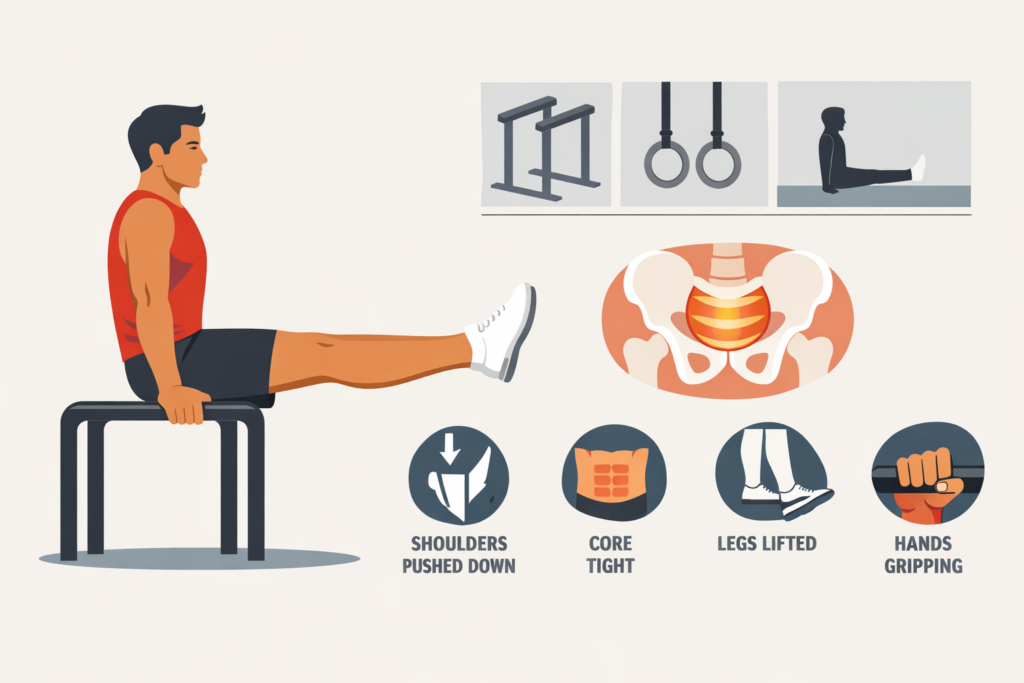
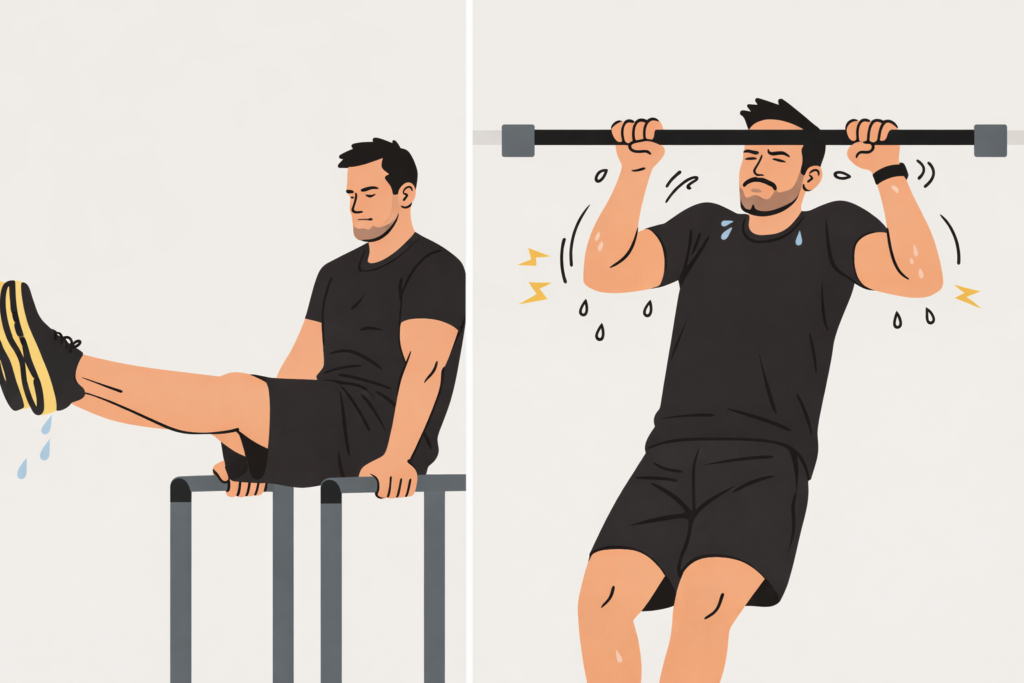
An L-sit is when you support your body on your hands and hold your legs straight out in front of you, so your body looks like an “L.”
Most people do it on parallel bars, dip bars, or rings, but you can also do it on the floor if you’re already strong and flexible enough (and if your hamstrings aren’t running the show).
The point isn’t just “abs.”
You’re asking your shoulders to push down hard, your upper back to stay tight, your hips to lift, your thighs to stay straight, and your core to lock everything together like a seatbelt.
How I was doing L-sits before (and why it didn’t feel like a big deal)
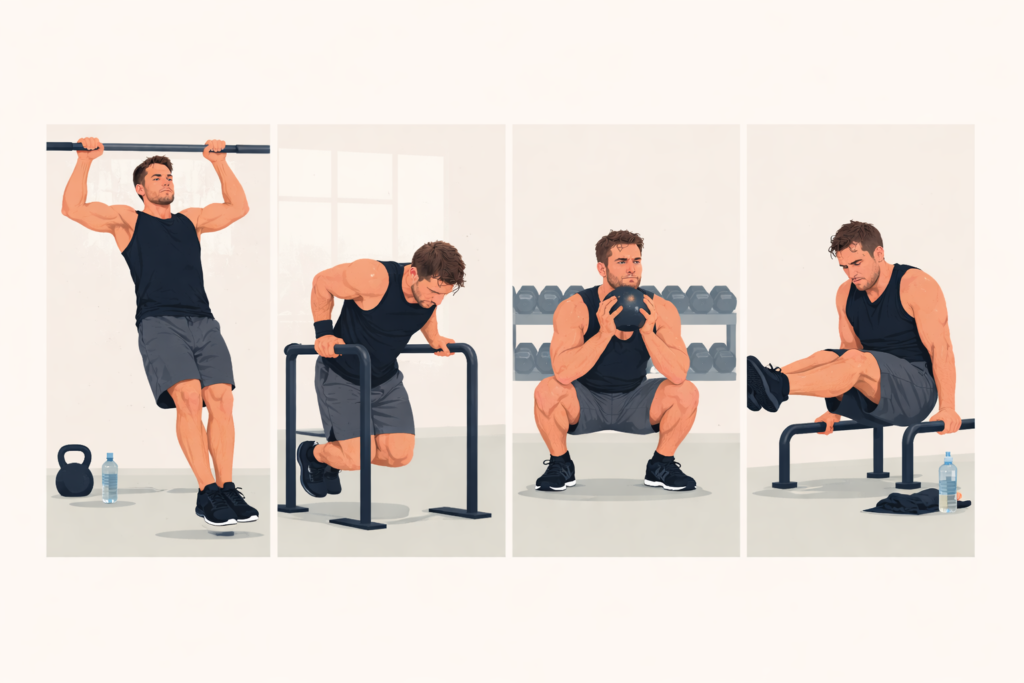
My old routine was simple.
I’d train pull-ups and dips first, because that felt “important,” and I’d throw L-sits at the end when I was already tired.
It looked like this on most days:
- Pull-ups: 5 sets of 5, rest 2:30
- Dips: 5 sets of 6, rest 2:00
- Squats (goblet or bodyweight): 4 sets of 10–15, rest 1:30
- L-sit attempts at the end: 6–10 shaky holds of 6–12 seconds, rest “whenever my lungs stopped insulting me”
The L-sits felt hard, sure, but they felt like a separate thing.
Like dessert.
You suffer a bit, you finish, you go home.
I Put L-Sits First One Day and Something Felt Different
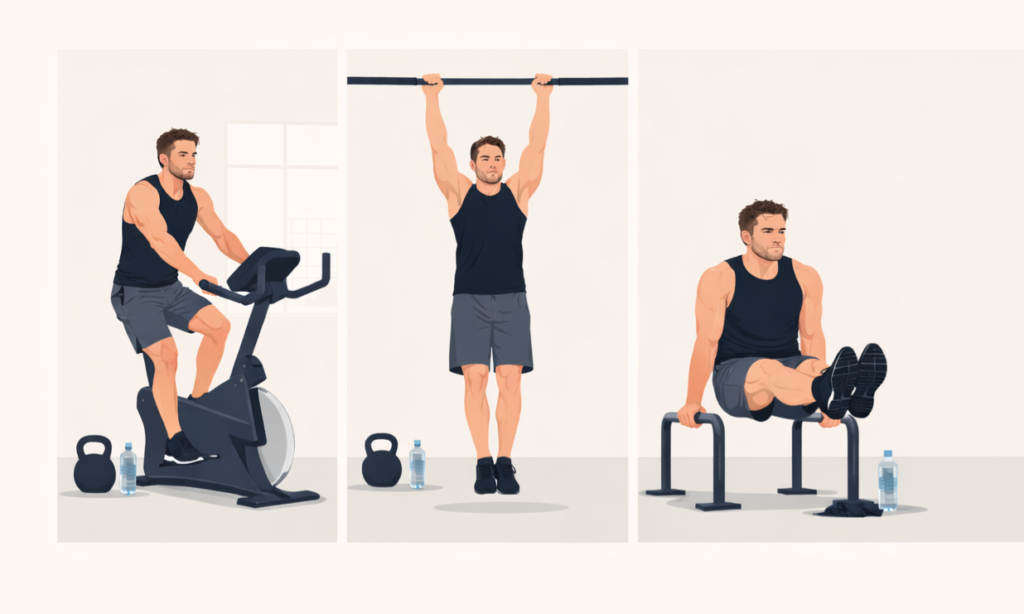
How the session started
That day I walked into the gym feeling completely normal.
Energy wasn’t high, but it wasn’t low either, just that average “I had coffee and responsibilities” level of readiness.
A short warm-up got things moving.
- 5 minutes on the bike at an easy pace.
- 2 rounds of 8 scapular push-ups.
- 2 rounds of 5 dead hangs, about 10 seconds each.
- A couple of slow bodyweight squats just to wake up the hips and knees.
Instead of heading straight to pull-ups like I usually did, I decided to start with L-sits just to get them out of the way while I was fresh.
The plan wasn’t complicated.
- L-sit on parallel bars: 8 sets of 10 seconds.
- Rest between holds: about 50–70 seconds.
Effort climbed to around an 8 out of 10 by the last few sets.
Hip flexors started cramping a little.
Shoulders felt pushed down and locked in place.
Hands were already sweating like they were nervous about something.
Nothing extreme overall.
Eighty seconds of total time under tension, spread across the sets, doesn’t sound like much on paper.
What I felt when I moved to pull-ups
Walking to the pull-up bar felt normal at first.
Grip on the bar felt familiar.
Breathing was steady.
The first rep went up cleanly.
Something felt different anyway, and it took a moment to understand what it was.
Upper body felt slightly pre-engaged, almost like the stabilizers had already been working for a while.
Back felt ready to pull.
Core felt tight and organized.
Grip and coordination, though, felt a bit less fresh than usual.
I just had the subtle feeling that part of the system had already spent a small part of its daily budget.
That sensation became clearer as the sets went on, and the comparison with my usual sessions started to make sense.
Then dips got even stranger: my shoulders felt amazing… and my triceps felt betrayed
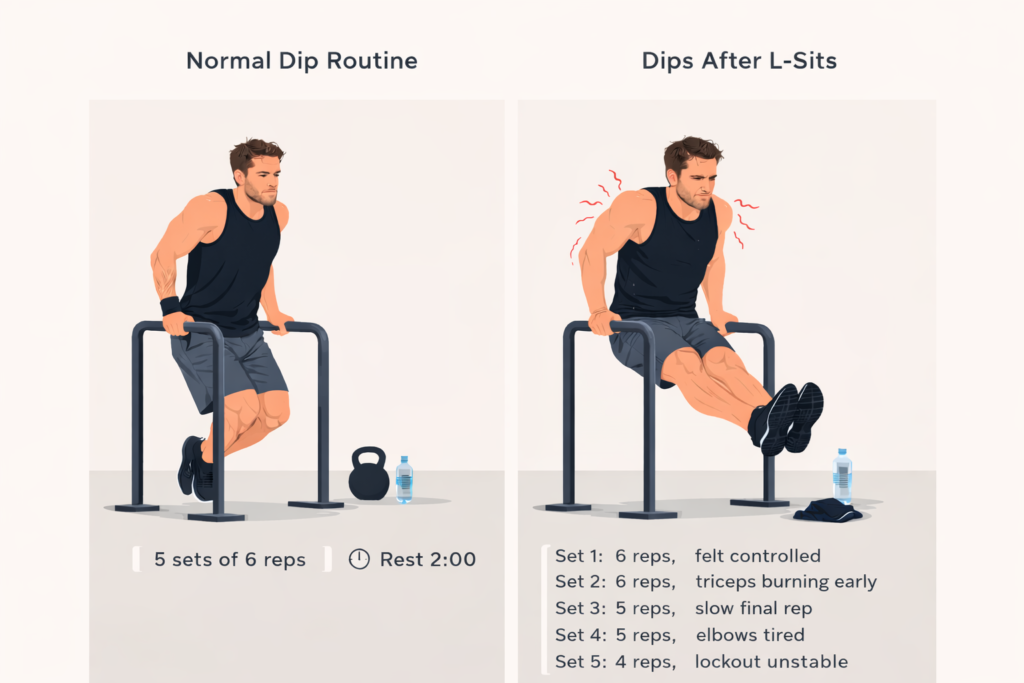
Dips are usually straightforward.
I feel chest and triceps, shoulders stay stable, life is simple.
That day, my shoulders felt like they were on rails.
Super locked in, super controlled.
But my triceps fatigued sooner, like they didn’t get the memo that we were here to do dips.
My normal dip numbers (no L-sits first):
- 5 sets of 6 reps
- Rest 2:00
- Effort: last set is a grind, but I get it
Dips after L-sits first:
- Set 1: 6 reps, felt controlled, nothing unusual
- Set 2: 6 reps, triceps started burning early
- Set 3: 5 reps, last rep slow like a bad elevator
- Set 4: 5 reps, elbows felt “tired” not painful, just cooked
- Set 5: 4 reps, stopped because my lockout felt unstable
Again, not a “my muscles exploded” kind of fatigue.
More like I had already used some stabilizing strength and some arm endurance doing those holds, even if the holds didn’t look like much.
Why this happens: L-sits are a support exercise disguised as a core exercise
Most beginners think the L-sit is an ab move.
It is, but that’s not the whole story.
An L-sit is basically “push the ground away and don’t collapse” while your legs try to pull your pelvis forward like a heavy backpack.
That means your shoulders, scapulae, elbows, wrists, and grip are working constantly.
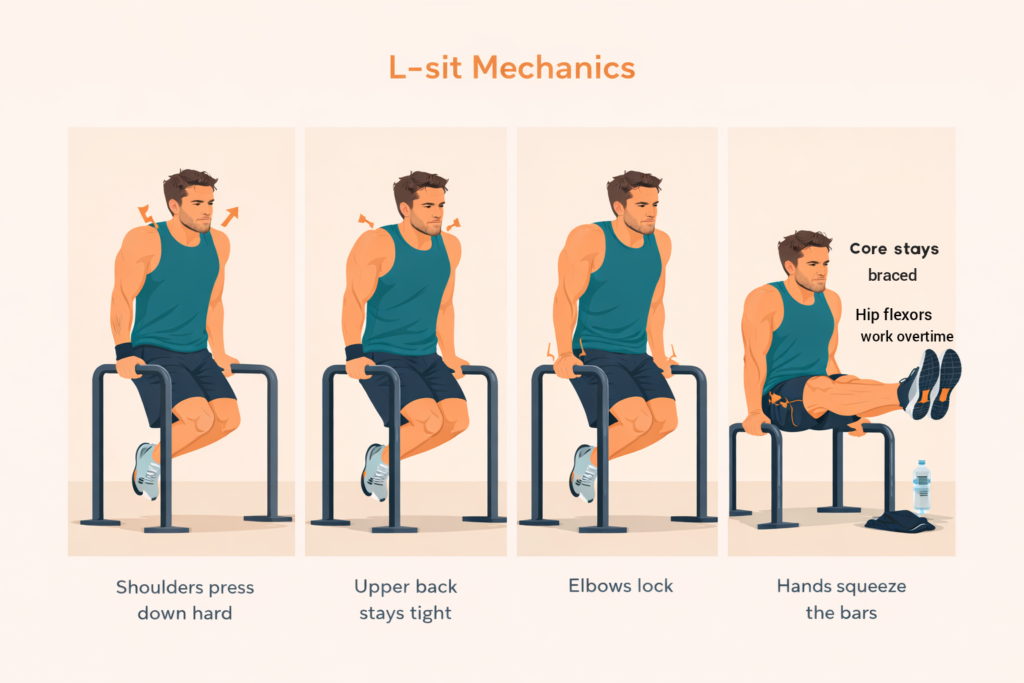
Here’s what’s quietly happening during a solid L-sit hold:
- Shoulders press down hard (like you’re trying to make your neck longer)
- Upper back stays tight so you don’t sink between your shoulders
- Elbows lock so your arms become pillars
- Hands squeeze the bars because your whole bodyweight is now a grip problem
- Core stays braced so your hips don’t fold and your legs don’t droop
- Hip flexors work overtime to keep the legs up
So when you do L-sits first, you’re not just “warming the abs.”
You’re pre-fatiguing the exact support system you use for dips, pull-ups, handstands, push-ups, and even things like squats (because bracing and breathing carry over).
The biggest shock: squats felt different too (even though L-sits are “upper body”)
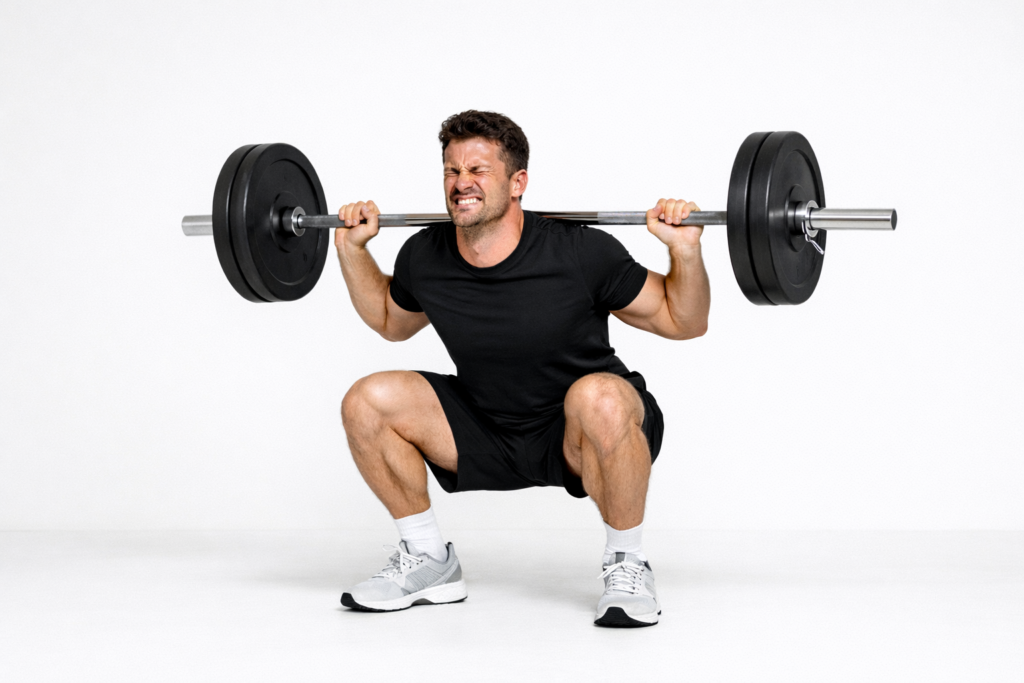
This was the part that made me laugh in the gym, because it felt so unfair.
After pull-ups and dips, I went to squats.
Nothing heavy, just controlled reps.
I did:
- Bodyweight squats: 3 sets of 15
- Tempo: 3 seconds down, 1 second pause, stand up
- Rest: 60–75 seconds
Normally, this feels like legs and lungs.
That day, my legs were fine, but my breathing pattern felt weirdly restricted, like my trunk didn’t want to relax.
It felt like my core stayed “on” too much.
Like I was still bracing as if I needed to hold my legs up.
My squat reps were fine, but the session felt more tiring than it should have for such simple squats, mostly because my midsection never really “unclenched.”
What I Felt in My Body When L-Sits Came First
When L-sits were first, the sensations showed up in the same places every time:
- Forearms: early pump, especially near the thumb side
- Wrists: tightness if I rushed the setup
- Shoulders: stable and “down,” but also slightly fatigued
- Upper abs: strong tension, not a burn, more like a belt pulled tight
- Hip flexors: cramp-prone, especially on sets 6–8
- Breathing: shorter breaths during later exercises, like my ribs didn’t want to expand fully
Nothing was sharp or scary.
It just felt like I walked into the workout with my support muscles already halfway through their shift.
How to Do an L-Sit Without Beating Up Your Hips and Shoulders
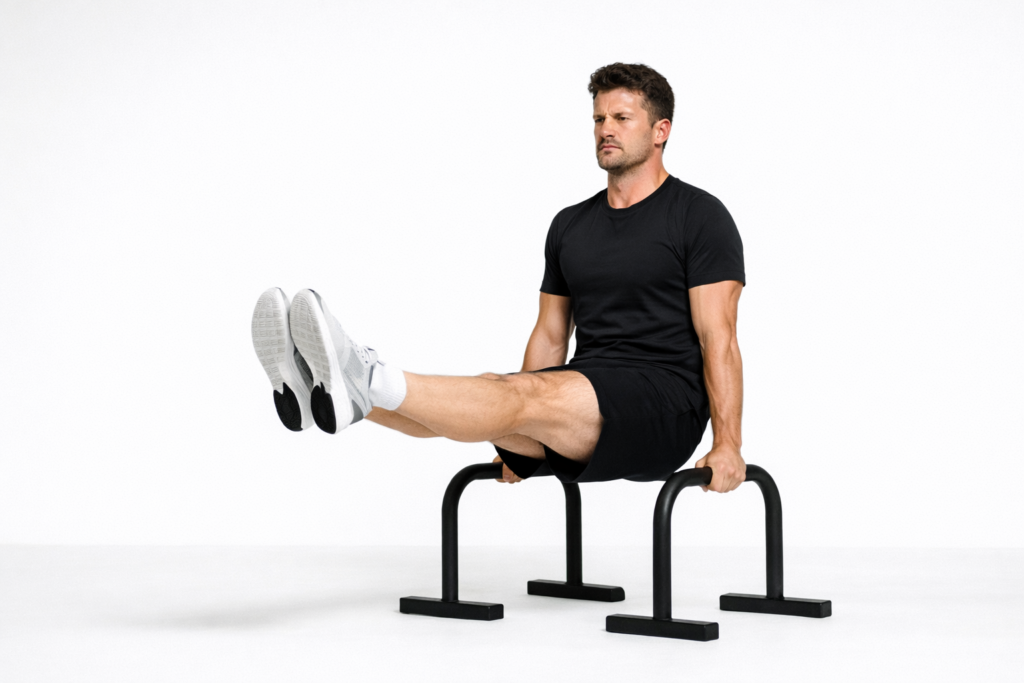
If you do L-sits with a sloppy setup, the discomfort usually lands in your hips, wrists, or lower back.
So here’s the clean version, step by step, with the cues that actually helped me.
Setup on parallel bars or dip bars
Start with your hands on the bars, arms straight, shoulders not shrugged.
Push down into the bars as if you’re trying to make your torso taller.
Think “long neck,” not “turtle mode.”
Then squeeze your glutes lightly and pull your pelvis into a tiny backward tuck, like you’re trying to flatten your lower back.
That tuck is what stops the hold from turning into a hip-flexor panic show.
It also protects your lower back from doing all the work.
Leg lift without turning it into a circus kick
Don’t fling your legs up.
Lift them like you’re raising a heavy box, slow and controlled.
If you can’t straighten your knees, don’t force it.
Bending the knees in a tuck is still a real L-sit progression, not a “fake version.”
If your hamstrings are tight, straight legs will pull your hips forward and your back will round in a bad way.
That’s not toughness, that’s bad geometry.
Breathing that doesn’t ruin the hold
Most people hold their breath and shake.
Instead, do short breaths.
Inhale through the nose for about 1 second.
Exhale through the mouth for about 2 seconds, like you’re fogging a mirror gently.
It keeps your ribs moving without losing tightness.
What Happened When I Moved L-Sits to the Middle of the Session
After a couple of sessions like that, I tried a different placement.
Not at the end when I’m a tired noodle.
Not at the beginning where they hijack everything.
I put them in the middle, right after my first main movement.
One of the cleanest-feeling sessions looked like this:
- Warm-up 10 minutes total
- Pull-ups: 4 sets of 5, rest 2:30
- L-sits: 6 sets of 10 seconds, rest 60 seconds
- Dips: 4 sets of 6, rest 2:00
- Squats: 3 sets of 12, tempo controlled
That version felt balanced.
My pull-ups didn’t suffer from grip fatigue too early, and my L-sits still felt strong because I wasn’t already wrecked.
Dips felt more normal too, because I wasn’t asking my shoulders to do “support work” at maximum freshness and maximum volume before pressing.
How I choose L-sit variations depending on the rest of the workout
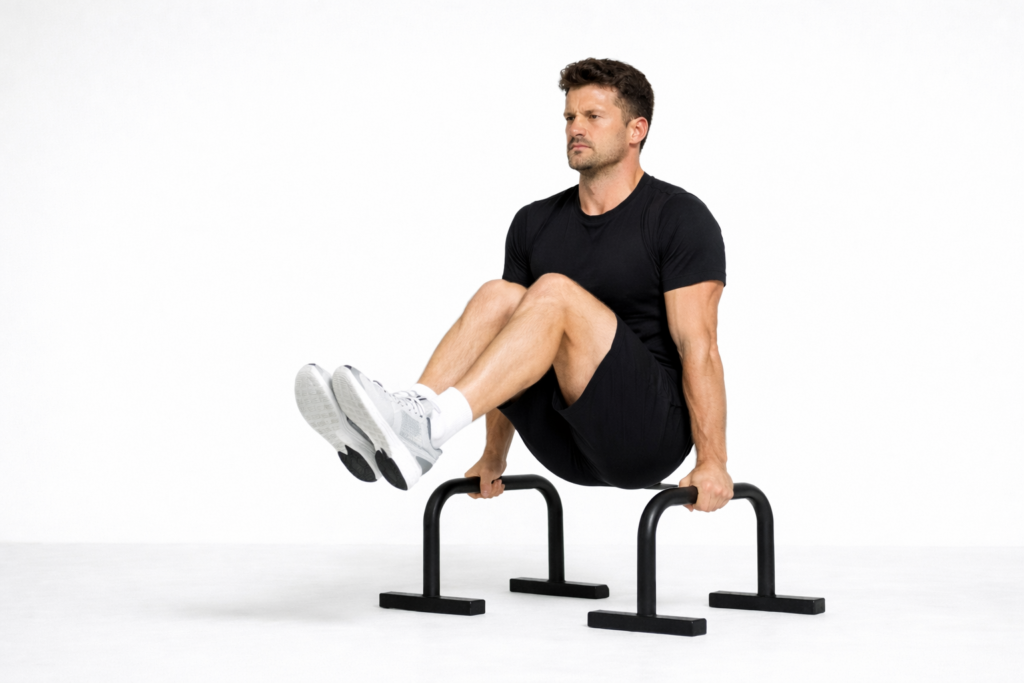
This part matters because not all L-sits cost the same.
If my session has a lot of dips or push-ups
I pick an L-sit variation that doesn’t fry my shoulders.
That usually means:
- Tuck L-sit holds: 8–12 seconds
- Rest 60–75 seconds
- Total holds: 6–8
It keeps the pattern but reduces the shoulder load compared to full straight-leg holds.
If my session is pull-up heavy
I watch grip fatigue like a hawk.
So I do:
- Shorter holds: 6–8 seconds
- More rest: 75–90 seconds
- Fewer total sets: 5–6
That way my forearms don’t feel like overcooked pasta by the time I grab the bar.
If my session is mostly legs
That’s when I can put L-sits earlier without caring as much.
The support fatigue won’t sabotage squats the same way it sabotages pull-ups.
I still keep it reasonable, because hip flexors can cramp and turn the whole session into a comedy sketch.
The “clean” L-sit menu I keep coming back to
When I want L-sits to build skill without stealing the whole workout, I rotate between these two options.
Option A: skill-focused, low chaos
- 6–8 sets of 8–12 seconds
- 60–75 seconds rest
- Stop each hold while you still look controlled
- Total time: about 12 minutes including rest
This builds consistency without turning your grip into a limiting factor for everything else.
Option B: slightly tougher, but still realistic
- 5 sets of 12–15 seconds
- 90 seconds rest
- After each hold: 10 seconds relaxed support (arms straight, shoulders down, legs resting)
- Total time: about 15 minutes
The “relaxed support” teaches you to stay tall on your hands, which transfers nicely to dips and rings.
What to do if you can’t even lift your legs yet (without pretending it’s fine)
If you can’t lift your legs, that doesn’t mean you’re weak.
It usually means one of these things is missing: shoulder support, core compression, or hamstring mobility.
Here are the regressions that actually feel like the real movement.
Foot-supported L-sit on bars
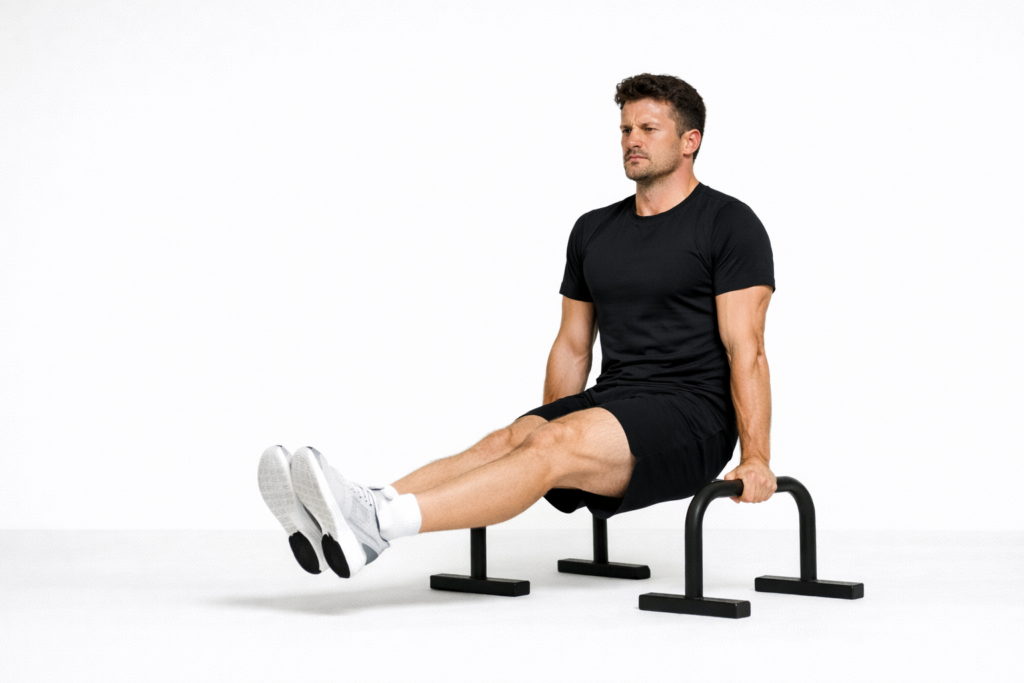
Put your heels on the floor in front of you, hands on the bars.
Push down hard, lock the arms, and lift your hips slightly.
Then slide your heels forward a little and try to unweight them for 1–2 seconds at a time.
A clean session looks like:
- 10 rounds of 5 seconds “barely unweighted”
- 45–60 seconds rest
- Focus on shoulders down and pelvis tucked
It sounds small.
It feels serious.
Tuck hold (knees to chest)
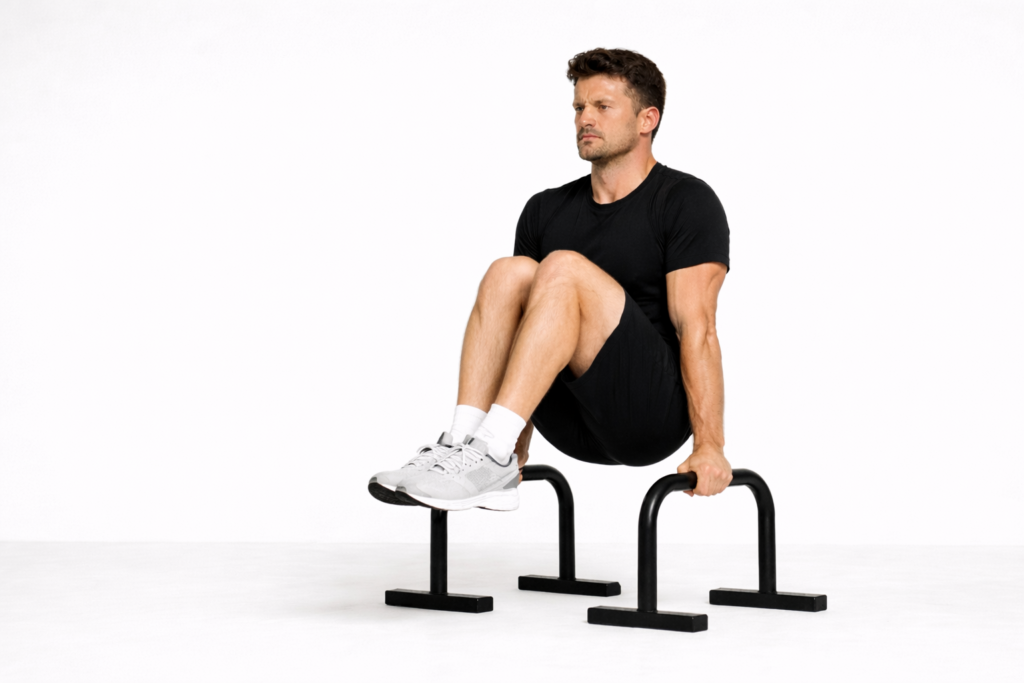
This is the one I used when straight legs were just not happening.
Support yourself on bars, bring knees up, hold.
- 8 sets of 8–12 seconds
- 60 seconds rest
- Keep shoulders down, don’t shrug
If your shoulders creep up toward your ears, end the hold.
That shrug is your body trying to outsource the work to your neck.
The sneaky detail that changed everything for me: the pelvis position
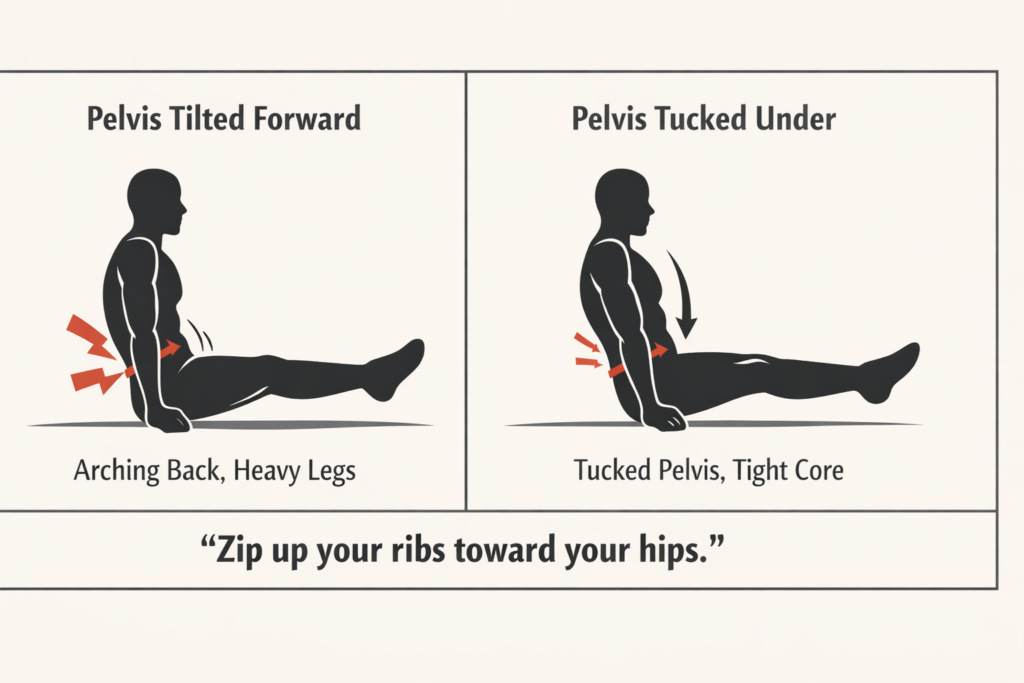
I used to think L-sits were about lifting the legs.
The real game-changer was realizing it’s about controlling the pelvis.
If your pelvis tips forward, your legs feel heavier and your lower back complains.
If your pelvis tucks slightly, your core can “carry” the legs better and your hips don’t do all the screaming.
The cue that clicked for me was:
“Zip up your ribs toward your hips.”
Not crunching hard.
Just tightening the front of your body like you’re bracing for someone to poke you.
RELATED:》》》Doing 100 Push-Ups, Sit-Ups, and Squats Every Day Really Change Your Body?
So… should you start sessions with L-sits or not? (Here’s the honest version)
Starting with L-sits is like doing a challenging “support drill” before anything else.
It can make you feel more connected and stable, especially through the trunk.
At the same time, it can subtly reduce grip endurance and shoulder freshness, which can affect pull-ups, dips, and any movement where you hang or press.
If your main goal that day is improving the L-sit itself, putting it first makes sense because you’ll be fresh enough to practice clean holds.
If your main goal is hitting strong pull-up or dip numbers, putting L-sits first might make the rest of the session feel heavier than it should.
Either way, the big lesson for me was simple:
L-sits aren’t a cute ab finisher.
They’re a full-body support skill that charges a real price, and the timing of that price changes how the whole session feels.