
It happens to almost everyone at some point.
You finish a quick home workout, catch a glimpse in the mirror, and the pump looks solid… until the eyes land on that stubborn little “line” in the center of the chest.
That little empty “line” in the middle of the chest that loves to act like it owns the place.
You know the one.
That tiny gap your T-shirt never talks about but your eyes notice every time you flex.
And just like that, the mind slides straight into the classic home-workout rabbit hole: “Is there any way to hit the inner chest without weights?”
Spoiler: yes… but not in the magical way TikTok sometimes promises.
Still, you can shift more tension toward the sternal fibers of the pec major with smart bodyweight tweaks.
Let me walk you through what actually works.
A Quick Reality Check Before You Start Targeting the Inner Chest
Before diving into techniques, there’s an important truth most people skip.
The “inner chest” is not a separate muscle you can magically isolate.
What you’re really targeting is the sternal head of the pectoralis major, specifically the fibers closest to the sternum.
Those fibers handle horizontal adduction — the movement of bringing your arms toward the midline.
The more your hands move inward (or “want to” move inward), the more these fibers contribute.
This is why certain push-up variations feel like they’re “pinching” the middle of your chest.
But here’s the key:
You’re not isolating, you’re biasing.
And once you understand that, every variation suddenly makes a lot more sense.
Inner Chest Activation With Push-Up Positioning

The biggest mistake people make is assuming the inner chest is a separate muscle you can isolate like a bicep head.
It’s not.
But you can position your hands and elbows so the fibers near the sternum do more of the heavy lifting.
One small shift and the whole exercise feels like it’s pointing straight at the center of your chest.
Here’s how to set it up.
Close-Grip Push-Ups With a “Crush” Cue
The classic narrow-hand push-up doesn’t just hit triceps.
If you use the right cue, it lights up the inner pec like a Christmas tree.
Place your hands just inside shoulder width.
Now imagine you’re trying to push your palms together as you press.
You won’t actually move them — but the intention creates what trainers call adduction torque.
That’s the secret sauce.
Keep the elbows slightly tucked.
Pause halfway up and squeeze your chest like you’re trying to trap a credit card between your pecs.
It burns in a strangely satisfying way.
Where Most People Mess Up Without Realizing It
Since push-ups feel “simple,” people rush through them.
That’s exactly how you lose chest tension — especially the inner fibers.
Here are the biggest killers of inner chest engagement:
- letting elbows flare to 90°
- turning the lockout into a triceps-only move
- going too fast
- lowering too shallow
- keeping hands too wide
- forgetting the squeeze at the top
Fix these and even regular push-ups start hitting differently.
Inner Chest Tension Through Hand Movement
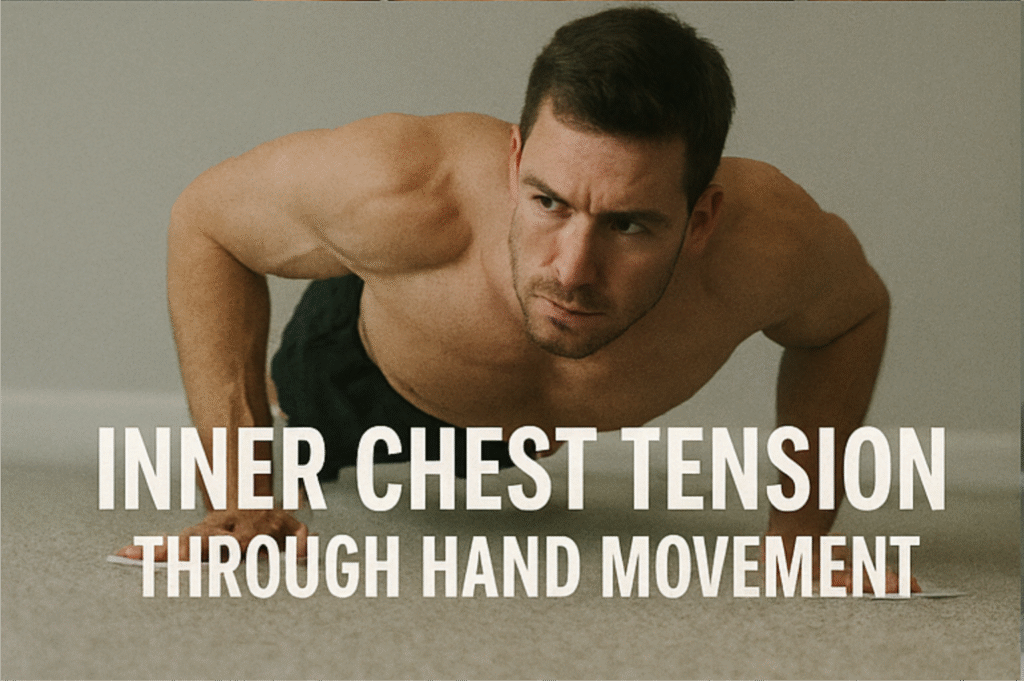
If you’ve ever done yoga and realized how much tiny shifts change the intensity, this is the same idea.
Training with your own bodyweight is often about leverage more than load, so changing where your hands move can completely change the pump.
Sliding Push-Ups (The “Floor Flye” Move)
This one is criminally underrated.
Grab two small towels, sliders, or even plastic container lids if you’re desperate.
Start in a high plank with hands slightly narrower than shoulder width.
As you lower, slide one hand outward like a flye motion while the other arm does most of the push-up.
Then switch sides.
The magic here?
As your hand moves away, your working arm has to pull inward to stabilize, and that inward pull is exactly where inner-pec fibers kick in.
It feels suspiciously like a cable flye but with gravity doing the pulling instead of weight stacks.
Inner Chest Emphasis With Angles and Body Lean
Angle changes make a difference even without equipment.
Your chest isn’t a flat wall — the fibers run in different directions depending on which part you look at.
Shift your torso angle, and the line of force changes too.
Incline Lean Push-Ups Against a Wall or Counter
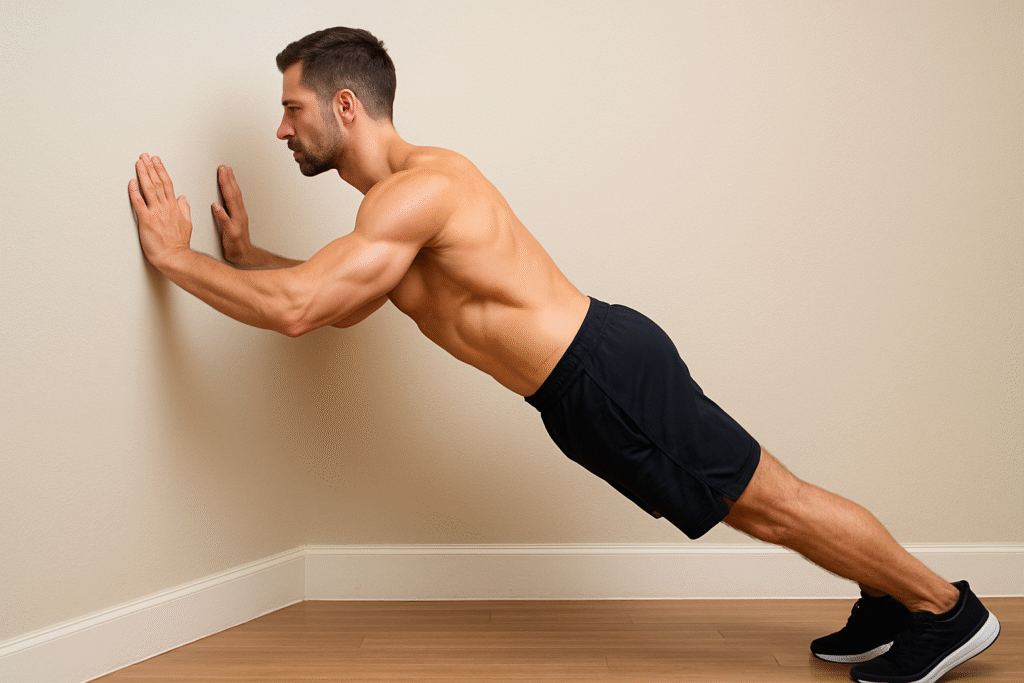
Most people only think about incline push-ups for upper chest, but there’s a trick here.
If you lean forward so your hands are slightly below chest height, and you push inward as you extend, the force travels right across the sternum region.
The sweet spot is when you feel the pressure travel from the mid-pec toward the center as you lock out.
If it feels too easy, walk your feet back and take a steeper angle.
You’ll feel the inner squeeze almost instantly.
The Role of the Serratus and Core in Inner Chest Activation
Here’s something rarely mentioned in chest articles, but it matters.
If your serratus anterior doesn’t stabilize your shoulder blade, your pecs can’t fully contract.
If your core collapses, your chest loses leverage.
This is why sliding push-ups feel incredible — the instability forces your serratus to fire, giving your pecs a stable base to pull from.
A solid midsection equals stronger, deeper inner-pec activation.
Inner Chest Focus Through Static Holds
There’s a reason gymnasts have pecs that look like armor plates.
Static holds force all the fibers to fire at once, especially when you’re trying not to slide sideways off your own sweat.
Prayer Press Holds
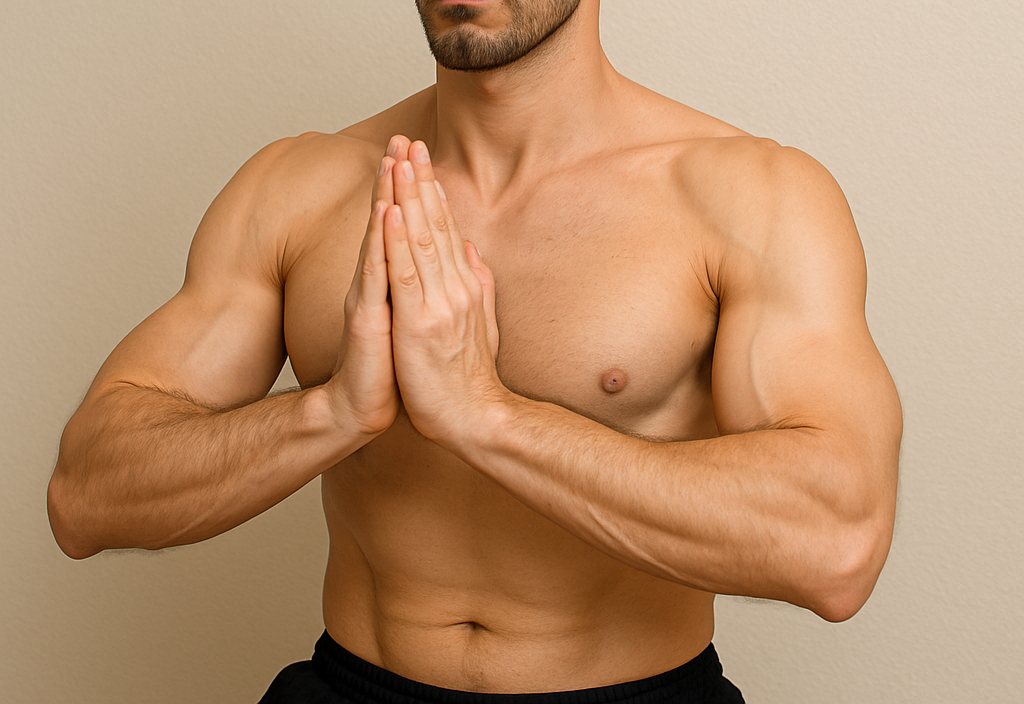
This one looks simple.
It’s not.
Put your palms together at chest level.
Press them inward as hard as you comfortably can.
Hold for 20–30 seconds while slowly raising and lowering your elbows.
The inward pressure is everything — that’s horizontal adduction, the exact movement the pec fibers near your sternum are designed for.
It’s like giving your chest a handshake from the inside.
Inner Chest Work Through Slow Tempo and End-Range Squeeze
If you can’t add weight, you can always add time.
Slowing the rep down forces your chest to stay under tension longer, especially near the lockout where the “inner” fibers come into play more.
A slow two-second squeeze at the top of a narrow push-up can hit harder than banging out fast reps with perfect form.
This isn’t just bro science either.
In hypertrophy research, longer time-under-tension increases mechanical stimuli and metabolic stress — two things bodyweight training thrives on when you use them correctly.
What You Can Expect (and What You Can’t) Without Using Weights
You can develop a fuller inner chest with bodyweight training.
You can improve the definition along the sternum.
You can strengthen the sternal fibers and increase that tight midline squeeze.
But let’s also be honest: bodyweight alone has limitations.
You won’t get that ultra-dense, deep “carved ridge” unless you eventually introduce external load or flye patterns with resistance.
Still — for home training?
You can absolutely build a noticeable, aesthetic improvement that most people never achieve simply because they don’t train with intention.
Two Simple Inner-Chest Bodyweight Routines You Can Start Today
Here’s how to apply everything without guessing.
Beginner Routine (6–8 minutes)
- Close-grip push-ups → 3×8–12
- Slow top-end squeezes → 2×10
- Prayer press holds → 3×20s
Rest 45–60 seconds.
Intermediate Routine (12–15 minutes)
- Sliding push-ups → 3×6 per side
- Forward-lean close-grip push-ups → 3×8–12
- Inward-drive isometric lockout hold → 3×15–20s
- Incline lean push-ups → 2×15
Rest 60–75 seconds.
The Simple Way to Combine Everything You’ve Learned
When you’re training the inner chest without weights, think about intention, line of force, and adduction.
Your goal isn’t to “isolate” some mythical inner chunk of muscle.
Your goal is to shift more work toward the fibers near the sternum using smart hand positioning and tension cues.
Mix these drills in two or three times a week:
Close-grip push-ups with a palm-crushing cue
Sliding or flye-style push-up variations
Incline lean press-outs
Prayer press holds and squeezes
Slow locked-out squeezes during standard push-ups
Rotate them, play with angles, and don’t aim for exhaustion every single time.
You’ll know you’re doing it right when that part of your chest — the one that used to feel “inactive” — starts warming up faster than the rest.
Final Thoughts
You don’t need a cable stack or fancy machine to bring out the center of your chest.
You just need mindful mechanics, a few new movement patterns, and the consistency to apply them every week.
Give it a couple of weeks.
The way your chest fibers start firing together will feel so natural that you’ll wonder how you ever trained without it.
Keep finding new ways to make bodyweight training feel fresh, challenging, and fun.