For a long time, HIIT was simply something that worked.
Short sessions, high effort, and that clean feeling of having trained hard without dragging fatigue into the rest of the day.
Adding more sessions didn’t feel extreme.
It just felt practical.
If something works, doing a bit more of it usually sounds like a safe idea.
The workouts still felt solid.
Breathing was heavy where it should be, and during training everything felt normal.
What changed showed up slowly.
Sleep felt lighter.
Energy was less steady.
Legs sometimes felt heavier than usual, even without particularly hard workouts.
It didn’t all happen at once.
Just the feeling that the body wasn’t handling the same work the way it used to.
And that’s often where the real story begins.
What I Mean By HIIT (Because People Use That Word for Everything)

HIIT means High-Intensity Interval Training.
That’s a fancy way of saying: short bursts of very hard effort, with rest in between, repeated several times.
A real “hard burst” isn’t “I’m breathing a bit more.”
It’s closer to “I can’t talk, my lungs are loud, and if someone asks me a math question I will simply disappear.”
A basic HIIT structure looks like this:
- You pick one simple movement.
- You go hard for a short time.
- You rest for a short time.
- You repeat.
Example with a stationary bike:
- Pedal very hard for 20 seconds.
- Pedal very easy for 100 seconds.
- Repeat 8 times.
- That’s 8 hard efforts of 20 seconds each.
- Total hard time: 160 seconds.
- Total session time (with warm-up and cool-down): often 15–25 minutes.
And yes, you can do HIIT with running, rowing, burpees, jump rope, bodyweight squats, or hill sprints.
But the movement has to be simple enough that you can go hard without your technique falling apart.
If the movement is complicated, intensity turns into messy form fast.
My “Small” Change That Wasn’t Small in Real Life
Before the change, HIIT was something I did occasionally.
Two sessions per week, sometimes one if life got busy.
Each session was short, and I recovered fine.
So I thought: let’s bump it up.
I went from 2 sessions a week to 4.
Same style, same intensity, just… more often.
That sounds innocent.
It also sounds like doubling the amount of times you punch a wall “for conditioning.”
The wall doesn’t care.
Your hands eventually do.
The first sign wasn’t pain.
It was this weird feeling of always being slightly “on.”
Like my body forgot how to fully switch off.
Rest days stopped feeling like rest days.
They felt like I was waiting for the next alarm.
The HIIT Workouts I Was Doing (Exact Timers, Exact Moves, Exact Madness)
I kept the movements simple on purpose.
Because if intensity is the goal, simplicity keeps it honest.
Here are two sessions I rotated the most.
Session A: exercise bike intervals
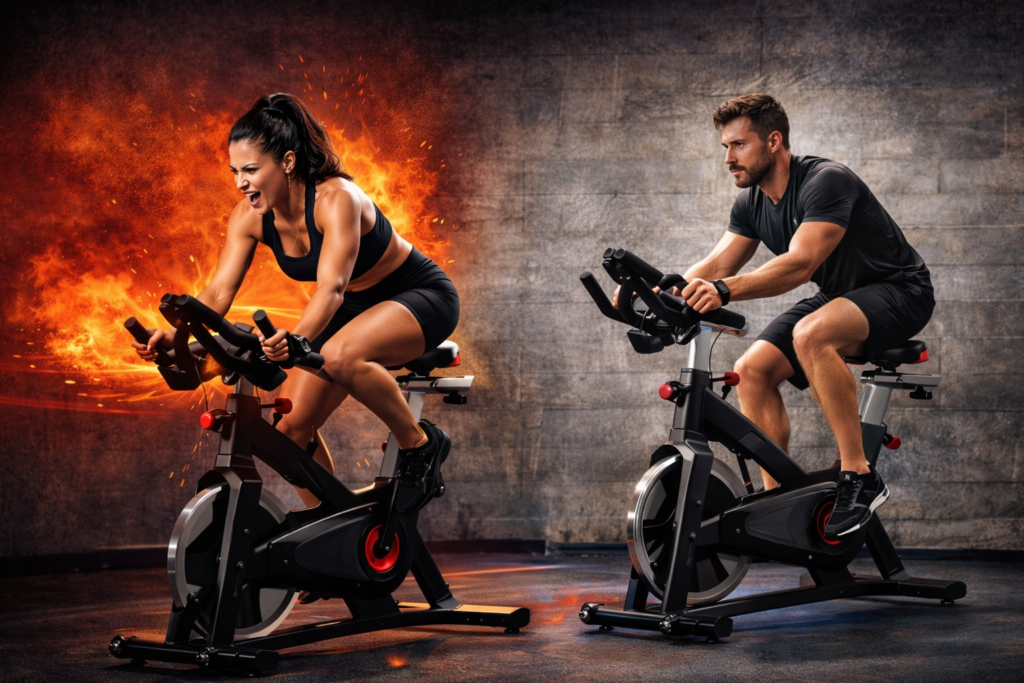
Warm-up: 6 minutes easy pedaling, then 3 short “wake-up” efforts of 10 seconds slightly hard with 50 seconds easy between.
Main set: 10 rounds of 20 seconds hard + 100 seconds easy.
Cool-down: 4 minutes very easy.
Total time: about 30 minutes.
What “20 seconds hard” felt like:
- By second 8, breathing was loud.
- By second 14, legs were burning.
- By second 18, brain was negotiating with me.
- By second 20, I was staring at the timer like it owed me money.
Session B: bodyweight squat intervals (yes, that can be HIIT)

Warm-up: 5 minutes of easy movement—walking, hip circles, gentle bodyweight squats, slow lunges.
Main set: 12 rounds of 15 seconds fast squats + 45 seconds standing rest.
Then 6 rounds of 10 seconds squat jumps + 50 seconds rest.
Cool-down: 3 minutes easy walking until breathing calmed down.
Total time: 18–22 minutes.
Squat form I used (super simple):
- Feet about shoulder width.
- Toes slightly turned out.
- Hips go back a bit like sitting into a chair.
- Knees track in the same direction as toes, not caving inward.
- Stand up fully at the top so the rep is complete.
For the fast squats, I stayed controlled.
For squat jumps, I kept the jump small, landed softly, and reset my feet each time.
Because high intensity plus sloppy landings is basically a handshake with future knee complaints.
The First “Rebellion” Sign Wasn’t During HIIT — It Was the Next Morning
HIIT itself still felt satisfying.
That’s why this is sneaky.
During the session I felt like: “Nice, I’m training hard.”
The next morning was different.
My legs didn’t feel sore like strength training sore.
They felt heavy and flat.
Like someone replaced my muscles with damp towels.
Walking up stairs wasn’t painful.
It just felt unnecessarily hard.
And the fatigue wasn’t only in the legs.
It was also in the head.
Concentration got worse in tiny ways.
Reading something simple felt like it took more effort.
And I started wanting caffeine earlier than usual.
Not for enjoyment.
For survival.
The Sleep Shift: Same Bed, Same Routine, Different Brain
This part surprised me the most.
Because I didn’t connect it to training at first.
My bedtime was similar.
My room was the same.
I wasn’t scrolling more than usual.
But sleep changed anyway.
I would fall asleep… then wake up after 4–5 hours.
Not wide awake like “good morning.”
More like “why is my brain doing push-ups at 3:12 a.m.”
Sometimes my heart felt like it was beating harder than normal.
Not panic-level.
Just noticeably “present.”
And then I’d fall back asleep late, or not at all.
So I started tracking it with actual numbers.
Because guessing makes everything feel dramatic.
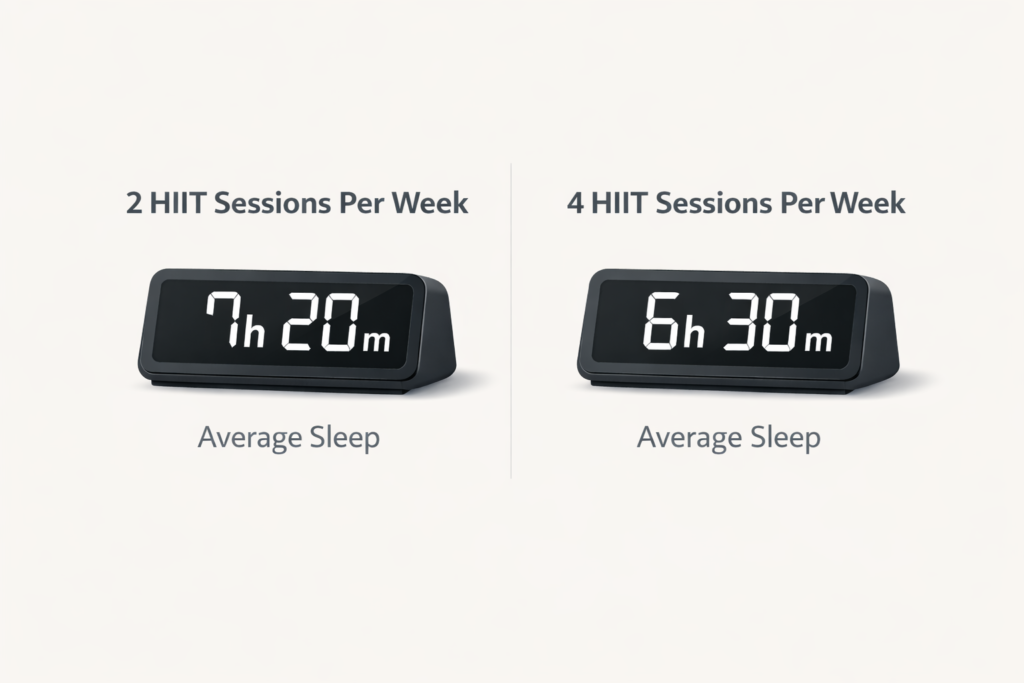
On weeks with 2 HIIT sessions, I averaged about 7 hours 20 minutes of sleep.
On weeks with 4 HIIT sessions, it dropped closer to 6 hours 30 minutes.
That’s not a tiny difference.
That’s the difference between “normal person” and “human phone battery stuck at 12%.”
The Hunger Problem: I Was Either Starving or Weirdly Not Hungry
This was the most confusing symptom.
Some days I’d finish lunch and feel hungry again 45 minutes later.
Not “I could eat.”
More like “my stomach is doing a drum solo.”
Other days I’d do a HIIT session and then feel oddly uninterested in food.
Which sounds like a weight-loss hack until you realize it messes up your whole day.
Because when you don’t eat enough after hard training, you don’t recover well.
And then you go into the next session with less fuel.
And then the body gets annoyed.
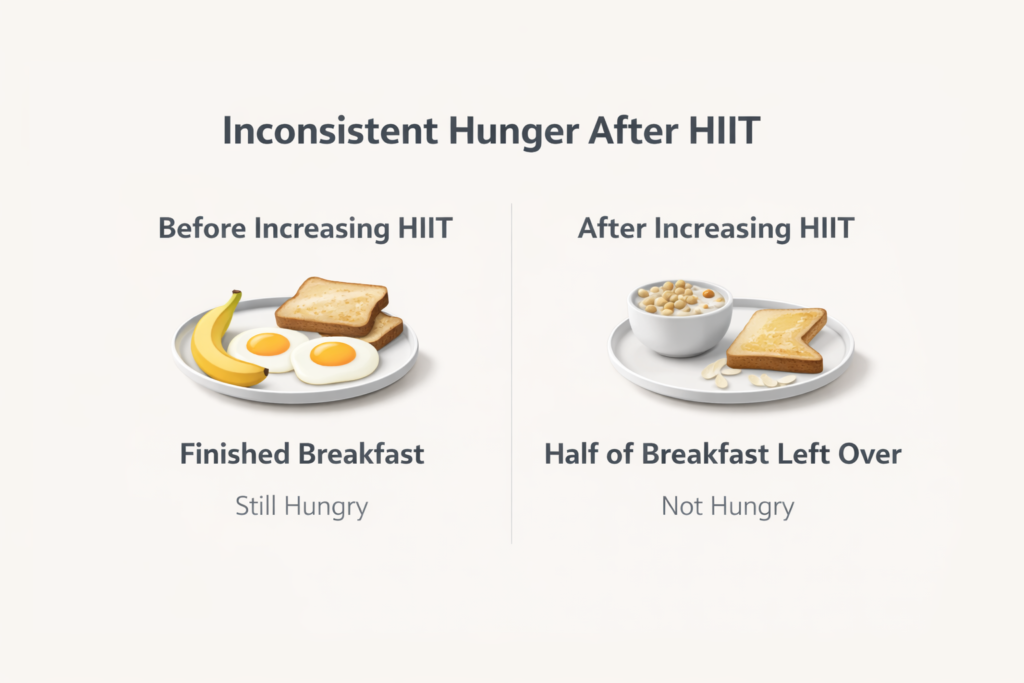
I started measuring something simple: my usual breakfast.
Normally I could eat:
2 eggs, 2 slices of toast, and a banana.
After increasing HIIT, that breakfast sometimes felt too small.
So I’d add yogurt and cereal and still feel hungry.
Other times, I’d eat half and feel “done.”
That inconsistency was new.
My body wasn’t sending clear signals.
It was sending mixed signals like a bad Wi-Fi router.
The “My Legs Feel Slow” Test I Did (And the Numbers Were Annoyingly Clear)
I didn’t want to rely only on feelings.
So I created a tiny, simple performance check.
Nothing fancy.
Just something repeatable.
I used a set of stairs near my place.
Same staircase.
Same shoes.
Same time window in the day when possible.
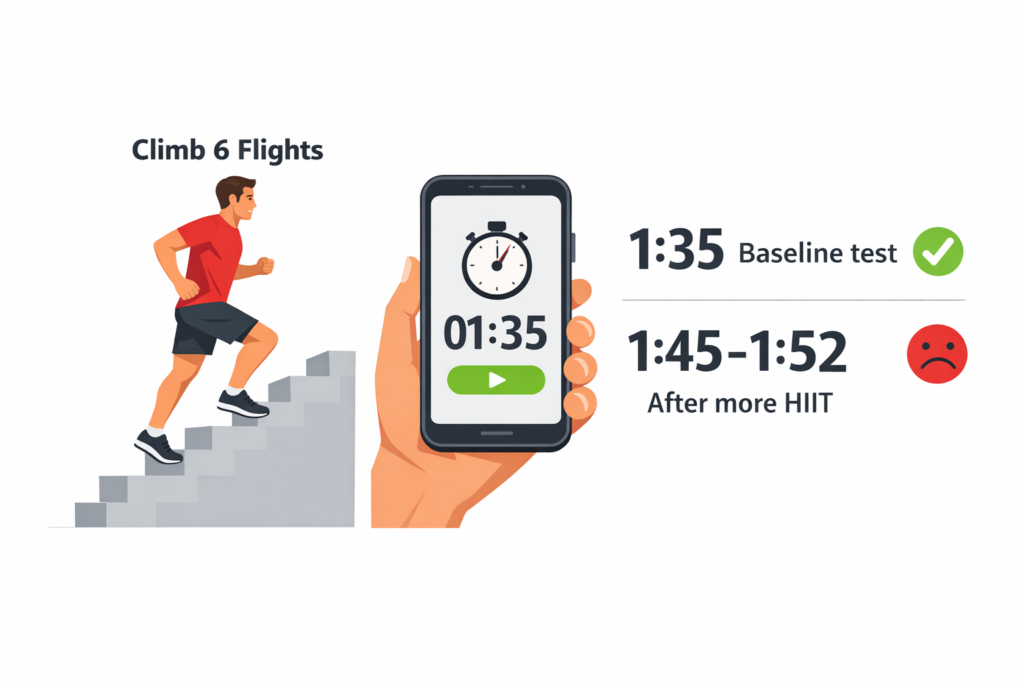
The test: climb 6 flights at a steady pace, not sprinting.
I timed it with my phone.
On my “normal HIIT” schedule, I’d do it in about 1 minute 35 seconds.
After increasing HIIT, it drifted to around 1 minute 45–1 minute 52.
And it felt harder.
Not “out of breath” harder.
More “legs are not cooperating” harder.
That matters.
Because HIIT is supposed to make you feel more capable over time, not less.
If the baseline stuff gets worse, something isn’t adding up.
What Was Actually Happening (Simple Explanation, No Fancy Words Required)
Hard intervals are stressful.
That’s not bad.
Stress is how the body adapts.
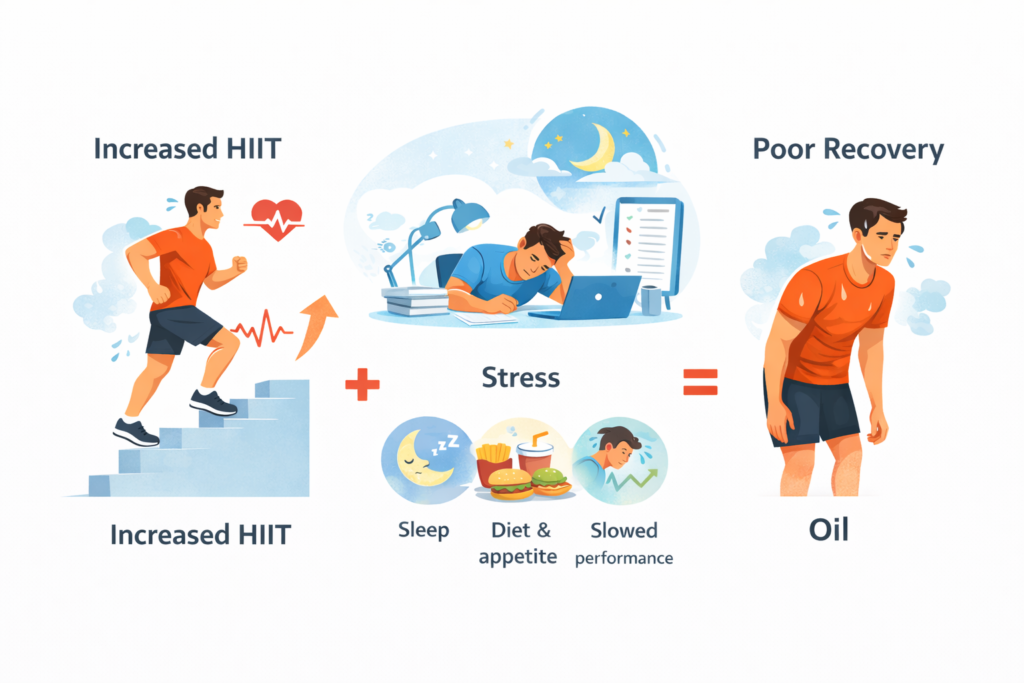
But the body needs recovery to turn stress into improvement.
If stress keeps stacking with not enough recovery, the body doesn’t “upgrade.”
It just tries to survive.
When I doubled my HIIT sessions, I increased the number of times I pushed my body into a high-alert state.
High heart rate.
High breathing rate.
High demand on muscles.
High demand on the nervous system.
And I didn’t adjust the rest of life enough to match it.
Sleep didn’t increase.
Food didn’t consistently increase.
Stress outside training didn’t magically disappear.
So my body started reacting.
Sleep got lighter because the system stayed “on.”
Hunger got chaotic because energy needs were changing and stress affects appetite signals.
Performance got worse because fatigue was accumulating.
It was like revving a car engine every day and wondering why the oil light showed up.
The “Intensity Honesty” Check: I Realized My “Hard” Was Too Hard Too Often
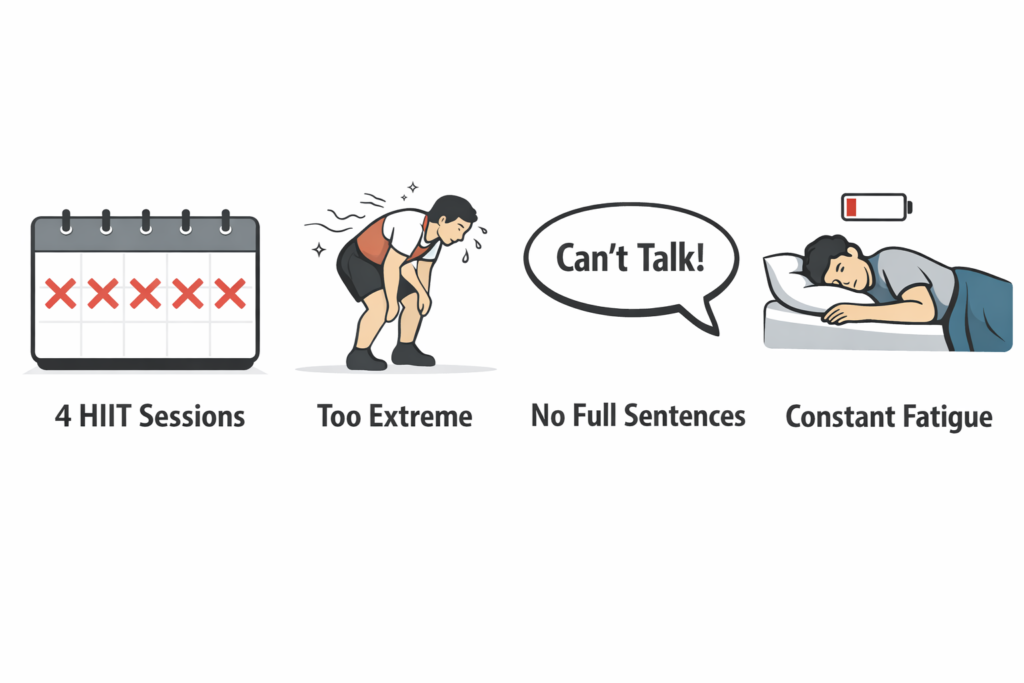
Here’s the embarrassing truth.
When people say HIIT, many imagine “hard but manageable.”
I was doing “hard enough to see my ancestors.”
That’s fine occasionally.
That’s not fine four times a week.
So I ran another test.
Not with a fancy device.
Just a simple self-check during training.
One question only:
“Could I speak a full sentence right now?”
During the hard intervals the answer was no.
Not even close.
I could maybe say two words like “this sucks.”
That’s very high intensity.
Then I looked at how often I was hitting that intensity weekly.
It was frequent.
And it was stacked close together.
Two HIIT sessions with that intensity is one thing.
Four sessions is basically signing up for constant fatigue unless recovery is perfect.
And recovery is rarely perfect.
Life loves being messy.
The “My Joints Aren’t Injured, But They’re Grumpy” Stage
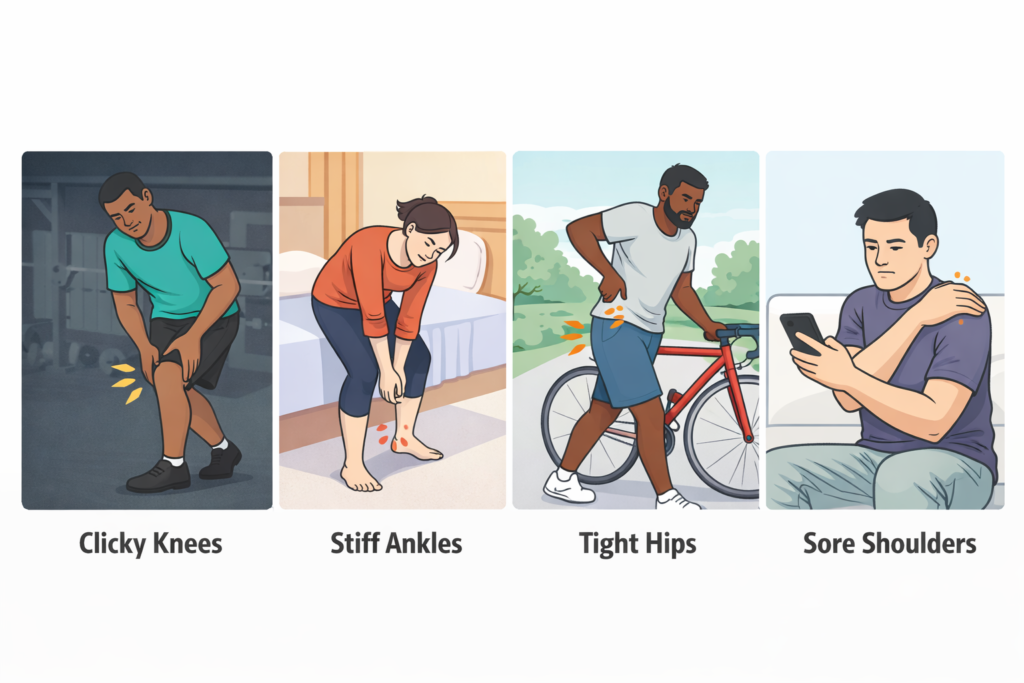
I didn’t get a big injury.
But I started feeling tiny warnings.
Knees felt a little “clicky” after squat-jump intervals.
Ankles felt stiff the next morning.
Hips felt tighter after bike sessions.
Nothing that screamed “stop.”
More like a steady whisper: “Hey, we’re not thrilled.”
That’s the phase people ignore because it’s not dramatic.
But it’s also the phase that often comes right before something becomes dramatic.
So I started taking those small grumpy signals seriously.
Not with panic.
Just with respect.
Like when your phone gets hot and you don’t wait for it to melt before closing apps.
The Fixes I Tested (Real Adjustments, Real Timers, Real Outcomes)
I didn’t want to quit HIIT.
I wanted to stop my body from quietly plotting against me.
So I changed a few variables one at a time.
First change: fewer HIIT sessions per week
I dropped from 4 to 3.
Then from 3 to 2.
The difference was noticeable within about 10–14 days.
Sleep started to stabilize.
Waking up at 3 a.m. happened less.
Leg heaviness reduced.
Second change: lower the “peak intensity” on some sessions
Instead of “20 seconds as hard as humanly possible,” I used “hard but controlled.”
On the bike, that meant I picked a resistance where I could keep speed consistent.
I aimed for a pace I could repeat without the last intervals turning into a collapse.
Example:
If my sprint cadence was 110–120 RPM (very fast), I’d keep the controlled intervals around 95–100 RPM.
Still hard.
Still breathing heavy.
But not “life flashing before eyes.”
Third change: longer warm-up
I extended warm-ups from 5–6 minutes to 10–12 minutes.
Not because warm-ups are magical.
Because my body needed more time to feel ready when fatigue was in the background.
I added:
- 1 minute easy.
- 1 minute slightly faster.
- 30 seconds moderate.
- 30 seconds easy.
Repeat that pattern a few times.
Then I did 3 short pick-ups of 8–10 seconds faster effort.
That made the main intervals feel smoother.
Less shock to the system.
Fourth change: I scheduled HIIT farther from strength training
On days I lifted weights, I avoided HIIT right after.
When I did both on the same day, the total stress was too high.
If I had to combine them, I made the HIIT shorter.
Example:
6 rounds instead of 10.
That’s a real difference.
Because 6 hard rounds is a sharp stimulus.
10 hard rounds after lifting is a full-body complaint form.
The Recovery Signals I Started Tracking Like a Slightly Paranoid Scientist
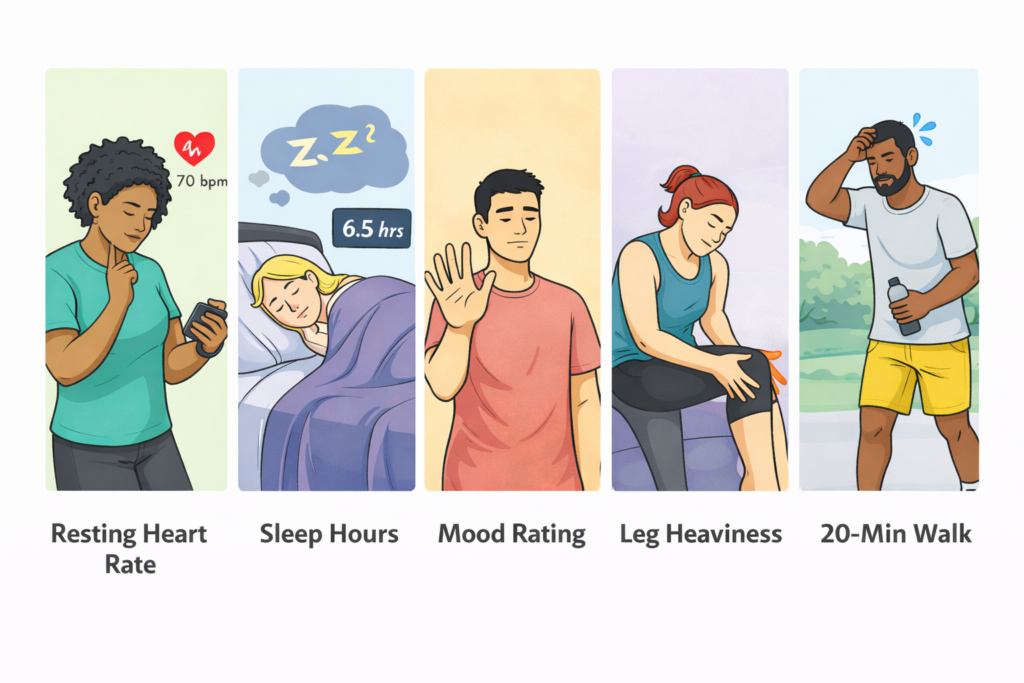
I didn’t use fancy wearables.
Just simple repeatable checks.
Morning resting heart rate (counted for 60 seconds).
Normally I’d be around, for example, 58–62 beats per minute.
When HIIT was too frequent, it crept up to 66–70.
That’s not “danger.”
That’s “body under load.”
Sleep duration (rough estimate, but consistent tracking).
Mood rating (simple 1–10).
Leg heaviness rating (1–10).
And one physical marker: how easy a 20-minute walk felt.
When the walk felt annoyingly tiring, I knew fatigue was sitting deeper than I wanted.
These signals weren’t perfect.
But together they formed a pattern.
And the pattern matched my HIIT increase almost too well.
RELATED:》》》 Is Balancing HIIT and Strength Training Actually an Effective Way to Train?
What I’d Tell a 18-Year-Old Version of Me Who Thinks More HIIT = More Results
HIIT is like hot sauce.
A little makes the meal exciting.
Too much makes everything painful and confusing.
Doing hard intervals more often doesn’t automatically mean getting fitter faster.
It can mean accumulating fatigue faster.
The body adapts when stress and recovery balance out.
When that balance breaks, the body doesn’t usually scream at first.
It whispers.
Sleep gets weird.
Energy gets unpredictable.
Performance dips in small tests.
Joints feel slightly grumpy.
And you start needing more willpower just to feel normal.
That’s not a character flaw.
That’s biology.
If I could go back, I’d keep HIIT, but I’d treat it like the strong tool it is.