Cardio before lifting sounded “responsible” when this started.
The logic felt clean.
Warm up, get the heart going, then lift.
It also felt like brushing teeth before eating cookies, which is technically a choice.
What changed everything wasn’t a single magical workout.
It was the boring part: repeating the same sessions, keeping the same exercises, and tracking numbers like a mildly obsessed accountant.
Not “perfect science,” just enough structure to stop lying to myself.
And yeah, the difference showed up fast in performance, not just in vibes.
How I Locked the Variables Before Changing the Order
After a few sessions, something felt off in a very specific way.
The workouts weren’t bad, but they didn’t feel solid either.
Some days the weights felt heavier for no obvious reason, even though effort and focus were there.
Instead of changing exercises or adding more work, I decided to touch just one simple habit.
I kept doing everything the way I was used to.
The only thing that moved was timing: cardio first, then later, or the other way around.
That small shift ended up telling me more than I expected.
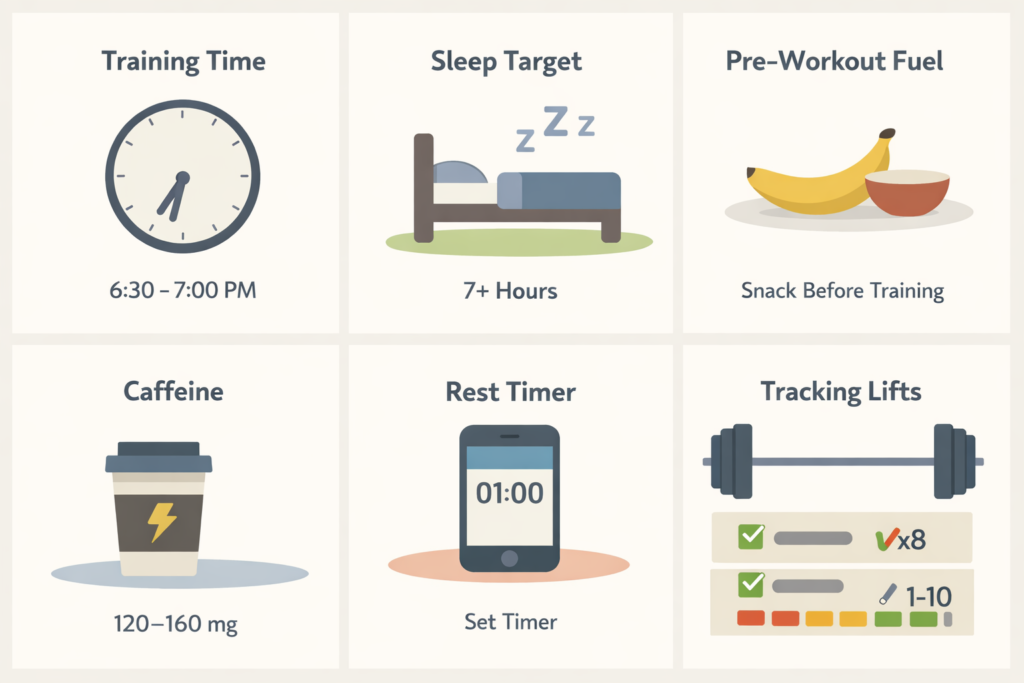
Here’s what stayed consistent.
- Training time: I started my sessions within a 30-minute window, usually around 6:30–7:00 PM.
- Sleep target: at least 7 hours, and if I got less, I wrote it down because it matters.
- Food timing: a normal meal about 2–3 hours before training, and a small snack 45–60 minutes before if hunger hit.
- Caffeine: same dose, around 120–160 mg, taken about 35 minutes before I touched a weight.
- Rest times: I used a phone timer and didn’t “feel it out,” because “feeling it out” is how people accidentally change a study.
How I tracked performance without getting fancy.
- Working weight and reps for the main lift of the day.
- Total reps across all working sets (not warm-ups).
- Rest time actually used between sets.
- A simple “effort rating” from 1–10 right after the main lift.
- How my legs and lungs felt during sets, because that’s the whole point here.
The Two Cardio Styles I Tested (Because “Cardio” Can Mean Anything)
People say “I did cardio” the way people say “I ate food.”
That could mean a salad.
That could mean two family-size pizzas and regret.
Cardio before lifting can be gentle, or it can be a sneak attack on your legs.
The “Easy” Cardio I Used
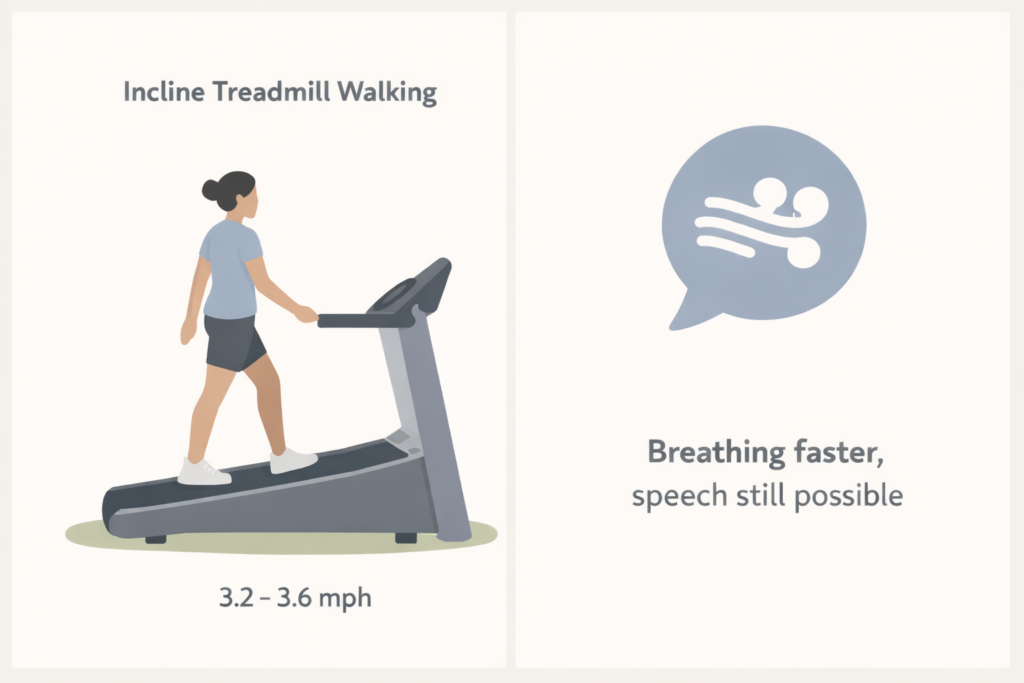
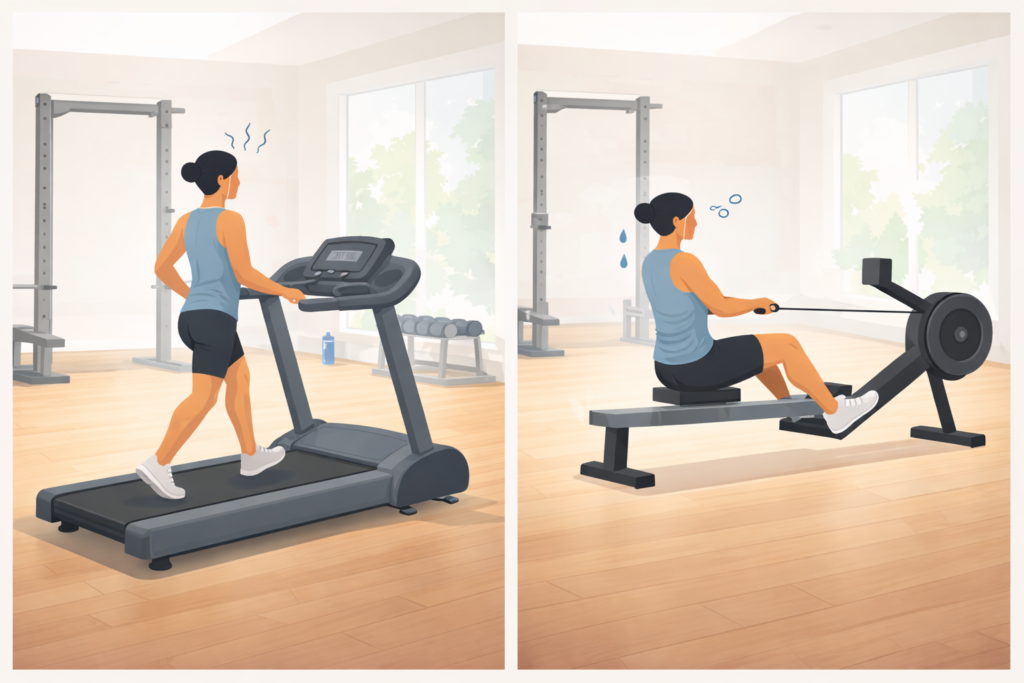
This was incline treadmill walking.
Nothing dramatic, just enough to raise breathing without turning my legs into jelly.
The speed sat around 3.2–3.6 mph, incline 8–12%, for 12–18 minutes.
Execution-wise, it’s simple: stand tall, hands off the rails, steps smooth.
If holding the rails is necessary, the incline is too steep or the speed is too high.
Breathing should be faster than normal, but conversation should still be possible.
Think “I can talk but I don’t want to,” not “I can see my ancestors.”
The “Harder” Cardio I Used
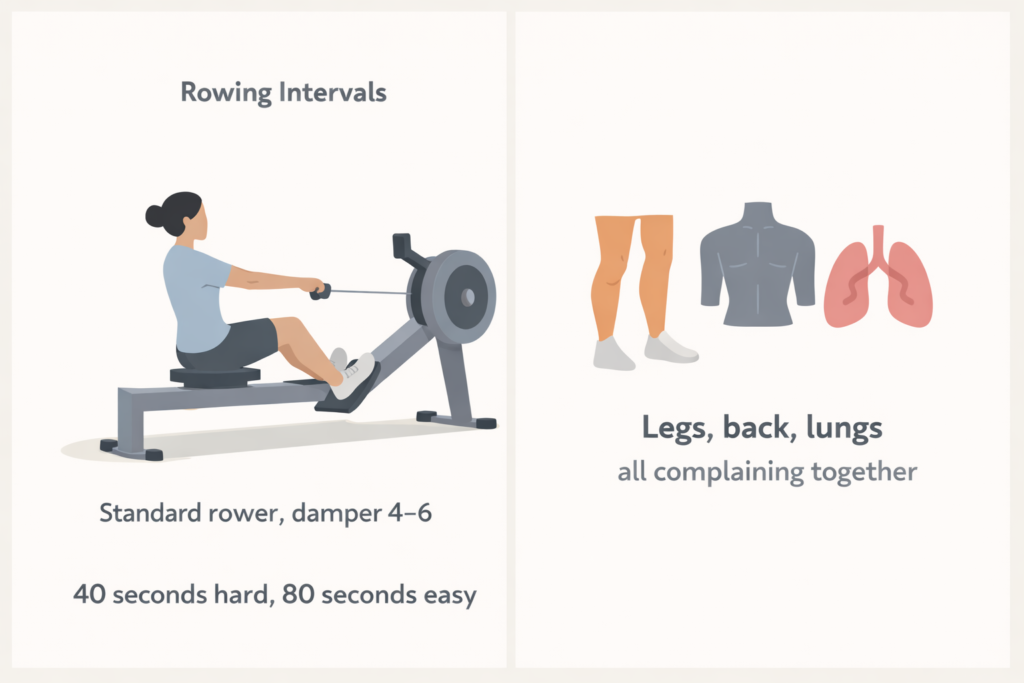
This was rowing intervals, because I wanted a version that clearly hits performance.
I used a standard rower and kept the damper around 4–6, not 10 like a cartoon strongman.
The structure was 6 rounds of 40 seconds hard + 80 seconds easy.
Hard meant I was pushing near my limit but still rowing with control.
Easy meant slow enough to recover, but not fully resting.
Total time was 12 minutes, which sounds cute until you do it.
Rowing is basically a group project where legs, back, and lungs all complain together.
What My Lifting Looked Like (With Full Details)
I’m going to spell this out like you’ve never stepped into a gym.
Because if someone says “I did squats,” that could mean anything from heroic depth to bending knees slightly while texting.
So here’s the exact format I used.
Main Lower-Body Day — Squat Focus
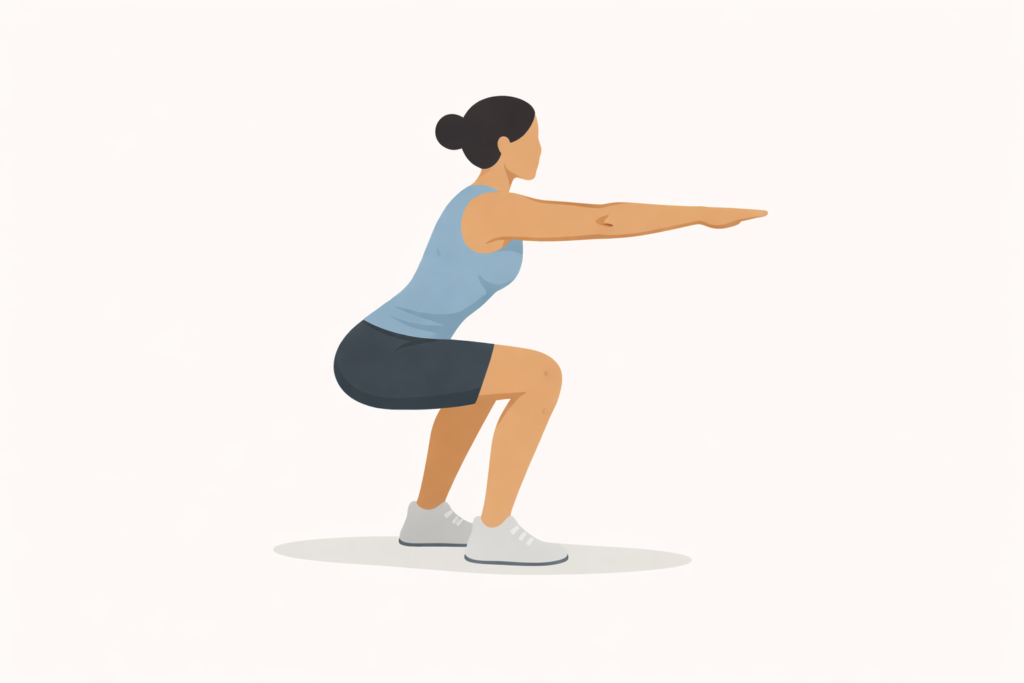
Warm-up: 5–7 minutes of light movement.
Then 3–5 ramp-up sets where weight climbs gradually without tiring out.
A ramp-up set is not a working set.
It’s practice with heavier loads so the body doesn’t get surprised.
Working sets looked like this:
- 3 to 5 working sets of 5 reps.
- Rest between sets: 2 minutes 30 seconds to 3 minutes 30 seconds.
- Tempo: controlled down, slight pause if depth felt unstable, then strong drive up.
How to do a basic barbell squat safely, explained simply:
- Feet about shoulder-width, toes slightly outward.
- Brace the stomach like you’re about to get poked, not like you’re sucking in for a photo.
- Sit down and slightly back, keeping the chest proud and the back neutral.
- Go as deep as you can while keeping balance and control, then stand up without the hips shooting up first.
Upper-Body Day — Bench Press Focus
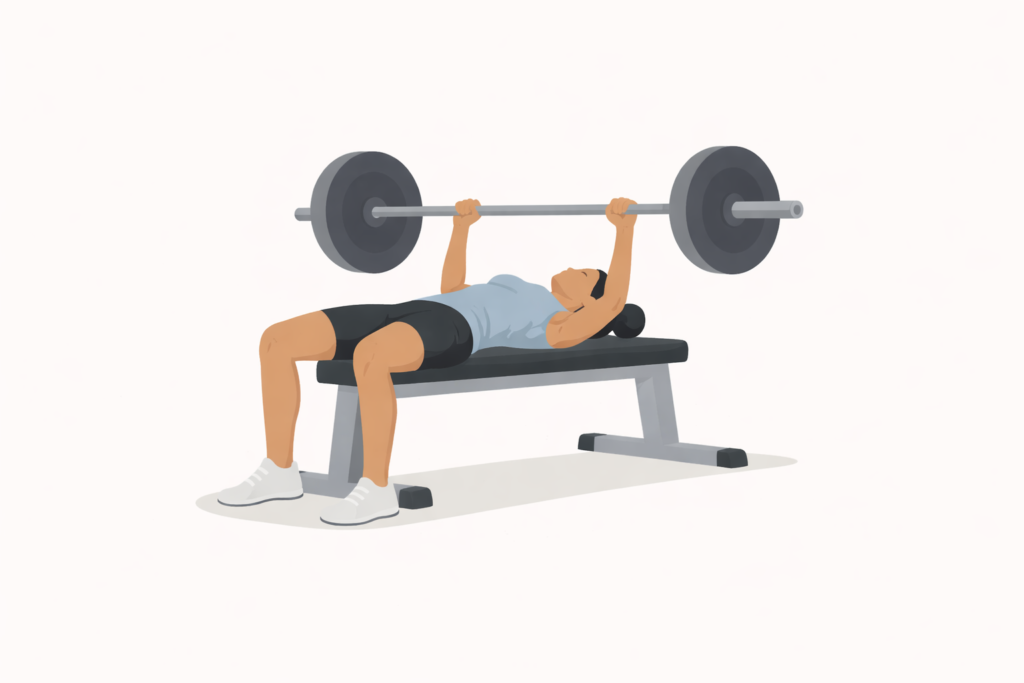
Warm-up sets built up the weight in steps.
Working sets were 4 sets of 6 reps with the same load.
Rest was about 2 minutes 30 seconds.
Bench basics:
- Eyes under the bar, feet planted, shoulder blades pulled back and down.
- Lower the bar to the mid-chest with control.
- Pause for a split second, then press up while keeping the upper back tight.
- If the shoulders feel sketchy, the setup is usually the problem, not “weak joints.”
Pulling Day — Row Focus
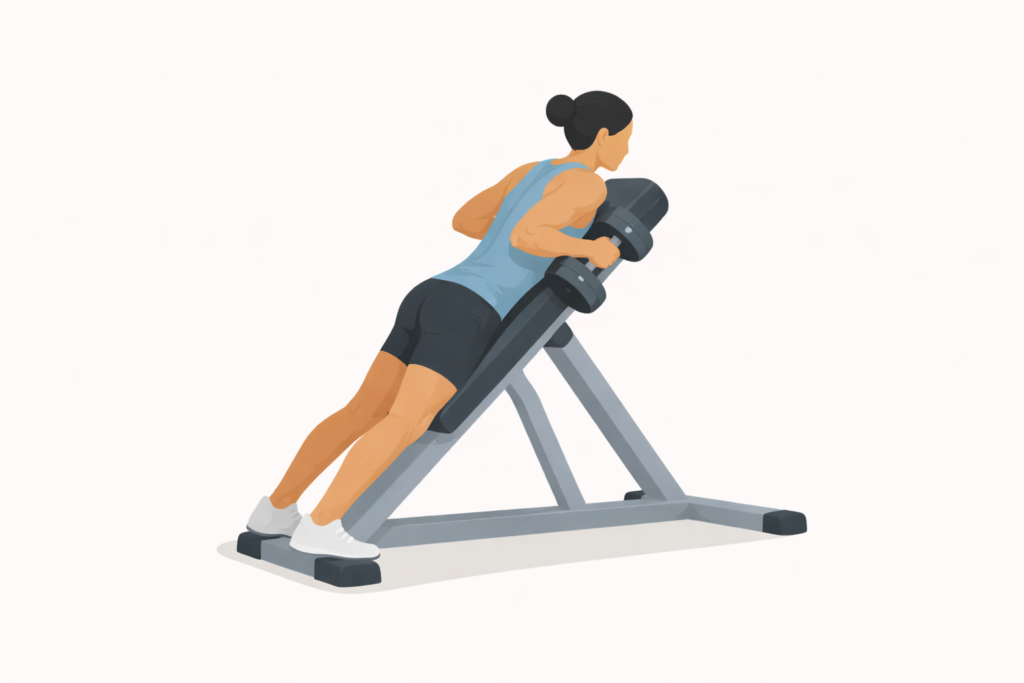
I used a chest-supported row sometimes, and a cable row other times.
The goal was consistent: pull with the back, not just the arms.
Working sets were 4 sets of 8–10 reps with 90–120 seconds rest.
Row basics:
- Start with shoulders relaxed, then pull elbows back like you’re trying to tuck them into your back pockets.
- Pause briefly when the handle reaches your torso, then return slowly.
- If you’re swinging your body, you’re not rowing, you’re doing interpretive dance.
When I Did Cardio Before Lifting: What It Felt Like In Real Time
The first thing I noticed wasn’t soreness.
It was that my “pop” was gone at the start of the main lift.
Not destroyed.
Just… muted, like someone turned my volume knob down.
With Easy Cardio Before Lifting
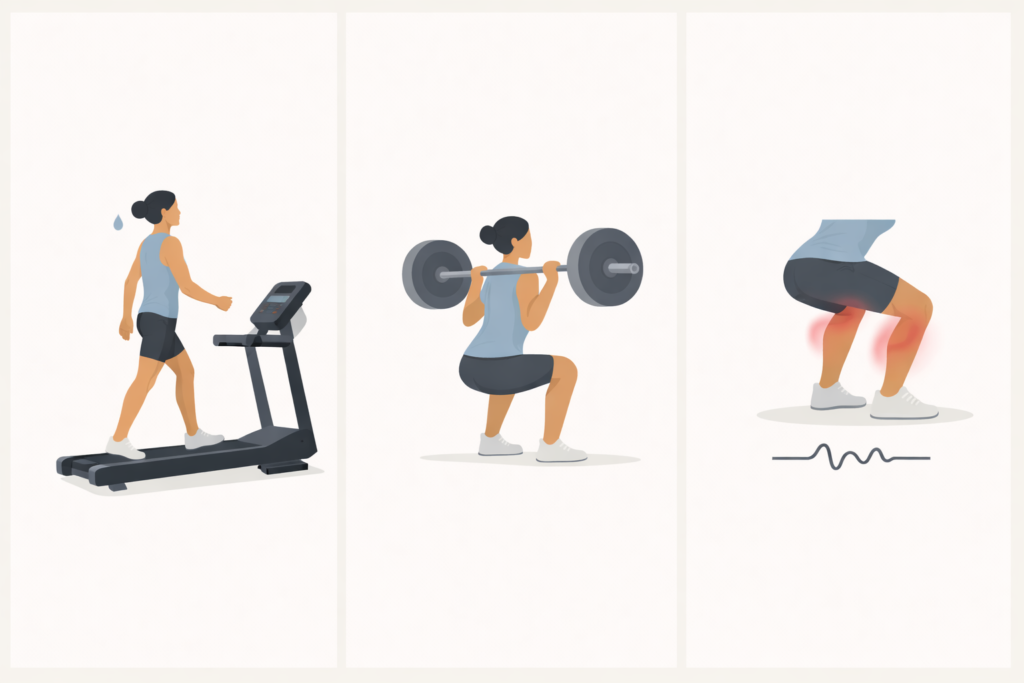
On squat days, incline walking first felt harmless.
Breathing was up, sweat started, and mentally it felt like I was “in the workout.”
Then the first heavy set arrived and my legs felt oddly polite.
Not weak, just less willing to explode upward.
A typical example from my notes looked like this:
I’d hit 100 kg for 5 reps for 4 sets when cardio came after.
With incline walking first, that same 100 kg often turned into 5, 5, 4, 4 with longer rest.
The effort rating jumped from around 7.5/10 to 8.5/10.
Same weight, same day type, different cost.
What I felt during the reps was specific:
Quads felt warm but not fresh.
The bottom of the squat felt less stable, like balance needed extra attention.
Breathing got loud earlier, especially around rep 4 and 5.
The set ended because everything felt “heavy” sooner, not because form fell apart.
With Harder Cardio Before Lifting
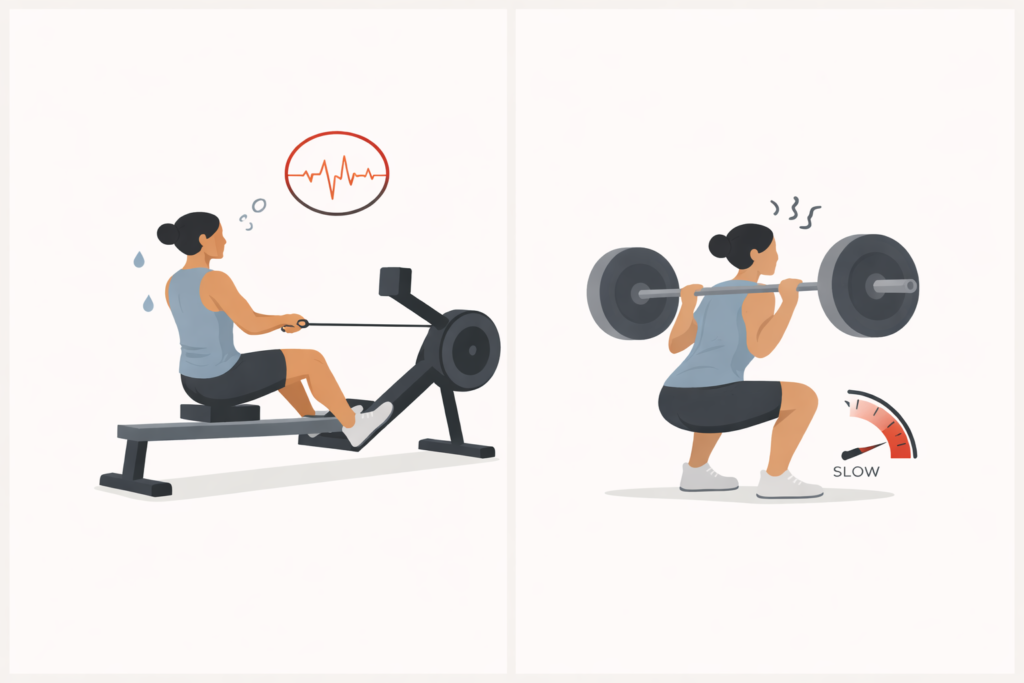
Rowing intervals before squats was a different animal.
That wasn’t a warm-up.
That was a small battle before the actual battle.
And my squats noticed immediately.
The clearest change was bar speed.
Even on the first working set, the bar moved slower.
It wasn’t dramatic failure.
It was like trying to sprint on sand.
Numbers reflected it too.
A load I normally owned for 3 sets of 5 suddenly felt like it wanted negotiations.
Rest times stretched because I needed lungs back, not just muscles.
By the last set, I wasn’t “dying,” but I was definitely bargaining with the universe.
The Switch: Cardio After Lifting (Same Amount, Same Machines)
This was the part that surprised me.
I expected cardio after lifting to feel worse overall because I’d be tired.
Instead, lifting felt cleaner and cardio felt… doable.
Not fun, but doable, which is the only honest category cardio has.
How Lifting Felt When It Came First
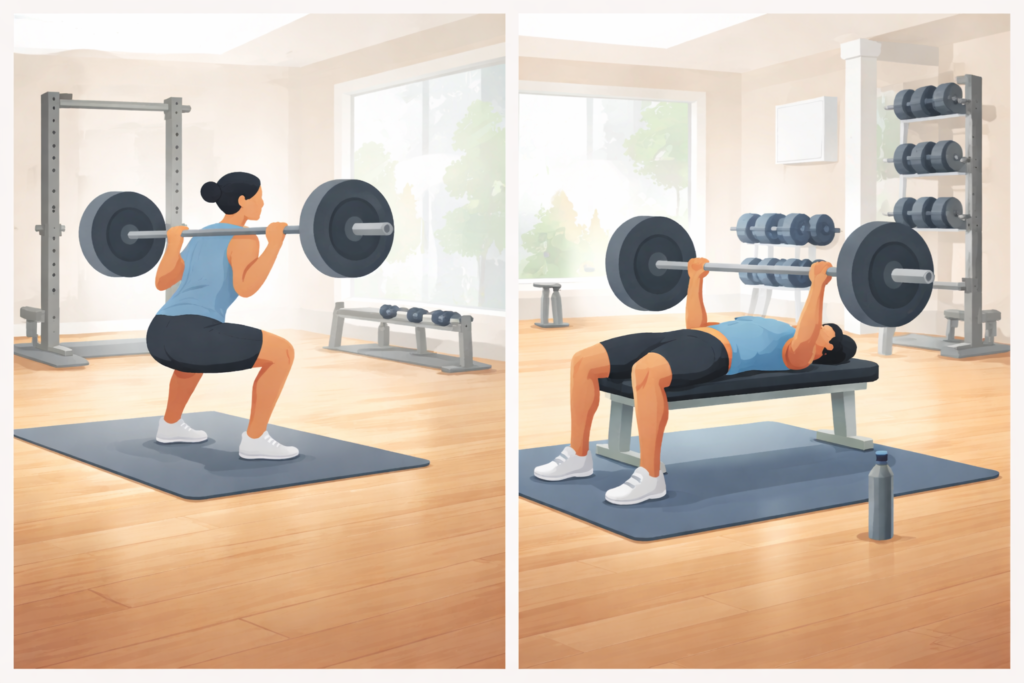
Strength work felt sharp again.
The first working set didn’t require a long mental pep talk.
Leg drive returned on squats, and bench felt more stable off the chest.
My breathing still went up, but it climbed gradually instead of starting halfway up the hill.
The biggest difference was consistency across sets.
Instead of a slow leak in reps and speed, sets stayed closer together.
That matters because training is basically stacking decent sets like bricks.
If the bricks crumble early, the wall ends up short.
How Cardio Felt When It Came Second
Cardio after lifting felt like paying bills after buying groceries.
Not exciting, but the essentials were already handled.
The first minute always felt stiff, because legs were already used.
Then breathing settled into a rhythm, especially on steady incline walking.
Rowing intervals after lifting were harder than walking, obviously.
But the suffering was more “cardio suffering” than “my legs are already cooked suffering.”
That distinction matters.
One feels like lungs working; the other feels like your legs filing a complaint.
The Results That Made Me Stop Arguing With Reality
I’m not going to pretend my notes were a laboratory study.
But they were consistent enough that the pattern was hard to ignore.
Cardio first didn’t ruin my training.
It just quietly taxed the exact systems I needed for performance.
Strength Output (Weights and Reps)
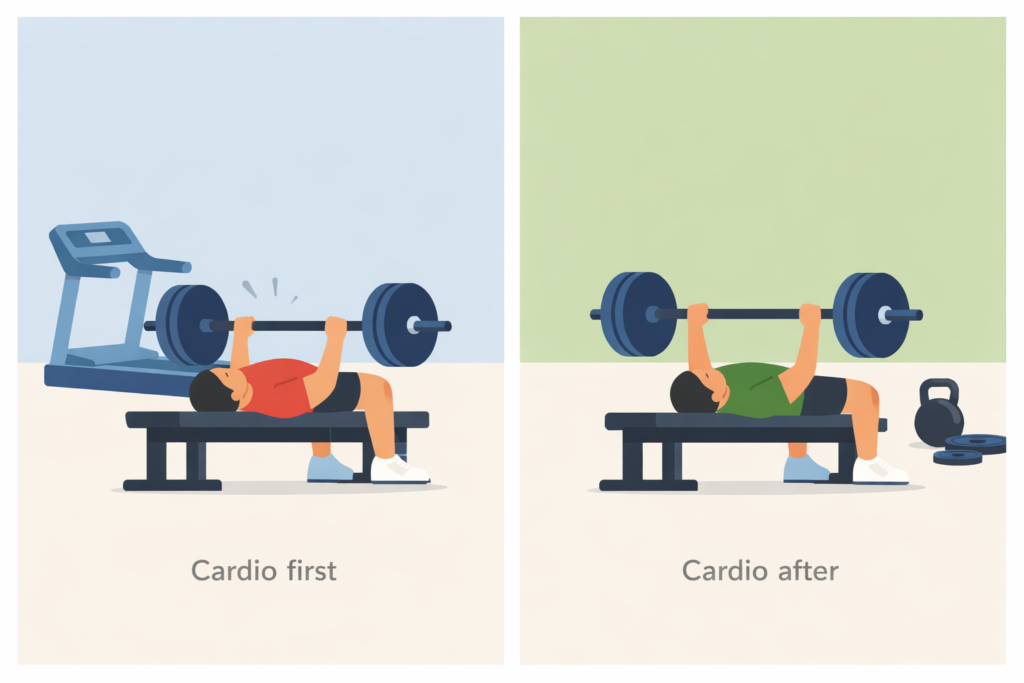
When cardio came first, the heaviest work felt heavier sooner.
Not always a huge drop in weight, but a clear change in reps completed and bar speed.
When cardio came second, the top sets stayed stable more often.
That’s basically the difference between “I trained” and “I trained well.”
Rest Times (The Sneaky Performance Killer)
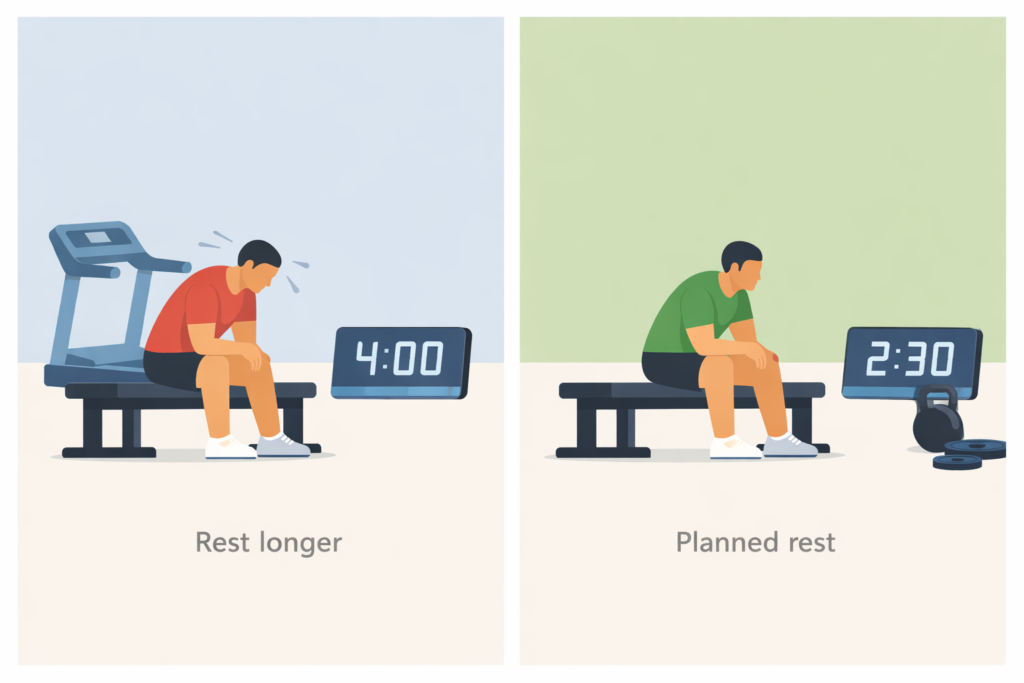
With cardio first, my rest time naturally stretched.
Not because I wanted to slack.
Because breathing wasn’t ready when the next set was supposed to start.
If rest goes from 2:30 to 4:00 without meaning to, workload drops even if the weights look similar.
With cardio after, rest time stayed where I planned it.
That made the whole session more predictable.
Predictable training is boring.
Boring training is usually the kind that actually works.
How My Body Felt (The Non-Scientific but Very Real Part)
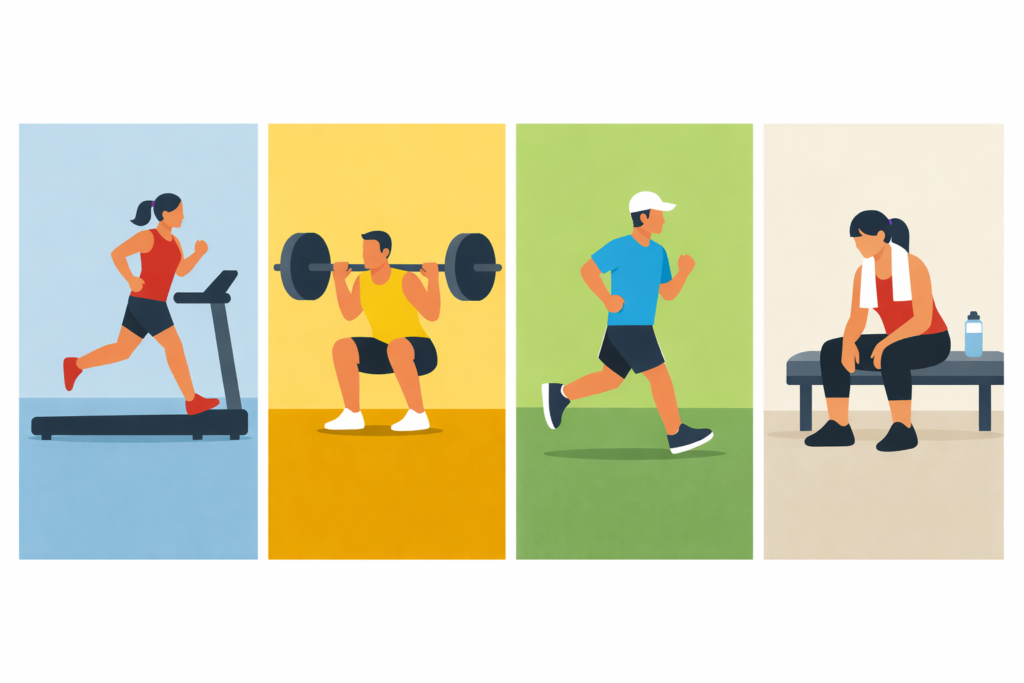
Cardio before lifting made my legs feel “pre-fatigued.”
That’s a real thing: muscles can be warm but less capable of producing force quickly.
Cardio after lifting made my muscles feel tired, but the strength work was already done.
So the tiredness didn’t steal from the important sets.
Why This Happens (Explained Like You’re New, Not Like You’re Studying Physiology)
The body has different “resources” it uses for different tasks.
Heavy lifting needs quick energy and a nervous system that can fire hard.
Cardio, especially hard cardio, uses energy and creates fatigue that lingers.
So if cardio comes first, lifting starts with fewer resources in the tank.
The Energy Side Without Complicated Words
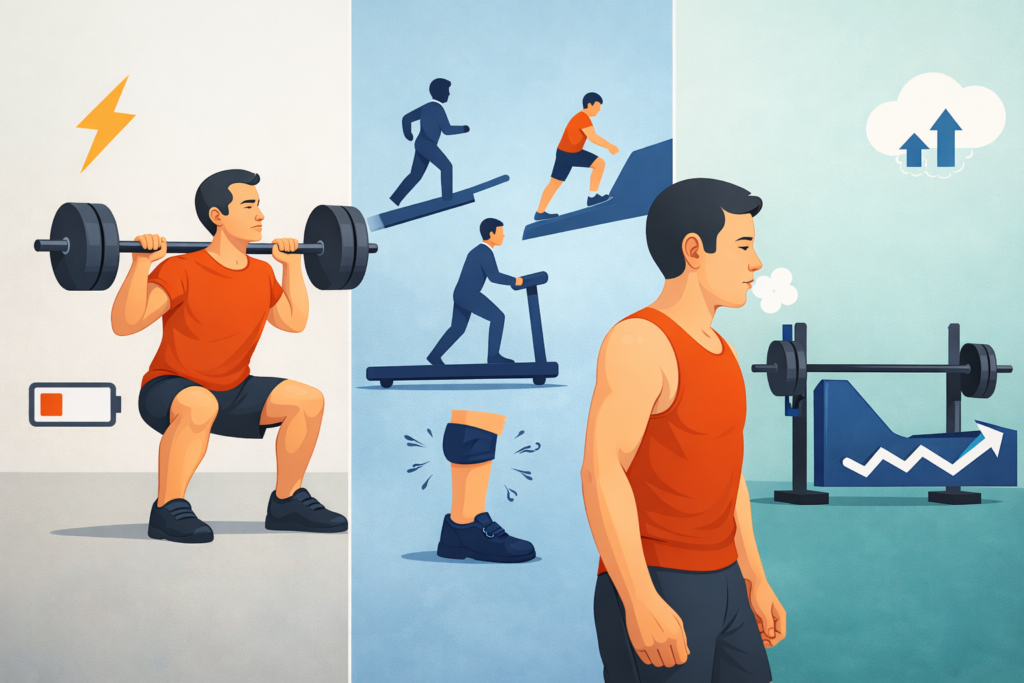
For hard sets of squats, the body leans on fast energy systems.
They’re like the phone’s “burst mode” camera: great for quick power, but limited.
Hard cardio uses a chunk of that burst capacity even if it doesn’t feel like it.
So when you try to lift heavy, the burst isn’t fully available.
The Leg Side (Local Fatigue Is a Big Deal)
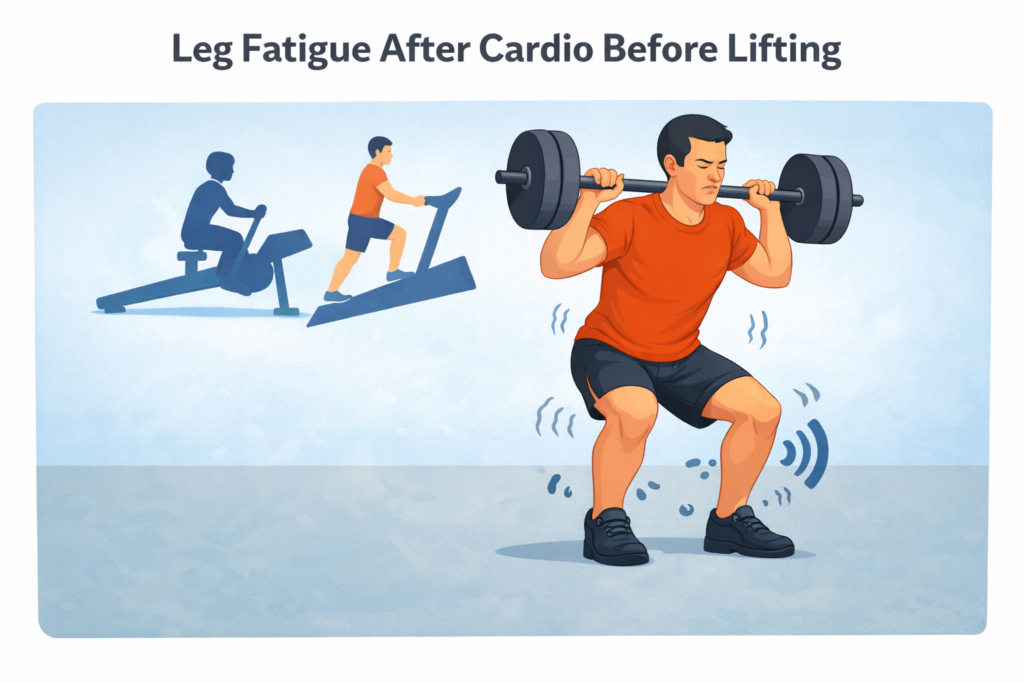
If the cardio hits the same muscles you’re about to lift with, that’s double tax.
Incline walking uses calves and glutes more than flat walking.
Squats also need legs and glutes, obviously, so overlap is huge.
When I did cardio first, legs weren’t “sore.”
They were just less responsive.
Like a controller with slight input lag.
Everything still works, but timing feels off.
The Breathing Side (It’s Not Just “Being Out of Shape”)

When breathing is elevated from cardio, it takes time to normalize.
Even if you feel okay, your body is still trying to manage oxygen demand and carbon dioxide buildup.
Heavy sets already spike breathing.
So starting heavy sets with breathing already high means you hit that uncomfortable ceiling earlier.
The “Quiet Saboteurs” I Noticed When Cardio Came First
Not calling these “mistakes,” because that word makes it sound like people are dumb.
Most of these feel reasonable in the moment.
They just change the outcome without announcing themselves.
Like a backpack you forget you’re wearing.
Turning Warm-Up Cardio Into Real Training
A warm-up is supposed to prepare you, not compete with you.
If sweat is dripping and legs feel pumped, that’s not a warm-up anymore.
That’s cardio training.
And then lifting becomes the second event of the day.
Using Incline Like a Cheat Code
Incline walking sounds gentle.
But incline turns walking into a glute-and-calf workout.
So if the plan is heavy leg work, that incline can quietly steal freshness.
Flat walking for the same minutes felt way less disruptive for me.
Letting Intervals Steal Your “Explosive Gear”
Intervals are great for conditioning.
They’re also excellent at draining that sharp, explosive feeling.
So if performance is the goal in the weight room, intervals first are like revving a car hard before a race.
The engine still runs, but it’s not as crisp.
Different Goals, Different Best Order (This Part Matters More Than People Admit)
The “best” order depends on what you care about most in that session.
I learned this the annoying way, which is the only way people actually learn it.
So here’s how it played out in real life.
Not rules, just reality.
If The Main Goal Is Lifting Performance
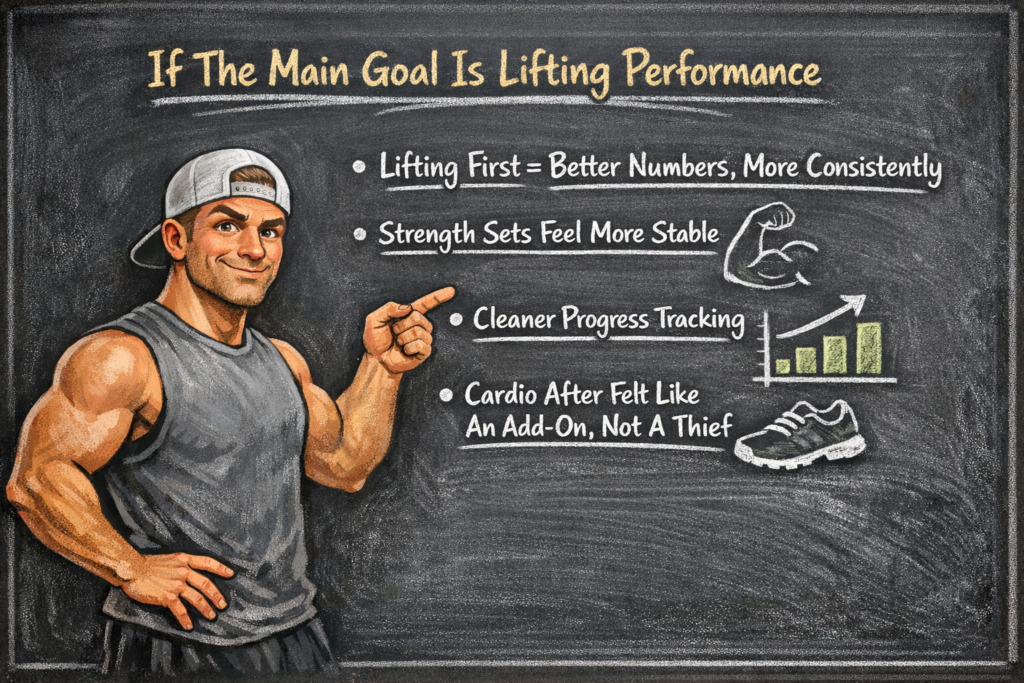
Putting lifting first gave me better numbers more consistently.
Strength sets felt more stable.
Progress tracked cleaner, because fatigue wasn’t front-loaded.
Cardio after felt like an add-on, not a thief.
If The Main Goal Is Improving Conditioning
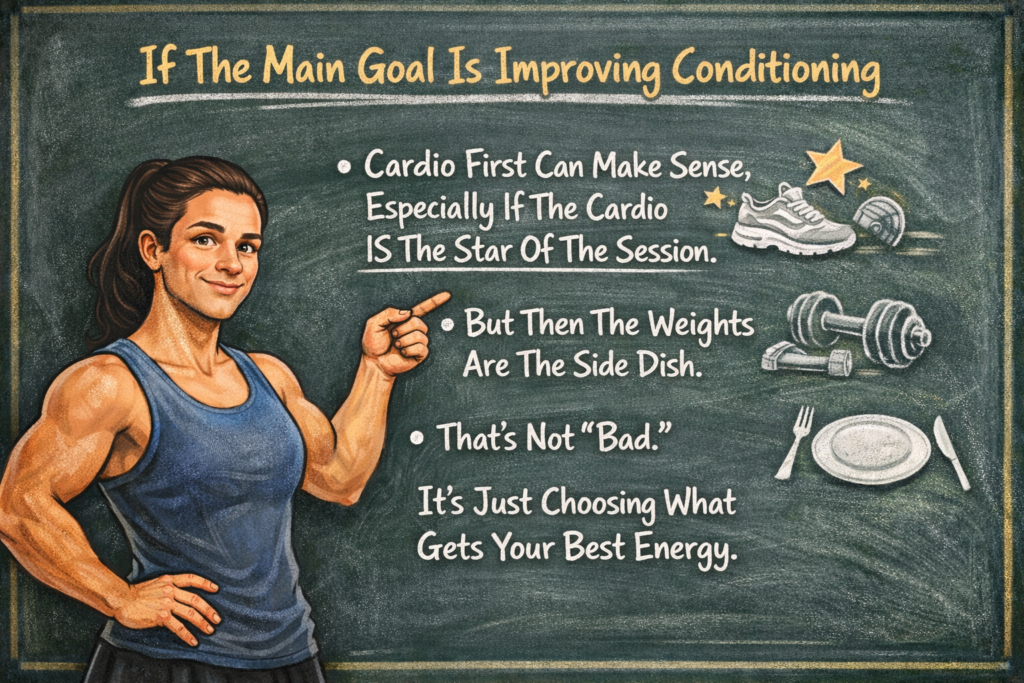
Cardio first can make sense, especially if the cardio is the star of the session.
But then the weights are the side dish.
That’s not “bad.”
It’s just choosing what gets your best energy.
If The Goal Is Fat Loss or General Fitness
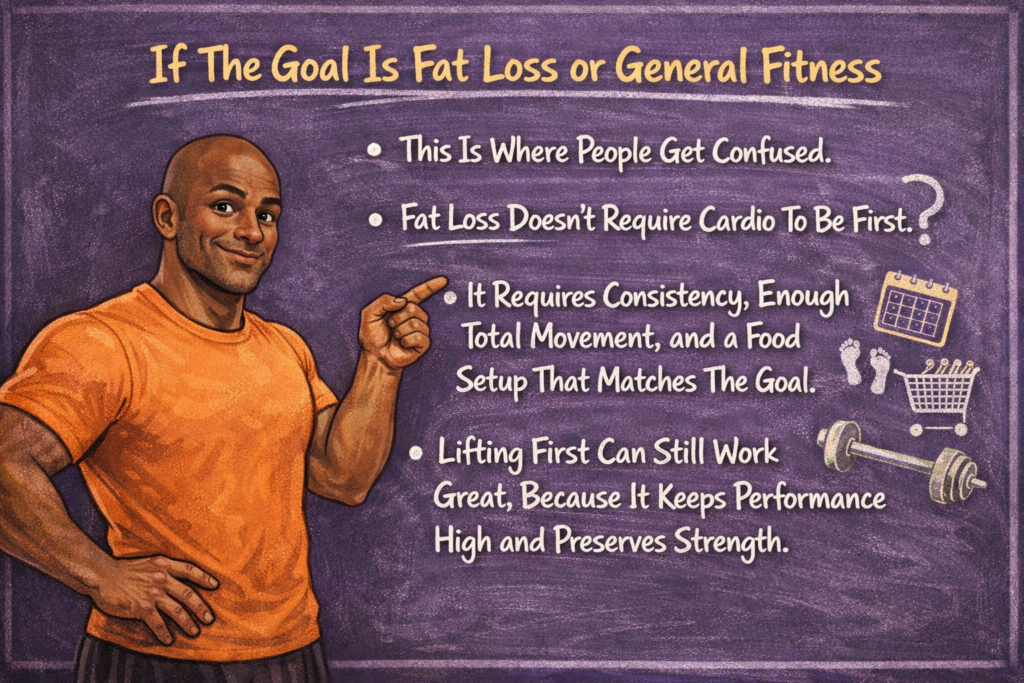
This is where people get confused.
Fat loss doesn’t require cardio to be first.
It requires consistency, enough total movement, and a food setup that matches the goal.
Lifting first can still work great, because it keeps performance high and preserves strength.
The Version That Worked Best For Me
Here’s a full session layout that matched my best results.
Not as a commandment.
Just as a real template with exact timing, so nothing is vague.
Lower-Body Session With Cardio After
Arrive at gym, start timer.
5 minutes easy bike or flat treadmill walking, just to raise body temperature.
Then 6–10 minutes of squat-specific warm-up sets, gradually heavier.
Nothing to failure, nothing dramatic.
Working squats:
- 4 sets of 5 reps at a weight that feels like 2 reps are still in the tank.
- Rest 3 minutes between sets, timer on.
- After the last set, sit for 2 minutes, sip water, breathe normally.
Assistance work (simple and controlled):
- Romanian deadlift: 3 sets of 8 reps, 2 minutes rest.
- Hinge at hips, slight bend knees, back neutral, lower to mid-shin, stand tall.
- Split squat: 3 sets of 10 reps per leg, 90 seconds rest.
- One foot forward, one behind, drop straight down, front knee tracks over toes, push up through front foot.
Then cardio:
- Incline treadmill 15 minutes at 3.4 mph, incline 10%.
- Breathing steady, not gasping.
- Cool down 2–3 minutes flat walking.
Total session time: usually 70–85 minutes depending on rest discipline.
Energy after: legs tired but not wrecked, brain calm, appetite definitely louder later.
Sleep that night was better than when I did hard intervals first, which was an unexpected bonus.
Where Cardio Before Lifting Didn’t Hurt As Much (Fair Is Fair)
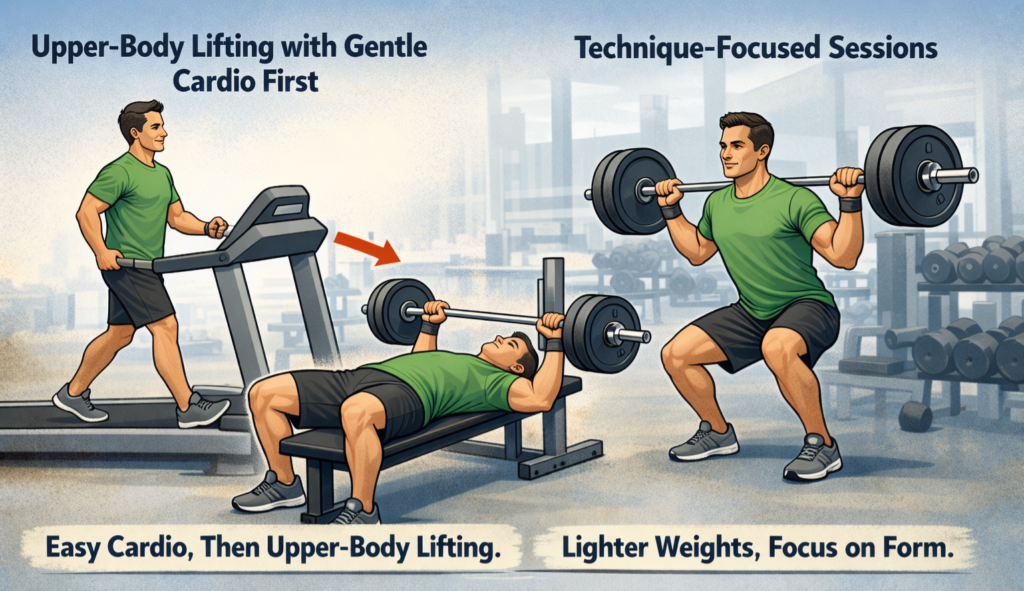
Cardio first wasn’t always a disaster.
It depended on what I lifted and what cardio I chose.
The overlap between muscles mattered a lot.
So did intensity.
Upper-Body Lifting With Gentle Cardio First
If the session was mostly benching and rows, incline walking first didn’t hit performance as hard.
Legs still did some work, but the main lift didn’t rely on them directly.
Breathing was the bigger factor, not muscle fatigue.
So as long as the cardio stayed easy, numbers stayed closer to normal.
Technique-Focused Sessions
If I kept weights lighter and focused on clean form, cardio first was fine.
That kind of day is more about skill and control than top-end output.
So being a little tired didn’t ruin the goal.
Trying to set personal records on that day, though, was a different story.
RELATED:》》》 Rest-day cardio — helps progress or does nothing?
The Biggest Lesson I Took From This (Without The Pep Talk)
Order isn’t a moral issue.
It’s just a lever that changes what you’re good at during that hour.
Cardio first made me better at cardio during that hour.
Lifting first made me better at lifting during that hour.
After tracking it like a normal person who occasionally becomes an unhinged spreadsheet creature, the choice got easy.
When I cared about performance in the weight room, lifting came first.
When I cared about conditioning, cardio took the spotlight.
Trying to make both “equally perfect” in the same session was the only thing that consistently failed.